studiot
Senior Members
-
Joined
-
Last visited
Everything posted by studiot
-
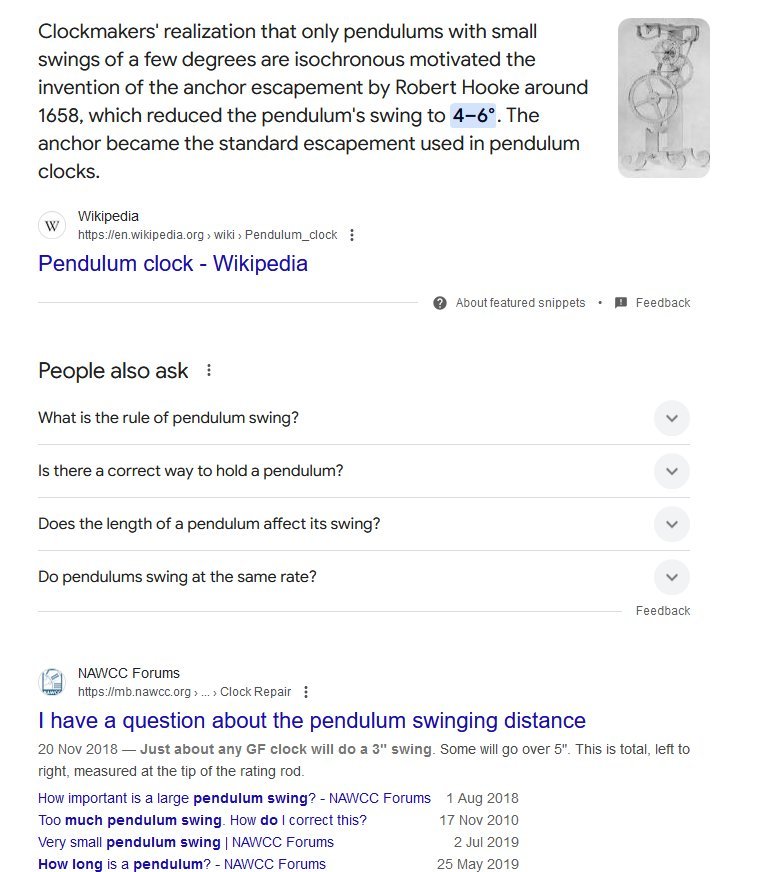
Look at your formula estimate for maximum speed. I make it less than 2m/s or walking pace ie less than 4 miles per hour. How much air resistance do you anticipate at this speed ? Look at this google page in response to a question "how far should a pendulum swing ? Gravity only acts vertically. The string tension has to have both vertical and horizontal components. What hppens if you increase the angular displacement to 90o ? Basically I am encouraging you to think about the mechanics of the setup.
-
OK
-
@exchemist Di you mean to quote me ?
-
Useful, but doesn't answer my questions. A google search of the use of hydrogen in diving gases is interesing. Here is an authoritative publication. https://pubmed.ncbi.nlm.nih.gov/38507913/
-
Perhaps you misunderstood my comments. I was questioning the importance of the drag effect. Further I am having trouble understanding how a displacement of 30o could keep the swing arm properly constant. Wouldn't the string be slack ? And you should make clear whether the 30o was measured from the horizontal or vertical.
-
Since you have quoted less than 5% of a mixture you must have had a source of information to start from. So for instance what is in the rest of the 96% ? And how is it applied ? Please post it here for comment.
-
I don't know where in the world you are, except that you don't seem to be in my time zone. Consequently I don't know what you mean by 'ice cream' ? I remember from a few years back a major row between the EU and the UK about this question. Whatever, if I wanted any, why on earth would I ask a Chemist ?
-
Perhaps a trawl through this book might help

-
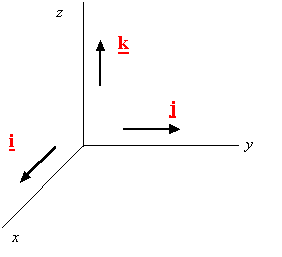
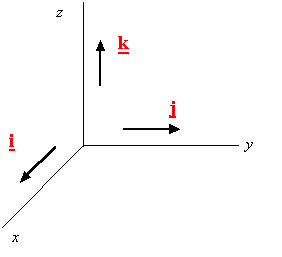
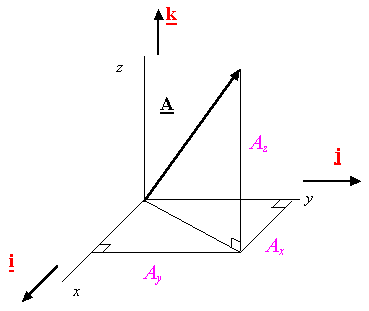
In many ways this is true and indeed there is even a great deal of theory in science and engineering that take great advantage of this. However we do not live an a 2D world. In fact such a world is incomplete as we can deduce the exsistence of at least a 3rd dimension mathematically. So there are times when it is necessary for 'solid' thinking. Ok we will do some trigonometry when we have done the next bit about sigmas. And perhaps reinforce stuff about vectors as we go along. I take it you are happy with labelling the axis with X, Y and Z in some order or other ? We will deal with the order in a minute. The diagram shows that we can create or imagine vectors i , j and k respectively parallel to or along the 3 coordinate axes, X Y and Z. (bold letters are often used to denote vectors) Further we make each of these vectors of magnitude exactly one. So i , j and k each have magnitude exactly 1. We then call these unit vectors in the directions of the axes. Having done this we can create any vector whatsoever that is parallel to one of these axes by invoking the first law of vectors. That is a larger (or smaller) vector is a scalar times a vector. So if I have a scalar a and a unit vector i then the larger (or smaller) vector is ai That is the meaning of the second figure I posted where the vector A is the sume of the three components A = axi + ayj + azk - where ax, ay and az are usually different say a1, a2 and a3 So our vector, A = a1i + a2j +a3k Note they have used capital As where I have use small ones. OK to move on one stage further Instead of naming the axes X, Y and Z as we learn in school we can call all the axes X-something. If we call them X1, X2, and X3 something rather clever happens. We can bring in the sigma notation A = [math]\sum\limits_{n = 1}^3 {{a_n}} {X_n}[/math] Where the index, n runs from 1 to 3 for both the coefficient scalars and the axes. My reference to Einstein was that he proposed to simplify even further and for get the sigma alltogether So A = [math]{a_n}{X_n}[/math] Where the summation is 'understood'. And there you have your first @Mordred type tensor.

-
I believe I said don't woryy about the rest of the maths, there is more there than we need for now. The main message is about splitting a vector into components one parallel to each axis. (hence the i, j, k) Or if you prefer components combining components to make a single vector ( they call the single vector A on that webpage)
-
Good on you. +1 It was noted in the experimental link that Do you agree with this ? If so or not why ? Whay was the lift angle chosen to be 30 degrees ? What difference does it make if any ? The pendulum is one of those experiments that can offer much more insight than just verifying the period formula. Why was twine used as the suspension method and would other methods perform differently ? Note pendulums clocks often have rigid bar support arms. Other aspects of this experiment are being discussed here. Scroll down the page to the sketch.
-
I wondered if you would notice that so wel spotted. If you will indulge me until next time we will return to the more difficult uses of sigma and its whys and wherefores. I mentioned vectors and einstein last time so please take a look at this webpage which is the source of this picture about vectors in 3 dimensions and their components, using XYZ axes http://emweb.unl.edu/negahban/em223/note4/note4.htm There lots of useful graphics, but can you spot the difficulty (clumsiness really) they get into using XYZ ? Don't worry about the rest of the maths, but it is a good page to refer to in the future. Note they make use of sigmas. We can then return to answer your question about r2 and also see if we can improve on the XYZ issue. We can use it
-
Alas, Alac, poor Joe His voice we'll hear no more. For what he took for H2O Was H2SO4
-
Ah I see, thank you I will give it some thought.
-
I see you are a new member so welcome. 😀 Can you elaborate on what you want ? The standard works for these are Roark's Formulae for Stress and Strain and Kleinlogel Rigid Frame Formulae. How many handbooks and textbooks contain shorter tables eg Fiona Cobb The Structural Engineers Pocketbook
-
The usb interface was designed to be safe for hot disconnection/connection with the original devices it was designed for such as cameras, printers, scanners.. which have safe reset on powerdown/up. It was not designed for hard drives. So hot connection/disconnection capability depends upon the connected device. And as you say hard drives should be 'ejected' properly. +1
-
I'm not being awkward, but what you are attempting is still not clear to me. Classical geometric construction is not coordinate geometry. It starts with a blank sheet. So what do you mean by the centre is known ? And what do you mean by I don't have a ruler ? I'm only trying to help after all.
-
Don't worry, it is tricky. So I haven't told you all of it. I am trying to do it in bite sized chunks. When you get to the level of Einstein you can dispense with the sigmas altogether, using what is known as the einstein convention. Sadly this is where you will most likely come across the need. Anyway. Yes you can use any letter, but n is by far the most common, followed by i. Remember they are the index, which tells you how many terms you are adding up or how many times you are repeating the formula with differnt values. That is why they have to be integers. Yes the bottom one is the start point (0 is often acceptable but adding zero doesn't add much) And the top one is the last or end one (unless it is infinity where this is no end) Yes that is correct, Gold star point. I will come onto vectors because that is your most likely use. No it is simply a number, but I call it after the sigma not infront of (ie not before) Yes they do end up with a single output, but you will see when I do vectors the formulae are more complicated. I wish . I did invent one once and actually thought about going into production. But there are too many obstacles in blighty. https://editor.codecogs.com/ or https://www.sciweavers.org/free-online-latex-equation-editor
-
Chemistry is messy. What a suprise. 😀
-
Well yes the tangent is perpendicular to the line joining the centres. So it can be constructed as a perpendicular line anywhere along the common centreline. Two things. Firstly constructed using a ruler and compass has two variations. The otiginal strict meaning was that the ruler could only be used as a straight edge, not for linear measurement. These days many relax that and allow the use of the ruler as a scale device. Secondly you haven't mentioned if you know the diameters of at least one of the circles ?
-
Physicists like atoms whereas chemists like molecules. This book about the story of the molecule is fascinating. John Buckingham is an organic chemist and a pharmacist.

-
OK so the symbol is the greek capital letter sigma and represents what is called a continuous sum. It is really an instruction not an equation by itself, although it can form part of an equation. Some examples might help. [math]\sum\limits_{n = 1}^4 {formula\;involving\;n} [/math] This is an instruction to form the sum of the squares of the foirst 4 integers ( 12, 22 ,32 and 42 ) [math]\sum\limits_{n = 1}^4 {{n^2}} \;which\;is\;1 + 4 + 9 + 16 = 30[/math] n is an index for the formula and runs from n = 1 through to n = 4 Lazy folks may abbreviate this a bit to [math]\sum\limits_1^4 {{n^2}} [/math] This is a finite sum (n is finite) comprising only 4 terms. Sigma may also be used to symbolise an infinite sum or sum to infinity. [math]\sum\limits_{n = 1}^\infty {formula\;involving\;n} [/math] This sum may be used in an equation if there is a formula that gives you the answer directly [math]\sum\limits_{n = 1}^4 {{r^2}} = \frac{1}{6}\left( n \right)\left( {n + 1} \right)\left( {2n + 1} \right)[/math] Note capital sigma should not be confused with little sigma which is used for an entirely different purpose. Sigma is for summation. There is similar symbol for multiplication called continuous products. This uses the greek capital letter pi insteat of sigma, but works in the same way. I am using the star to indicate multiplication [math]\prod\limits_{n = 1}^4 {{n^2}} \;which\;is\;1*4*9*16 = 576[/math]
-
Did you mean this ? Not quite sure what you mean, but yes I did say that waves could travel through material objects. Incidentally the word particle has special significance in Physics. Very many different areas on Physics have models or theories that rely on the interactions of huge numbers of very tiny elements which are called particles. They are the smallest bodies or bits of the subject theory that we can consider as acting as individuals and interacting with each other to produce the observed physical phenomena. These theories don't inquire as to what is inside the particle, just how it interacts with the others. We spent nearly 2000 years developing th idea that the smallest piece of matter is called an atom. Then at the end of the 19th century scientists began to realise that the atoms may be made up of yet smaller bits., which became known as sub atomic particles. That is the famous history. But in the 1930s a quiet revolution occured that is not so famous but perhaps even more startling and revolutionary. They found out that there are 'particles' small enough to be sub atomic, but that never appear as part of an atom.
-
Not a good way to think of it. It takes two to tango. Gravity is a phenomenon that takes place between two or more objects. Since most objects have an actual size, the various parts of that object display that phenomenon between each other. Gravitational Potential is an imaginary field that records the strength and direction of that phenomenon at any point in the field, were we to place a material object there. But until we do it remains imaginary, which is why it is called potential.
-
Thanks you have taught me a new word and facts about I subject I am pretty ignorant of. +1