studiot
Senior Members
-
Joined
-
Last visited
Everything posted by studiot
-
I understand from this claim that you did not actually understand my explanation at all or you would not have said Because in a laboratory you would have control over the concentrations. What I also meant was we do not know what concentrations to control. That follows directly from my description of chemical kinetics.
-
Do you really think this is a sensible question ? We do not have a recipe book for life of any description. So let us say I show you a large opaque black bottle and say this black bottle has grains of sand in it. How many grains doe it contain ? You may not examine the bottle or know how big the sand grains are. That is a far far easier task.
-
OK so Chem K is based upon the idea of estimating the chances of two molecules, say A and B meeting to create the reaction. That is called a simple reaction. In general, The greater chance the faster the reaction. The chances increase with concentration of the molecules A and B. They decrease with the requirement that three (or more) molecules need to meet to further the reaction. Now, as @genady says, at astronomical volumes the concentrations are minute (concentration being the number of reacting molecules in a given volume) There is a further complication. That is that many, if not most, reactions are actually what is called multistep, not simple. Each step has to occur in the correct order within the correct timescale (ie before something else happens to the reactants) for the final products to emerge. Now remembering that all probabilities are less than 1 and that these probabilities are multiplied together you should be able to see that this will result in a very very small number of successful reactions. The trick, of course, is estimating these probabilities.
-
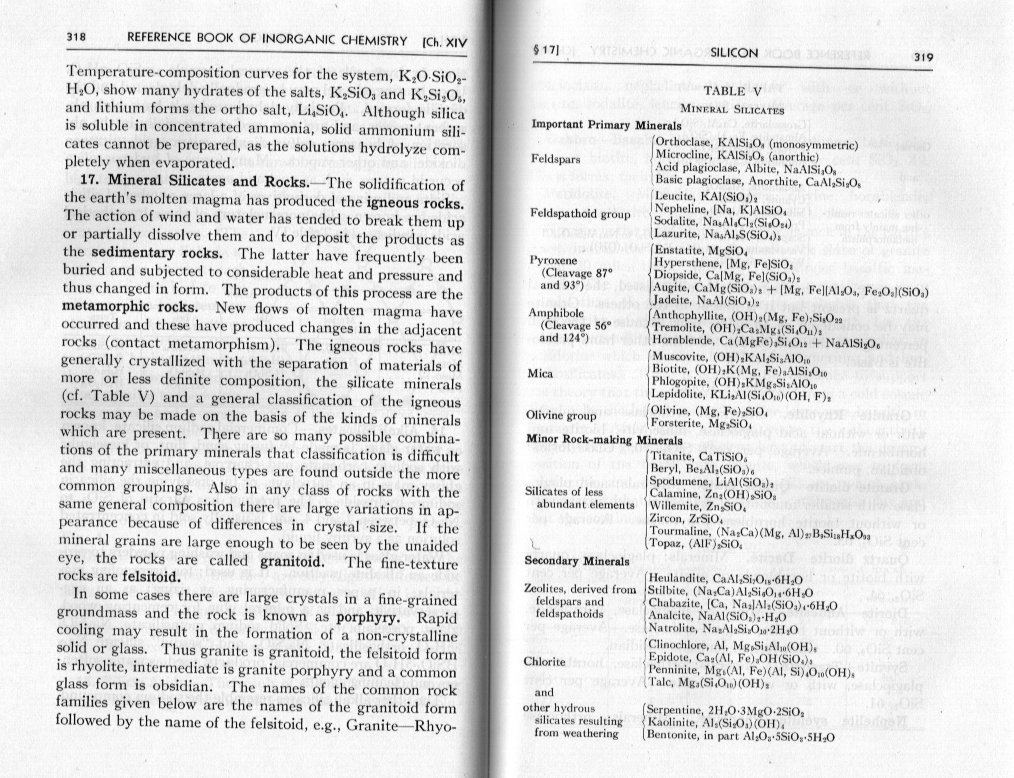
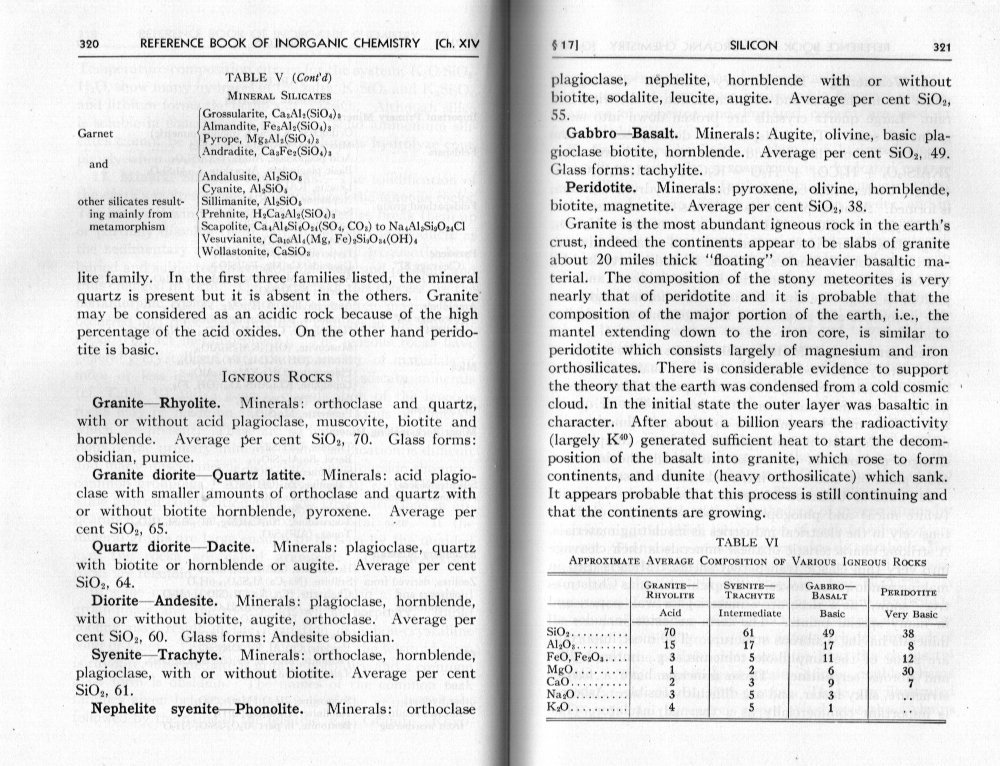
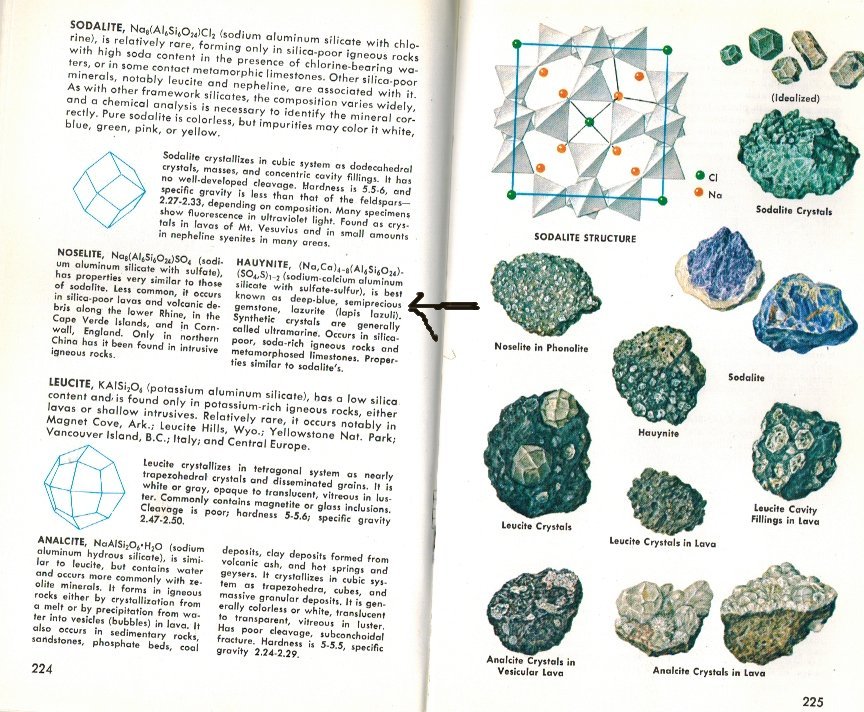
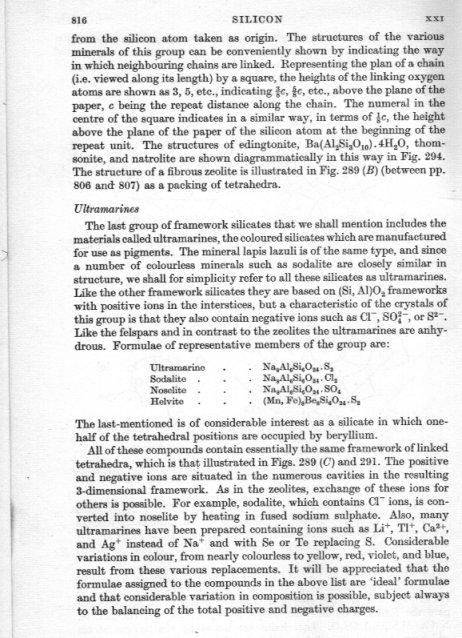
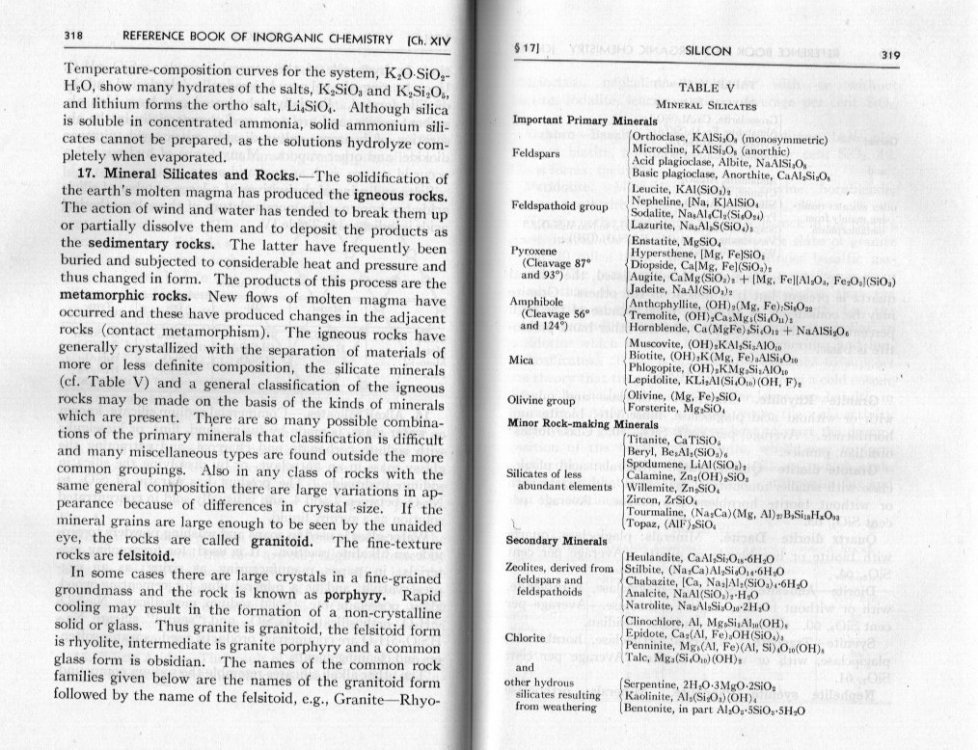
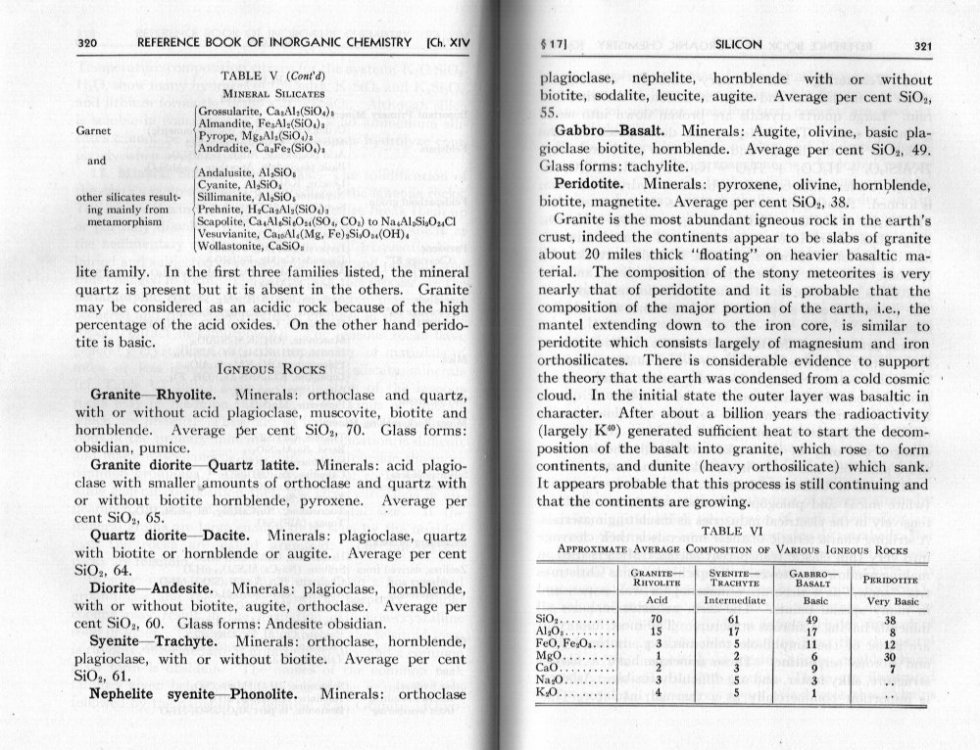
The classification depends upon where, and in which country, you look as well as the date of the classification scheme. All very confused. I think the sulphur comes from pyrites. https://www.nicholaswylde.com/content/lapis-lazuli/ This discussion below is interesting. https://www.mindat.org/mesg-326838.html Meanwhile here is some scanned material that I promised. First, Wells Then here is some well presented wider information from Latimer and Hildebrand Reference Book of Inorganic Chemistry
-
What do you know about chemical kinetics ? The answer lies therein.
-
I see that vague questions receive vague answers - suprise suprise. I a I also see that specific answers to very specific questions do not even receive acknowledgement.
-
Interesting subject +1 It is important to distinguish between the gemstone lapis lazuli, lazulite and lazurite minerals, all of which are blue stones. https://minds.wisconsin.edu/bitstream/handle/1793/11597/Lazulite.pdf?sequence=1&isAllowed=y Since my return I have also dug out my 3rd ed of Wells (1962) which has some things to say about this. I cannot trace a later edition. I willpost what he has to say when i can.
-
Much of the knowledge of today came directly from the stimulation of the economies I referred to.
-
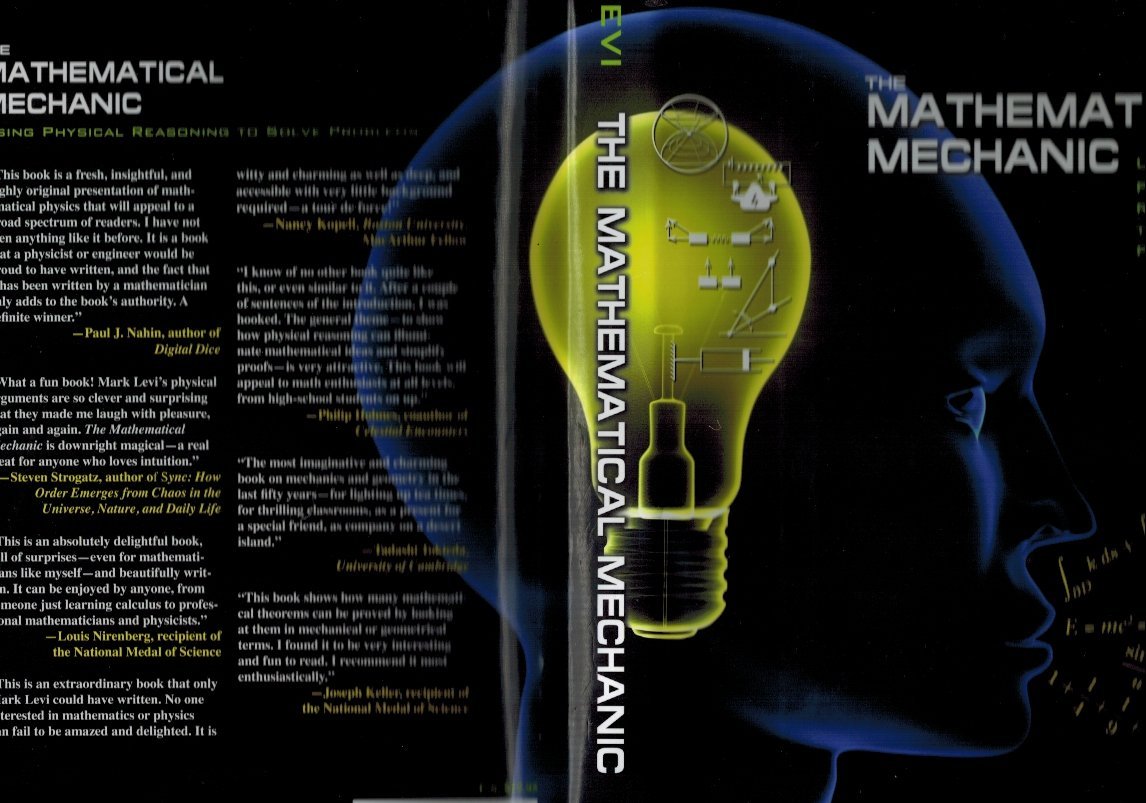
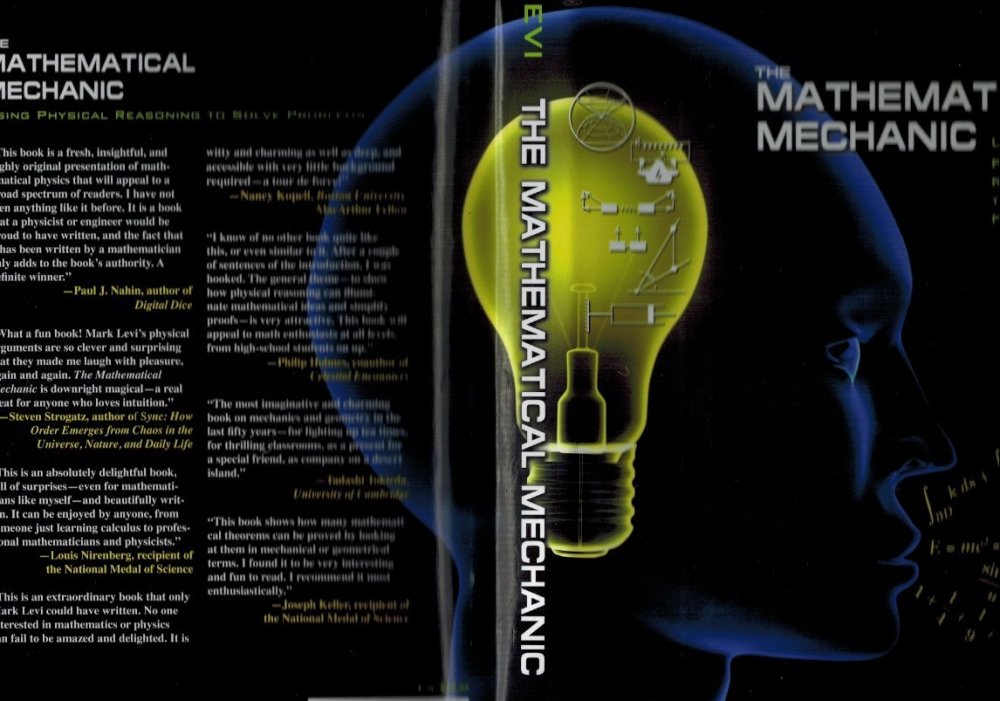
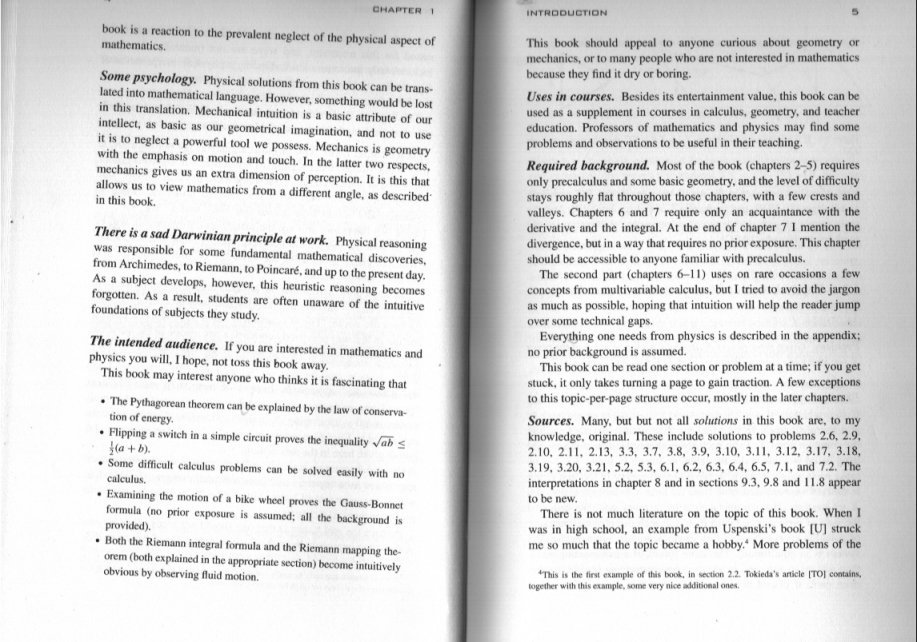
That's really good news. I think we can build on this mechanical experience. I have been busy these last week but I see other members have been looking after you. I would, however like to bring your feet fimly back to ground to feel the gravity. I think you could benefit from this book. It is one of a kind where the author tries to use physics to explain well known mathematics, rather than the other way round. So rather than dry mathematical general theorems about polygons try the polygon of least area (p35) The Mathematical Mechanic : Mark Levi : Princeton University Press. But remember to keep asking questions as you will find much unfamiliar as well as some familiar stuff.
-
Tomography is a highly mathematical subject that takes a great deal of postgraduate level understanding.
-
No they are invalid criticisms as demonstrated by the wartime economies of Britain and Germany. There was great efficiency and great innovation on both sides.
-
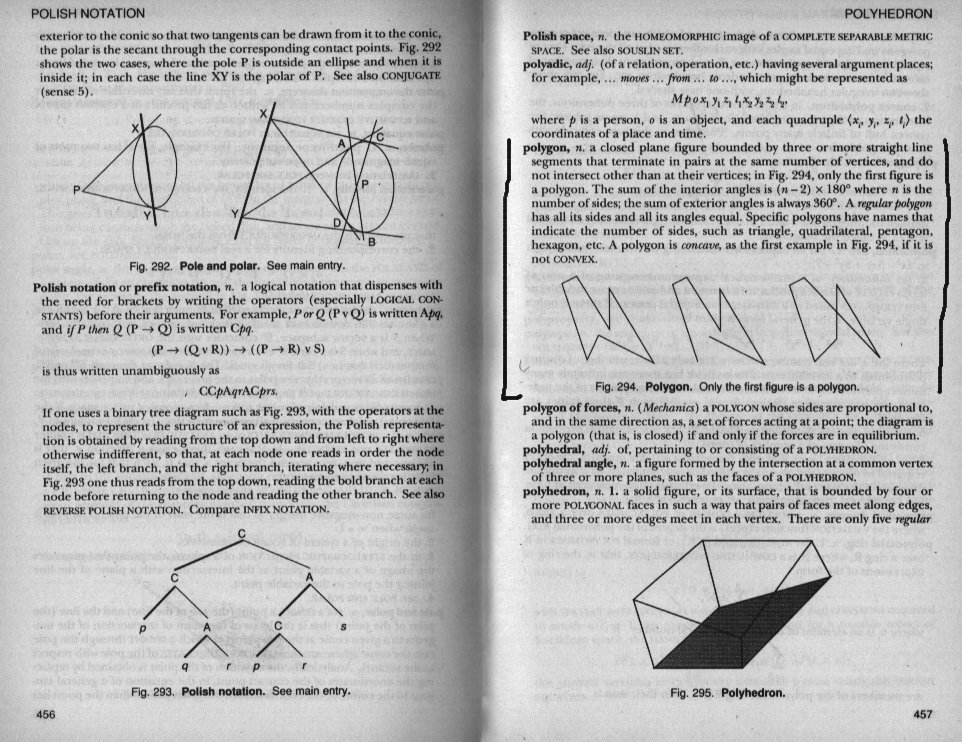
I'm glad we are making progress. A plane figure is the perimeter only of a shape that lies all in one plane (ie flat not like the surface of the Earth). Such a shape may have any combination of curved or straight or straight sides, but it must be 'closed'. That is it must come back to its starting point and enclose some area, although the area does not form part of the figure. The only closed shape with a single side is a circle (note a circle is the perimeter only of a disc so it is the circle that has a circumference but no area and the disc that has the area). A lens or lenticular has a two sided perimeter Of course both lenses and circles have curved sides. A polygon is a many sided figure, with all the sides straight. (poly means many) So a rectangle is a four sided figure. If all the sides are the same length the figure is called a regular polygon and these are the sorts of figures we are considering. There is more but that's the bare bones of it.
-
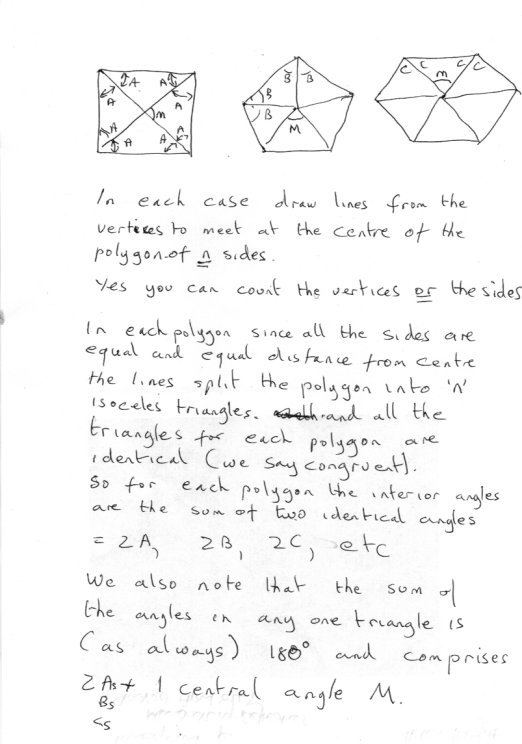
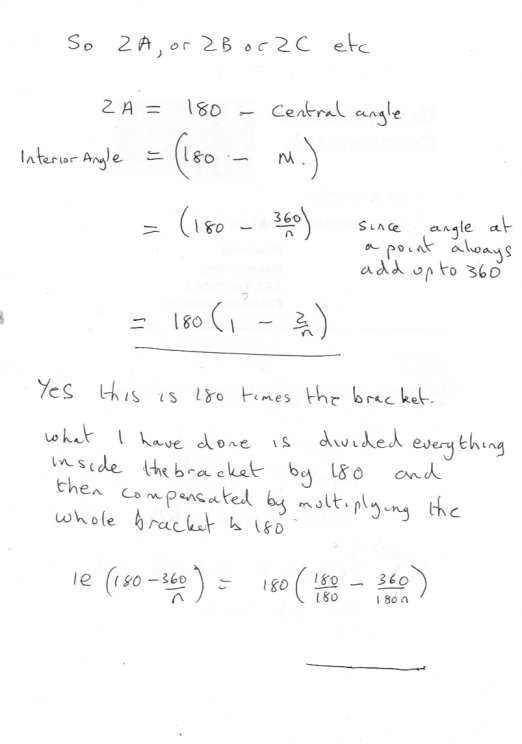
I know its harder to study just out of a book or online because you can't ask questions of a book or pdf, when you come across something you are not sure of. So you are doing exactly the right thing because SF is exactly the right place to ask. +1 OK so there are no polygons with 1 side or 2 sides (can you say why ?) So in the expression (1-2/n) n must be 3 or more, that is greater than 2. so 2/n is always less than 1 and so the whole expression is always positive. Discussing this helps us since we now know you can understand the notation (brackets and algebraic expression) so keep it up. This was an example of mathematical reasoning. Butit does not answer you question. The answer comes from the proof of the formula. Here is a chatty version. We can do a formal proof if you like but you need understanding rather than formal instruction. Incidentally do you understand X - Y graphs ie plots with x and y axes on graph paper ?
-
To further your studies, have a look at this pdf and see wht you make of it. http://www.benjamin-mills.com/maths/Year11/dimensional-analysis.pdf Then look here at the other pdfs in this range (they are all free) https://www.benjamin-mills.com/maths/Year11/ In fact this little experiment is successful, there are lots of free pdfs for Physics - we can help you find some good ones. One good online resource resides at http://hyperphysics.phy-astr.gsu.edu/hbase/hph.html But you may need to imbrush up your maths a bit.
-
You asked for a book. Try this one, it can be obtained very cheaply second hand. https://www.goodreads.com/book/show/1259850 Ferris is the editor , but the authors are all solid solid scientists saying their piece. The World Treasury Of Physics, Astronomy And Mathematics (paperback) £2.99

-
What the Dickens is that ? The challenge was Note that the poet is addressing the kittens (in the plural) with declensions of thou.
-
Thanks I have learned something here as I was considering the difference between singular and plural. +1 Apparantly we are both wrong since the addressee is plural (kittens)
-
Why so ? Though I agree it is just drivel. Was that meant to be in the style of Shakespeare or Browning ? Surely poetry competitions 'in the style of...' are just more plays upon words up with which we will not put - in the style of Churchill ? 😀
-
Well you have already taken the first two steps so +1 You have understood your current limitations and are looking in the right direction to overcome them. But take heart. We can provides some basic explanations here at SF. Your idea of a book is a good one because once found you can always refer back to it again and again. However first please give us some idea of your education since you cannot get far without some maths. Much of the requirement is or was on the school syllabus for instance have you done any algebra (secondary school) ? I deliberately introduced MLT to investigate your reaction to some very simple algebra of indices or powers, roots and reciprocals. You will come across this again and again so if you don't understand something - copy and post the part you need help with. Never bre afraid to ask in the manner you have. These questions are not silly at all.
-
Energy is not fundamental nor is it an entity or substance. Mass, length and time are fundamental properties of what we see today. Firstly I did not supply an equation. Combinations of M, L and T are special and complete in themselves. for example force is MLT-2 that is it is not energy. Acceleration has no mass term LT-2 I take it you are comfortable with the square cubes tc notation and the negative indices ? In answer to your first question. We simply don't know what was there or fundamental at the 'big bang', or even if there was a bang. It is really pointless trying to describe those conditions in terms of what we see today.
-
I suggest a better way to think of the maths/physics of these matters is to understand that we recognise three basic quantities, which we call dimensions, that can be combined to explain, describe and work with what we observe in the universe today. These are Mass, Length and Time , given symbols M, L and T. Very simple combinations are length squared, (written L2) which gives us area. and Length cubed (written L3), which gives us volume. Energy can be described in this way (written ML2T-2) Notes There are a couple of other basic 'dimensions', which I won't introduce at this point. The use of the word dimension in this way is perhaps unfortunate as it is quite diferent from common perceptions of dimension but it is well embedded in Science.
-
Yes but 'scientific progress' is patchy. It proceeds at different rates at different times and in different places on Earth. And sometimes it goes backwards and stuff is lost.
-
OK so I have obtained the original article, which for the benefit of other readers is Finite Elastic Waves in Rubber P Mason Proceedings of the Royal Society of London: Series A, Mathematical and Physical Sciences March 19th 1963 pages 315 - 330 I agree the diagrams are a bit odd, but In the first 5 pages Mason clearly describes the meanings of the variables v, u, λ1 and λ2 ; It seems that the 'wave' referred to is a single unloading pulse which travels back towards the fixed point faster than the material itself. Different parts of the rubber are travelling at different speeds. That is how is is contracting.
-
A good idea to stick to the OP. One topic per thread is preferred at SF. My aim is to encourages participants to look much further back in history and much mor widely geographically when discussing progress of Science. I think the picture looks very different from an expanded point of view.
-
So can you advise on this question please ?