
studiot
Senior Members
-
Joined
-
Last visited
Everything posted by studiot
-
You should read him G I Brown's book for bedtime reading. 😀

-
Clearly there is a glitch in the translation from Russian to Emglish. A trick question (which is what is I said) is designed to mislead or trick. A tricky question is more simply a difficult one in some way. So I repeat my assertion that any intention to mislead would be challengeable in English. Your AI (or LLM ) is just plain incorrect. It is indeed a maths question not general parlance, and was posted as such. However in mathematics Incidentally it was too difficult to access your scoop link.
-
I certainly agree. +1 In any mathematics course I have ever attended a question in which the provided diagram did not match the wording would be considered ill posed and void. I have seen 'trick' questions like this in psychologcal evaluations though. But of course the evaluator is not interested in the real answer, just the reaction of the candidate.
-
Well sort of. Density functions like charge density and mass density are not Lorenz invariant. Suppose an observer is at rest relative to a row of charges or mass points, strung out along a line at equal spacing. This observer will observe exactly that. A line of charges or mass points. The stationary observer does not see a magnetic field in either case. Now consider an observer passing the line at speed. The travelling observer sees the same number of points but, because of length contraction, sees the charge density or mass density differently. With the elctric field the travelling observer experiences a sideways force that he interprets as magnetic in origin. The two mirrors is not a bad 'guess', although you only need one mirror. Actually the wave can either penetrate the matter (refraction) or reflect off it like a mirror or a bit of both. It can also transfer momentum to the matter or be absorbed by it. Anyway your thoughts are more like a physicist so well done. I am trying to divert you from mentally roaming the universe, guessing solutions to twenty five intractable questions before breakfast. No one can do that - it is counter productive. 😀
-
There is already a standard symbol for this purpose - another greek letter epsilon. Since the same epsilon concept is also used for other purposes in Analysis (eg the epsilon - delta process) what benefits does uisng upsilon bring ? You upsilon is not an infinitesimal in the strict sense of the word and again there is standard symbolisn for infinitesimals, which have the advantage that they can distinguish what quantity or quantities is being referred to when the algebra of infinitesimals is being used. For the purposes of decimal expansions of real number you need to refer to Archimedes Condition which states that Given any positive real number x there exists an integer n such that 1/10n < x (Note that none of these are infinitesimals.) This condition is used twice to create a decimal expansion of any real number. More detailed analysis of that expansion of say 0.9 recurring and 1.0 leads to the proff I referred to earlier.
-
I don't know what your background in mathematic is but have you seen the proof that 0.9 recurring and 1.0 refer to the same decimal number ? This proof is part of a first year university 'foundations of mathematics' course.
-
Interesting question. You might be suprised to learn that the answer is even more interesting. This is because it is like in a police drama or a gangster movie, where there is a knock at the door and a vocie says "Are you Mr Smith ?" Because the answer "depends upon who's asking. Who want to know ?" also applies in Physics. This is a direct result of relativity. Collisions are also interesting. Being scientific about it you can ask what happens when two (or more) something or anothers collide. When matter alone is involved damage, deflection, chemical action, coalescence and many other results occur. On the other hand when two waves collide, the waves can pass right through each other and come out the other side, undeflected, undamaged and apparantly unaffected. So what do you think might happen if a wave collides with some matter ?
-
Well I don't see that a negative vote is a good welcome to a potential new member who might have other worthwhile comments to make. So I have balanced it with a +1 Thank you jeremy. I believe it is legitimate to post links to sites which offer a free calculator or other processor or data even if they would like visitors to venture further and buy something from them as with your link. Google will alo find many free plotters.
-
Pour evaluer le AI vous avez besoin de travailler en francais. 😀
-
Here is an easy experiment you can try. Equipment 1 sink of water 4 dinner plates 1 washing up brush Immerse the stack of plates in the sink of water, make sure they are completely submerged. Take the washing up brush and make a swirl in the water above the plates. Report what happens when you go faster and faster. Where did the force come from ?
-
The discharge pipe went straight up from the airing cupboard containing the tank into the attic and curved over the header tank to discharge into it. Straight into the block of ice at the top of that tank.
-
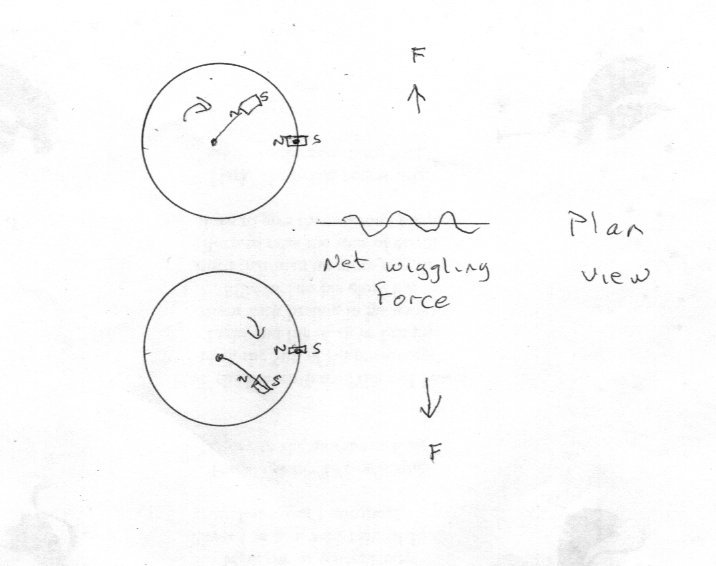
Not quite, if I understand the mechanism of your thrust correctly. Since you have drawn a circular boat ( ie a coracle) I have also indicated one. Fixed on the edge is a stator', in my case with the North pole facing inwards, As the centre rotor rotates the axis of its magnet always points along the radius, with its south pole at the put end of the rotating arm or rotor. As the rotating arm approaches the stator. the stator (and therfor the boat) will experience an increasing sideways pull towards the end of the rotor. When the rotor passes the stator the pull direction will reverse. This induces a left - right wiggling to the stator. However the vector of the force has a component along the line between the wiggles as shown. ~This is your thrust. So there is a polarity ( in direction) reversal involved.
-
I'm glad you understand that your are trying to create a model. However you are relying on two features, present in the model, but not present in gravity. Firstly polarity, as I have already said. Your vibration relies on alternate attraction and repulsion to work Gravity has only attraction, but never has repulsion. Secondly, again as I have already said and you have now ignored twice, the distances over which gravity acts effectively are very different from the distances in your model. So your model is inappropriate.
-
Polarity means positive and negative, as with electricity and magnetism, (though we call magnetic polarity north seeking and south seeking) Gravitational attraction is always positive. Please note that the force of electrostatic attraction is vastly stronger than gravity at atomic and molecular distances. Please note that most substances (matter) occur as molecules not individual atoms. You have drawn the typical 'miniature solar system' representation of two atoms with several or many electrons, also called the Bohr atom. This is perfectly adequate for this discussion. You can consider the electrons as little balls moving round so fast that they can be considered 'smeared out', over the shell and take an average. But I also commented Hence my offering about shielding.
-
My comments only take into account the effects of rotations of not the direct effects on quantities (differential or otherwise) as projections or components. Rotations by themselves do not lead to the cross products involved.
-
Indeed the electrons in both the Bohr orbital model and qhantum models suffer the opposite effect, which has significant consequency in the chemistry of atoms and molecules. It is called the electrostatic screening or shielding effect. https://en.wikipedia.org/wiki/Shielding_effect Folks so often forget the effect of the other electrons in an atom or molecule when considering the actions of one single electron.
-
Interesting, you have taught me something. +1 It the dangers rather depend on where the freeze up is. Some years ago, when we had colder winters, we were away for a holiday and when we came back there was no water coming out of the hot taps, except for an initial flow. These taps were fed from a DHW copper cylinder, with an attic header tank and gravity inlet feed. The attic tank had frozen, blocking its outlet to the DHW tank, causing a vacuum to prevent water exiting the hot tank. I found this when I heard a crumpling sound and investigated. The DHW tank had crumpled inwards because of the vacuum. I was so relieved when the soft copper popped back to shape, but remained watertight. after the attic tank was thawed.
-
There is no polarity involved in gravity.
-
This contains a fundamnetal inaccuracy mixed up with correct statements. exchemist is correct about the principle of induction heating conductive material. You are correct that this is not the cause of melting deep within a planet. Solid materials from ice to carbon dioxide to methane to iron can melt if the pressure is high enough. The pressure can be high enough due to gravity. If, only only if the resulting liquid is electrically conductive, convective currents within the liquid will generate electric curents according to Faraday's Laws. These curents will in turn generate magnetic fields. Even within the Earth the exact circulatory pattern has yet to be resolved.
-
Thawing pipes containing frozen water can have unwanted consequences; how to go aout the job needs careful consideration. Also a hair drier or other hot air blower is better since you won't have wet pipes to cope with. If you must use hot water, soak a cloth in the water and wrap it round the pipe. Rinse and repeat.
-
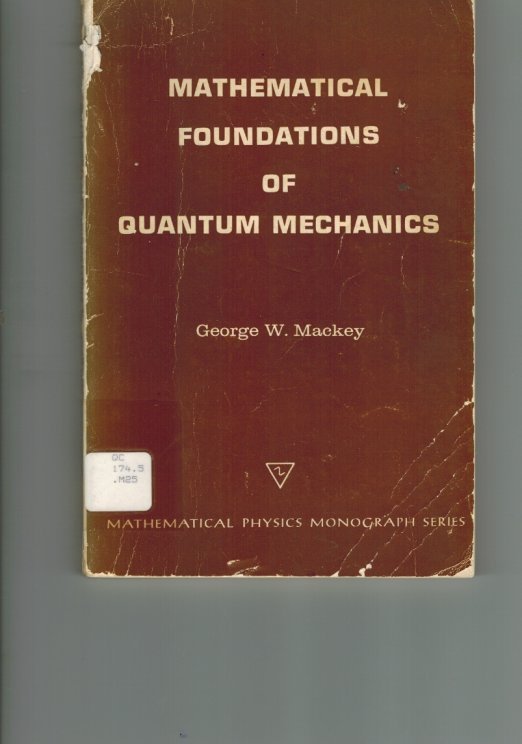
Obviously not well enough known to be noted here. The issue is a practical one, that both GR and QM share since both assume infinite divisibility of space. The issue is that the smallest particles we have identified are about 15 orders of magnitude greater in size than the planck length and 20 orders of magnitude greater than we have successfully been able to probe. ( note I am measuring size by L units, not M units ie diameter not mass). If you want to probe the mathematics of the region between this sizes I recommend this book which take you from Brirkhoff and Von Neuman (1936) through Segal (1947) to Kakutani(1948) and Gleason (1953) and Bogachev (1998) for mathematical models of what happens with Borel sets in (possibly infinite Hilbert spaces (manifolds). The question of the meaning and existance of A*B and A + B and A-B and commutators is examined in great detail leading to Segals axiomatic statement of QM. It is how ever admitted that (axiom VII) the justification is 'that it works'. As my last reference indicated work has proceed since Mackay's 1963 original.
-
That is true for finite rotations. However the calculus and for instance KJW's presentation is based on the fact that infinitesimals in the limit rotations do commute and differential geometry works at all. And GR is based on diff geom. That is why partials form linear combinations. Also the discussion seems to be being dragged further and further away from the OP, which was about what happens in that limit. And there is a fundamental issue between GR and particle physics that no one has thus far brought up.
-
Good summary +1
-
Work it out for yourself. Gravitational potential times Mass Density ML2T-2 x ML-3 = ? Actually I must own up to a definition error here I gave the dimensions for gravitational potential energy, not gravitational potential (which is potentential energy per kg) so the multiplication is Gravitational potential energy times Mass Density ML2T-2 x ML-3 = ? Gravitational potential times Mass Density L2T-2 x ML-3 = ? neither of which work out to ML2T-1
-
Good insights getting straight to the heart of the matter. +1 Work it out for yourself. Gravitational potential times Mass Density ML2T-2 x ML-3 = ?