
studiot
Senior Members
-
Joined
-
Last visited
Everything posted by studiot
-
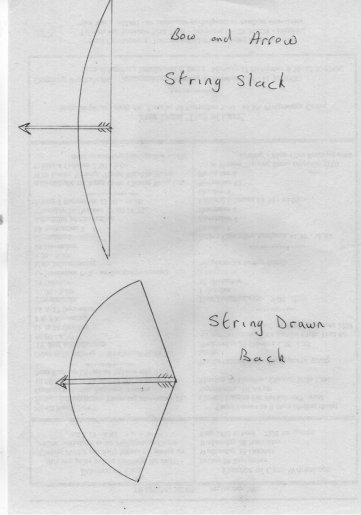
OK let's try vectors Vectors are little arrows. Before I add the little arrows please confirm that you understand the digrams of a bow and arrow, firstly with the arrow notched but the string slack ie not drawn back. Then secondly with the bow bent and the string pulled back. This is an ideal introduction to the sort of vectors we will be interested in. There are other sorts but don't worry about them.
-
Fantastic. +1 I tried drag and drop, which usually works with non animated pics. @cpu68 you also need to read the article - it is quite easy going, never mind the formula they give.
-
Perhaps you would be better served by asking questions, rather than trying to guess in subjects you do not know enough about. To fully understand your proposal you need to understand what the subjects are. Despite what Disney would have you believe, Fields are not emanations from a magician's wand or spread about by one. In this context, Fields constitute a propagation medium. Waves are a form of propagation in a suitable medium and simple wave (the sort we first meet and study) obey the principle of superposition, which is the mathematical name for the mechanism that causes interference. But some more complicated waves and other structures in the medium do not obey this principle. Some of these structures have been investigated as candidates for 'particles' or at least models of particles, formed out of the medium. vortices and solitary waves (also called solitons) are two such structures. Have a look at this animation of two solitons interacting without interference. http://www.acs.psu.edu/drussell/Demos/Solitons/collide-1.gif https://www.acs.psu.edu/drussell/demos/solitons/solitons.html Then if you have questions, ask away. I have a question. Can anyone tell me how to make the animated gif work on an SF page please ?
-
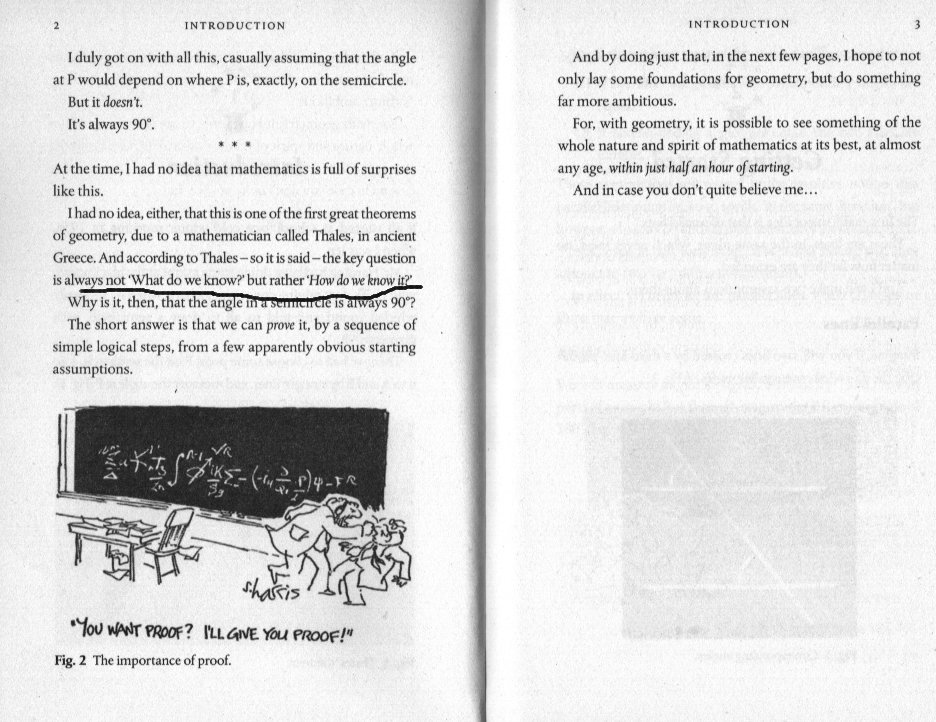
Please remember you are not the first to ask 'why ?' or 'How do we know that ?' It is a very reasonable question. Here is an introductory page from a newish book by a well respected maths author. You may be suprised to learn that Thales, a well respected Greek philosopher wondered exactly that several hundred BC. I have underlined the important sentence. Now that we have established that experimenters originally started by naming things in front of them and working from there perhaps we can revisit the posts I made about why Dalton thought of atoms and molecules and The law of constant proportions or definite proportions. You didn't say if you followed the reasoning in those posts. Once we have that out of the way we can move on to what is inside those atoms and molecules.
-
So why do we find fields inside matter ? If particles are created by interference, why does the photoelectric effect occur with a single light source and direct illumination ?
-
The speed of electrons in copper noted in my previous post imply you would have to apply 1011 volts to boost their flow speed to 0.1c
-
OK let's exapnd on this and think about it. Magnetic fields generated externally to a solid lump of ferrous metal can cause it to heat up and even (perhaps partially) melt. But these fields have to be there independently of the lump of metal. That is why we have to power induction heating devices from cookers to furnaces to welders. The case of the Earth is different. As the material of the planet was collecting together,the gravitity of the aggregate increased as the aggregate size increased. It may be that this aggregate was molten or semi molten from the heat generated from the kinetic energy of the impacting material. Either way the self generated gravity had a greater pull on the more massive elements such as Iron, Nickel etc than the lighter ones such as lithium , Oxygen etc. Because this greater pull inward was maintained for a long period of time the heavy elements tended to collect together in the middle. At this time there was no magnetic field. As previously noted gravity develops the greatest pressure on in the middle of a body. For the Earth this pressure was enough to melt the core iron, if it was not already melted. Once the core was molten. and indeed ionised (the surface of the liquid core is hotter than the surface of the Sun which is ionised plasma) the motion of the ions in the liquid constituted electric currents for thermal reasons. In turn these currents generated magnetic fields. This situation continues today, although part of the core has now solidified. So there were no 'eddy currents' as we find in a transformer because there was neither a source of external electric current or magnetic field. doe sthis help ?
-
I am inclined to wonder how you can do everything in your head, whereas lesser mortals like myself need a diagram. Perhaps because I am a plodder I need to know what electrons are travelling at speed in that copper wire to produce observable relativistic effects. For instance say 10 V is applied to the ends of a 1mm diametre copper wire 100m long what is the electron velocity at 290oK ?
-
Hi @Markus Hanke have you read the attachments in my posts a couple back.? That might help.
-
Hopefully this is your Eureka moment. There have been several times in history where there were suddenly a lot of discoveries that need names. You live in one it is called America. So not all discoveries were in Chemistry or even scientific.
-
Yes, mist, steam or condensation. You could collect a bottle of it then cool and let the clear liquid settle then compare it with some water from the faucet. The main thing is that you meet the stuff often enough to have named it. That is exactly what Dalton, Lavoisier etc did. This is also exactly what Scheele did when he discovered Chlorine. He grabbed a bottle of it and noted that it was not clear like air but had a greeny yellow tinge See the picture of a bottle on Wiki https://en.wikipedia.org/wiki/Chlorine
-
When the temperature drops and you see 'stuff' coming up from beneath the sidewalks or you just breath out and see 'stuff' what do you call it ?
-
Thank you for finding the original article. +1 As you say the graph is very interesting. Not only does it show the spike (@swansont I am not doubting there was one) but it also shows a similar flattenting of the log plot at the left hand edge or zero years age, ie now. In the detailed discussion the authors point out that there was a drop in sea level at the time of the spike they identify, whereas of course we are experiencing rising sea levels. I note that the latter part of the Columbia river basalt flows (the last major continental flows 25 to 6 mya) occurred at this time.
-
from swansont's article One matter is not clear to me. Whilst coring the deep ocean sediments tells us the annual rate of acculation at any time, with good acuracy, it does not tell us how long they took to arrive. As the authors note Be 10 originates in the upper atmousphere from a nulear reaction between cosmic rays and nitrogen ( and to a lesser extent oxygen) from whence it has to be laid down as a land sediment before it can be eroded, thenuplifted and transported by the hydrological cycle to reach the deposition ocean. Radiometric dating assumes a constant rate of input or a closed system to work successfully. It is also known that during this geological time period there was a burst of igneous activity, spanning for instance from Scotland and Ireland to Iceland, Greenland and into North America. The example is known as the north Atlantic igneous province. If there was one zone of heightened igneous activity there may well have been others that I do not know of. Such activity is a source of Be 9 particular in the mineral Beryl.
-
Basically yes but it is mass and energy which cause 'deformations' in space, not mass and gravity. Gravity is the observed result of these 'deformations'. As swansont says particles with mass (aka massive particles) follow different paths through spacetime so this is a very good question +1 Unless you know of a particle of similar mass to the Sun it is likely that the massive particle would be drawn into the Sun by the stronger effect. It should also be said that we really only notice this deflection effect on light when it allows us to see a star that should be behind or hidden by the Sun.
-
Interestingly Beryllium is more plentiful in both lunar rocks and meteorites than terrestrial rocks. In terrestrial rocks it is usually par of the minereral composition of igneous rccks, particularly weathered ones. Quite a few Beryllium compounds are soluble; Notable insoluble ones are beryllium hydroxide - which supports the accumulation in marine nodules and other sediments theory. https://adsabs.harvard.edu/full/1972LPI.....3..699S
-
Interesting, thanks. +1 I note that this is very early days for this and the first step is to determine whether this is a local or earth-global event.
-
The passage of light is affected by many factors as it passes from distant astronomical bodes to your eyes. Locally to you, yes the atmousphere changes the colour of that light, blocking some colours more than others. Your own optical instruments, including your eyes, are subject to distortions, called aberrations. these are responsible for most of the 'halo' round the edges. In addition there are dust and gas clouds in deep space that filter and block parts of the light. The light is not affected by electric or magnetic fields, but it is deflected (bent) by gravity. So sometime the twinkling stars are not actually where you think they are by 'line of sight'. Yes I advise to use either classical (including relativity) or quantum explanations, but not both together. I like whichever is easier for the observed results.
-
That is why I have been holding back about the last stage and how we got to our present view of atoms and molecules. If you look at pages 38 and 39 of the World Treasury book I recommended and I believe you bought you will find the first two pages of an article about electrons by early 20th century physicist George Gamow. Never mind the electrons we will come to them eventually so don't bother to read the whole article for now. I have mentioned divisibility and indivisibility a couple of times in this thread. The ancient Greeks spent a lot of time arguing about this subject. The arguments were not just to do with substances and matter but space and time as well. The famous paradoxes of Zeno are some examples. The Aristotle camp believed that you could go on cutting matter into smaller and smaller pieces for ever. That is an infinite count of cuts. As George describes the alternate camp led by Democritus believed that you would reach a stage where you could cut or divide no more. This he believed that there waas a smallest particle he called atomos. We do not now how a clear reason why he thought this. But we do know that the Greeks never resoved their argument. Roll on just over two thousand years and Dalton and other scientists discovered evidence to support this contention. They found that regardless of how many experiments they did the proportions in either their analysis or their synthesis of substances was always the same regardless also of the total quantities employed. It was clled The Law of Constant Proportions. This law has remarkable implications because it means that if you try to synthesise a substance from its elements in any old proportions there will always be and amount of substance and an amount of one element or another left over unused. Think very hard about this because it can only be true if Democritus was right and there is a smallest piece of any substance or element. For example you cannot tack on an extra third or one sixteenth of a piece of oxygen to water. Come back and talk about this idea until you are happy with it and then we can move on again.
-
Well humans have known for thousands of years that milk 'goes off' if you try to store it in the ordinary atmousphere. And they further found out that the warmer the climate the quicker this happens. But one day some genius (we don't know who or when) found out that there were two types of "going off". One type led to definitely unpalatable, posibly poisonous, result. The other type tasted different but not unpalatable and seemed nourishing. A further benefit accrued in that the eatable fermented products lasted longer, especially in warmer climates. Today we have identified the many different organisms that cause either type of of fermentation and can produce a huge range of fermented or cultured products. Equally today we can preserve ordinary milk for comparable periods so it becomes largely a matter of personal taste. Because we have some of these organisms or similar naturally in our own gut which play a part in our own digestion, consumed cultered products may help those with weak intestines or after illness. Originally these products were made exclusively from millk and the organisms and flavourings. But today many manufacturers substitute cheaper ingredients such as cornflour, gelatin or even air to increase their profits. Finally some products contain the organisms still live, most have have dead organisms killed by a pastuerisation process.
-
The short answer is : He didn't. Avogadro was a lawyer turned Physicist. He was not a chemist. Although in his day there was not real distinction between Physics and Chemistry. I see you have some other names in your list. During the end of the 17hundreds and into the early 18hundreds what are known as 'the gas laws' were discovered and some of the these were associated with Torricelli and Boyle. There was a problem however in that careful weight measurements could not be reconciled with the idea that each element had a smallest particle called an atom. In 1811 Avogadro published a paper in French (although he was Italian) which now appears in every school textbook as At the same temperature and pressure equal volumes of gas contain the same number of molecules. Avogadro did not use the word molecule in our modern sense he meant particle. But he did include the words "if you assume that the smallest particles of an element may be made up of more than one atom. " This and our modern version make up Avogadro's Hypothesis. An Austrian named Loschmidt was the first to calculate the number of these particles, but he worked on a cubic centimetre. The modern version we call Avogadro's number in his honour is arrived at on the basis of molecular weight. The molecular weight of a substance is the sum of the atomic weights of all the atoms making up the molecule. The atomic weight of Hydrogen is 1 and the atomic weight of Carbon is 12 So looking back at our ethane molecule. This has 2 carbon atoms and 6 hydrogen atoms So the molecular weight of ethane is (2 x 12) + (6 x 1) = 30 I did ask last time if you have heard of the kinetic theory of gases. To understand more detail this is needed so an answer would be appreciated.
-
Then I will leave it to those who understand it. Good night.
-
I didn't say it was. You need to read the whole book to understand that he has one main point to make which is that there is only one quantum field that encompasses the entire universe and everything in it. Further that this one field describes everything and answers all the problems we encounter if we try to split it in separate fields. It follows that if anything or any one in the universe is conscious, however you define that state, it is described by the universal field. Nor did I say whether I agreed or disagreed with it. I was simply pointing out its existence and where to find it for anyone interested enough to look.
-
Don't be ridiculous. Links are for websites; I provided adequate reference in conventional form for you to be able to identify the book. If you were to read it I can only assume you would find out that Carroll states many times exactly the opposite of the false impression you have gained from a synopsis I have not seen.
-
With how much respect should I view a person who says and then says this Have just looked at of one small part of the book and gained an entirely false impression ?