
studiot
Senior Members
-
Joined
-
Last visited
Everything posted by studiot
-
https://www.bbc.co.uk/news/science-environment-61723806
-
The AI has landed. https://www.bbc.co.uk/news/uk-england-devon-61710706
-
Well I know nothing (except the little Wikipedia tells me) about Stephen Pinker so it is not clear to me who the 'I' person is in your second paragraph. Who was the research assistant of yore, yourself or Pinker ? Now your actual question, and therefore the topic of this thread, asks about randomness and feeding pigeons. There are several statistical techniques for measuring things by using what is known as 'random sampling'. Say you wanted to measure the 'average' size of stones in a pile in a quarry. You could measure every stone and calculate a very accurate average. Or you could take a shovel here and a shovel there and just measure these as 'representative'. Statistical techniques exist to take the shovelsfull in an orderly fashion to best represent the pile. These are based on random numbers being used to identify where to dig the shovel in. Experience has found this to be far superior to allowing the operator his or her own choice. I don't know what experiment was being conducted with the pigeons, but I would guess it was similar to what are known as Latin Squares. If you want to test and compare various varieties of seed, you cant plant them all in the same place, so you divide the field into small square and use random numbers to identify which square each variety seed will be planted, using several for each variety. This takes out (statistically) any fertility and other differences in the planting for proper comparison. So I would guess something of this sort went on in the pigeon loft with perhaps trials of different feeds. OK that begs the question how to get random numbers ? Well there are lots of ways, some to do with calculations on paper or by computer and some to do with observing naturally random phenomena. The thing about 'random numbers' is that in the real world numbers are only truly random over a particular range of interest. Obviously we want that range to coincide with out problem. Around the time in question another form of physical random generator was also popular. This is called a white noise generator. A white noise generator provides electrical or sound that contains, on average, all frequencies equally in a particular range. It was so important that special electronic components called 'noise generators' have been developed for this purpose. So there you have it, my guesswork from the sparse information you have provided. Nevertheless a good topic for discussion. +1
-
Glad to help. That's a major function of this site. 🙂 Ask again if you need more help.
-
But I was. The Drake equation clalculates probability. It's fine that you answered no, although you might have been straight about it first time round rather than that sideways dismissal you offered. Anyway I agree with others that the problem here is you use of the absolute. Far too many promising ideas falter at the first counterexample someone brings up because they have been couched in absolute terms. Proving the negative is incredibly difficult. I recommend reading this (short) thread, several very good points about this are made there. https://www.scienceforums.net/topic/119871-what-is-falsifiability-exactly/#comment-1209560 These two deserve particular attention. Why is it nonsense? A single black swan is enough to disprove a statement like "all swans are white". But if I say "all swans are black or white", I can't prove that, not even if I check every living swan. I'd have to check every swan there ever was, or ever will be, and I'd have to be sure swans didn't live on any other planet in the universe as well. This is the basis for theory, the idea that we can only accumulate evidence in support rather than "proving" an idea. It's what keeps us searching for the most supported explanations, rather than answers we decide on and never go back to check. The key word here is "every"... No, it would not. It would show that "In every room in every building on earth, there's a green unicorn!" is false statement.
-
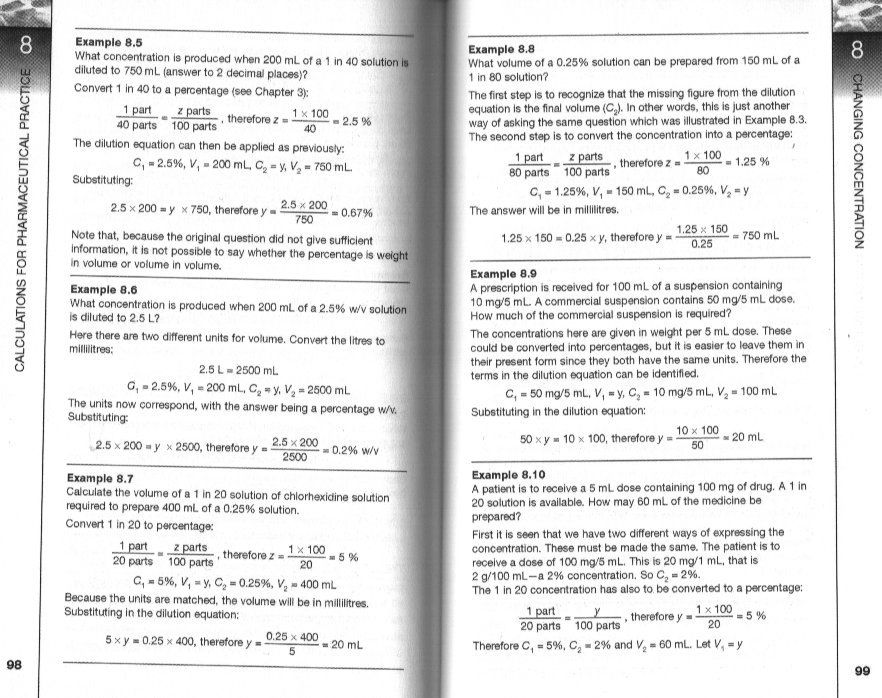
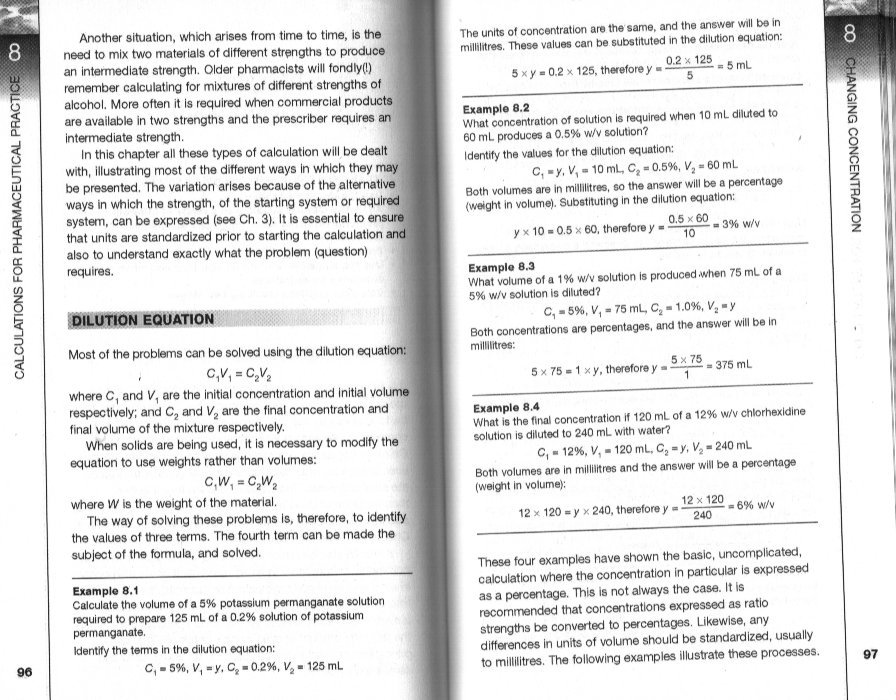
Well I was replying to your question to bufofrog Which your repeated acouple of times. In fact I did double the volume in my original post to get from 500ml to 1000ml as the easiest way to get to moles/litre. But sure you could work on actual volumes if you prefer - It's just more mistake prone and longer winded. Bufofrog also offered you a very handy formula that can be applied in many cases That is C1V1 = C2V2 This is much used by pharmacists who do a lot of fiddling about with concentrations like you have been doing. Here are a couple of pages from a pharmaceutical calculations course that also show what to do when you can't directly apply the formula. I don't know what you wil be getting up to in Biology, but the most general situation is when you are mixing two different strengths of solution etc. There is one formula that works in all cases. [math]\frac{{{\rm{Resultant}}\;{\rm{Concentration - Weaker}}\;{\rm{Concentration}}}}{{{\rm{Stronger}}\;{\rm{Concentration - Resultant}}\;{\rm{Concentration}}}}{\rm{ = }}\frac{{{\rm{Amount}}\;{\rm{of}}\;{\rm{Stronger}}}}{{{\rm{Amount}}\;{\rm{of}}\;{\rm{Weaker}}}}[/math] This formula works whether you use w/w, w/v, v/v %, P ie all units so long as you are consistent.
-
A much posher reply than my post +1 @Alkonoklazt The Drake equation does not refer to any alogorithmic method or Von Neuman machine. It attempts to evaluate probability. So please don't patronise me or try to foist explanations about matters I didn't mention.
-
No they are quite different, which is why I raised the subject. For instance in thermodynamics we have A open system allows both energy and matter to pass freely into and out of the system. A closed system allows only energy to pass into and out of the system but not matter. An isolated system does not allow either matter or energy to pass into or out of the system. Note that the terms open, closed and isolated refer to exchanges between the system and its environment. Not the values of properties of the system itself. It is the system's own properties that determines the 'state' of a system. As energy or matter enter or leave the system, the system changes its state according to the controlling relationships of Thermodynamics.
-
This is where you went wrong and why it is a good idea to convert to equivalent vol of pure ethanol. You have taken the density of 215ml of a liquid (that indeed has the same amount of ethanol as 150ml of pure ethanol) but it also contains 30% water since your liquid is 70% ethanol. So some of its density ie mass will be due to the water. So multiplying this density by the volume will not get you the mass of ethanol. secondly you only made 500ml of solution with this 215 ml of liquid You need to double this quantity to get moles / litre. That is why my calc ends up at about 5M whilst yours ends up at about 8M. You are however right, and even said you made the volume up with 9 parts of water in your opening post - I missed that. I just saw the 1 : 10 which is usually interpreted as I said. Does this help ?
-
Can I respectfully request you change your terminology ? This is to avoid confusion/conflict with the already accepted definitions/use of the terms 'open system' and 'closed system' and 'state'. The first two are not properties of state as implied and their actual definition is quite different from yours.
-
It's not. It denies consciousness for all algorithmic entities equally. I don't recall either you or I specifying an 'algorithmic' entity. If you wish to limit your 'entities' to algorithmic ones, you should specify this as the issue becomes quite different.
-
1) Molarity 500ml solution contains 150ml ethanol 1000ml solution contains 300ml ethanol = 0.300 litres [math]{\rm{Number}}\;{\rm{of}}\;{\rm{moles}}\;{\rm{in}}\;{\rm{0}}{\rm{.3L}}\;{\rm{of}}\;{\rm{pure}}\;{\rm{ethanol = }}\frac{{{\rm{volume \times density}}\;{\rm{pure}}\;{\rm{ethanol}}}}{{{\rm{molecular}}\;{\rm{mass}}\;{\rm{ethanol}}}}{\rm{ = }}\frac{{{\rm{0}}{\rm{.300L \times 789g/L}}}}{{{\rm{46}}{\rm{.069g/mol}}}} = ?M[/math] But this amount is the amount of ethanol in 1 litre of 30% aqueous solution So the molarity is ?M 2) You do realise that diluting a solution 1part to 10 parts will result in a fraction of 1/11 or less than 10% ?
-
+1
-
Thanks I didn't know that. +1
-
Can I ask if this paper is a version of the Drake equation suggesting that the probability of any artificially constructed system becoming self aware, sentient or conscious is so low that it can't happen ?
-
+1 for reading the rules here and posting appropriately. What a good start for your discussion. You have posted a lot of material so it will probably take some time for folks to read and digest. There are several members interested in aspects of AI here.
-
A couple of things I don't quite understand here. Historically the old scandinavian culture is only other culture I know of with a tradition of 'beserkers'. But that was more than a thousand years ago. Does anyone know if there were many or even any such incidents from the 1860s to say the 1930s in America, when there was an abundance of guns ? Secondly I understand that whilst it is illegal for Texas to ban abortion directly, they have weazelled around it by making it illegal to "travel to an abortion". So could some indirect bans be effective with guns ?
-
I think that both creation and evolution are often ill specified terms thrown about with 'gay careless abandon' by 'all and sundry' , so +1 for bringing out that fact. This is, of course, why we are more careful when talking scientifically and often 'create' new specialist words, such as abiogenesis, with precise meanings. Create, of course, remains unspecified in this thread. Rowling 'created' Harry Potter, but does he exist ?
-
This is not surprising news, as species location boundaries have always moved with changing climate. However it is good news, especially if Man looks after the new areas as suggested in the article. Coral is one of the 'canary' lifeforms for global warming. https://www.bbc.co.uk/news/uk-england-devon-61592108
-
My question was a joke. Your question cannot be answered without further information. I would be inclined to say zero because the dessicant has become saturated.
-
If three monks can drink 15 bottles of wine in 5 hours how many monks can 24 bottles drink ? We need much more information, mate.
-
This is posted in Earth Science, where there are many disparate definitions of 'mineral'. https://www.uky.edu/KGS/rocksmineral/minerals_definition.pdf A sub class of these definitions, which I assume you are referring to concern chemical compounds of definite proportions and sometimes crystalline definite structures which form the ingredients that make up the rocks, such as olivines, quartz, feldspars. Minerals can be pure metal (eg native copper) , metal or non metal compounds such as oxides (eg hematite), silicates (eg garnet) , carbonates (eg calcite), sulphides etc etc. Of these, some can truly be called salts and some of these are indeed coloured, for instance Azurite - copper crbonate is 'azure blue. Chromite - the iron salt of chromic acid is black Wulfenite - the molybdate salt of lead is yellow/orange/brown Most coloured minerals are not salts though and many arise from replacement metal atoms in a silicate matix. Silica (silicon dioxide) is itslef colourless but impurities create many coloured varieties wg rose quartz.
-
I think you need to look elsewhere. Your nearly had the right idea when you replied to my question. I say the positively charged proton exposed due to electrons orbiting a ways from that nucleon. The point for this thread is that standard valency bonds are permanent, as are permanent dipole interactions which do not form valency bonds. Both of these types can hold solids together. The non valency ones are a type of VDW force. But yes, a further interaction can be due to a temporary dipole. These are the London forces. Both temporary and permanent dipoles have two possible sources of derivation.
-
Thanks for the further more detailed information. +1
-
Deformability is not a very well defined concept either. You listed a some 'plastics' materials. Plastics as a collective term are renowned for their long term deformability. Continued unrecoverable deformation over time is called plastic behaviour and the result is called creep. A seal that slowly squashes is of no long term use. Soft copper for instance squashes once and stays that way. It also has a higher upper and lower temperature working range. But if this is critical you really need expert advice.