studiot
Senior Members
-
Joined
-
Last visited
Everything posted by studiot
-
What are you talking about ? [math]1 + n/\left( {n/2} \right) = 1 + n \times \frac{2}{n} = 1 + 2 = 3[/math]
-
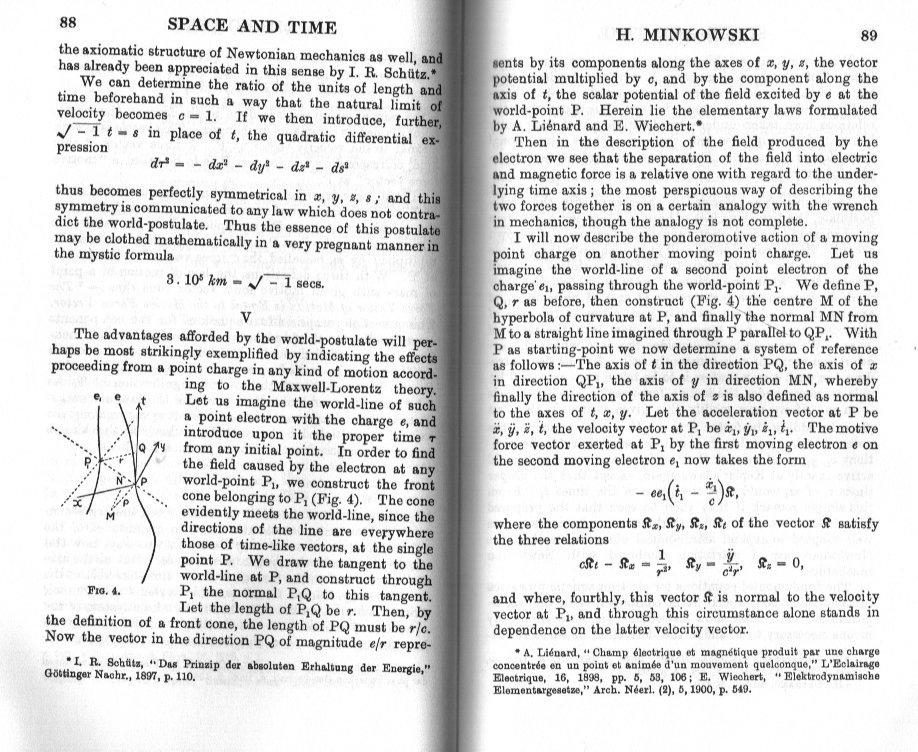
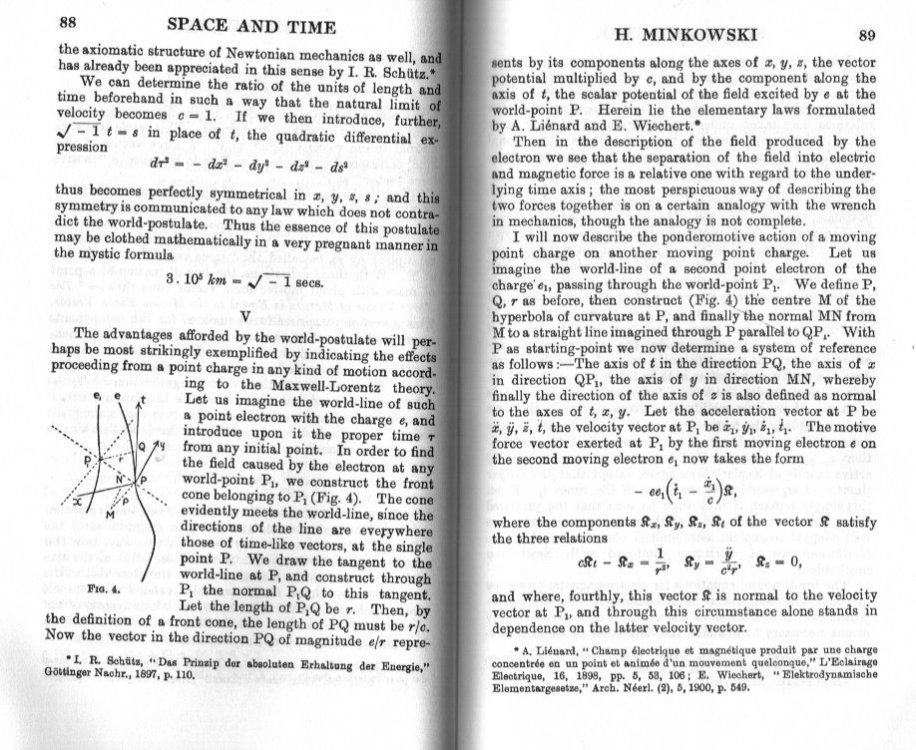
Yes indeed, +1. However, as ever, life is more complicated than that. To the best of my knowledge Minkowski didn't write any books, only papers and died prematurely. Here is an extract from one of his papers on the subject. The first 13 pages of this paper are as Markus implies but doesn't say explicitly. They are couched in terms of the real numbers. That is all variables are are measured in real numbers. Minkowsk then introduced imaginary numbers (note not complex numbers) to the mix, near the end of the paper. I am not sure if the reference at the bottom of the left hand page to Schutz acknowledges that Schutz did this first. Some later authors formalised this by starting with the inclusion of i. The use of the 'mystic' formula from natural units is also interesting. [math]3x{10^8}kilometres = \sqrt { - 1} \sec onds[/math]
-
Inaccurate ? Damn perhaps that's why I never win those lotteries.
-
Note I wrote this earlier but obviously never got round to posting it. Sorry. I seem to be having all sorts of trouble with postings here and elsewhere just lately. Just think. We can't calculate the weather on our own planet over 10 days. I tell you what. When I win all the lotteries in the world at once I will buy lots of supercomputers from @Sensei and help you. How does that sound ? 🙂
-
No it would not be wrong to create a global picture, but you would have to do it as you describe in your second paragraph because GR functions are pointwise functions. You could create a standard net and calculate deviations from it, as opposed to calculate absolute (ie direct coordinate) values but you would still have to do this point by point. There is an analagous pair of approaches in fluid mechanics, respectively called Eulerian and Lagrangian.
-
Two neon atoms in an otherwise empty bar ?? Surely the sound is the question who is paying for the drinks ? 🙂
-
Indeed so. +1 I would just add to that :- The volume occupied by any wave has a time value attached since all waves expand from thier point of origin over time. So you can't just say the sound occupies 20 litres but you have to say "it occupies 169 litres after 1 second" or similar depending on when you measure it.
-
Rather than indulging in a non productive slanging match about mostly off topic material I suggest you go away and study Alfven and Lerner. Alfven got the 1970 Nobel Prize for his work on such theories.
-
You made a big argument about it being only one piece, as though that was significant in some way. How was it significant ? If one cuts a length of plank to size, the remainder of the plank is usually a short plank , not a wedge, if the whole source timber is sound. If, however, the remainder part is unsound due to say splits or shakes, the remainder will fall apart in the cutting off process. Some of these parts may well be wedge shaped, depending upon the course followed by the splits. This would then be a random process. I said the end was 'damaged'. All along I have wanted to discuss the possibility of intelligence arising randomly. And you keep trying to wriggle away from this, by introducing all sorts of extraneous subjects like machines and big words like teleology, neither of which are relevent. Your claim is that artificial intelligence is impossible. That is a two part claim the part about the 'artificial' and the part about 'intelligence'. Intelligence requires a host system, however it arises. It would be sensible in a discussion like this to lay out what exactly you mean by intelligence. Artificial also requires careful definition. My example shows how an artificial construct (my wanted length of plank) can lead to the accidental construction of a machine (the wedge). Do you consider the wedge artificial ?
-
The references are given automatically by the website system at the top of each quote.
-
I didn't make an 'argument about it. You did. Not only did you misrepresent what I actually said, you directed the attention of another member to your false representation. And you made a big thing of the offcut being a single piece (your actual words) I actually said How many pieces do you now think the offcut came in ?
-
I'm still waiting for an acknowledgement (and perhaps an apology) of the misrepresentation.
-
I'm sure you know about regenerative feedback. The output is different from what it would otherwise be in the absence of feedback. But unless you have an output you have no feedback. You can call the regenserative feedback the phenomenon or just the output to suit yourself.
-
Even that is not so cut and dried it is not arguable. Without the output, in regenerative feedback, the phenomenon could not occur. 🙂
-
What makes you think scientists are not already working on this ? One thing is certain. Nature is under no obligation to Man's artificial classification schemes into say plants and animals. Hard reality is the other way round. It is up to us to observe and update accordingly. Cyanobacteria were once classified as plants but apparently that is no longer the case (Charony ?). What are plants? What are animals? What is the difference between them? If you take an old fashioned view that plants generate oxygen (through photosynthesis) and animals breath it then plants must have come first since there was once pretyy well zero free oxygen in the Earth's atmousphere. But see this
-
Well you have the opportunity here to do what you said you came here for, to learn. I don't know what you know about reverberation time, or even if you have ever hear of it, but basically it is the time for burst of sound to spread throughout a container and bounce back (reverberate) off the far walls. The sound then bounces back and fore (reverberates) between the walls growing ever weaker all the while until it becomes inaudible. So yes we really do fill a room with sound until it dies away. And by fill I mean fill. Sound, being a wave phenomenon, goes over, under and around obstacles like tables and chairs and people. The technique I remember using involved bursting a balloon and recording the sound of the pop as it died away over several seconds. The Albert Hall apparantly has a reverberation time of 3.4 seconds, though I have personally not measured it. http://hyperphysics.phy-astr.gsu.edu/hbase/Acoustic/revlow.html#c3
-
I hate to contradict such a learned soul but of course you can put sound in a bottle or even the Albert Hall. I agree there is no transmitted sound in a vacuum, but objects like the vacuum bottle wall can still vibrate so I also agree that sound require matter. But of course the Albert Hall does not contain a vacuum. So all my courses about architectural acoustics and the measurments I made of reverberation times tell me that sound can exist in a container for a very long time. Far longer than the existence of many sub atomic matter particles. The decay is exponential so mathematically at least a sound never actually dies away completely. This last sentence shows what you might deem 'a flaw in the theory' and others would simply say it is going beyond the bounds of applicability.
-
Not necessarily. There are 3 axioms of addition Just for simplicity I will stick with whole numbers (integers) 1) Closure : If a, b and c are whole numbers and a + b = c then c is a whole number. 2) Commutation a + b = b + a 3) Association (a + b) + c = a + (b + c) None of these define the operation + (that is what I must do when presented with a form a + b Suppose I define that operation to be a + b = (a + b) + 1 ? Then 2 + 2 = 5 It is easy to show that this operation satisfies all 3 of the axioms of addition.
-
Yes, I read what you wrote. The question is did you read what you actually wrote and I quoted ? I ask this because not only did you ask questions, but you answered them as well also saying that physics is wrong. Asking questions is really good and should be welcomed by all good teachers. However repeatedly challenging the veracity of what the teacher is saying is not asking questions. Sometimes even good teachers make mistakes (even sometimes to keep the class awake) so they should be challenged but there are considerate ways to do this, just as there are considerate ways to ask questions, since they may after all be right and know something you do not. Your aim should be to learn whatever it is they know before you make any judgement as to the correctness of their statements.
-
So what was this then, if not My Version v Physics ? or this As a matter of intrest I suggest you should be careful distinguishing between c, which is indeed a constant, and 'the speed of light' which varies according to the environment. Nice one Phi.
-
I'm glad you added this bit at the end. Otherwise your opening post could be taken as yet another attempt to challenge conventional wisdom in quite an aggressive way. Anyway a few comments on your many posts. Photons may not have mass, but they have measurable momentum. Physicists, as I said to you before, recognise at lease four states of matter, solid, liquid, gas and plasma. Most of the matter in the solar system is made of plasma. Yes you are missing something. Several things in fact. But you are not alone in that. Here is a short true story about reasoning from too little information. When things burn, they loose mass right ? Surely this is obvious since if I burn a piece of paper or wood or whatever there is little or nothing left behind. But this is false reasoning which misled scientists for several centuries. It was not until lavoisier collected all the products of combustion and weighed them before and after that it was realised that in fact mass is gained by combustion! So less of the 'Physics must be wrong because My point of view is right', please.
-
I'm not suprised as there is far too much off topic material being introduced in this thread. +1 I don't see states of matter have to do with relativity? In any even Physics recognises at least four states of matter and Chemistry several times that number. Again I don't see any connection between Thermodynamics and Relativity. Both Energy and Mass are frame dependent quantities. Energy is also configuration dependent, as is mass to a lesser degree. So do I take the short response as meaning you have understood my answer to your title question and agree with it ? Thank you for this lengthy response to my question. Rather than jumping the gun a simple answer would have done. I still do not know if you understand the difference between moment of inertia and product of inertia. One point before I elaborate, both forms also apply to slight bending as opposed to spinning. And surely we are talking about slight bending here rather than rotational dynamics. Or are you of the opinion that space / spacetime is somehow spinning ? For any given moment of inertia value there are an infinite count of configurations that possesses this value. These are indistinguisable from the point of view of MOI. The product of inertia contains the information of the distribution of the mass about the centre of rotation to achieve this value. That is it selects a particular configuration. In the 'Inertia Tensor' the product does this by including off diagonal elements, not present the the moment. This is similar to the tensors in GR, but as I said much simplified since the coefficients in the GR tensors are themselves functions of the coordinates and not simple constants like inertia tensor. These differences can also be show in matrix formulation, for those who, like me, prefer them.
-
I think it is a very reasonable question that many don't think to ask, but I also think swansont's question was not only perfect physics, but just the question I was going to ask when he got in first. Unfortunately I also think this thread has become rather hectic with a lot of extraneous off topic material being suddenly thrown in. I have reversed one red mark and offer my expanded answer to your question, in exchange for your answer to one of my own. Do you know what the moment of inertia and the product of inertia are in mechanics. There is no catch, these provide an example of a simpler but similar mechanical effect. GR itself is a mechanical theory. The point is the the so called Field Equations of GR that make up GR do not only refer to a 'quantity of matter' in a local sense. They are global equations that also refer to the distribution of that matter. And the 'curvature' is determined by both the quantity and the distribution of the matter. So if you 'take some matter away somewhere locally' you must move it somewhere else globally. So the matter is then redistributed and the curvature reconforms itself to take this into account, according to the Field Equations. Over to you for your reply.
-
Since they are taking measurements that is quantifying. Yes I place consciousness above awareness. No awareness pertains to more than just sensors. The optician example was just that - a single example. I was also making the point that awareness is not a binary function of being aware or not aware, although that can be the case sometimes. At other times there is a whole scale of awareness. For example: I am aware there is a world F1 championship going on. I am also aware of some of the results for some of the drivers, but I am not aware of all the details. Does this help ?
-
As already noted quantifying awareness, at least in some cases, is well defined. What can you see in your peripheral vision ? Basically nothing at all in general, at least you are not aware of anything. Now suppose a moving object approaches from your side, you will become aware of this and may even take evasive action. But opthalmologists have a machine for measuring this precisely. By testing your 'field of vision' they are measuring your visual awareness. This is what I meant by I think the pecking order is quite the reverse. The exact nature of consciousness is very difficult to pin down and I am not sure I can do that. But what I understand about awareness is that it is definitely a graduated quality on a measurable scale and appropriate technicians do this all the time, day in day out. Further this graduation is partly at least under the control of the subject who must be 'conscious', whatever that means. Equally if that subject is not conscious she will be unable to be aware of many things, again in a scientifically measurable manner.