
studiot
Senior Members
-
Joined
-
Last visited
Everything posted by studiot
-
Why would a truly irreligous scientist know or care how many persons or persons 'wrote' the bible or how many books, chapters, gospels, appendices, apochripahas etc it has ? I'm sorry if my oblique references were too obscure for you.
-
I don't see how this represents a chain of reasoning explaining how you get from my demonstrating that there is more than one meaning to the word grounding to your assertion that Surely you can see that many implications could result from from my demonstration. So it is encumbent upon your own goodself to sift through and discard inappropriate ones before asserting anything ? In fact the correct implication is that scientists use particular definitions of many if not most words so that they are not confused with everyday definitions or if there are multiple definitions the appropriate one is chosen. Exactly so +1
-
Try reading through again what I have said to both yourself and Genady very carefully. A point I was trying to make is that there is plenty of theory that comes before deduction / induction. None of that is repeated in the definitions or theorems of deduction / induction, but it is all still potentially applicable. For instance what is a deducton from a premise ? Its structure is antecedent- connective - conclusion So here goes 3 plus five makes eight. Therefore Uranus is closer to the Sun than the Earth. This introduces the idea of sound v unsound reasoning. The premise is true, there is a connective, yet the conclusion is false Because the reasoning is unsound. This also works the other way.
-
Can you please explain in detail the steps of reasoning that led you to this curious conclusion. I would conclude something quite different from the information you have supplied. Please note for the record I am referring solely to grounding, not balloons, walls, forces, balanced etc.
-
No. A child that has misbehaved my be 'grounded' , but that is also an entirely different non scientific usage. I agree the experiment is not relevant to this thread, any more than most of your posting. However I also observe that you appear from your responses not to have understood it. Firstly Millikan's experiment was to measure the ratio of charge to mass of the electron, not the charge or the mass. Secondly the oil drop experiment did confirm Faraday's electrochemical experiment that there is a fundamental unit of charge that the charge always changes in integer multiples of. Millakan's book is a masterpiece of patient experiment - observation - deduction.
-
@exchemistI declaire you sockhunter extra ordinaire. Yes, I have yet to see any science in this thread. I thought that the Religion section here was supposed to host scientific aspects of religion, not religous content. There are huge discrepancies beween certain 'books', particularly in the old testament. Scientifically we can trace this to the fact that in the centuries BC there were two widely separated centres of jewish culture where the books were authored. Alexandria and Jerusalem. Further the Alexandria versions were written in Greek and the Jerusalem ones in Hebrew Most of our translations stem from the Greek version, I suspect because there were more Greek scholars than hebrew ones , years ago. There is a postgraduate course somewhere in Kent where you can study these things. Also the point about 'sin' is what led to the legal doctrine of 'criminal intent'. Can an idiot sin if she is incapable knowing what sin is ?
-
Did you only read my first line ?
-
Why don't you ask the man who wrote the bible ? This is a science site, how do you expect us to know ?
-
1)Why not ? It is an example (there are many) where your claim that either A is true or not A is true is violated. 2) What about the answer I gave to your actual question ?
-
Thank you that is what I said many moons ago.
-
Gosh I feel the judgement of Solomon is called for in the light of diametriclly opposite answere so far. Noha you have mentioned 'context' in many of your questions so far. This is good because I feel this is the key to the answer to your question. Both biologists and mathematicians are (well some are) good scientists. They are good because both are aware that any scientific analysis depends upon the conditions (the context). Biologists embrace these nuances within their scheme of things and let the reader decide what is and is not in context. Mathematicians incorporate context into their statements limiting what unwanted nuances through the 'domain of definition' or boundary conditions etc. Just different approaches to the same problem. Does this help ?
-
That's the whole point in maths. You need the apparatus of maths to perform the induction. Either by set theory or setting an equivalent condition or constraint. There is a whole cadre of mathematicians who refuse to accept any inductive proof as a result.
-
Unlike French, there is no 'authority' that tries to control what is and what is not good English. The nearest we come is The Oxford English Dictionary. The OED, particularly the longer versions, draw from usage stretching back to before Shakespeare up to and including just before the annual updating as examples of 'correct English' I am sure that at least 60 years ago people were using and/or and that I understood it at that time. So that is good enough for me. That is another strength of Ennglish - It is not hidebound by stuffy rules and regulations.
-
What a pity Imatfaal is no longer active as both a qualified legal professional and a talented amateur scientist he would have been the ideal member to answer this. Legal people often have very penetrating thought processes and this question is largely about thought processes. Anyway deduction / Induction is a good topic to introduce (I will use that word again later) so +1 Both words are very important in many scientific disciplines and, as often happens, each discipline tailors the specific meaning to its own requirements. Thankfully as far as I know everyone within a given scientific discipline agrees that meaning, unlike some terms. Thank you for outlining what perhaps some legal system means by it, I was not aware of such a difference between science and the legal world. But beware that legal systems can vary enormously in different parts of the world so what holds good in one country may not pertain in another. We see that the words are important in English because they appear equally as the noun, verb and adjective, but all spring from the same root the Latin duco to lead. The Greeks actually developed both concepts before the Romans but the Romans introduced both deductivus and inductivus. The difference is that Induction is usually associated with introducing (I said I'd use that word again) the consequent, perhaps by some sort of causation or forcing of it. The consequent could stand alone from the introduction, which is important in maths. Whereas deduction requires no such additional help, the consequent being inherent in the antecedent or premise(s). Which means that so long as you have the antecedent the consequent is there, whether you acknowledge it or not. Philosophy examines the situation whe Philosophy examines what happens when this is not true, maths does not, except in a few very special circumstances.
-
6 is divisible by 2 as well as 3 ! Interestingly this example demonstrates the power of the English language compared to Maths or Philosophy (Which or did I mean ? I could also have said and/or) English provides many ways to express something, very often allowing for small differences and gradations of meaning. Note I said 'as well as' instead of 'or', or 'both 2 and 3'.
-
I have no more proof that you are genuine or a clever troll, than you have for any of the outrageous and unsubstantiated claims you have made here. But I do find your response style to anyone who genuinely tries to answer your questions reminiscent of a now banned member who claimed to be a philosopher living in Hong Kong. To whit ignore the offered explanation and introduce further irrelevant or outrageous statements.
-
I don't know where you are or what options your high schools system offers but in the UK you can take (straight) Biology or Human Biology. The choice would depend upon your intended career. Human Biology was largely created for those intending to go on to study Medicine, although suprisingly enough the only compulsory A level required when my daughter went to Edinburgh to study Medicine was Chemistry. Edit sorry I missed out the reference https://www.google.co.uk/search?hl=en-GB&gbv=2&q=A+level+biology+v+human+biology&oq=A+level+biology+v+human+biology&aqs=heirloom-srp..
-
No, homongenous and flat have greater significance in SR. Here is a good piece from Turner (University of Sussex)
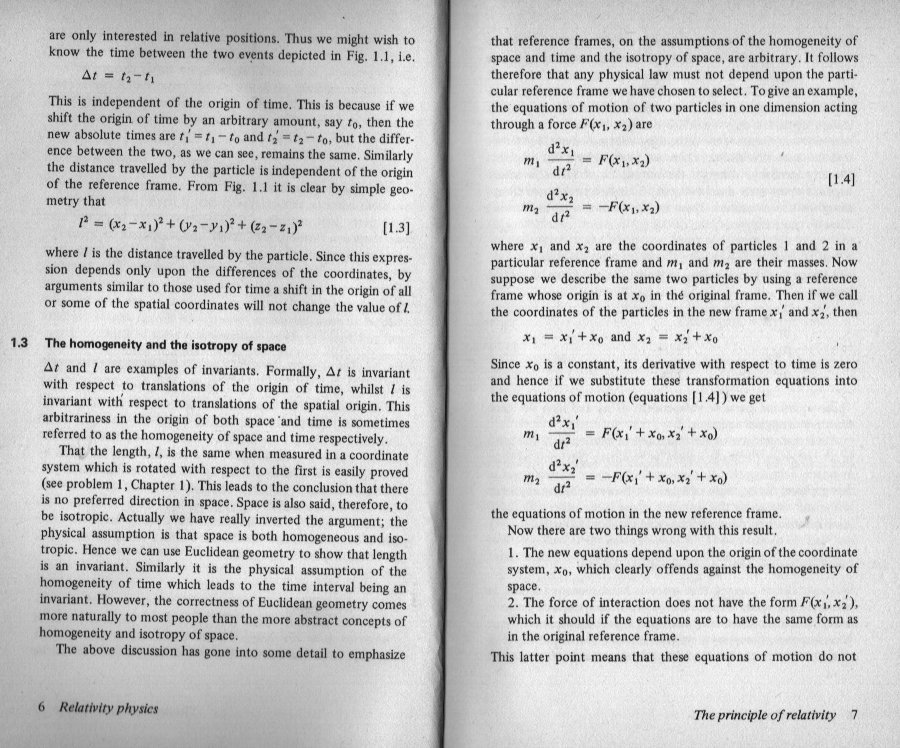
-
Thank you for this, I wasn't aware that Einstein contradicted himself so completely. +1 But then perhaps these were just fireside musings a process many thinkers on the subject have indulged themselves in. Did you read more of this article ? On page 176 he says But then on the next page he says But he does not explain how something that has no physical properties can be either isotropic or homogenous. I have offered to describe non controversial standard theory about your claims but since you wish to dismiss them and substitute what I consider wild assed guesses of your own which would be fine if you were to follow the rules of speculations and provide solid derivations and other evidence of their validity. I will leave you until this happens or a moderator starts closing threads as being outwith the rules.
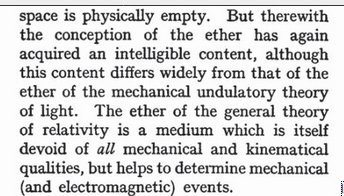
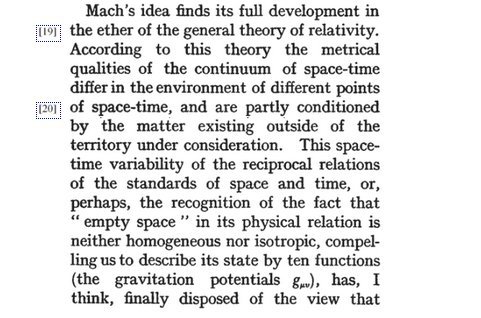 That could be a reasonable question except that matter refers to any particle with mass. (which for your information means not photons) A neutron is a particle with mass that has no charge. A Uranium atom has only 92 protons and 92 electrons but 143 - 146 neutrons. I would be very grateful for a proper reference to any of Einstein's writings or lectures stating this ?Small wonder your understanding of electrical phenomena is all over the shop. Without going into sub-nuclear particle physics which would add nothing to the clarity here are my answers. Charge is the basic property possessed by some, but not all matter to which we attribute electrical phenomena. At all levels of analysis we call matter which posseses this property a charge carrier. When charge carriers move from place to place we call the flow of such carriers a current. By itself no energy is involved in a single particle of matter possessing a charge. The energy arises as a result of interaction of two or more charges. When two or more charges interact, they set up a potential field which we measure as a voltage. Grounded is an adjective describing a ground or earth which is a circuit theory term not a physics term referring to a circuit node or point which does not change in voltage regardless of how much current flows into or out of it. Please note it is possible to have a current without a voltage or a voltage without a current. Please ask about any terms used above that you are unsure of or did not understand.Excellent answer +1 Joe you have an number of threads you have left hanging, all of which suggest you need to review some basics. What do you understand by:- Voltage Current Charge Grounded ? You need a clear picture of what these mean before you can progress to the answere to the questions you are asking.In general I would agree with you but how about tristate logic gates ? https://en.wikipedia.org/wiki/Three-state_logic1) Have you ever heard of fuzzy logic? 2) Even in first order logic it is not always possible to conclude that a statement is right or wrong, have you ever heard of the liar paradox ? Apart from the mathematical versions of the above examples, what about statistics and probability ?
Important Information
We have placed cookies on your device to help make this website better. You can adjust your cookie settings, otherwise we'll assume you're okay to continue.