
Genady
Senior Members
-
Joined
Everything posted by Genady
-
Today I learned that after a moving body collides non-centrally and elastically with a body of equal mass which is at rest, they move in mutually orthogonal directions. It is quite obvious in the hindsight, but I was not aware of this.
-
Is it AI to blame? The movie Idiocracy has been made long before AI.
-
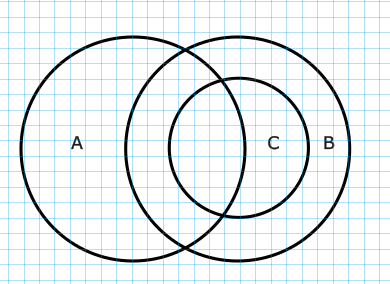
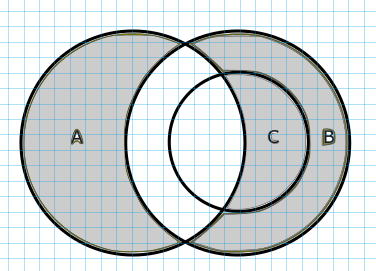
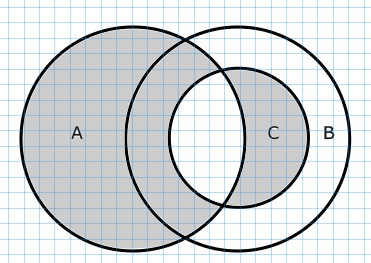
OK. Now I know what the triangle means. It's the operation XOR (exclusive OR). Let's make a diagram with [math]C\subset B[/math]: Now, let's paint the set [math]A {\Delta }B[/math]: and the set [math]A {\Delta }C[/math]: As you see, in this case [math]A {\Delta }B \neq A {\Delta }C[/math].
-
I don't know what that triangle sign means. Some set operation, I guess, but which? Union, intersection, subtraction...?
-
Consider an example. Let set W be all women and set B be all black persons. The intersection of W and B contains all black women. If a person x doesn't belong to this intersection, then x is not a black woman. x can be a black person but not a woman, a woman but not a black person, or neither a black person nor a woman.
-
You're talking to somebody who never came back after posting the OP.

-
No, it does not imply that x doesn't belong to any set. It implies that there is at least one set such that x doesn't belong to it. IOW, it does not imply that [math]x \notin A_1 \wedge x \notin A_2 \wedge x \notin A_3[/math]. It implies that [math]x \notin A_1 \vee x \notin A_2 \vee x \notin A_3[/math]. Yet IOW, it does not imply that [math]\forall i , x \notin A_i[/math]. It implies that [math]\exists i , x \notin A_i[/math].
-
What specifically don't you understand? The OP is too noisy. I am having problem understanding it.
-
What is your question?
-
I like that LLM can "talk." It might force humans to think more and to talk less.
-
You've just proved by contradiction that it is not a set: if it is a set then it is an element of itself, but it follows from Zermelo-Fraenkel axioms that no set can be element of itself. See, e.g., Set is Not Element of Itself - ProofWiki
-
This is not a set either. Zermelo-Fraenkel
-
"Everything" is not a set. Just from curiosity, I've just checked the "classics", "A Book of Abstract Algebra" by Charles C. Pinter. The word member appears there 28 times. The word element, 500.
-
Moreover, subsets of a set are never elements of that set. They are heavily confused.
-
You call them members; we call them elements.
-
Which places?
-
Yes, good. I've posted this to @studiot :
-
Which part: [math]\frac {1} {1000 \ m^{-3}} = \frac {m^3}{1000}[/math] [math]=\frac {100 \times 100 \times 100 \ cm^3}{1000} [/math] [math]= 1000 \ cm^3[/math] ?
-
An arbitrary function f(x-ct) is a wave in the sense that the entire set of the function values rigidly moves along x by ct when the time advances by t.
-
Maybe this helps: How to disable every AI feature on Microsoft Edge for Windows 11 - Pureinfotech
-
1/(1000 m-3) = 1/1000 m3 = 1/1000 x 100 x 100 x 100 cm3 = 1000 cm3
-
I've learned things like this: Though the size of the computation for training can be large, the trained neural network can be quite small. In our MNIST example, training the network involves a reasonable amount of computational power to find the optimal values of the parameters. But the network only has 11,935 parameters. It is relatively small. This observation tells us chips containing trained neural networks can be small and cheap. It will be easy to install them into everyday devices. Bernhardt, Chris. Beautiful Math (p. 185). MIT Press. 2024.
-
Not everyone and not all the time needs to heat their house. I never need it. And nobody else in my country.
-
They require this huge power for training, but not for answering queries. (I skip the LLM responses just as I skip commercial ads.)
-
They will read the paper.