
Genady
Senior Members
-
Joined
Everything posted by Genady
-
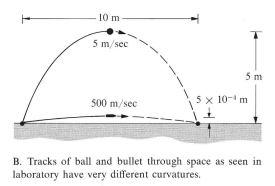
The main problem with the trampoline analogy is that it has nothing to do with the gravity related spacetime curvature. A curious student should ask after watching it, "How can the tracks of a ball and of a bullet be curved so differently if that curvature arises from the geometry of space?" (MTW, Gravitation (p. 32).)
-
No, I am not interested in this distinction. Sorry that what I said or how I said it sounded like this distinction is of any importance to me.
-
One might say whatever one wants.
-
This analogy doesn't work because a particle does not extend into its field in QFT, but rather it is its field when the latter is not in the ground state.
-
This is the difference in our approach: I think that my consciousness is a symbolic reflection of my experiences. The experiences, including thoughts and concepts, are not conscious.
-
My consciousness records these experiences.
-
Yes, its functioning changes. And sometimes stops.
-
Consciousness does not have amount or direction. It is a symbolic system of recording experiences.
-
In spite of this, a 'causative relationship' exists operationally, i.e., we can, in principle, manipulate the source and this would affect geometry, but there is no way to manipulate geometry without manipulating the source. The 'symmetry' is broken.
-
Not for you, but for me
-
Just looked up the definition:

-
Does it mean day / month / year?
-
This is my experience as well.The answer is here:is horrible.Similar effect allows bacteria to withstand much higher osmotic pressures than eukaryotic cells. In this case, it is the line-square rather than the square-cube law. When you decrease the size by a factor, the ability of a membrane to withstand tear decreases by that factor while the tearing force decreases by the factor squared. Thus, a bacterium that is 100 times smaller than a regular cell can withstand 100 times higher osmotic pressure.Spacetime curvature is associated with radiation. The latter does not have mass.Is it a motion?None of this *** has anything to do with quantum theory or the science of physics.What they are is described by specific QFT theories. Generally, field is an entity that pervades space and time and is defined by its properties such as spin. "How they were created" goes back to the dawn of the universe.It was not. It is rather the other way around. Photons are quantum excitations of EM field. The QED and other QFT theories describe interactions of fields. (QFT = Quantum Field Theory.)Same here.


Important Information
We have placed cookies on your device to help make this website better. You can adjust your cookie settings, otherwise we'll assume you're okay to continue.
Account
Navigation
Search
Configure browser push notifications
Chrome (Android)
- Tap the lock icon next to the address bar.
- Tap Permissions → Notifications.
- Adjust your preference.
Chrome (Desktop)
- Click the padlock icon in the address bar.
- Select Site settings.
- Find Notifications and adjust your preference.
Safari (iOS 16.4+)
- Ensure the site is installed via Add to Home Screen.
- Open Settings App → Notifications.
- Find your app name and adjust your preference.
Safari (macOS)
- Go to Safari → Preferences.
- Click the Websites tab.
- Select Notifications in the sidebar.
- Find this website and adjust your preference.
Edge (Android)
- Tap the lock icon next to the address bar.
- Tap Permissions.
- Find Notifications and adjust your preference.
Edge (Desktop)
- Click the padlock icon in the address bar.
- Click Permissions for this site.
- Find Notifications and adjust your preference.
Firefox (Android)
- Go to Settings → Site permissions.
- Tap Notifications.
- Find this site in the list and adjust your preference.
Firefox (Desktop)
- Open Firefox Settings.
- Search for Notifications.
- Find this site in the list and adjust your preference.