
Genady
Senior Members
-
Joined
Everything posted by Genady
-
It comes with shortcomings, though.
-
My worldview is mathematics.
-
I ask this because the OP question is very broad and knowing why it is asked could help to understand it better.
-
Why do you ask?
-
Alice does not know which column is assigned to Bob, and Bob does not know which row is assigned to Alice.
-
Did you ?

-
A. Einstein. As a teen, I was driven by the ideas and by the evolution of "the attempts of the human mind to find a connection between the world of ideas and the world of phenomena" in The Evolution of Physics by Albert Einstein and Leopold Infeld.
-
Hmm... Now define the following: grouping, representation, practical, pattern, process, new, knowledge, fact, actualize, tool, technology.
-
Also, in QFT and SM, I'd add.
-
AI generated image for "Bill Gates installing windows":

-
Where we are, T1 is (about) 14 bln years. When we observe an object 9 bln light years away, its T is only 5 bln years.
-
How do you know this?
-
It does not matter. You are simply wrong, and it is known for 300 years by now. You have nothing to show for and there is a pile of arguments against your guess. It does not fit a definition of Speculation by the rules of these forums. IMO, this thread is to be closed.
-
Doesn't CBH1 affect S2? Doesn't CBH2 affect S1? To the other questions, the general answer is, the more gravitating sources surrounding the observable universe, so more they diminish each other's effect on the observable universe. Ultimately, there will be no gravitational effect from these sources on the observable universe at all. This is the consequence of the same Newton's shell theorem that I've mentioned earlier.
-
Not much. You need only one additional step: 1. Using the same formulae as before, calculate \(ra\) for each gravitational source. 2. Add all the \(ra\) vectors. 3. Using the same formulae as before, calculate the angle \(x\).
-
R.I.P. "the simplest cause."
-
which is 15 orders of magnitude higher than our models have been tested so far, right?
-
No, it is not. It is rather quite straightforward. Here: You could make a table in Excel that calculates the angle \(x\) and you could play with different configurations of distances between the Earth and the CBH, \(EB\), the Galaxy and the CBH, \(GB\), and the Earth and the Galaxy, \(EG\). When \(x \lt \pi/2\), the Galaxy accelerates toward the Earth. When \(x \gt \pi/2\), the Galaxy accelerates away from the Earth.
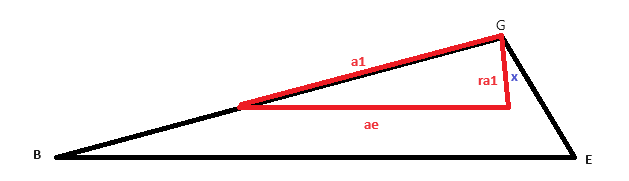
-
This figure is also incorrect. If the mass of CBH and its distance are such that the accelerations are almost parallel, then these mass and distance would make the accelerations almost equal. I.e., \(ra_1 \approx 0\).
-
Hardly. Big Bang is not a point.
-
They are incorrect. There are several errors in these figures: 1. If CBH is very far, the dotted curves should be very close to parallel lines. 2. The accelerations should be perpendicular to the dotted curves. 3. If CBH is very far, the magnitudes of the accelerations should be very similar to each other. 4. As \(a_1\) and \(a_2\) shown incorrectly, so the \(ra_1\) is also incorrect.
-
Arctangent is not a calculation. I want to know, what part of the sphere is in the cones when CBH is far away. To show it, algebra / trig / calculus / computer can be used, but not hand waving.
-
BTW, you can stop wasting time on drawing sizes of CBH. You can just mark their centers. According to the Newton's shell theorem, their gravitational effects do not depend on their sizes anyway.
-
No, there was no such misunderstanding. When I said "as CBH gets farther", I was not talking about it moving farther away. I was talking about comparing cases when it is farther from vs closer to the Earth.
-
Show your calculation.