Genady
Senior Members
-
Joined
Everything posted by Genady
-
Then, I think, they always have a multiplicative identity, but when p is prime, they are fields, as then each element has a multiplicative inverse.
-
-
Is 'Zp' the same as 'Z/pZ'?
-
Are the last three languages North Germanic while Finnish is not?
-
+1 (when the system lets me.) Replace that remark with, "... if you're not an electron."
-
I have a question. Before they start with the multiplication, after they learn only addition and subtraction of integers, do they know how to deal with, say, 4-(-6)?
-
The tables are often turned nowadays. The locals here usually ask visitors, "English, Espanol, Nederlands, Papiamentu?"
-
+1, but I've used up my daily quota. Will try to remember tomorrow. This option gives integers a ring structure.
-
Sorry for this impression. I went back and expressed my sincere appreciation of the inputs.
-
Yes, this is exactly my point, with the emphasis on "has to".
-
... unless you're a fermion 🙂

-
Sorry, the link is broken.
-
What you refer to is, -(-2)=2. It is not intuitive that it has to do with multiplication, i.e., (-1)*(-2)=2.
-
Interestingly, it seems that it went through the transposition between 'l' and 'r' twice. First, from 'taler' to 'tarel': (тарелка - Wiktionary, the free dictionary) Then it flipped again: (talerka - Wiktionary, the free dictionary)
-
Well then. The only issue is that this book is aimed at adults as you said rather than at "little children" and thus does not answer the OP question.
-
Right. It would be a part of the big picture if other operations were presented in this way, too.
-
An alternative to appealing to symmetries approach could be to uncover what these number operations do to number line: - adding number shifts (translates) the line - multiplying by positive number stretches / compresses the line - multiplying by -1 flips / inverts the line. When the line is flipped / inverted, 2 -> -2, 3 -> -3, ..., and correspondingly, -2 -> 2, -3 -> 3, ... .
-
"Little children" in my question are school kids which are taught this rule - 3rd grade? As I don't remember any explanation given then to me, I think that there was not one. Like above. Just a rule. I wonder, is it still this way? Everywhere? "Hand waving" explanations like in the book posted by @studiot and the odd-even metaphor recalled by @MigL help perhaps to "get" the rule. How about a "Guess the Rule" game? Let them come up with a possible rule and find that other suggestions don't work?
-
I also know one word in Finnish: 'talerka', a plate. I remember it from childhood because we had a Finnish set with this word on it and it was funny as it seems to be a misspelled and mispronounced Russian word, 'tarelka' (тарелка), a plate. Now I wonder which way the "misspelling" went and who in fact was dyslexic.
-
Every language has homonyms. In most cases, they are unambiguous in a context/sentence.
-
Does anybody know/remember how this rule of number multiplication (see the title) is/was explained to little children?
-
Perhaps it is so in 'language for tourists' courses. In no language class I've taken I was taught how to ask that.
-
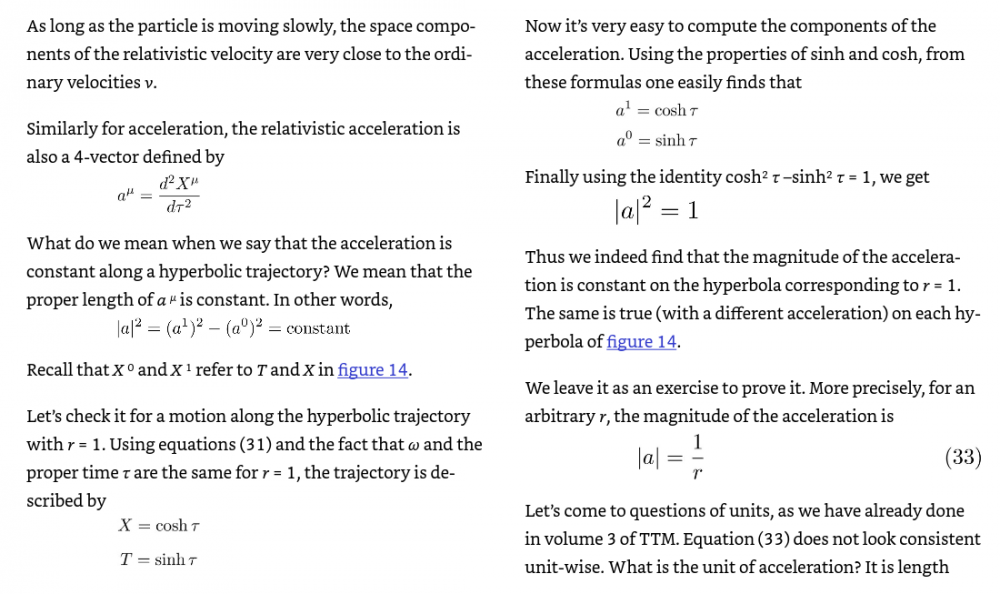
While the parts with constant relative speed require just algebra, the acceleration and deceleration are more involved. E.g.,
-
No, there are no such assumptions in science. (With the exception of "etc.", of course.) Demonstrate them.
-
You haven't demonstrated this kind of bias in science.