
Genady
Senior Members
-
Joined
Everything posted by Genady
-
IOW, Let's take any h in H. Because of H being closed, all combinations h, hh, hhh, ... are in H. But because of H being finite, some combinations should repeat, say hm = hn for some m<n. Then hn = hmhn-m = hm and thus hn-m is identity, e (from G). e = hn-m is thus contained in H. Now, if n-m = 1, then e = h is inverse of itself. Otherwise, e = hhn-m-1, which makes hn-m-1 an inverse of h.
-
I think, that being finite and closed guarantees that it contains the identity and all the inverses.
-
H is a finite subset of a group G, and for each h1, h2 in H their combination h1h2 is also in H. Is H a group?
-
Plus, even without other equivalent elements, each element forms a class of itself.
-
OK then.
-
Have you noticed that you reply to a four years old post to a member who did not visit since September 2021?
-
Equivalence relation R on set X defines equivalence classes in X. Do they form a partition of X?
-
I have applied for my retirement benefits in November. My application is still in process. I understand that eventually they will pay retroactively whatever accumulates since November. Without any interest. Thus, the OP question.
-
^^^^ fact, but ^^^^ speculation.
-
They have, e.g., Invasive Cup Coral | Flower Garden Banks National Marine Sanctuary
-
When the first plane crashed, I was straight under the WTC. 500m was how far I walked away before the structures collapsed.
-
It sure did. I watched it from about 500 m.
-
Almost three years after the OP, here is the status. One of the main lionfish hunters got bends while hunting lionfish and left the island long ago together with her partner, the other lionfish hunting champion. Since COVID, lionfish hunting practically has stopped. It is not promoted anymore. The result: no effect whatsoever. The lionfish is there, there is no more and no less of it, as well as the rest of the reef. Evidently, the devastating effect that has been predicted, was in fact a myth.
-
Right, but I do it intentionally, before entering the water.
-
They did it in Russia, but not in Azerbaijan. It was entertaining to see them on TV. I scuba dove in a quary in PA in winter when most of the surface was frozen. But I wore dry suit with sweater and sweatpants. Very cozy.
-
In a field K the equality a4=a is satisfied for all a. Find the characteristic of the field K. My calculations: 2a = (2a)4 = 16a4 = 16a 14a=0 This allows for the characteristic to be 2 or 7. But, e.g., 34 = 81 = 4 (mod 7) rather than 3. So, the only answer is 2. 1. Is this derivation correct? 2. The hint in the textbook says to show that 2a=0. How to do that?
-
Thanks guys. I think it is important to clarify that my so called "cold water" is much warmer than 15°C.
-
No, I didn't consider this connection. Thank you. Interesting, but the connection to the water temperature is not clear to me. It could be a coincidence that the water happened to be cold, couldn't it? Maybe the plunging head-first did it. Or jumping itself, if he had an undiscovered brain aneurysm. Etc.
-
It might be so, while the other possibility is that inhaling and holding breath while entering water takes my mind away from the "pain" of being hit by the cold water. Yes, I've noticed it as well. Another "trick" that works for me is, while standing in the shallow, before putting the body in the water, I put my face in or simply splash the cold water on the face. The face does not feel much, but it somehow prepares the whole body, and the shock is diminished quite a lot.
-
Why does jumping into cold water feel less shocking when I inhale and hold breath while jumping in?
-
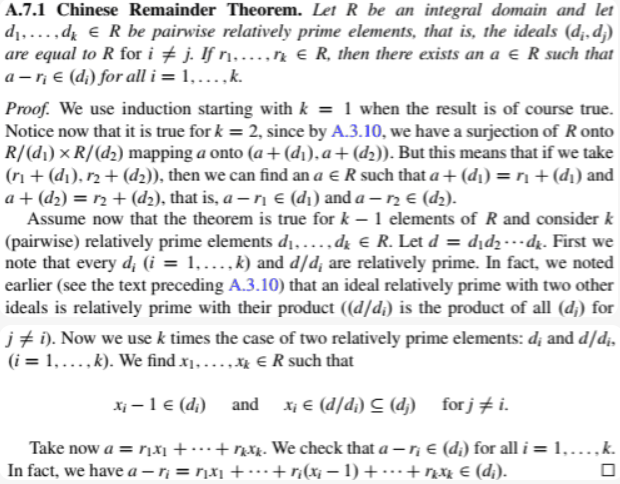
Consider the following proof: My question is, does it in fact use induction? It says, "Assume now that the theorem is true for k-1 elements," but I don't see this assumption being used in the proof to advance from k-1 to k elements, which would be an induction step. Actually, this assumption is not used at all, AFAICS.
-
Correct. Correct.
-
Just want to clarify that the class was in Duke University, NC, with American students. And that I was among the ones who understood and answered the question as was intended by the professor, i.e., it is visible sometimes.
-
This reminded me of another ambiguous term, ever. I remember (vaguely) an argument in a class I took many years ago, about a quiz question that was something like, Is the star A ever visible at the location B? Some students answered Yes because it is sometimes visible, while others answered No because it is sometimes invisible.
-
Thank you. It answers the question. Thank you. I will keep it in mind.