Genady
Senior Members
-
Joined
Everything posted by Genady
-
Right. Moreover, even when the position is right, the atmospheric conditions don't always cooperate. Then, nobody gets to see it.
-
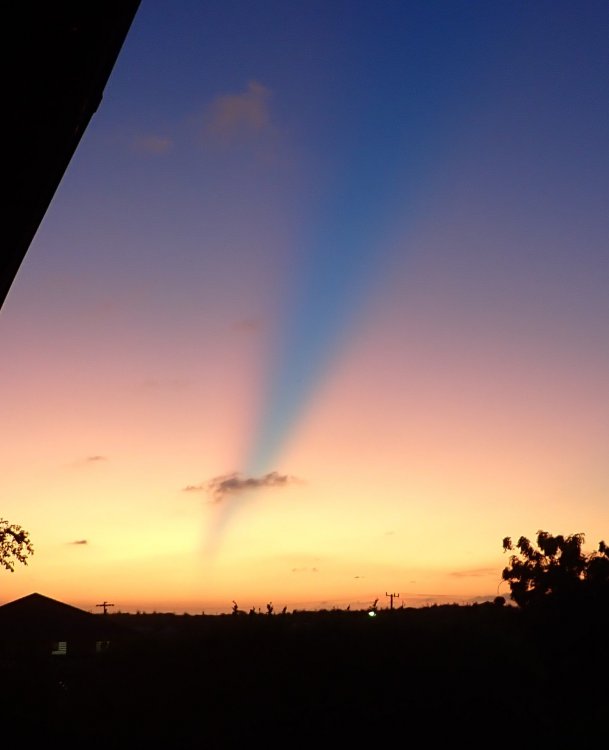
This is what I think, too. Here is a little calculation supporting it. The Earth circumference is about 25,000 mi. The Sun makes it in 24 hours. Thus, it moves about 17 miles a minute along the Earth surface in our area, i.e., near the equator. That is, about 40-50 miles in 2-3 minutes. Thus, after our sunset, the Sun is still for 2-3 minutes above the horizon for that neighboring island. What we see then is its long shadow in the sky.
-
No, I'm not sure in this.
-
Because of this observation, I thought that the phenomenon is rather optical than atmospheric.
-
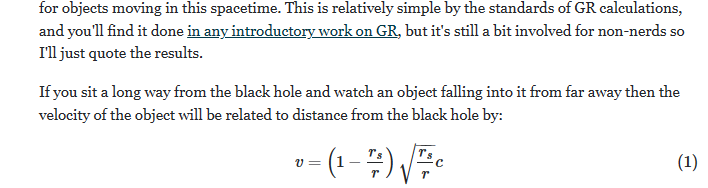
Where do you get this from? From here, among many other similar sources: general relativity - Will an object always fall at an infinite speed in a black hole? - Physics Stack Exchange The link is to the Wikipedia: Schwarzschild geodesics - Wikipedia
-
Right. And that was the proposal I've disagreed and still disagree with as the substitution shows a significantly different outcome (if my algebra is correct, of course). (Ignoring the angle-dot is fine. I am talking only about the free-falling r-dot.)
-
PS. When I said, and what I meant was removing the r-dot term of the equation for approximation. (@joigus)
-
Sorry, @joigus for not making myself clear. I do not suggest adding gravitational and kinematical effects as I know that all is already there in the equation. What I did was not something common-sensical but rather something algebraical, by simply substituting expression for (r-dot)/c = v/c in the second equation above, instead of approximating it by 0, as you did in your approximation. Is there a mistake in my algebra? I'd like to know.
-
Thank you, @joigus for the clarity. This calculation shows - both formally and intuitively - how the proper time behaves if we consider only the gravitational time dilation. I am just not convinced that we can ignore the kinematical time dilation of the free-falling from infinity observer C. That is because for such an observer, (v/c)2 = (1-rs/r)2(rs/r) Substituting it in the second equation above gives, I believe, dτC= (1-rs/r)dt rather than dτC= (1-rs/(2r))dt making τC smaller than in the calculation above.
-
The quoted post was the @AlexanderSamualDunnett's greatest contribution to the total well-being rating of all beings...
-
What is it?
-
What @Mordred said, plus the better picture is them being squeezed all together into one crazy soup of elementary particles rather than torn apart. Good night to both of you.
-
No, they don't get smaller. Yes, it is. The explosion occurs into the space. In expansion, the entire space is expanding.
-
Phew lol
-
Yes, I am. I understand that this is what you've referred to in: I don't know. There are many inflationary models on the market. I am referring to the standard Big Bang model, LCDM, and to the expansion which we observe.
-
It was not clear. In this case, I've asked wrong questions. In this case: I don't know anything about M. Kaku, but I've read several books and have heard several presentations of R. Dawkins. I think that AI's imitation of R. Dawkins is OK in words used, but completely wrong in content. I think, his response would be very different, sharp and short.
-
Why is it unlikely?
-
Are there mysteries there?
-
Which mysteries?
-
We don't have much air traffic here. Only about 2 jets a day. I am sure there was no jet on that line that day. I certainly would've noticed otherwise. Moreover, the "trail" stays in place without going anywhere for a couple of minutes while the wind blows, and the clouds move.
-
Could be, especially since there is in fact another island in that direction, not far behind the horizon, about 50 miles away. However, the data don't support it. The camera is pointing to the West, the sunset. The prevailing wind is from the North-East, the trade wind. The wind blows from the West only during one short period in September called, wind reversal. I didn't observe this phenomenon during a wind reversal.
-
This phenomenon can be observed on the island where I live at sunset. From time to time, not often, maybe a few times a year. This image holds for a couple of minutes and then fades and dissipates. I think I know the answer, but I might be wrong. Pix from my porch:

-
Normally, yes. But this OPer was not serious and was not really interested and has been banned. So, now we're free to discuss the question in any context. I consider a proton to be a "bag" of two positive and one negative charges. At a small enough distance, the electron would induce the proton to be more positive in the electron direction and more negative in the opposite direction. Increasing the attraction as a result. Perhaps, at a small enough distance electron and neutron also attract, by a similar mechanism. Your thoughts?
-
Me too. Still?
-
Maybe at some very small distances?