
Genady
Senior Members
-
Joined
Everything posted by Genady
-
Professional psychotherapy?
-
Sorry, it should've appeared in my previous post.
-
I don't know how, but it does not mean that it is impossible. E.g., A. Zee mentioned such possibility here (just an illustration that it is not obvious that it is impossible):
-
There are many things in physics that exist without us being able to visualize them. Or did I misunderstand the question?
-
This is good enough to continue the analysis. The statement, does not affect this point:
-
1. Do you mean, if it cannot be measured it cannot change? I disagree. 2. Regardless of the 1 above, couldn't a measuring particle be attached to the changing particle? I.e., without a space.
-
Right, we've established already that a change is necessary for time to make sense. I don't see yet that change requires space. If there can be change without space, then there can be time without space.
-
I think, they all agree that particle falls through the horizon. They disagree only on the timing of this event: for one, it happens in a finite time, for the other - infinite.
-
Without space, wavelike characteristics wouldn't apply. Does it mean time wouldn't exist? Are the wavelike characteristics necessary for a change?
-
Why not? Some kind akin oscillating neutrinos?
-
Is it correct to say, that for an outside observer the electrons (as anything else) will never disappear behind the BH horizon, and their charges will never disappear behind it, too?
-
However, it happens all the time. A car moves as seen by a person standing outside, and it does not move as seen by its passenger. No contradiction.
-
A car moves and doesn't move. Is it a contradiction?
-
In other words, yes, time could exist without gravity and without space, if I understand your statement correctly.
-
I don't have any idea what is/was their believe.
-
Do you mean seasons as in spring-summer-fall-winter?
-
Haven't I been taught what?
-
"Taught"? I said, "told."
-
One can be told fairy tales. One cannot be told a human institution.
-
Yes, it is. Perhaps I should've said, "religion as a human institution vs religion as a bunch of fairy tales." PS. Sorry, I like to read but I avoid listening because of APD.
-
As @Markus Hanke has pointed, the gravity (as we know it) would not exist without time. Would time (as we know it) exist without gravity? Without space?
-
The link is "physical" as it can be measured. And it "stretches" across space. The paradoxes arise from seeing something else, I guess.
-
Yes, I also think that distinction between religion and theism is only technical. What is distinct for the purposes of this discussion, I think, is a human institution vs fairy tales.
-
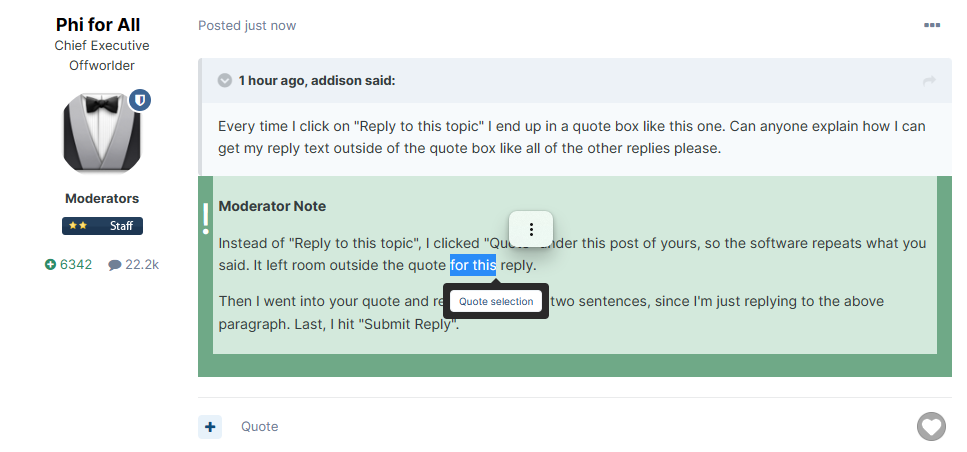
There is a shorter way to reply to only a part of a post. Select the part, a floating text appears offering to quote the selection (see below), click on it, the rest is the same minus a need to remove anything.
-
just a very tiny insignificant correction: 2nd.