
Genady
Senior Members
-
Joined
Everything posted by Genady
-
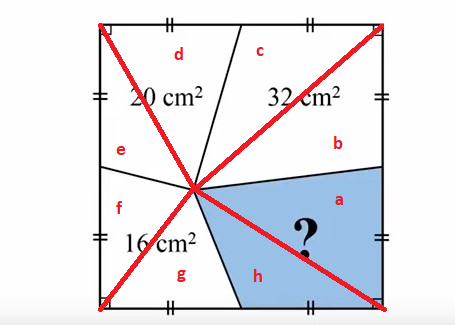
As we don't have much to do with areas of arbitrary shapes like these, but we know much about areas of triangles, let's make the triangles: The triangles above are named, a to h. The puzzle is, to find the area a+h.
-
Thank you for asking clarifying questions. There are no gridlines here, only the points, which are the intersection points of the 'imaginary' gridlines. The shape should not intersect any of these points. BTW, to be sure, the OP question has been changed to this: prove that any shape with area <1 can be placed on the plane without intersecting these points.
-
I certainly agree with you that there is no issue, and I don't try to guess what the fundamental misunderstanding is, but the OP asked to point to an error in his construction, if there is one. I use sets to formalize his construction to point out the error.
-
It doesn't let me see the whole step-by-step solution, but it looks like it just keeps simplifying the original expression. If so, it misses the beautiful insight: after the first step of taking the cube, the puzzle boils down to the simple equation, which is quickly solved by inspection.
-
What do you mean, it solves them right away?
-
So, after taking cube of the expression in question, and simplifying, we get it (i.e., the cube) being equal to Do you see something peculiar here?


-
No, I don't know.
-
If we define "a type T set" to be "a set of numbers from 1, increasing by 1, up to a finite number", then there is no infinite set of type T.
-
Yes, it is. But there is no such set in your construction. IOW, there is no set in your construction "that starts at 1, increases by 1 and has infinite elements."
-
I understand. There is no set equal to N in your construction. There is nothing to compare to because there is no infinite set in your construction that starts at 1 and increases by 1.
-
There are never infinite elements and so no such n is needed. There is no such jump.
-
A.I. says,
-
It doesn't go through the entire NN every time, but rather a random subset. So, it produces different response every time you run it. I got a similar, correct answer on the 6th trial.
-
Any comment? Question?
-
This is a possibility. Or, just hanged around with a black hole for a while.
-
Yep. This reminded me of my physics teacher who liked to say, "When I ask them any question, they give me any answer."
-
You are right. +1 Here is my take:
-
Because it never goes from R to N.
-
This does not exist. It never happens. There is no such symmetry breaking. There are only finite numbers of elements in R on the left side. As has been said above, R(n) is always finite. There are only R's on the left, never N.
-
Yes.
-
R(n) does not change to infinite. R(n) and {R(n)} are different things. The former contains numbers in the range [1, n]. The latter contains sets R(n) for all n's. The former is finite, the latter is not.
-
Correct. R(n) is finite. {R(n) | n∈N} is not. R(n) = {1, 2, 3, and all other numbers up to n} LIST = {R(n) | n∈N} = {R(1), R(2), R(3), and all other R(n)'s}
-
This last example not only is not permitted, but it does not have any meaning in the set of natural numbers. Infinity is not an element of this set. This example does not make sense. Yes, each R(n) has n elements. None. Each R(n) is finite.
-
-