
Genady
Senior Members
-
Joined
Everything posted by Genady
-
More rigorously,
-
Mars rover made 100 km South, then 100 km West, and then 100 km North, arriving to the starting point. What was the starting point? This puzzle is easy, but not too easy.
-
@md65536 Hint:
-
Yes, you are right (I know how you did it ).
-
The answer is right, and it is a very good heuristic, but it is not rigorous. It doesn't happen to be so in general - it works here because we assume that the answer is completely determined by the given data. +1
-
Yes, it is. +1
-
Let's reformulate the question then: To what extent can a computer program approximately simulate QM behavior of electron? Which aspects of it cannot be simulated in principle?
-
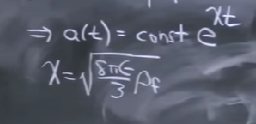
Yes, here it is: This is snapshot from about minute 35 of this lecture: Lecture 23: Inflation | The Early Universe | Physics | MIT OpenCourseWare. At about minute 50+ he gives the numerical estimate for the parameters. I think that in this lecture Guth answers most or all of the questions you've asked about inflation (including, "Here is where inflation stops, and the conventional big bang begins.") Highly recommend.
-
Re reason 1. A simulation could use numerical methods and calculate with precision according to a measuring instrument. Re reason 2. Wave function provides a full QM description. The simulation could calculate eigenvalues with the associated probabilities and output an answer accordingly. Wouldn't the above solve these two issues?
-
I think that Bell theorem answers this question negatively.
-
Curious mental experiment: Imagine that the torus is made of a fabric, like a sock closed on itself. With the wind and the wing as described, will the sock be turning around the circular axis inside the torus? (Does that axis have a name?)
-
When people ask the bot a question, they don't care if the answer is wrong? If so, it tells about the people more than about the bot.
-
If you go back to your first post on this question, https://www.scienceforums.net/topic/131410-how-does-chatgpt-work/?do=findComment&comment=1238821, and follow about a dozen or so comments after it, you will find several different wrong answers that the commenters got from the bot.
-
OK, I will read it, 1 week a year for 10 years. Seriously, thanks for the recommendation.
-
I got the solution, relativity is safe. Phew . The answer, by MTW, is "a three-dimensional spacelike hypersurface of homogeneity and isotropy." At each event on such hypersurface, the density, pressure, and curvature are the same, and the radiation is isotropic. The fundamental observer is an observer at rest relative to such hypersurface. His worldline is orthogonal to the hypersurface. So, everything else can be moving with c relative to this observer with no problem.
-
P.1 defines: However, we are in the situation where the substratum moves with c. Thus, there is no observer at rest with respect to it. How do we fix this?
-
Yes, I've read it before, but I still try to understand the meaning of it. If everything moved with c, relative to what did everything move?
-
Imagine we have "an electron simulator", which simulates behavior of an electron in various conditions. Let's run two instances of the simulator and let them communicate with each other. Would they simulate an interaction between two electrons?
-
Ignoring new physical effects that we don't understand, can we simulate everything we know well about electron? If not, what aspects we cannot simulate?
-
How?
-
Something like this. The input is an electron's state and an interaction, if there is one, and the output is result of a measurement.
-
Can a computer program be made that fully and accurately simulates an electron?
-
If you travel to US and make online reservation to rent a car, look for a little checkbox, 'foreign resident'. Some rental companies (e.g., AVIS) in some destinations (e.g., Newark) give quite a big discount (e.g., 30%) to visitors with a foreign driver's license.
-
LOL But seriously, "maximum speed of causality" is rigorous. It means that two events can be causally related if and only if their distance d and time difference t are such that d <= ct.
-
Firstly, as you said, any other medium would only permit lower speeds, saying "maximum speed" says it all. Secondly, there is no "maximum speed". For example, a shadow of moving object can move with any speed. Or a spotlight of projector. Or a dot on computer screen. Etc.