
Ghideon
Senior Members
-
Joined
Everything posted by Ghideon
-
Thanks for your reply. Since your description deviates from the predictions of Newton's law of universal gravitation (and also general relativity) can you provide the mathematical equations used in your model that predicts the results you claim? What scientific method did you use? I know about models for gravity and a few things about applying such models. As an engineer I find Newton useful for low relative velocities and masses. Einsteins model predicts bending of light and is supported by experiments. What experiments and observations support your idea?
-
Hello. A quick answer, your scenario sounds like a task for RPA*, Robotic Process Automation. Typically such frameworks have some means to interact with office programs such spreadsheet programs. No or limited amount of coding may be needed; it is often more like recording and modifying macros. You typically teach the software how to manipulate the GUI of the office program. In cases with a singel user and where no central orchestration is required I would look at a community edition** of some of the commercial vendor's product. There are also or open source alternatives. Personally I would start looking from the RPA/Macro/automation perspective rather than from software development/programming language perspective in the described situation. *) https://en.wikipedia.org/wiki/Robotic_process_automation **) Often free for personal or limited commercial use. I'm not going to promote some specific vendor or product here; that would require more information and some evaluation.
-
Are you talking a bout events in a specific country or something that you suggest are applicable on a global scale? I see no attempt at answering my question. Maybe your version of gravity do not adress the points I did want to discuss.
-
Trying to understand/rephrase your question by using @iNow answers @MPMinIs your question something like "can gamma rays (wavelength of ~100 picometers) emitted from close to a black hole be redshifted into the visible spectrum (400-700 nanometers)?
-
You seem to describe something not physically possible: one object with two different accelerations at the same time. Please clarify.
-
Trying to understand you claim and its implications: are you claiming that you created gravity* that did the lifting or was your "gravity" and electromagnetic effect? As far as I can tell a device** capable of artificially generating enough gravity to move or affect a small, (low-mass) object would also have an effect on large objects (with large mass). How does this match your observations? *) As modelled by mainstream physics **) No such device exists. Artificial gravity=having a significantly different gravitational pull than what is modelled by m1*m2*G/r^2. Hope this is enough precision for this discussion
-
Does as habitable as the Earth include for instance identical atmosphere, temperature, vegetation, amount of sunlight and gravitation? If not, what are the differences between mars and earth in the scenario you speculate about?
-
What makes 72 special? Can you show how the method works in the general case [math]n(n+2)=m[/math] where [math] n \in N, m \in N [/math]?
-
Hello! Why not try this forum you just joined? Post a science question and evaluate the responses you get! Personally I have no preferred best forums, I use many different sources depending on the context since the topic of computer science and its applications are so wast.
-
Unfortunately the video doesn't seem to be public, was that intentional? When I click the link YouTube responds with: "The video is unavailable" "This video is private."
-
Apply* Newton's laws F=ma (2nd law) and when an object A exerts a force on object B, then object B must exert a force of equal magnitude and opposite direction back on object A (3rd law). You will find that the mass is always m, or in other words, that the ratio m/m1=1. Your definition will result in F1=F, m1=m and a1=a or an unphysical situation according to Newton. I may get some time to post an example later if you wish. *) correctly applying them that is.
-
Maybe this helps: As predicted by general relativity and confirmed by observation of the GW170817 neutron star merger*, the speed of light and the speed of gravitational waves is identical. On what scientific grounds do you base your doubts regarding distances in space? *) https://dcc.ligo.org/public/0145/P1700294/007/ApJL-MMAP-171017.pdf
-
Ok. Feel free to post an updated version for further discussion. You can report the issue, edit the post (within 60 minutes) or post a followup with clarifications. FTFY: The quote of Ghideon is unfortunately incorrect. Red strikethrough does not belong there: Thanks for observing that!
-
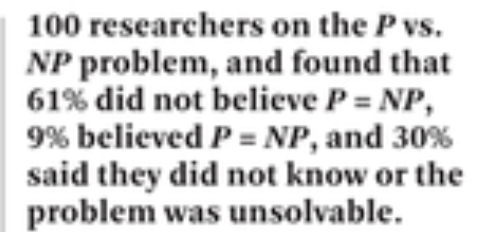
You are assuming P=NP . It is equally valid* to assume that P≠NP . How does the proof handle that? *) Or even better, according to a majority of researchers in a poll: https://mags.acm.org/communications/201205?pg=12#pg12
-
I agree. And even if the medium is in a state in which is stable it may be destroyed by accidents, failures, sabotage and other. In my opinion, no.
-
You mean to compare these two different calculations? [math] \sqrt{-2}^{10}[/math] and [math] \sqrt{-2^{10}}[/math] The order is important and well defined. Adding parentheses explicitly to show: [math] (\sqrt{-2})^{10}[/math] and [math] \sqrt{(-2^{10})}[/math] Since the calculations are different there are two results: [math] \sqrt{-2}^{10}=-32[/math] [math] \sqrt{-2^{10}}=32[/math]
-
from the paper: Trying to understand: The method works on equations of the form [math]n(n+2)=m[/math] , [math]n \in N, m \in N [/math] The integer [math]m[/math] is known and the method will find the unknown integer [math]n[/math] ?
-
It depends*. "Idle", "connected to power" and "program loaded" may have different meaning. For instance ACPI** (Advanced Configuration and Power Interface) standard defines several different states where CPU has power but reduced capability to perform actions. States such as Halt, Stop-Clock, Sleep (C1, C2, C3) exists on the specification. So an answer might require more details to be known to be sure with state the CPU will operate in if it has power but no means to access any device or software. I do not know if there is a standard for default state and which parts of a specific CPU that would be active. (This is an interesting question possibly touching many aspects of computer engineering.) *) Im trying to interpret the question as stated by OP. Any contradiction to the previous good answers by @Halc, @MigL and others are unintentional and due to ambiguity. **)https://uefi.org/sites/default/files/resources/ACPI_Spec_6_3_A_Oct_6_2020.pdf
-
This isn't my area of expertise but I'm curious: How does your result differ from known properties of other NPC problems? What are the specific consequences that does not show up in for instance SAT** or others? If I recall correctly: under the assumption that [math]P=NP [/math] it follows that [math] NPC \approx NP=P [/math]. if any NP-complete problem can be solved quickly*, then every problem in NP can. Every problem in NP must be reducible to every NP-complete problem in polynomial time. Hence all NP-complete problems share properties; there needs to be something fundamentally new to claim such a prize? (Note: The title of the thread is not clear; problems are NP-complete, not algorithms.) *) Quickly=polynomial time. It is not known if P=NP, as @joigus said no proof exists yet. **) Cook–Levin theorem, Boolean satisfiability problem
-
Can you summarise the proof and attach the pdf as reference? (The link just displays ads when I try to access)
-
In my opinion it is better to provide context or to add a reference to clarify when the discussion benefits from it. For instance in this case when it is not clear if we discuss delegation in programming in general or delegation in OOP. No. And it is not what you said above: Your one-sentence definitions are vague so a reference would help.
-
No it does not mean that.
-
(Due to my profession) I am familiar with inheritance vs delegation in programming. It does not match your description and googling "Method inheritance by delegation" returns zero results. Maybe you could add some context to what you try to describe? Which programming language and which compiler?
-
Ok. That means you and altaylar2000 are the same? How else can you be certain about the facts? Thanks for clearing that out.
-
Ok, you seem to have detailed insight in what OP mean, can you provide a reference to clarify your reasoning? You seem to mix interpreter and compiler.