Alex_Krycek
Senior Members
-
Joined
-
Last visited
Everything posted by Alex_Krycek
-
 Therefore those negatives you outlined are not inevitable. It depends on the value ascribed to those material possessions on the part of each individual.
 -
Those individuals are innovators. They create new value by applying science to produce groundbreaking products that are extremely useful to ordinary people.
-
In my view, "adversary drones" spying on the US is the least likely scenario. These type of events/craft have been reported since the mid 1940s. Further, with the competitive advantage that the US maintains in terms of military innovation and hardware, I seriously doubt that any adversary would possess technology that we don't know about, or can't respond to. Which leaves two other possibilities: it's our hardware being tested, or it's some other phenomena.
-
Interesting piece about Canadian pilots seeing numerous UFOs: https://www.vice.com/amp/en/article/z3xewj/air-canada-westjet-porter-pilots-ufo-sightings By combing through thousands of reports in a government flight incident database, VICE World News has uncovered dozens of recent UFO sightings from Canadian and international airlines.
-
Interesting article here: https://www.sciencenews.org/blog/context/new-einstein-equation-wormholes-quantum-gravity
-
Excerpt from the article: (April 25th, 2021) Twitter removed tweets that were critical of India's response to the COVID-19 pandemic at the request of the Indian government, the company said Saturday. Twitter censored tweets from a member of parliament, an actor, a former journalist, and West Bengal's minister of labor and law, according to Indian news outlet MediaNama, which first reported the news. Indian law allows the country to censor language it deems defamatory or that it views as possibly inciting violence, The Verge noted. The country in February enacted a new regulation that could allow it to jail employees of social-media companies should they refuse to comply with the government's demands to delete content it considers illegal, Fast Company and the Wall Street Journal reported.
-
Yes, India - according to the article I just referenced. Administrations in other democratic countries try, although it's more difficult legally. In other news, George Dubya himself has recently been condemning misinformation online. Kyle Kulinski from Secular Talk pointed out the absurdity of it: https://www.youtube.com/watch?v=KsoSz5i6wkE
-
India recently demanded that tweets critical of the government's handling of COVID-19 be censored under their defamation laws. This is the slippery slope that exists. Imagine if Trump had been able to quell dissent regarding his COVID inaction using some vague defamation law. In a democratic country people should have the right to voice dissent, especially in times of great difficulty. https://www.msn.com/en-us/money/other/twitter-removed-tweets-that-criticized-indias-covid-19-response-after-the-countrys-government-asked-it-to-do-so/ar-BB1g0OvG
-
Fair enough, but the point is, at the end of the day human bias is at work even in the supposedly unimpeachable bastions of journalism such as the NY Times. Such bias can and does affect how certain people or issues are covered for decades, if that same editorial perspective is maintained. It's interesting to go back and read about the media's coverage of the invasion of Iraq, for example. https://en.wikipedia.org/wiki/Media_coverage_of_the_Iraq_War#cite_note-autogenerated1-42 I didn't know that the NY Times wrote an exposé on Pentagon officials meeting with members of the media in a "public relations" campaign leading up to the invasion. So maybe I shouldn't be too hard on the Times after all... Pentagon military analyst group[edit] An investigation by the New York Times discovered that top Pentagon officials met with news analysts where they gave the analysts 'special information' and then tried to convince them to speak favorably about the Iraq war.[42] The discovery was based on 8000 pages of secret information that had been revealed to The New York Times through a lawsuit under the Freedom of Information Act. The article states that top Pentagon officials would invite news analysts to secret meetings, and urge the analysts to speak positively of the war. Often, the US would give "classified information," trips, and contracts to the news analysts.[42]
-
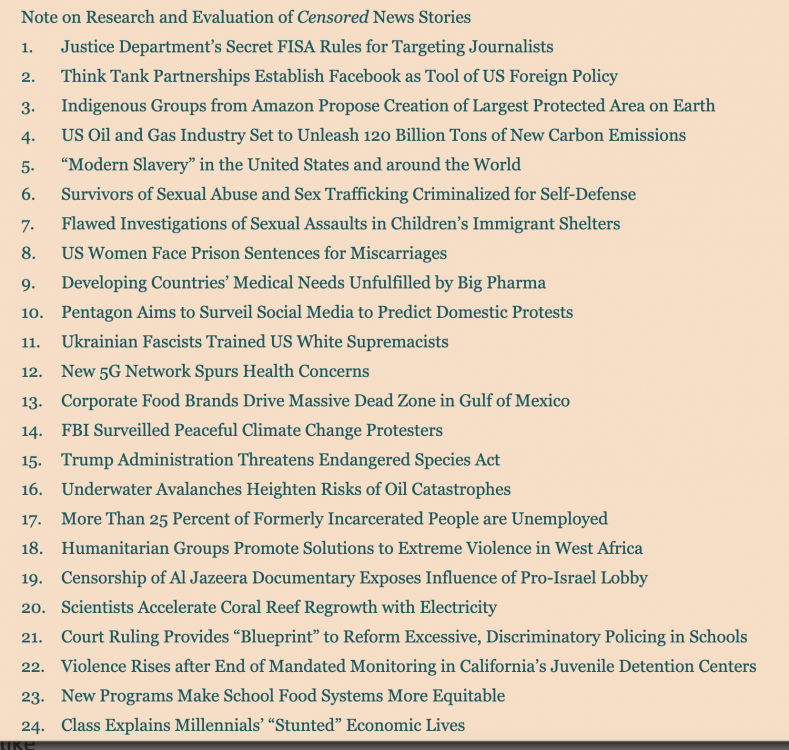
Well, the fact is, even with the highest rated news outlets on the schema you posted earlier (CNBC, NBC, CBS, Reuters, etc) there is still an editorial process that is taking place. A group of editors is deciding what is newsworthy and what isn't, what to cover in depth, what to gloss over, what stories to omit, and how to frame certain reporting. There are built in, institutional biases at play also; biases that conveniently overlook stories that might challenge the status quo. It's self serving human nature at the end of the day - nothing unusual - but it does underscore the need for independent journalism to offer an untethered, outsider perspective. There's an excellent annual publication released every year called Censored. It looks at extremely important stories that saw little to no coverage in the mainstream media. We can debate why these stories were neglected, but we can't debate that this neglect happens on a regular basis. I posted some of the news stories from Censored 2020 below. https://www.amazon.com/Censored-2020-Andy-Lee-Roth/dp/1609809602/ref=sr_1_2?dchild=1&keywords=censored+news+stories+2020&qid=1619283251&sr=8-2
-
Except big corporations tend to regularly pay less tax than small businesses, due to their lobbying power. I support lowering taxes on small businesses, not letting big businesses who rake in billions in profit pay little to no tax. I ask because he mentioned safety standards for the oil company he worked for. My perception is that safety standards are higher in the UK and EU, thanks to more robust regulation from government, unlike the US where the regulation is disturbingly absent.
-
Was this oil company British or American?
-
Most corporations in the US are driven to maximize profit, and so they make decisions based on that priority. If they can pay workers less, they will; if they can pay lower taxes, they will; if they can make an unsafe product at a lower cost and get away with, they will. And not just "if" - they work exceedingly hard to make their priorities a reality, due to their "lobbying" efforts. Morality doesn't really enter into it: "it's just business". Most CEOs and executives of major corporations are in their own elitist bubble and are immune to the consequences of their actions. Yes, I agree there are some corporations that take an ethical stance and flout convention, but they are in the minority in the US. Seattle CEO Dan Price of Gravity Payments runs one such company. He made the baseline salary for his employees 70 k USD in 2015, and interestingly has reported great success over the last five years. It seems when you treat your employees right and produce happy workers you make more money. Go figure. https://www.cbc.ca/radio/asithappens/as-it-happens-monday-edition-1.5482390/seattle-ceo-who-pays-workers-at-least-70k-us-says-it-s-paying-off-in-spades-1.5482394
-
Yes, "relating to or characterized by advocacy for the control of a state or organization by large interest groups" is how I was using the term. And I disagree that corporations don't tend to have monolithic interests. Primarily these are: lower corporate taxes, less legal accountability for corporations, and fewer rights for workers - anything that maximizes profit for shareholders.
-
"Corporatist" is a term referring to any narrative supports the interests of corporations over voters - for example, a narrative that advocates for a lower corporate tax rate but disparages the idea of higher wages as "impractical". There isn't any mention of "false" information here.
-
Which they do currently. However, FB, youtube, twitter, etc do not generally censor any information unless it promotes violence. Other sites, such as Parler, have risen up specifically to cater to communities that feel they are maligned, such as the right wing. Which is why I said it wouldn't be possible in a free country. Very hard to come by, these days. It's very difficult for the average person to adequately vet all the information that is presented. That's why emotional trust in the messenger overrules the information factor. Since most people do not have the time or capability to sift through all the shards of data coming at them and construct a coherent picture, they place their trust in a messenger. This is why Fox News works, and Trump, and Alex Jones. People place trust in a personality, not the information. It doesn't matter how wrong Trump is on the information - the emotional trust factor overrules it all and makes his followers feel safe. IMO, there are only a few sites out there that have a high quality of information in terms of trustworthiness: The Hill, The Intercept, and The Guardian; but even these are susceptible to bias sometimes. The Guardian omits facts from their political stories sometimes, especially if it relates to police shootings. The NY Times has a corporatist bias, and they generally twist the narrative to fit their own purposes, especially if Bernie Sanders or progressives are involved. Politico has a conservative leaning bias. Bloomberg is corporatist, and so on. That's why I stand by the idea that critical thinking and open debate are essential. The higher the critical thinking, the better the ability to parse information, to compare and contrast narratives from various sources, to recognize the inherent biases in a media organization, to see past the bias to what is probably the underlying truth, etc.
-
The only way to circumvent that would be to regulate the internet as a whole, with some predetermined arbiter (a government agency) determining what information people are allowed to peruse. Simply not feasible in a free country.
-
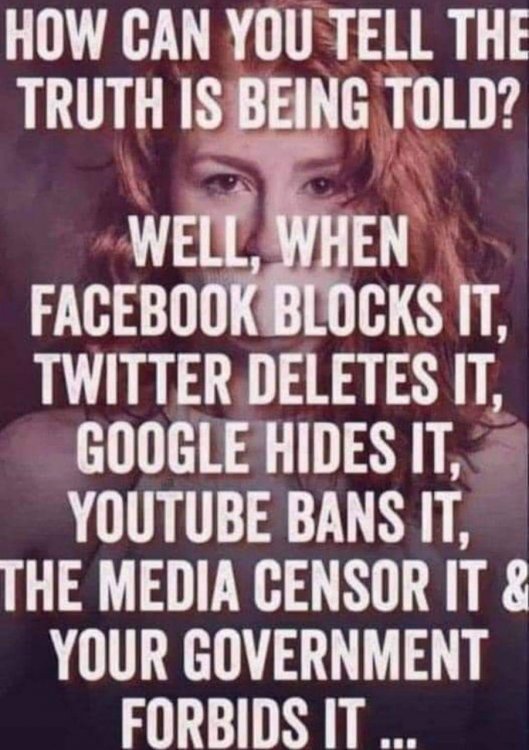
Of course. It's not difficult. There are numerous avenues, existing prior and subsequent to the recent censorship, for those not validated by the mainstream to discuss their views. Parler, for one, is back in full effect. Yes, the yard signs have come down, Trump isn't on the nightly news anymore, and I'm sure we're all a lot less irritated, but regardless of our own brief respite from his ramblings, the recent censorship of Trump has proven to the Trumpists that everything they originally thought was true: the government is out to get them, the tech giants are in it with George Soros, Christians are being persecuted, etc. This is why, from a purely utilitarian standpoint, censorship does not work. Unless you want to go full Stalin and start imprisoning people for their ideas, people with all different views have to be included in the discussion. To reiterate my previous statement, I believe that attempting to purge others from the discussion for holding different perspectives will only strengthen their resolve; while inviting them to participate in the discussion has a greater chance of moderating their views and eventually changing their minds. Below is a post from a Trump supporter. This is how they think. The media played right into Trump's hands by censoring him. 70 million people.
-
I took this statement to mean you were suggesting another approach besides using logical and critical thinking. What exactly did you mean by this statement? How did it make it harder? If anything it fueled his movement to find alternative pathways to continue their discussions. In the context of Germany after WW1, merely censoring Hitler would have accomplished nothing. The deep rooted causes of Nazism: economic despair, widespread racism, an indignant national psyche - all of these would have manifested regardless of one particular leader, and censorship would never have been able to quell it. Neo nazis are a group that espouse a primitive racist ideology that I believe most modern citizens reject. To censor them would be to validate them as powerful, and to me they are not.
-
Disagree. Logic and critical thinking, in the context of an open debate, is the only viable solution. The alternative is censorship, which simply doesn't work. Censorship is an attempt to expunge incorrect ideas (or those that are perceived to be incorrect), from an "intellectual ecosystem" (society, a political discourse, etc). The arbiter responsible for the censorship believes that it purifies the ecosystem and upholds its integrity. But this is an illusory process, and serves only to strengthen the views that have been censored - be they right or wrong. Take Trump, for example. Throughout his presidency, Trump repeatedly made false statements about numerous issues. For most of his presidency he was not censored by the media. He was able to publicize his views on Twitter, through press conferences, etc. Only late in his presidency did certain media outlets begin to make editorial decisions about how to censor Trump (cutting away from his speeches, informing the public about erroneous statements, etc). Ultimately, after he left office, Trump was banned from Twitter, his primary means of direct communication with the American public. The question is: did this censorship of Trump, this "purge", change anything regarding the views he promulgated? I highly doubt that it did. Those supporting Trump are now increasingly compartmentalized into their own self-reinforcing echo chamber (all 70 million of them). Most have sought out alternative channels of communication to discuss their views - be it on Parler (which was removed from Apple's App store, but will be back soon) and other platforms. So censorship will have had little effect on Trump supporters: they believe even more fervently than before, and feel justified in their perception of the mainstream media as a repressive liberal machine. The next step after censorship would be arresting people that don't hold the correct views, but of course we don't do that in a free society. So in short, censorship is counterproductive. It excludes people from a dialogue that might otherwise have changed their minds. Even if their minds aren't changed right away, being included in a group with different views has an effect on such people over time, such that they are become less extreme in their thinking and become more open to other possibilities.
-
Couldn't agree more.
-
My problem with that is it's a slippery slope. Pretty soon you would have some arbiter deciding which theories are correct or incorrect and stopping further discussion. This is already happening in the political sphere with youtube: certain content (left and right) is being deemed unworthy and is being demonetized. There's some people arguing for flat Earth theory on youtube - they're wasting their own time, not mine. Incorrect theories/positions should be refuted with facts, logic, and critical thinking, not censorship or quelling of debate.
-
It's a good point - with the impending "deep fakes" and other artificial data, even entirely fabricated websites, the government will likely have to step in and regulate the quality of information being propagated.
-
yep, that's what I stated: That being said, a private media outlet has the right to determine what information is shared on its platform, and legally there is no argument against corporate censorship
-
I'm against censorship of any theory or information unless it actively encourages violence, in which case it should be removed. Shutting down open debate is never a good thing. That being said, a private media outlet has the right to determine what information is shared on its platform, and legally there is no argument against corporate censorship, odious as it may be. Ultimately, as long as the internet remains free and accessible to all, such efforts to quell free speech won't be successful.