
sethoflagos
Senior Members
-
Joined
-
Last visited
Everything posted by sethoflagos
-
That makes a lot of sense. If you start with the Olduwan, Acheulean, and Mousterian for Africa it will give you a good early foundation for understanding the progression in other regions. You might consider taking a craft course in flint knapping, if there is one sufficiently close to you.
-
In my youth, much of which was spent in Scarborough, fish and chip restaurants were plentiful and the tables always had three shakers: two small ones for salt and pepper and a larger one for sugar. The latter was to sweeten your tea - the only beverage provided in such establishments. I do recall mistakenly putting sugar on my chips. A mistake you only make once. Me too, though European mustards are hard to obtain/ridiculously expensive in my neck of the woods. However, our large Indian community ensures the ready availability of black mustard powder and mustard oil, which services my home production of pickled onions and lime pickle. I'm trying to summon the courage to try these options on devilled kidneys and devilled eggs, both of which I've previously only made with Coleman's English. I know the yellow is just turmeric, but will roasted and ground black mustard seeds made into a paste with mustard oil be a good substitute? Guess there's only one way to find out.
-
There is no 'before' the palaeolithic. It is an archaeological term for a stage in human development characterised by the occurrence of the earliest recognised human artefacts - stone tools. It occurs at different times in different places, first appearing in Africa about 3.3 million years ago and later elsewhere as our ancestors migrated. In Australia, the palaeolithic began perhaps 60 thousand years ago and is generally not regarded as ending before the late eighteenth century. There is no particular tie-in with the geological timeline other than on a very local basis. It's a measure of cultural development, not absolute time.
-
Our family tradition was to use whole black peppercorns in stews. This went back to at least my maternal great-grandmother's kitchen when the stew was cooked in a set pot overnight in front of an open hearth ready for the menfolk's breakfast before they headed off for a shift down Saint John's in the West Riding coalfield. I'm not sure exactly when she was born, but I was left her father's birth mug dated 10th October, 1840 as we shared a birthday 118 years apart. Anyway, she passed her tradition down to my grandmother and mother, and although we'd left the pit villages and scrag end and shin behind, our stews still were seasoned with whole black pepper, with ground white pepper reserved for tomatoes, strawberries and peas pudding mainly. Btw how can anyone mention nutmeg and not mention rice pudding? Match made in heaven!
-
Sorry, senior moment. Deposition came from south and west so that's Dartmoor as you say. Well spotted!
-
Interesting. I had some work involvement with the Wytch Farm development back in the nineties. The hydrocarbon source is the same early Triassic Sherwood Group sandstones that underlie your Littleham nodule beds. So upwards migration via local faulting of reducing fluids from that source is quite reasonable. As @studiot's reference suggests, the primary source for the uranium and other exotic metals is almost certainly from weathering of the Exmoor granite a little to the north.
-
During my apprenticeship in the paper industry I lost several colleagues to hydrogen sulphide poisoning. It's detectable by smell in the non-lethal ppb level, but not so at the lethal ppm levels they were exposed to. I guess that Darwinism survival only works when the chance of survival is non-zero.
-
But won't a significant number of bronze alloys yield a false positive for this test? I'm thinking in particular of most aluminium bronzes and gunmetals. And perhaps a word of caution against employing aggressive bucket chemistry on materials that can have significant lead and arsenic content?
-
No. There are too many (ie hundreds) of different alloy compositions under these umbrella headings, and no simple single test will uniquely separate them. Aluminium bronzes typically contain no intentionally introduced tin. (But some grades do) Admiralty brasses can contain both zinc and tin in varying amounts. So there is a certain amount of overlap and the choice of whether to class an alloy as a brass or a bronze can be a matter of convention rather than actual composition. Any experienced eye can usually recognise the more common (and more familiar) brass alloys by colour (both metal and patina) and context (brasses and bronzes typically have distinct applications). It takes a certain amount of courage to make a positive identification of many of the bronzes without recourse to eg. X-ray fluorescence spectroscopy.
-
Emily Lime prefers her limes detartrated.
-
Execrable. No. My street food takeaway tonight is four sticks of barbecued kidney; salad of raw cabbage, onion, tomatoes, and cucumber seasoned with suya pepper. Delicious, healthy, and enough to see me through tomorrow. Cost me all of $2.
-
Checked my own favourite brand. Interesting FAQ that has a ring of honesty about it. Taylors ImpactProgress on our plant-based tea bagsWe're working towards removing all oil-based plastic from our tea bags, moving towards plant based alternatives.Obviously a bit of a dilemma as to the biodegradability of PLA. I have to admit to a leaning towards pyrolysis as the most credible disposal route (short of a simple ban on manufacture/ import) for all persistent polymers. https://www.taylorsimpact.com/environmental-footprint/products-packaging/products-and-plastics/plastic-in-tea-bags
-
Dark times maybe. But I enjoyed that!
-
No. Not really. Think about it. If DPG keeps cosmetic products moist under drying ambient conditions, this implies that at some concentration within the formulation, it is able to extract moisture from air at perhaps <50% RH. This makes it a humectant wrt to the facepack or whatever it is a component of, but wrt the ambient surroundings it is a dessicant, and this is how it is classified on eg. PubChem. This does not sound compatible with a 50:50 aqueous solution buffering an equilibrium 70% RH atmosphere which is what you want in a humidor and what MPG provides.
-
... where it is a part of the formulation and helps retain moisture within that product. So yes, it acts as a humectant in that context. But we are not talking about that context are we? The DPG is not going inside the... cigars(?) As I said, I wish you well.
-
I wish you well. But I would caution that just as ethylene glycol (MEG), diethylene glycol (DEG), and triethylene glycol (TEG) have very different enduse applications due at least in part to their very different hygroscopic strengths (TEG being by far the strongest dehumidifier), then you may find out why propylene glycol is a recognised humectant and DPG is not.
-
Take Copernicus' heliocentric model as an example. Due to his lifelong conviction that planetary orbits should be perfectly circular, the existing epicycle models had better predictive success than he could ever achieve. Any contemporary who valued empirical data more highly than mathematical purity would naturally reject Copernican theory until Digges' modification began to shift the balance. Do we not see some of that difference still at the forefront of science today? Those who follow the empirical data, however ugly, wherever it leads, and those who go seeking pretty mathematical models whether or not the data is pointing in that direction. May be it's not so much a dichotomy as a spectrum, but even so... Sorry, I'm quoting @TheVat there, not @CharonY
-
No. Just our way of telling you to...

-
Not sure @zapatos has yet posted to this thread. That's you referring to those who have not read the papers... ... and this is also you referring to people who have and don't buy into the science (otherwise "obtuse" would be the wrong word) Different "thems". Why are you attempting to conflate two mutually exclusive contexts? Obviously. The phrasing had a distinct odour of LLM. The paper discusses the challenges of real world measurement NOT the validity of estimates generated by mathematical modelling. Two entirely different classes of data and therefore utterly irrelevant to the discussion. It doesn't support your argument in the slightest. Clearly a bit of dead catting. Howl it to the moon. No one else is agreeing with you. My assertion is withheld as it would contravene site rules in so many ways.
-
The other way round, isn't it? Australia sent them Rupert Murdoch.
-
Back when "them" referred to people who hadn't read any of the science rather than those who had but were simply being "obtuse"? Nevertheless,, comment withdrawn with apologies.
-
But it didn't, did it. It is even further away from the <-50o C limit currently accepted for an ice dominated earth. So your assertion is, as you would not hesitate to say, "factually inaccurate". The heart of this thread is about how to establish credibilty. Your postings are fine examples of how to achieve the opposite. You didn't use those words either. Not even close. Haven't you been pulled up for misquoting in other threads? Illuminating. Chrome has a neat little "Find" function that allows one to check if a purported quote is truly contained within a document. This one isn't from your referenced paper. Not even close. Under the circumstances, I don't feel inclined to take this assertion at face value.
-
Yet your 'precise' -18o C turns out to be a worse estimate than my 'nearest round number' -20o C. Isn't that strange. Where exactly did you say this? Can't seem to find it.
-
In the absence clearly stated tolerances, the more the number of significant digits, the greater the lie (a generalisation but pretty well grounded) Do you have a shred of evidence that more than one person in a hundred habitually reads academic papers?
-
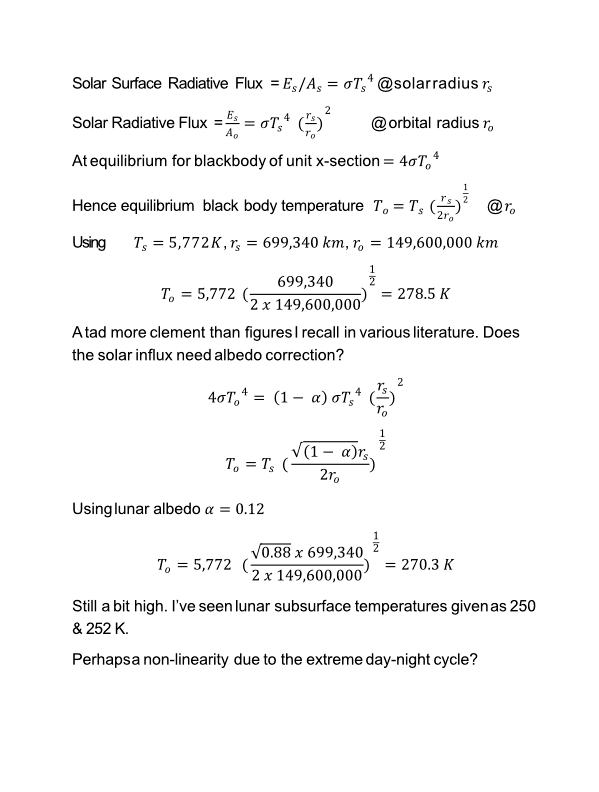
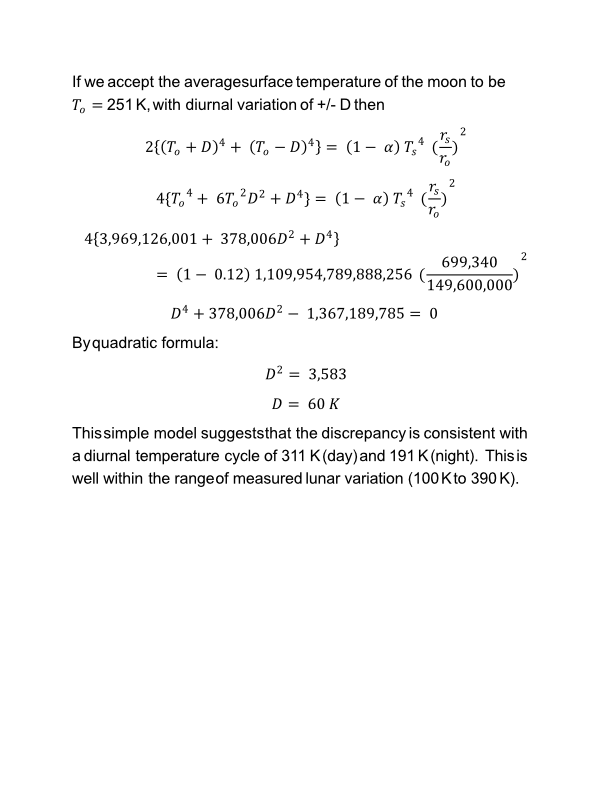
The lunar diurnal variation has been gnawing away at me. I approximated the lunar surface temperature to be 251 +/- D Kelvin for daytime/nighttime average temperature values and calculated for D. Turns out that a D value as low as 60 K was enough to account for the temperature discrepancy of 20 K I'd run into in the opening post.