Mordred
Resident Experts
-
Joined
-
Last visited
Everything posted by Mordred
-
One of my favourite purchases is my electric handplaner. I do a lot of smaller work with pallet wood and its a huge time saver though tend to have to sharpen the blades often lol.
-
For honing I prefer the sheets on glass works extremely well
-
Never force wood excessively beyond light placement taps. Glue does take up spacing but more likely it is a case of placement from dry test to glue stage. I typically place alignment marks when matching pieces together to ensure the same placement from one stage to the next. Such things do occur regardless of how diligent. As mentioned before this thread. A good craftsman isn't one that never makes mistakes but knows how to hide any mistakes. ALL Too often joints can be too tight, it should only take light taps to get a tight fit, excessively tight fits are as you noticed problematic. If you find gaps a trick to to mix glue and the same sawdust as the material used as a filler. Its not perfect on blending but better that many store bought fillers in matching coloration (use a stain ready glue). PS the very statement "You hammered the $$$$ out of the boards" tells me your fit was misaligned on gluing stage and possibly too tight. Once glue has already started to set even if not completely dry it is too late to realign. Practice chisel skills as well on joint and levelling corrections/blending. Chisel skills can oft remove unwanted material as well as save a lot of time in coorections. For fine detail slice not tap or force. I've found that one truly learns to understand the strength in the different grains of different woods when chiselling joints. For example oak is easier to fine tune chisel than maple. Teak one must take extra care on cleaning the natural oils from tools and hands as you work. Speaking of maple you will also want to develop your chisel sharpening skills.
-
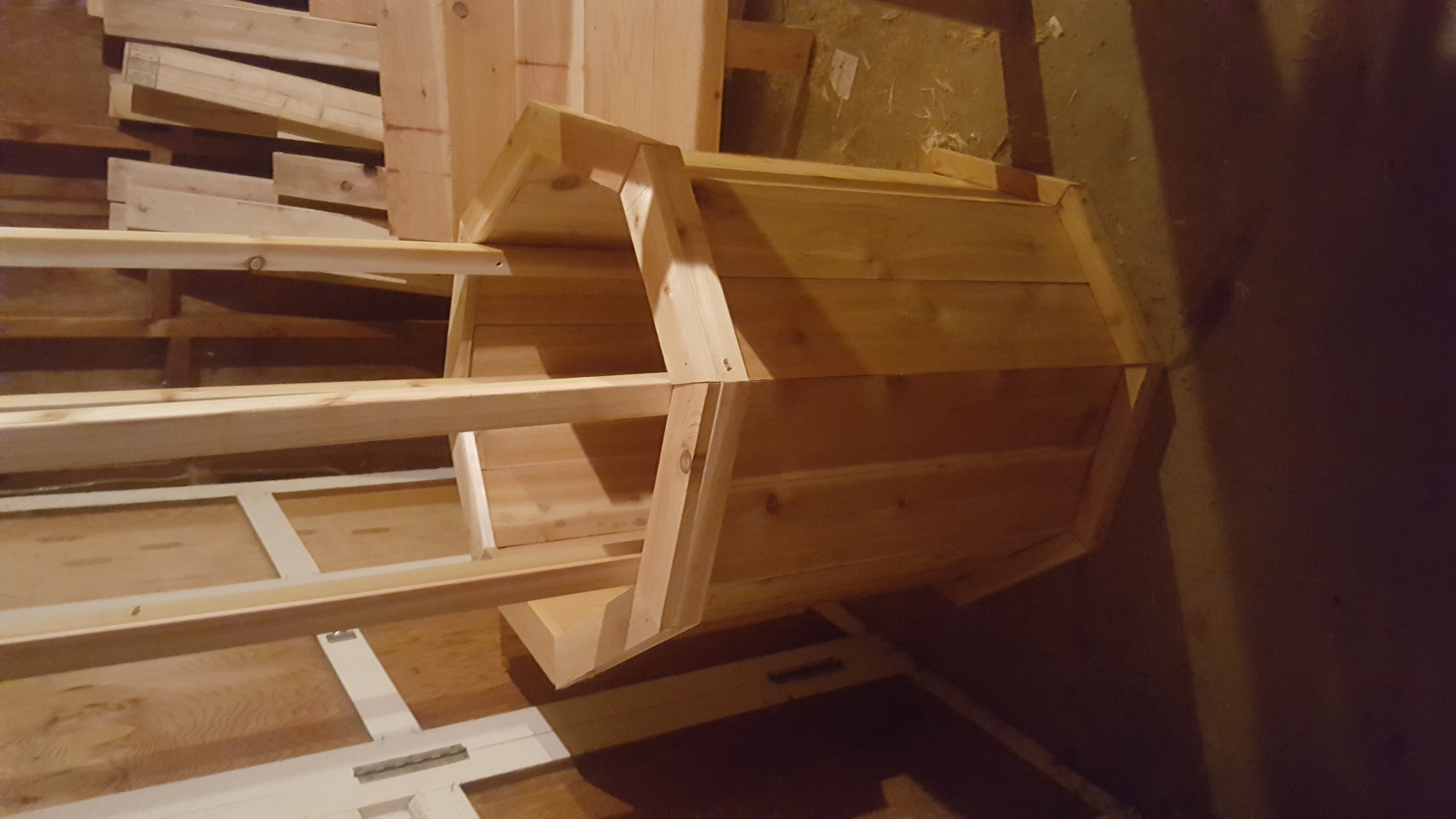
The angles and ensuring precise 22.5 degrees took some scrap pieces to fine tune. For the other cuts I usually make sure I am within 1/16 of an inch. That often requires some chiselling to fine tune the joints. For squaring up each side I used a tape measure diagonally from corner to corner.
-
Dowel joint on the trim pieces, with glue of course. Further strength is added by the bottom base inside with screws hidden by the bottom trim.
-
My current project wishing well made out of cedar, Dimensions 30 inch diameter, height of bucket 30 inches. Costs roughly 150.00 Canadian for the wood. Magic angle for the hexagon 22.5 degrees
-
Welcome aboard.
-
Yes different spin rates would allow for different radius ratios.
-
Yes you can use multiple modules to counter spin.
-
If you try to rotate one module for work/medical processes then you need the fuel to counterrotate the remaining station as the rotation would gradually affect the station via f=ma and friction. NASA has undoubtedly looked into the possibility of artificial gravity on the station via rotation but probably found the costs and ensuing problems of implementation too problematic to justify compared to simply having crew rotations for medical reasons. Its not the implementation that presents the problem but the cost justification.
-
You would need to rotate the entire station adding a centrifuge isn't sufficient. Then if you do so the problem is compounded on fuel costs and how difficult it would be to refuel the station.
-
Lol my most nightmarish project over 20 years ago was a non profit company hired me to build a 12 by 10 by 6 foot rifle display cabinet. They had so little funds available that they supplied me with old wood from railroad tracks that they salvaged. I only had an 8 inch table saw, 1 jackplane and odds and ends hand woodworking tools. I build a table to support larger wood cuts on that 8 inch table saw and had to design my own jigs guides and antikickpack arrestors. I never wanted to photograph the end project even though the company liked the work. I personally was disgusted with the project. Though it was rewarding on one aspect. The sheer creative usage of making such a large project with a highly limitted selection of tools and materials. My clamps was made out of the same material and rope to tighten the clamps. (challenged my rope skills lol) as one example.
-
Don't forget to preknife any cut lines, keeps to edges sharp with reduced splintering. You should try to fine tune joint fits with a chisel. Tight fits is best, though you will need to focus on keeping all joint cuts as square as possible. Ideally you should need to lightly tap in any joint fits without damaging wood surfaces. Most cutting blades are 1/8 th in thickness mark both sides of any blade cut where pieces can be salvaged and knife score all cut lines.
-
No WMAP, COBE and Planck all agree with the cosmological principle despite the pop media coverage of those studies. This includes the great attractor etc. The consensus is that 100 Mpc may not be a sufficient volume where the principle becomes applicable below this scale obviously you have LSS anistropy but just like looking at an ocean with waves the larger the volume, the less the waves on the surface matters in terms of applying a uniformity. Some papers suggest upgrading the scale to 120 or as high as 150 Mpc. This is the trick many fail to see, usually from efforts to self teach. Barbera Ryden "Introductory to Cosmology" has an excellent descriptive of the size to uniformity relations. Cosmologists obviously understand the gist of the principle as being one of scale. Think of the ocean analogy the further you are away from the surface and the larger the view, the more uniform the ocean appears. The closer you are the smaller the view the more chaotic the surface appears. The Principle is the same. Secondly 1/1000th of a degree difference in the temperature variation studies of the CMB certainly supports the uniformity. The planck anistropy of evil was a dipole anistropy calibration error. (Matt Roose Introductory to cosmology) has an excellent coverage of dipole anistropy including the basic calibration formula to account for Earths motion effects on redshift. Which is written long before Planck even published its data. Never trust pop media or heuristic explanations, they will mislead you every time...
-
Well the spin 2 statistics of GR is contained in numerous textbooks of GR and cosmology. ( usually in the introductory textbooks. Later when I have time I will post the series of calcs from Matt Roose. However the spin 2 arises from the two linear polarizations of a GW wave. (H+ and H×) under Noether ( uses the Gell Mann matrixes ) The electromagnetic field is dipolar one linear field with two polarity states.( uses the Pauli matrixes)
-
While your at it, think about "Observer limits and range of validity within a given metric or function. Then think about observer limits to different observers, when it comes to BH's and if you understand particles as field excitations. Think about observer limits/range of validity of the metric. A model is only accurate within its range of validity, with field treatments observer limits is the effective cutoffs of a given metric. ( the above is needed to understand Hawking properly under different coordinate systems. (also applies to semiconductors in the emitter/observer limits)
-
Well I don't agree with that, so I will upvote it
-
excellent analagy highly accurate,
-
It is negative mass COMPARED to the e(k) of the field strength. Which is a positive field strength. This is what I meant by look at the math itself.
-
Don't be fooled by what is verbally described, study the math and you will see that the quote by Migl is still correct
-
They set the baseline at [latex]e=\frac{1}{2}\hbar v^2[/latex] this is the zero point energy baseline which is a non zero value. The above is due to the Heisenburg uncertainty principle. They set this non zero baseline as a zero baseline then for the negative [latex] \hbar v [/latex] state this is a negative energy density. Which is compared to the non zero, zero point energy baseline (average of HUP). In essence it is still a positive energy density if you use a true zero baseline and not the zero point energy baseline. This also applies to baseline treatments ie "effective mass" in solid state physics. That is the mislead. When you look at field equations were interested in the vectors. All your groups and tensors use vectors and spinors. So you set the baseline as the average between two charge polarities for your symmetry relations such as the Lorentzian group SO(1.3) which details the Euclidean vectors under charge/vector symmetry. Your vectors for charge will be related to the field. You have different fields involved in the series of articles you posted with different fields involved. So apply this to each paper, however apply Dirac to the electromagnetic fields as well as the HUP. Think of it this way any average field value can be set as a zero point. We do this all the time. Your charge dynamics under vector charge symmetry ( ie a 180 degree change in direction or attraction/repulsion) will be applied to that effective baseline. Effective mass is "find the (e,k) relationships/compared to the electron mass." Here https://www.google.ca/url?sa=t&source=web&rct=j&url=http://folk.uio.no/ravi/cutn/semiphy/6.l7_intrinsic-extrinsic.pdf&ved=0ahUKEwishIawo4fWAhUn_4MKHdLyAPkQFggdMAA&usg=AFQjCNFqQ-eItHJWlELje1g4PGLv-8Flfw k is the dimensionless curvature constant
-
That last paper is extremely misleading in its first paragraph. The negative energy density is negative compared to a higher ground state density. specifically zero point energy Which does not oppose GR....
-
Lol excellent book I agree with that sentiment Another good book is Mathematical methods for Physicists by G. B. Arfken, H. J. Weber, and F. E. Harris.
-
lol that's why I usually spend that time answering physics posts lol.
-
The error correction messages are of more exacting detail than the previous software as well. Now the error messages provide a direction in the error string involved in more complex latex forms.