studiot
Senior Members
-
Joined
-
Last visited
Everything posted by studiot
-
How is that an answer to my question where did the water go ?
-
You still haven't atempted to answer my most important question. Why are you avoiding it ?
-
m ω2 r is an imaginary force , introduced by D'Alembert to tranform the dynamic problem using Newton's Laws Newton: F= ma is the equation to be solved into one of static equilibrium. D'Alembert ƩF = 0 is the equation to be solved. Where bold type denotes vectors in both cases.
-
Have you looked at the Manchester Physics series ? (now pub by Wiley) Martin and Shaw's 'Particle Physics' covers this material and they keep the book up to date quite well.
-
The danger with simplifying is that word 'sees'. 😀
-
Have you read the entire thread (which was not yours) ? The original question was not an introduction to a character aassassination. Please don't turn it into one. My answer to the original question is that I don't pay much attention to the Man so I don't care one way or the other.
-
Hello @Imagine Everything I suppose you are coming towards the end of your self imposed break, but that you have been keeping an eye on things here. I am pretty sure @Mordred has been doing that as well. So it is time to crack on with my little bit of maths, always trying to connect it to some simple physical use or example. I will start with numbers and functions. So what is a number ? Well consider 5, V, O they all represent the number five in english, latin and arabic respectively. I say represent because they are symbols they are not the number itself. That's good because there are (at least) four different uses for those symbols. First and oldest use they represent a count. eg a count of 5 oranges. Usually counts are whole numbers. Secondly and most commonly they represent a value. Values may be any number whole or fractional. Eg 3.14159... Why do we make this distinction ? Well you may have five and a half oranges, but a clock does not tick 5 and a half times. It ticks five times or six times. A more important distinction is that you can't do arithmetic with counting numbers. Well you can sometimes add say five oranges and three oranges to get eight oranges. But five oranges divided by 3 oranges makes no sense whatsoever. Thirdly we have numbers which denote the order of something. First, second, third, fourth and fifth etc. Once again you cannot do arithmetic with these numbers - adding first to fifth makes no sense. Fourthly they can be used as a label. This is different from the ordering or ordinal numbers which have a fixed order. For example the first runner home in a race may have the number fifty-three on his back, the second may have number one and so on. In fact in general order is not required with labelling, but may be useful as below. Now for the first three types of number it is convenient to always arrange them in the same order. It is also convenient to arrange numbers as labels in the same order as for some purposes eg the lines of latitude on a map. For the most part we use the value representation. This allows us to perform basic comparison operations on numbers. These basics operations are Equality Greater than Less than Identical to Note I have distinguished between equality and identical to for example The value of (3 times four) is equal to the value of (2 times six) but the two expressions are not identical. A mathematical expression is a meaningful combination of numbers and symbols. These comparisons lead us naturally on to 'functions' , constants, variables and proportionality. Over the last few nights the minimum temperature outside my house has been 8o 6o 5o 4o I will stop there for tonight. You will be glad to learn that I am not intending to go through all the different classes of number like positive, negative, real, imaginary, odd, even as there are a great many. However in passing I will observe that there are many pairings of these types.
-
I preferred your previous statement. Points are not absolute. The distance between two points in a given inertial frame . But these are not necessarily the same two points in a different frame, whatever that means. I know it's difficult to spell out in a few words.
-
This may also be more to MigL's liking. +1

-
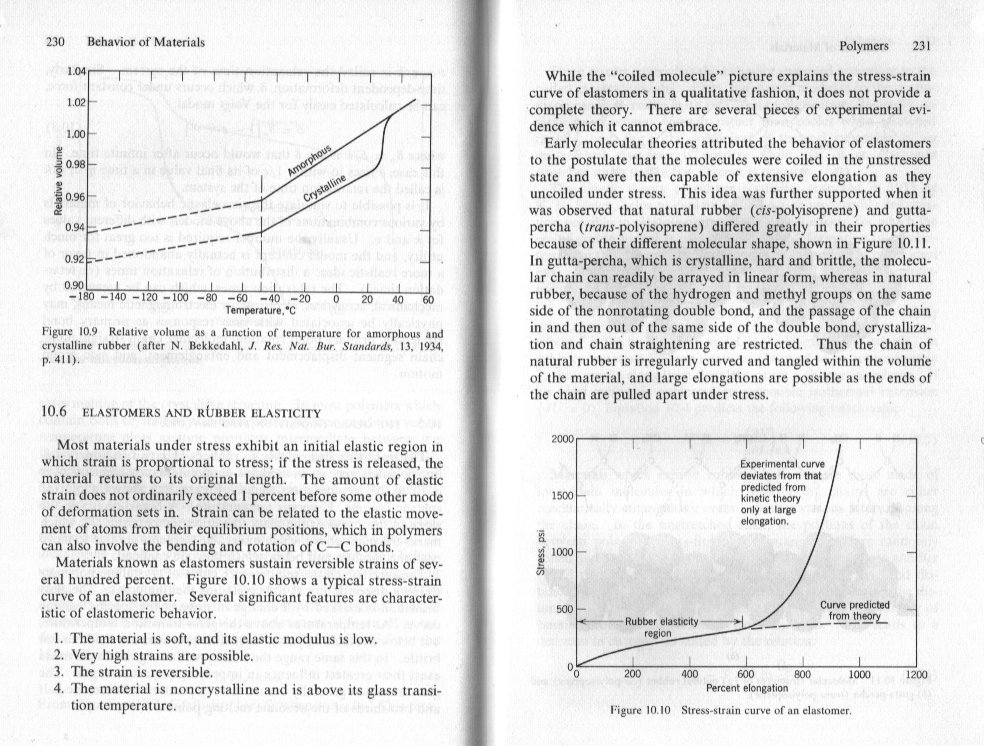
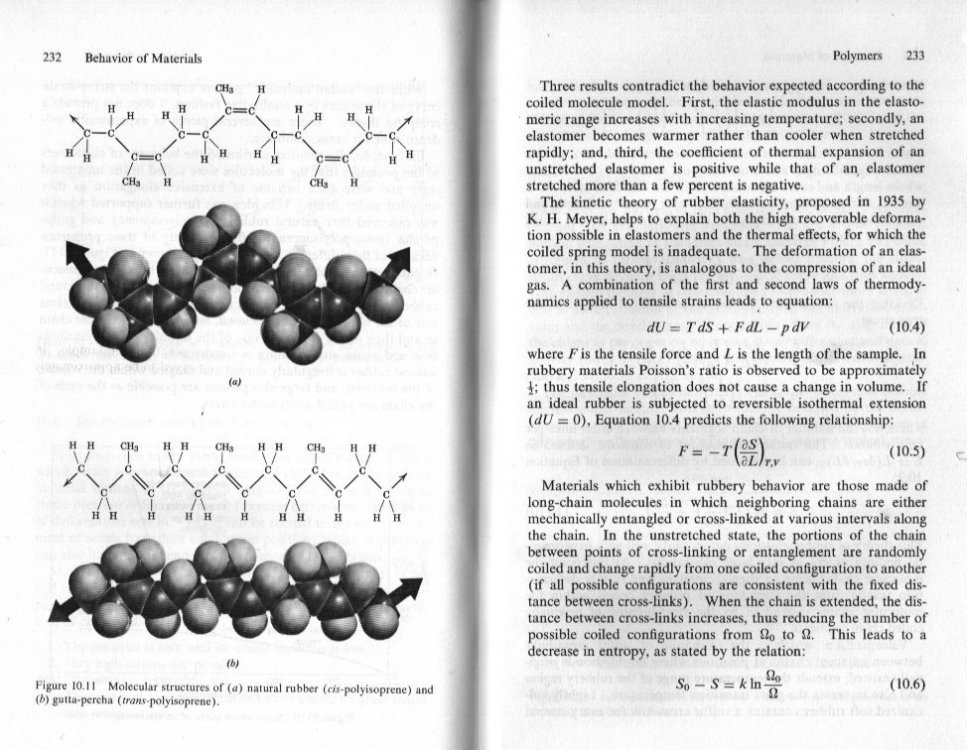
Good Morning @John Melody I was rather pushed last night so here is some more info and a better (more up to date theory) Note Hayden, Moffat and Wulff use stress strain curves not load /extension % , as I already noted.
-
Hello John. Glad to see you are thinking about this. All materials break at some point. Consequently the force extension graph only goe so far and the stops at the break so it never increases without limit. Secondly at the sort of extensions shown here the material will be 'necking' significantly. Now Young's Modulus is stress/ strain not load / strain as you have here so it is necessary to try to interpret this. Look carefully and you can see that the curve is turning over towards an asymptote (it never gets there as it breaks) This means that for a given % increase in extension there is a greater increase in load required as the rubber stretches. This is because the very long molecules are originally coiled and twisted up but the loading gradually straightens them up . Until you get to the point that to achieve fracture you have to start pulling molecules apart - a definitely harder process. A second consideration is that for the necking that occurs at these levels of extension the stress is considerably increased as the stressed cross sectional area is greatly reduced. So for this type of material tthe modulus is only correct as the slope of the curve at or near zero.
-
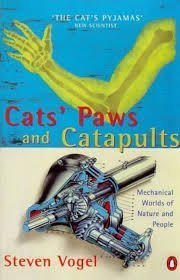
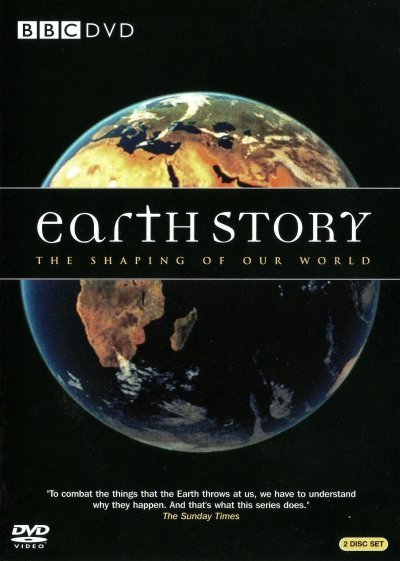
Let me commend to you this delightful little book, which compares and contrasts the ways in which Nature and Man achieve the similar goals with different designs. You might be pleasantly suprised. Cats Paws and Catapaults Steven Vogel. No I don't think it is off topic. Alvin was the first manned sub to dive to the bottom of the Atlantic, and thereby visit the mid atlantic ridge. The relevant part of the expedition was the discovery of hydrothermal vents and the organisms associated with it. Not only were lifeforms living in 200 - 300 degrees C videoed, organisms ranging from anaerobic bacteria throught iny shrimps to medium sized fish, they were sampled and DNA tested later back in the lab. There may be better records of this dive and many subsequent dives around the world. this was only part of the programme whcih was Episode 2 of the BBC programme series 'Earth Story' entitled The Deep
-
and you were not doing this when you castigated scientists for being tardy and not discovering things. ? Actually I think you are not only pretty intelligent and well educated/read/experienced but are sadly wasting it pursuing this one goal/viewpoint you keep referring to. That's a really good reply. +1 So why did you try to shut down my comment about defibrillitation ? So far as I am aware all life, with the exception of an amoeba dies. An amoeba can be killed, but that is a different matter. Dying has no meaning for an organism that reproduces by splitting as it does. In one of your threads, someone responded that Life is not a thing or a property but a process. And processes need a suitable host system. I think it is worthwhile examining the subject of life (and death) in terms of this idea as it not only allows for living and non living parts of the same system, does not imbue things like water molecules with life in their own right; it takes us beyond the current biological restrictions I posted earlier and I think are too narrow. In doing all this it offers somwhere to place this mysterious 'spark' you claim is non religious (so do I) as well as offering a platform to examine what happens as the process degrades and even fails. Yes indeed there is much to be learned.
-
You have said that maybe fifteen or twenty times now., yet has anyone disagreed with that statement ? Doesn't your penny whistle play any other tune ? If you really want to think about life you should also consider death properly, especially as we know more about it, rather than offer smart arse replies when such discussion is offered. prebiotic not yoghurt
-
'Humans' or 'Humankind' is not an organism either living or dead, it is a classification. I said A MAN and I meant A MAN. Your earlier thesis begged no exceptions to your rules. But apparantly you can ignore the rules. I only chose one of your life conditions to demonstrate 'exceptions'. I was watching the video of the first Alvin dive last night and low and behold saw indisputable evidence of another 'exception', namely non respiration. Interestingly these life forms are candidates for the very first ones on Earth. Can you not admit that this is even partway to creating life ? I
-
Is the negative button not working on your keyboard ?
-
Or he might have burst into song along with Pete Seeger, Trini Lopez and Peter, Paul and Mary. 😀
-
I agree with the first line, but wonder what you make of electric reanimation ? I also wonder why you avoided answering my question about a single man or group of men?
-
Surely you are man enough to admit you don't know something when you don't. I don't know, nobody does. Nor do I know if we ever will. The problem I am having with this sort of response is that you have contradicted it in the original thread. As with viruses The inner layer of the trunk is dead, the outer layer is alive. So you now agree that MigL was correct and it is possible to have organisms that have some living and some non living parts ? But you also required all the characteristics of life to be present so I ask you Is a man alive ? One man cannot reproduce on his own, nor can a bunch of men.
-
In my view that is too narrow a definition of the word purpose. There may be a will involved or there may not. For instance I might come along and look at the pebbles in the river bed or sea shore and say the bumping around in the swash and backwash has server a purpose to round those pebbles. Yet I can scarcely attribute any will to the sea or river be. I might then move on to look at the conglomorate in the cliffs above the shore and say those pebbles in the conglomerate are rounded so were also formed in a water environment. My purpose in using the former to deduce the latter would indeed involve a will - mine own.
-
Viruses evolve. So you must consider them alive.
-
Good point +1
-
That's almost the nice pat cant we teach for GCSE. When I was at that level in school they had the guts to admit that we don't know for sure about viruses. I have to tell that at higher level the jury is still out. https://microbiologysociety.org/publication/past-issues/what-is-life/article/are-viruses-alive-what-is-life.html Where exectly did I say it was ? The truth is I didn't. The truth is that I picked out a small part of a larger article, i referenced, and emphasised one particular point by emboldening it. I am not allowed to copy their whole article as that would be plagerism. Note the discussion article I linked to in this thread also refers to this idea you are preaching So tell me do you consider the heart of a tree trunk to be dead or alive ? It is a more organic example of MigL's argument. In any event the line between living and non living is much more blurred than you make out and there are borderline cases that are not well handled by our current classification. But "something happens for it to be alive" is definitely non scientific (wishful) thinking from the dark ages.
-
Since this thread is a discussion of life this link seems as good a modern definition as any https://bio.libretexts.org/Bookshelves/Introductory_and_General_Biology/Introductory_Biology_(CK-12)/01%3A_Introduction_to_Biology/1.05%3A_Principles_of_Biology#Homeostasis Please note that some of the characteristics are share with non living things. Homeostasis Homeostasis, which is maintaining a stable internal environment or keeping things constant, is not just a characteristic of living things. It also applies to nature as a whole. Consider the concentration of oxygen in Earth’s atmosphere. Oxygen makes up 21% of the atmosphere, and this concentration is fairly constant. What keeps the concentration of oxygen constant? The answer is living things. Most living things need oxygen to survive, and when they breathe, they remove oxygen from the atmosphere. On the other hand, many living things, including plants, give off oxygen when they make food, and this adds oxygen to the atmosphere. The concentration of oxygen in the atmosphere is maintained mainly by the balance between these two processes. A quick overview of homeostasis can be viewed at
-
My next bit will have that maths I mentioned. That will include numbers, scalars, vectors, constants and variables, functions and equalities. That will make it easier to talk about state variables, vectors etc.