studiot
Senior Members
-
Joined
-
Last visited
Everything posted by studiot
-
Unlike the first number I misquoted, where I made a silly copying mistake 156,423,343 is not prime. 156,423,343 = the product of two primes 22,343 x 7001. I should have constructed this example in the first place as it is beginning to show just how far you might have to go to find any factors. This of course is also beginning to demonstrate the interest in large or very large primes for cryptography. To recap Apologies for the earlier mistake 9,991,991 is not prime and = 2833×3527 9,999,991 is prime .
-
Gosh yes you are absolutely correct, I miscopied it I should have written 9.999,991 (which is the largest prime number less than 10 million) Thanks +1
-
I must admit that it is a long time since I last looked at Einstein's train and lightning though experiments and I was thinking about the length contraction one. I no longer have the original text of these experiments, but I have found a reliable explanation online here. https://www.vicphysics.org/documents/teachers/unit3/EinsteinsTrainGedanken.pdf Note the authors' comment that there are a lot of versions about, some quite misinformed. No there is no third, fourth or what ever observer involved and there are only two frames, the frame of the train and the frame of the platform. The referenced article explains quite well what you may be thinking of as a third observer as the point of view that the train is standing still and the platform is moving past it. However, as far as I can see all this is entirely off topic and you have made no response at all to my comments on the actual topic of this thread viz spooky action at a distance. I suggest the relativity issue be further discussed in its own thread as it is entirely off topic to action-at-a-distance, spooky or otherwise.
-
This seems to be the only actual question here. The point about the Einstein lightening strike is that it marks both the train and the platform with a visible, permanent mark that can be seen and measured at a later time. The act of the strike in such a small space is considered instantaneous and appears in both frames of reference. Do you understand what the two frames of reference are ?
-
I missed the author of Jurassic Park off my list, Michael Crichton. He has many feasible near future scenarios, a gripping style with plenty of suspense ans suprises. This has led to several successful films.
-
So did you manage to factor 156,423,343 ? Doing this or not is a good test of a method.
-
Yup there certainly are and further the emphasis has changed over the years. So, as already said, it depends upon your own personal taste and also your own personal circumstances. I don't know where you are or what your resources are but let me congratulate you on wanting to read books. +1 So many these days only want stuff on a screen, or are you looking to use kindle or kobo or other online sources ? In which case you will obviously be limited by what is available. Going back to books, I don't know if you are proposing to get them from a local library, or but them (many are available cheaply second hand. Scinece fiction books come in two types. Collections of short stories, either by one author or by many authors collected by one editor. These have the great advantage that if you don't like one author or story type you can quickly go on tto the next. So I would recommend starting with some of these, before movi ng onto full size novels and even long works that span several or even many volumes. You can also look forward to all sorts of story types, from fast action with Matthew Reilly, macabre stories from Ray Bradbury, miscellaneous collections from thinking authors like A C Clarke, Human sagas from Anne McCaffrey, and of course the spins offs from TV and film like Star Wars and Star Trek and Dr Who. There were series especially for youger readers one about children born in space stations around Earth - the Kemlo series, another about a flying saucer that visited Earth and took the mad professor and his children on wondrous and adventurous journeys around the galaxy - the same author was responsible for the Biggles series.
-
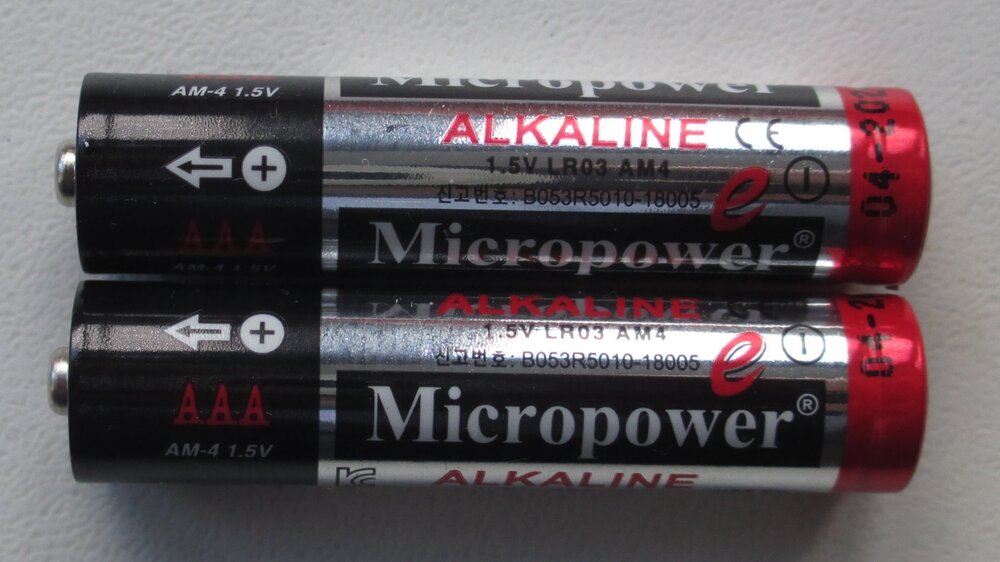
Changing batteries in a friend's remote I noticed this as in the picture. I have never seen a battery with the positive terminal at the black end and the negative at the red end before. Comments ?
-
Principle of least energy
-
What I had in mind was you to demonstrate your multiplication test in full. All numbers greater than 5, that end end 5, are non prime since all are diisible by 5. In fact that is another way of shortening my test. But why 5,23 and 7 (in that order ?) ? Your guess is correct 9,991,991 is prime but your last line should be something like therefore 9,991,991 is prime. this is actually a better number for a prime test. 156,423,343
-
Which echoes my point. I can't think of anything that is opposite in every way. Fundamental particles still obey the same laws of gravity., ie they don't have anti or negative mass.
-
Yes it follows it but the field alone cannot adopt different energy distributions. The PofLE really comes into play when the field interacts with something else, resulting in a minimum energy configuration of that something else, for example Place a load of magents in a mag field and they will line up with it. MigL didn't say the energy was stressed. That is a meaningless idea. He was referring to what is known as the energy-momentum tensor in GR.
-
Not in Newtonian mechanics. But in General Relativity yes massless fields which store energy can also gravitate by virtue of that energy.
-
So how would that work with say this number 9,991,991
-
And antigens and .......... Yes the list is quite long.
-
I understand all this, and there may even be a part in the overall scheme of things to come for this but I don't see the manufacture of what amounts to artificial coal as being a big player. Firstly there are better alternatives than forestry for fixing carbon. We recently had a thread noting that sea grass is up to 30 times more effective than the amazonian forests. Recently there has been much interest in spagnum moss as it is apparantly something like five times as effective for boggy areas, where forest will not grow. Talking about areas where forests will not grow, Why do you think vast areas of the Andes and Rockies and Himalaya etc poke out above the forest ? How much forest can you groe in the tundra or on Shetland, where there are no trees because the prevailing winds are too strong for them ? What about the Sahara, gobi, atacama, Kalahari, Australia etc ? So where exactly would you grow these trees ? Spruce will not grow in the Amazon and tropical mahogany will not grow in Alaska. The sea grass and moss have another advantage. They are immediate. You do not have to wait 50 to 100 years for carbon sequestration payback. Talking of immediate, the main thing we could all do is change our ways to create less waste. To make things last, not have extravagant ways.
-
Yes many things come in pairs. I have no proof that everything comes that way however. Partly because for any X you can divide the universe into that which is X and that which is not X. But elephants are not anti-dolphins, they are something else entirely. The 'anti' bit is a special relationship.
-
That date thjing is interesting, thank you. +1
-
You are very welcome here. Your questions are good technical questions. Your written English is quite good. But can you read English, or are you using a translator ? As already said, bu others it is a matter of sign conventions. Sign conventions are very important - Have you heard of them ? They are important partly because Physicists and Engineers use a dfferent sign convention compared to Chemists. So help us to help you by answering some simple questions about your circumstance. We don't care what they are. But we can then understand how best to help.
-
Further to this I also asked what are studying, without an answer. What I also don't understand is why the bonding in C2 is so important if as it appears you are still at the elementarty stage and this bonding has not yet been resolved (as of 2023) as far as I can tell. As a species, C2 has definitely been measure by traditional chemical means (molecular weight), But there is also evidence of other bonding schemes given by spectroscopy. Traditionally we have unravelled the molecular orbitals for ethane, ethylenes and acetylene by considering appropriate hybridisation schemes. These are, in fact, often used a standard examples.
-
Like you I will wait for the cosmologists to answer.
-
See -You can hold a conversation, and hopefully get something out of it. I am glad you know something about electron - electron repulsion, but that is not the reason why you are most likely to find electrons in these orbitals. electron-electron repulsion is the reason why things are so complicated however. I also note that you and exchemist have been having a conversation about bonding and anti bonding orbitals. I can't remember if I have said it to you but I am always saying this. A system, in this case of particles, attempts to minimise its energy on account of the Principle of Least Energy. So if we write an accounting for all the energy of such a system and try to find the places where it is at a minimum we find that this gives us the shape of the orbitals in space. It also gives solutions that are quantised - that is offers certain 'preferred' energy levels. However - and this is where electron-electron repulsion comes in - We have only been able to solve this equation (known as the Schrodinger wave eqaution) for the case of a single electron - that is a hydrogen atom or Lithium ion or Helium ion. To take account of multi electron atoms we use a special model, which is a modified hydrogen atom. All the pictures you see actually refer to a hydrogen atom and sometimes they tell you this in the small print and then move on quickly. We know it is a sufficiently good model because it works in general and its predictions match observatiosn quite closely. So - bearing this in mind - would you like to look further into the how and why we turn this model of isolated atoms into a model of chemically bonded molecules ?
-
Please just take note that Carroll's master quantum field is quite a different sort of field from the force field being discussed in the spacetime thread
-
Actually I don't exactly mean atoms either. And do you know why electrons are likely to be found there ?
-
In one of your earlier threads I asked if you understood orbitals and advised to to take a couple of steps back to full understaning. I did not receive an answer to this. Do you understand that s, p, d etc orbitals are just a convenient fiction (model) and do not describe what is actually going on in molecules ?