studiot
Senior Members
-
Joined
-
Last visited
Everything posted by studiot
-
Thank you for that childish personal remark. Although you know next to nothing about me, you have managed to teach me something. Here it is. I thought I would follow up on your Google remark so I typed in "xxyyzz" and should not have been suprised to find that Google will nearly always return some sort of result - just like a working calculator will always display something, even if it is GIGO. https://www.google.co.uk/search?hl=en-GB&gbv=2&q=xxyyzz&oq=xxyyzz&aqs=heirloom-srp..0l5 Apart from the music hots there appears to be a maths course on the subject and it apparantly has applications in Rheumatology. Sleep Well.
-
Sorry, that makes no more sense than the original statement. The first step always produces an isotope of something.
-
Of course it does. I am not saying that invalid means useless (see hogwash). But my development is to show that it forms an upper bound. Lots of posters here have offered various parts of the thinking development of this, including yourself. Since Tom rejects the whole caboodle, I am trying to offer these parts in a logical step by step order. Sadly everyone but Tom seems to understand that. And if he is genuinely doing all that work over decades then it is a shame for him it will ultimately be to no avail. I have not yet got into state variables, reversibility or the quasi-static concept and their implications for the discussion.
-
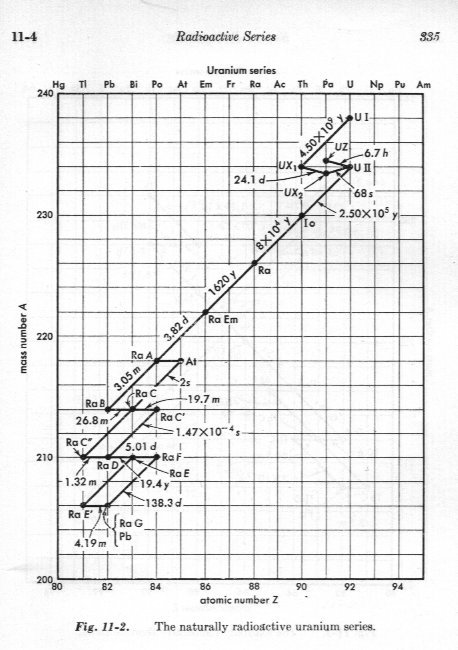
Thank you for the reply. I wonder what you mean by daughter isotope ? Are you using this definition ? or are you meaning that the 'daughter' must be an isotope of the same element as the starter ? That is the only way I can make sense of this absolute claim Because clearly all decay is to an isotope of some element or another.
-
Would you please explain that statement in the light of this diagram ? (After Semat.)
-
Actually I did, but you didn't completely read what I said, any more than you did the first time round. I didn't mention 'limit' or 'hogwash' and most importantly I didn't say that the Carnot formula is invalid full stop. I even quoted the exact passage for you and I am not going to do that again if you can't bothered to read that short passage to the end. The standard engineer's formula and analysis for elastic beam deflections is invalid for wide beams. In other words it only applies to narrow beams. That is why engineers use a different analysis and formula for the deflection of wide beams and narrow beams. No the Carnot formula is not hogwash if used for the purpose for which it was intended. I don't like to use the word limit because the word limit has a variety of meanings, some of which would be contradictory if used in the wrong place. A limit may be achievable or unachievable in both mathematics and other sciences. The only place it is used in Thermodynamics that I can think of is in the thermodynamics of chemical reaction rates and is used to define something called 'the limiting rate step'. In this instance it does not indicate the unachievable. So, if we were to call the Carnot formula a limit then would would be using limit in two contradictory ways within one discipline (thermdynamics). And that would require the reader to make the distinction.
-
Is (the) Carnot efficiency [limit] (formula) valid? No? My impression has been, that as a limit your answer(s) would certainly be "yes". Even perhaps an overly generous approximation. I certainly never imagined it was an exact representation. But certainly as a limit on the actual efficiency of any REAL engine it is considered absolutely valid. If therefore, no engine can exceed that limit, no engine can exist which does not emit "waste heat". I've watched dozens of tutorials and solved dozens of sample problems on how to use the Carnot efficiency equation and what it means in terms of real world applications involving joules of heat in and joules of waste heat out and joules converted to work. So, what do you mean by "invalid". Just a quick answer before I turn in for the night. This is a much better way of arguing your challenge. You are actually asking why someone says something. First we start with the premise that Every real world engine has an efficiency. So the issue becomes "How to calculate that efficiency ?" I have established that the Carnot formula only applies to an imaginary engine. So why would anyone expect it to be valid for any real world one ? What you will calculate if you use the Carnot formula will be incorrect for a real world engine. So I have begun the long process of delving into which leads on to "How should we calculate it instead ?"
-
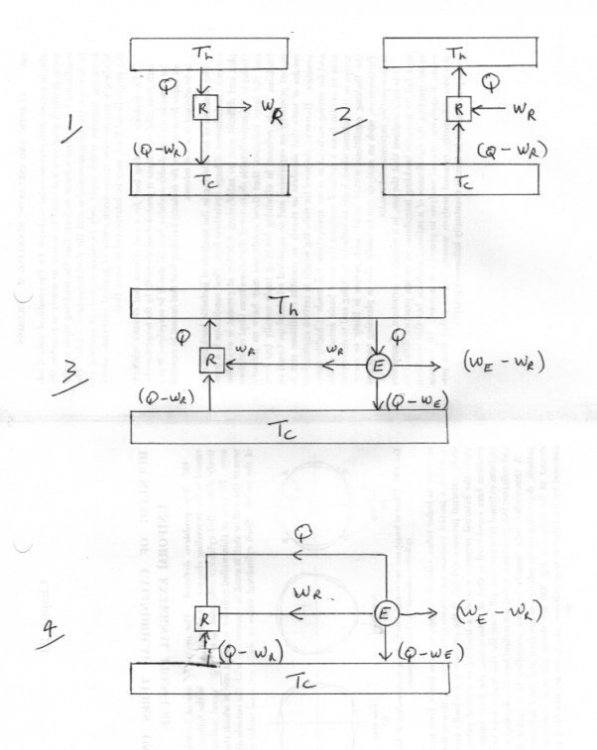
Good point, but can I add a thought here ? I used Th and Tc to try to keep the nomenclature simple. I also used them as shorthand for source, reservoir etc, perhaps a bit ckeekily. Most cycle diagrams have more than 2 vertices so are usually numbered 1,2,3,4.... These vertices also correspond to definite states, both in ideal and non ideal machines. So perhaps V1 and V 2 etc would be better ? A couple of other thoughts, @Tom Booth Beware of sign conventions. Chemists treat all forms of energy in a positive and all forms of energy out as negative. Engineers (and most phyicists) treat work done on the system as positive and work done by the system as negative ie (the opposite). Both systems have their uses and roots in history. Although Thermodynamic theory was the first discipline to make full use of the new advanced mathematics in the early 1800s I am trying to avoid this part. It is not needed for our purposes. Thermodynamic theory also pays scant regard to time there is no consideration of how long it takes to reach the mentioned states and most thermodynamic maths in independent of time. I am posting this diagram now as the beginning of the next installment. I will explain it later but I have other things to attend to over the next few hours. Meanwhile I'm sure Seth will recognise it.
-
There are lots of Gwave detector types and some of the sources are known to be moving away at appreciable speeds so it is not suprising that LIGO offer this
-
Was he ? " The acceleration vector always points in the direction of the Sun" What acceleration vector ? And what frame would that be please.
-
That isn't or is what I said, depending upon how you look at it. Maybe my phrasing could having been better, but I was trying to avoid switching frames from heliocentric to geocentric in mid description. So as I said the Sun's gravity does not change direction at any one place in the Earths orbit. It is always directed towards the Sun, whichever side of the Earth you are on.
-
Although not as well developed as the electron shell-orbital theory for atoms, Nuclear Shell Structure is still the most comprehensive model around for the nucleus. https://en.wikipedia.org/wiki/Nuclear_shell_model
-
Thank you for answering. +1 I asked this way to help you work out for yourself, which is by far the best way. Perhaps you would like to rethink the embolded part of your reply in the light of the fact that you understand that nothing shields the bodies on the Earth's surface, no matter which side they are on ? If you still can't see why what you said is wrong I will explain in greater detail. Remember also that the Moons gravitational influence at the Earth's surface is greater than that of the Sun. But yes, all other things being equal, a body on the dark side experiences a slightly smaller pull due to the Sun compared to the a body on the light side because it is further from the Sun. But theSun's pull does not change direction, it is the Earths pull that pulls in opposite directions on the dark and light sides. So the pull from the Sun on the light side opposes the pull from the Earth, whereas the pull from the Sun reinforces the pull from the Earth on the Dark side.
-
What effect are you expecting here ? Hopefully you realise that you cannot shield against gravity. So the mass of the Earth's body does not shield againsts the Sun's gravity. And what about the Moon ?
-
So let us return to the OP and explore what Carnot efficiency. The equation under discussion is efficiency = eta = [math]\eta = \frac{{{T_h} - {T_c}}}{{{T_h}}}[/math] So how does this stack up against what we know ? Well it tells us that @Tom Booth is correct when he says that eta is 1 (or 100% if you will) when Tc is zero. It also precludes the possibility of overunity since to get eta greater than 1 would require Tc to be negative, which it cannot be by definition. It tells us that eta is zero when Tc - Th. This is effectively the zeroth law of thermodynamics which describes thermal equilibrium. It is saying that reservoirs Tc and Th are in equilibrium so no heat will pass from one to the other. Since not heat passes none is converted into heat. It also tells us that Tc and Th must be different with Th > Tc. This is another way of saying that there must be 2 different reservoirs. One will not do as they are effectively the same, which statement leads to the second Law. So this shows why consideration of the reservoirs is vitally important. But can we probe further ? We can ask what are these reservoirs and how is heat exchanged with them and this brings us to the suprising conclusion. If you add to or subtract heat from any real physical material object you must change its temperature by the equation Temp change = mass times specific heat. Yet we have defined a reservoir as a body that does not change its temperature when heat is added or subtracted ! The only valid conclusion we can draw is that such a reservoir is not a real physical material body. It can only ever be an unattainable ideal. A further complication is the question of how is heat exhanged ? Again we run straight into the zeroth law, but this time it seems to be against us for it is quite adament that heat does not flow between two bodies in themal equilibrium. So the temperature of the working fluid must be greater than Tc to add energy to it and less than Th to receive heat from it. This leads to the conclusion that eta itself must be an unattainable 'limit' in some sense and also to the conclusion that a real material Carnot engine cannot exist. Chemists and Chemical Engineers will be familiar with a similar situation in regards of concentration where we can regard constant concentration as one that is so strong that it is almost unchanged by the addition or subtraction of solute. This is only the first step of deeper enquiry, however. When we look at the thermodynamic variables we run into the question of what is meant by Tc and Th. But that is a story for another post.
-
+1 particularly the last bit. I really must remember that quote, priceless. I didn't vote for them. We have now has 3 prime ministers out of the last 4 that were not elected by the electorate. Also excellent advice. +1
-
My apologies if that end paragraph was posted before I responded to the beginning of your lengthy post. Unfortunately almost everything you have said in this thread and previously leads to the inevitable conclusion But you don't understand it. That is the problem. When myself and others tell you that you are misquoting an equation relating to Carnot efficiency you respond quoting dead philosophers instead of Mathematics. You clearly have a facility with mechanics and the maths is actually very elementary so you should have no trouble understanding a properly phrased explanation. To answer your question as plainly as possible. NO it is impossible to buld a material physical 'Carnot Engine'. It is purely a theoretical concept to explore the theory of Thermodynamics. It is impossible in theory as well as practice for reasons that Seth and Joigus have hinted at and for reasons exchemist and swansont have tried to explain to do with your misunderstanding of various definitions in thermodynamic theory. You tell me that we do not need to explore what a 'reservoir' is defined as yet you do not seem to understand that the basic (Th-Tc)/Th efficiency formula is invalid for any real world heat engine. Considering the amount of time and effort you put into this, I really cannot understand why you do not want to explore the finer points of this issue.
-
Might that be the line at the end, the only line in the post with a question mark at the end. The rest of the post was , of course, useful information. Thank you +1
-
Sigh. You went to the bother of quoting my post. And got me all excited. Thinks : "Perhaps he has bothered to read it." But No. Another gargantuan post containing everything but an answer to a simple question. Thank you for wasting my time yet again. I am now formally reporting this nonsensical saga.
-
Like everybody here I too thought your use of the word 'stuck' meant that the engine had stopped running, from the context. So thank you for putting that right, stuck to the ice is perfectly acceptable, but the general misunderstanding shows the value of respectful discussion. I agree that a video can be a valuable addition, especially if it is short enough, to confirm the salient points. But these salient points should always be listed in writing. Photos and diagrams are also important, but as swansont says should be properly annotated to focus attention on the salient points. I use PaintShopPro for this. Likewise it is helpful if the video can be annotated with a voiceover and the demonstrator pointing out the salient points with finger or pointer. Please note this thread is allegedly about Carnot, not Stirling. I do not wish to make a formal off topic complaint which might lead to its closure but I would like to reiterate that I think you still have not understood the true meaning of a hot source or a cold sink (since you seem to wish to use those terms). I have offered you a formal definition and a block diagram in order to help as proper understanding stands at the very beginning of any analysis. In particular what heat gains and losses occur and where, how and why they occur. This understanding is also essential to sensible and efficient experimentation technique.. It is so important that perhaps discussing this one subject merits a thread of its own. What do you think ?
-
Yes and No or not really. All our theories , including quantum theory, are models which only deal with some aspect or aspects of reality. These are all fine within their respective realms of application. Sometimes different models describe the same aspect. In this case we distinguish between when the different models yield the same answer and when they yield different answers. Objective measurement and observation is the final arbiter. When the predictions are the same it doesn't matter which we choose so we normally use the easiest, most convenient one. But when the give different answers, clearly we must operate the most accurate one.
-
Could it also be to ask questions of those who know more than they do ? Is that possible ?
-
Sounds good to say to your mates down the cafe. But don't overthink it. In particular don't mix-n-match quantum theory and mechanical force theory. Orbitals and Pauli theory do not lead to expressions of force, They are energy theories.
-
Not so sure about this bit from your link. He later contradicts it anyway. No, it's not a limit, but a distance where the system has smallest potential energy. No me Guv, not guilty.
-
The original theory of touching was put forwrda by Lennard-Jones. Here is a simple version https://chem.libretexts.org/Bookshelves/Physical_and_Theoretical_Chemistry_Textbook_Maps/Supplemental_Modules_(Physical_and_Theoretical_Chemistry)/Physical_Properties_of_Matter/Atomic_and_Molecular_Properties/Intermolecular_Forces/Specific_Interactions/Lennard-Jones_Potential Wikipedia has a more detailed version with more famous names from the past. https://en.wikipedia.org/wiki/Lennard-Jones_potential