
studiot
Senior Members
-
Joined
-
Last visited
Everything posted by studiot
-
I do so love it when someone tells me something I don't know or reminds me of something I should know. +1 You are still not expressing you research goals and intentions very clearly or pehaps even correctly. I seriously suggest you accept this, ask to moderator to close this thread and let you start a new one with a half ways decent proposition. That way we could all stop bickering.
-
Yes your contention that p is necessarily zero. Consider the rocket (as I did) just moving along at velocity V, at time t. If the rocket engine is not firing this sytem has non zero momentum. If it is unimpeded by gravity or air or other resistance Newton's first law tells us this will continue indefinitely. If the rocket engine now fires and the rocket starts to accelerate (can you see why this must then happen ?) The rocket will gain extra new momentum equal to the negative momentum of the exhaust. But it will still retain at least some of its original momentum. This situation could easily occur in a series of rocket engine 'burns'. This is why I did not start the conditions at t = 0 or V = 0. These are conditions that can be added into the analysis, but many analyses start the rocket off fromstanding still. in which case its momentum will obviously be zero. However this last case can lead the unwary into a Zeno like paradox (have you heard of them?) where you can try to argue that no rocket can ever leave the ground since it cannot move until the exhaust start to move.
-
What is dp/dt ? I am asking what you thing the symbols mean mathematically, not what is momentum or the tim,e rate of change of momentum. You are confusing the derived function (derivative) with the value of that function at a single value of time in the case. Sometimes this distinction is unimportant, sometimes it matters very much. That is the case here. Not only is dp/dt a function it is a vector valued function.
-
Perceptive. +1 Taiwan ? I would just draw your attention to the current joint naval exercises off South Africa (with the ANC). The ANC have been spreading doctrine that the Ukranians in general and Zelensky in particular are dedicated zionists and also nazis (is that possible ?). You wouldn't believe the hatred I have heard from them. They are all gathering in their allies round the world.
-
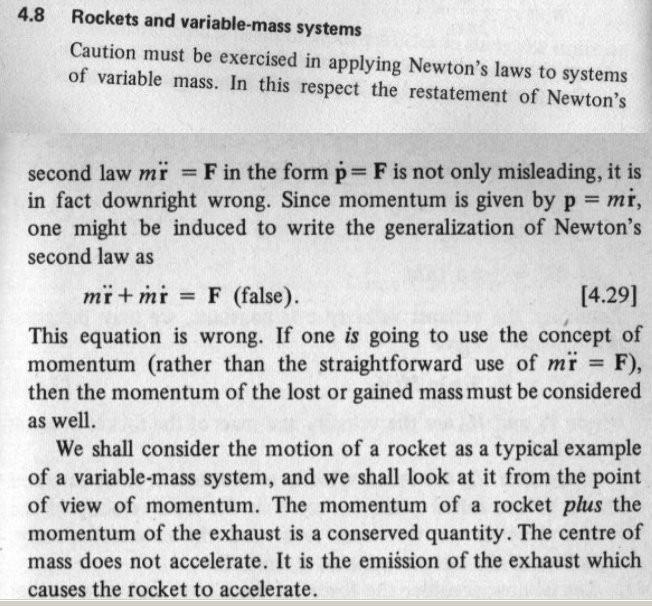
Well I was just following Dr Cowan from London University all those decades ago, when I learned this stuff. Here is his introduction to the subject. I was just trying to flesh out the explanations further and show where the mathematical tricks occur. Note very carfully what he says about f = ma v f =mdp/dt and his use of r as distance moved by centre of mass.
-
He's just not listening bro. He doesn't even know the correct definition of a closed system. So many misconceptions of a fundamental nature.
-
I see that hyperphysics does it my way, but with much better pictures. http://hyperphysics.phy-astr.gsu.edu/hbase/limn2.html#ln21 http://hyperphysics.phy-astr.gsu.edu/hbase/rocket.html#c2
-
No you don't. Can you honestly not see the difference between what I wrote and your copy of it ? BTW The centre of mass of the rocket changes. So the rocket at time t and time (t+dt) is effectively a different object. so you cannot use general formulae. MdV/dt is the force on the rocket at one instant in time only the force at time t. This is what is meant by saying the mass must be constant or how we get around that restriction. Suggestion Instead of all this constant criticism of theory, find yourself a few examples with numbers in or exercises with answers. Can you obtain the correct numerical answers, using your methods. whatever they may be ? In other words, Does your way actually work in practice. ?
-
I'm sorry you are so quick to challenge, rather than ask for further detail as to why I said what I said. No it is not exactly the same as the work of the others, although there are commonalities. If you were not so hasty you would see that you even misquoted my statement. I did not say Mdv/dt any more than I used m or F = dp/dt anywhere. I hoped you would follow my extended commentary instead of reaction with a Putin style knee-jerk. The whole point is to distinguish between M and m as well as V and v. If you did not understand it ASK.
-
I will answer your question, even though you haven't answered mine. Note this is your thread in Speculatrions and the rules you recently accepted when you joined require your answer. The constancy of G was established by Cavendish and confirmed by many subsequent more sensitive experiments. Also indirect confirmation comes from the experimental fact that a large part of theory in Astrophysics and Astronomy yield results consistent with constancy rather than variability. How many observations and experiments have you conducted ?
-
How am I supposed to take your question seriously ? First your claim is that g/G is the distance to the Sun. Then you question if G is constant. If you think G is not constant how cna it be related to a sensibly constant distance ?
-
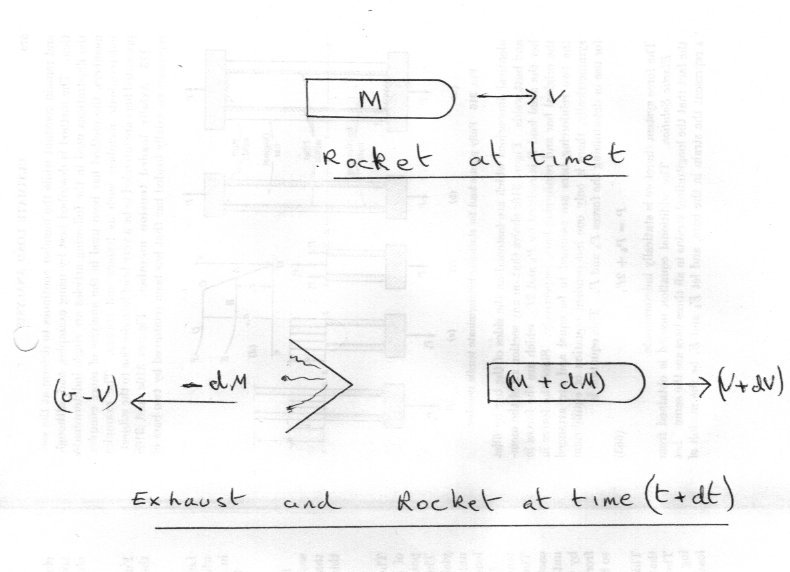
OK then to continue. I am presenting this a Physics exercise, not a formal maths one, although maths is involved. Physicists are allowed to bend the maths rules a bit. Let us consider a rocket travelling along. The trick to analysing this is to use the fact that momentum is constant for the whole rocket system (rocket plus exhaust), although it is variable for each part separately. Thus system momentum = p = a constant. But we analyse this by considering the parts of the system separately. At some time t the rocket has mass M and velocity V. At some time (t +dt) these have changed so the rocket now has mass (m + dm) and velocity (V + dv). Note dm is negative . Furthermore -dm is the mass of the exhaust, which has a velocity v relative to the rocket or velocity (v-V) to a ground observer Splitting the system mass in this way saves introducing m for the exhaust mass and simplifies the maths. Here is a diagram showing these essentials. So the system momentum at time t = p MV (first figure).................1 Note this excludes the need for considering the exhaust momentum at this stage But the system momentum at time (t + dt) is also = p = (M + dM)(V + dV) - dM(V-v) .......................2 Multiplying out the terms and taking care of the signs then either subtracting equation 1 from equation 2 or simply using the fact that the right hand sides are both equal to p we can equate them directly leads to the expression MdV + vdM = 0 .........3 Two notes here. This is a momentum equation, not a force equation. This equation is the springboard to answer questions about the desired properties of the rocket system. So for instance we can remember our schoolboy calculus and note it can be rewritten as (after dividing through by M) dV = -v d(lnM) where lnM is the natural log of M But you have asked for the force on the rocket also known as the thrust. To get this we proceed as follows We divide equation3 through by dt to obtain [math]M\frac{{dV}}{{dt}} + v\frac{{dM}}{{dt}} = 0[/math] If we let [math]\alpha = - \frac{{dM}}{{dt}}[/math] Then [math]M\frac{{dV}}{{dt}} = \alpha v[/math] This is the required force on the rocket.
-
What works ? I have shown you that it does not work on other planets for example Jupiter. I thought exchemist's die analogy was rather good. Didn't you? For your information g is specific to local conditions, even on Earth. It is derived from G by applying these local conditions. This is why G is called the Universal Gravitational Constant - it applies everywhere. G is used to calculate something called gravitational potential, and also the gravitational force exerted between any two bodies with mass, and that calculation involves the values of both masses. g is used to calculate the force on a singlebody with mass in the vicinity of Earth, but g already incorporates a factor for the mass of the Earth and varies fromplace to place on the Earth's surface or height above it.
-
That's good I can use them then. But so as I don't spring this idea on you let me explain why I am using r not x for distance. Consider Newtons second Law Force = mass times acceleration. Easy peasy yes ? But there is a twist. This refers to a single body (or system) that remains intact and does not shed (or gain) material. In fact it refers to the centre of mass (COM) of that body. And r is a common symbol for the position of that COM in your coordinate system. So when we quote Newton's 2nd law we really mean that The product of the mass of a body and the acceleration of its COM equals the force imposed on it. Swansont refers to this as the net force which is important for a rocket system, because the net force is exactly zero, in the absence of drag, gravity etc. This means that the acceleration of the COM of the rocket system must be zero since the mass is not zero. This is both good and bad. First the bad news: we cannot use f = ma directly since it only tells us the 0 = 0. Now the good news: we can use it to form a suitable momentum equation to work with. ( I will post this next time) I have slyly slipped in the phrase 'rocket system' there. That is because we normally speak of rigid body dynamics. The point about a rigid body for the purposes of Newton's 2nd law is that however the COM accelerates, so will any other point of the body. But we don't have a rigid body. We have a system of bodies that deforms with time. So your title has some truth in it, but not quite for the reasons you propose. You are however right to be suspicious of some of the explanations offered online.
-
I don't necessarily disagree with you. In fact I think the translation barrier has not helped added to the fact we have got several members offering different approaches and/or explanations. This must be very confusing. I also note that different texts derive different (not necessarily incompatible) conclusions and results from the same material and starting point. This fact is why I asked you what you want to calculate. Since you have told me several times that you do not want to calculate anything I now think perhaps you are actually asking to understand certain terms in one version of 'the rocket equation'. Another sidetrack is the introduction of 'generalised coordinates' and 'generalised momenta', both of which are coordinates and momenta in name only. This really is sidetracking a steamroller to crack a nut and quite over the top. Studying this updating of simpler mechanics is really important to Physicists but takes at least a year of hard study. You have a track record on not answering the one or two questions I aks in a post. They are all designed to help us (especially me) help you so please answer this one. Are you familiar with the dot and double dot notation for derivatives with respect to time ? [math]\mathop r\limits^{ \bullet \bullet } [/math] and [math]\mathop r\limits^ \bullet [/math]
-
[math]\mathop r\limits^ \bullet [/math]
-
New figures from the Office for National Statistics.
-
Firstly let me say that I don't think this belongs in the Relativity section. The extract is very short and I am not familiar withe the source but I think the subject concerns only the ordinary time we measure and live with on the surface of the Earth. The clue is in the statement "it’s inconvenient for noon to occur in the middle of the night in some parts of the world,". I would agree that the phraseology is rather poor but I think that 'coming apart from' describes the fact that 'noon' is related to the Sun being overhead and that this will only happen at 12:00 on the Grenwich Meridian. Everywhere else it will happen at some other time, unless the residents there use a locally adjusted time other than GMT. It is a pity also that his example of the use of standard GMT elsewhere in the world is military. Surveyors, navigators and astronomers have for centuries used it as the basis for star tables for peaceful purposes as well (and still do). Does this help ?
-
So would you say this was crackpottery ?
-
There is indeed additional theory to apply relativity to rockets. But I would suggest that you deferred this until you have sorted out non relativistic theory. I say non relativistic because relativity is now counted as part of classical physics. When doing this sort of thing it is useful to make a list of symbols and what they represent, to avoid using the same symbol for different things in different places. So first of all what do you mean by F ? You have one overall system and two subsystems viz the exhaust, the rocket itself and the combination of rocket and exhaust. That gives the possibility of 9 forces acting to choose from. Some of these may be zero or equal to other forces. Each of these 3 (sub)systems will have their own mass, acceleration, velocity and momenta as a result. Now consider the case where the rocket itself has zero acceleration. What do you think this means ?
-
Perhaps @MigL knows the answer to this but I would be very suprised if any useful rocket was designed for constant mass exhaust. Different accelerations and velocities will also be required at different stages of the flight. This implies that the force applied to the rocket will vary over the flight time. These are parameters that can be worked out for a desired flight history.
-
It is the experience of all my family and friends that curry, casserole and cottage pie all taste better the second time around. So my question is Is there any way to skip the first day ?
-
I feel this thread is wandering further and further off topic which is (not was) the formal logical soundness of a point particle. The Cosmologist has not answered my question to him about quantum numbers. In my oldfashioned day we had two quantum numbers concerned with 'angular momentum. There were 4 in all labelled, n, l m and s respectively. The first 3 had a classical interpretation, although they mark stationary point solutions to the Schrodinger equation. These describe the energy, position size and shape of the obitals. The final one, s, has only a quantum interpretation although it is common to refer to it as the spin or quantum spin of the electron about its own axis, the actual behaviour is not exactly that of a mechanically spinning anything. The second one, the azimuthal quantum number, l, can be associated with classical angular momentum of the electron as a point particle rotating about the nucleus. So where are we in relation to point particles ? Incidentally as regards the so called infinite limit that also seems to be causing trouble, We have no problem with density being a point function limit of mass over volume, nor of pressure being the force over zero area in the limit. I respectfully suggest crossing swords with a real organic chemist about chirality would be difficult. Chirality embraces a host of phenomena of which handedness is only one, but I'm sure exchemist would run rings round any of us on this subject.
-
Surely you dont need a course in basic calculus ? Definition momentum = mass x velocity p = mv Therefore if both m and v are variable [math]\frac{{dp}}{{dt}} = m\frac{{\partial v}}{{\partial t}} + v\frac{{\partial m}}{{\partial t}}[/math] Where both m and v are functions of t. To work this out you would need to have equations for both m and v as functions of t, unless you could devise an equation connecting m and v. Do you have such equations ? Some treatments specify that the mass flows out at a constant rate, that is [math]\frac{{\partial m}}{{\partial t}} = C[/math] Alternatively you can calculate the changing mass flow required to produce constant acceleration.
-
You said To which I replied Yes if the lifetime is 1 second* the muon expeience 1 second of 'life'. But the rest of what I said means that the lab observer sees (measures, experiences) the moving muon taking much longer than this to die, whilst the muon in his hand take exactly 1 second to die. *(Actually the time is about 2 microseconds, not 1 second)