studiot
Senior Members
-
Joined
-
Last visited
Everything posted by studiot
-
This is the point where I invite @iNow to step in with their famous cartoon.
-
I assume so are referring to this rather inelegant piece of English. Sorry about the spelling. First let me point out that existance in mathematics means is consistent with the axioms and other conditions assumed. Most of Mathematics is composed of abstract nouns. Whereas in Physics we are generally looking for existance to mean the physical instantiation or possibility of one, although there are abstract nouns in Physics as well. I understand the OP to lean towards the Physics meaning by it use of the word 'our' in the title. Some immediate examples in Maths, as you ask, would be the development of 'orders of logic' and their use in resolving the paradoxes (@Russell etc) that arise in first order point set theory. I am preparing to be away for a few days so will probably not be able to respond again until next weekend.
-
I agree. +1 More rigour please, Steve.
-
I am trying to keep my discussion at least covering a much wider field than just Mathematics. I am impressed by your choice of title an in particular the usee of the phrase 'nature of existence'. In my opinion this is so much better than asking what is existence, as so many do. I am also impressed with 'the nature' of your discussion in this thread. So +1 for all that Existence is a noun. The English language admits of two kinds of noun viz abstract and concrete. This is very useful in exploring existence and its nature. It is useful because it is possible because concepts are, in general, abstract nouns but we are, in general, interested in the effects of something in the physical world. So it is easy to see how a concret noun like 'football' can affect another concrete noun like 'window' (by breaking it). But the game becomes really interesting when you realise that abstract nouns can affect concrete ones and the action in the physical world can give rise to (many) abstract nouns like toughness, vulnerability and so on.
-
Yes seems like, and many dismiss the question without adequate consideration but would you want your emergency ambulance to be You could of course ask if the journey shoul be undertaken at all if there is 'not enough fuel'. But how do you know what is enough fuel ? Electric cars can vary by a reduction in available mileage of 50% worst case in cold weather. How would your algorithm cope with that. Equally, how much would be allocated to headlights, cabin heating/cooling and so on ? And what happens if the motorway is closed for an incident and vehicles are subject to a 50 to 100 mile diversion ? Living near the Severn Bridge it is suprising how many otherwise sensible people set off across the water with insufficient fuel to reach the other side. The Bridge Authority does not allow ordinary or private breakdown services to operate on the stretch between the junction at each end, charging a very hefty fee for their own service, partly to dicourage people chancing it.
-
I really think this discussion is pushing against the boundaries of language here. It should be remembered that in both ordinary and scientific English many words have not only multiple meanings but also multiple shades of those meanings. Furthermore folks sometimes try to combine words that although the combination follows the rules of grammar it results in nonsense, simply because some words cannot be combined with some others. Existence is such a word. For example if you have a hole, what does half a hole look like ? Is a hole of measure 5 the same of different from a hole of twice its measure (whatever measure means) or is it one hole or two holes or what ? Many of these 'philosophical' arguments that rand round and round in circles, like this thread is doing, or ran into an impasse, have found their counterparts in more modern mathematics where some solutions have been founf but these are not altogether satisfactory.
-
What do you make of this russian expermental treatment in the light of you 'all good and luvy duvy' claims for these hormones ? https://siberiantimes.com/other/others/features/beating-addiction-out-of-you-literally/?comm_order=&c_page=3
-
Four good books on geometry, curvature and gravity Norman Johnson : Geometries and Transformations - Cambridge https://www.google.co.uk/books/edition/Geometries_and_Transformations/adBVDwAAQBAJ?hl=en&gbpv=1&printsec=frontcover Frankel : The Geometry of Physics : Cambridge https://www.google.co.uk/books/edition/The_Geometry_of_Physics/2iq2EGNgX24C?hl=en&gbpv=1&pg=PA4&printsec=frontcover Frankel : Gravitational Curvature : Freeman https://books.google.co.uk/books/about/Gravitational_Curvature.html?id=ryPyfLsgmhsC&redir_esc=y Sternberg : Curvature in Mathematics and Physics : Dover https://www.google.co.uk/books/edition/Curvature_in_Mathematics_and_Physics/CUDDAgAAQBAJ?hl=en&gbpv=1&pg=PA19&printsec=frontcover
-
Go on then give details please? It's easy to say, not so easy to implement.
-
Good breakdown of your analysis, John. +1
-
I wonder what happens when one of these automated vehicles simply runs out of fuel ? If the AA or RAC are to be believed this is not an uncommon occurrence on UK roads with human drivers.
-
Thanks for both your comments about the trampoline and reminding me og that book. I looked it up again and this time found a sensibly priced version. +1
-
GI brown, despite his initials, was not in the american military he was a humble chemistry teacher, and author of a famous Physical Chemistry textbook. Amongst his other books was this history of explosives https://books.google.co.uk/books?id=PzXcAAAAMAAJ&dq=editions:ISBN075091923X

-
thank you for this useful information. I have learned something. But sadly, if you continue to talk down to other folks in this manner you will become pretty lonely here.
-
Not at all sure who your target audience is here. Are you asking 'kids' to think in the abstract, when they have not encountered enough concrete examples to compare with ? The most motivational thing I saw was starting Physics with a bunch of other 12/13 year olds in a coeducational school. The (lady) teacher's topic was 'Forces'. Please pause for a moment and ask yourself how you would approach this for a class of such kids ? before you look at the spoiler.
-
And there's me thinking that his works were of great length! 🙂
-
Please be aware that I was referring very specifically to the trampoline analogy when I talked about an extra dimension. The dimension is in no way "higher" than the others by the way, as they are all supposedly equivalent. For the trampoline the extra dimension is required. It is worth noting at this point that gravity is a distributed function or effect with a possibly different value at every point in the space concerned. This is why in the Newtonian model it is called a "body force" as opposed to the line segment vectors of contact forces. It is possible to modify the trampoline model by introducing a variable stiffness function, and perhaps extending it to 3 dimensions like a sponge, which would then produce the effects you show at the expense of considerable mathematical complexity. This could reproduce the animation shown. This is reminiscent of the efforts scientists made in the past to preserve the heliocentric model of the solar system by introducing cycle upon cycle to account for the observed movements. None of this gets away from the problem I stated earlier. The trampoline model, being a purely mechanical force model, requires that extra dimension. It is well known that the vector product in 2 dimensions automatically takes into the third known dimension. But there is no known corresponding effect in 3 dimensions that requires a 4th to operate. Rotations and other vector products are 'closed ' is three dimensions and only produce all their known effect within that 3D space. That is why, in my view, the trampoline model is counterproductive.
-
I thought perhaps it was for a story. +1
-
The short answer to your question is yes, some smouldering fires would continue to 'burn' unaided. Perhaps you remember the Monkees song 'Pleasant Valley Sunday' ? The line 'Charcoal burners everywhere' is relevant. charcoal is what happens when you burn oxygen in reduced oxygen. There is a nice chart for different fuels showinf the 'Limiting Oxygen Concentration' on Wikipedia https://en.wikipedia.org/wiki/Limiting_oxygen_concentration
-
More specifically it is the nitrogen in the air. This is why to dive deeper, where there is greater pressure, special gas mixtures without nitrogen are used. Endy does have the right idea about expansion being the cause of the the trouble so to answer your query more fully, you need to know two things. As pressure increases more gas dissolves in a liquid (water, blood, cellular fluid etc). Dissolved gas is no longer a gas but part of the fluid. If the pressure is then reduced the additional dissolved gas returns to being a gas, as Endy says. All the fluids in you body have to be at the same pressure as the water at any particular depth or they would be squashed into a smaller space. This is not like a submarine where there is a rigid (metal) shell to resist the difference between the external water pressure and the air pressure inside the shell. So the air you breath when diving is at higher pressure than in the open atmosphere. So more of the gas dissolves in your blood stream. As you return towards the surface the pressure regulator in your air supply reduces the air pressure to match that of the surrounding water at your depth (obviously it also increases the air pressure as you dive deeper - this is all automatic) So on return some of the gas emerges in your bloodstream as bubbles, nitrogen being the particular problem. Your body can only clear these bubbles at a limited rate so if you ascend too fast they build up. The Bends occur when uncleared bubbles start to acumulate within the rest of the body, particularly around the joints in the skeleton. This is why you ascend slowly and in stages if you have dived to any significant depth. Does this help? Feel free to ask for amplification of any point.
-
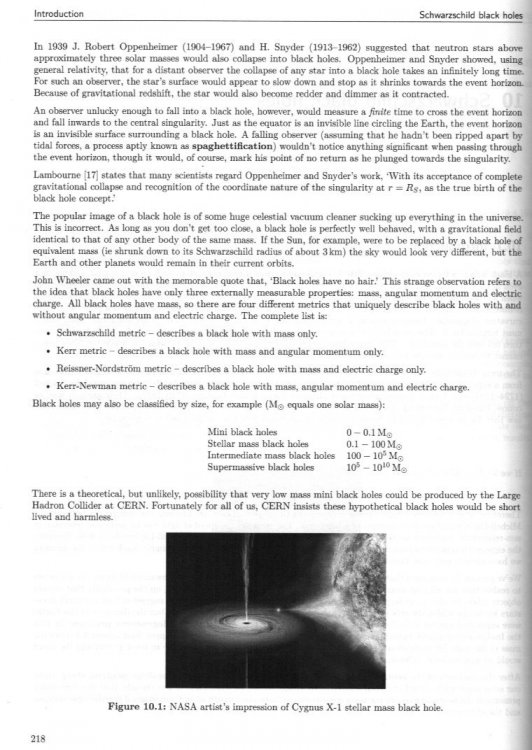
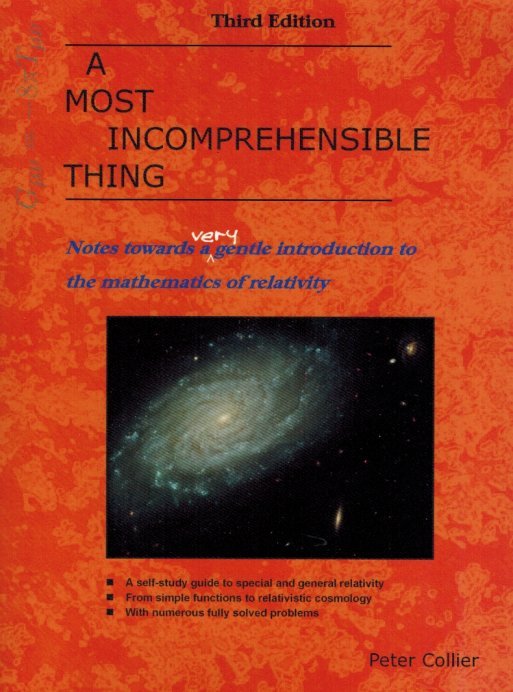
Here is some useful beginning information from this book which makes good bedtime reading. Peter Collier didn't understand it either so he taught himself from the ground up and wrote a book about it. hint Click on the image to get the full size
-
Simply put the trampoline is a 2D membrane that is distorted in the third dimension by a force acting in that dimension. That's all fine and dandy, but we live in a 3D universe - as far as we can tell there is no 4th dimension - but scaling up the 'trampoline' would require a 4th dim. There are proper astrophysicists here that can offer multicolour explanations @Janus?
-
Yes indeed, but are you not doing the same ? I clearly remember having hammered into me "You cam't take the square root of a negative number" Then some years later I learned about imaginary and complex numbers. You keep saying 'even light...etc'. But you should be concentrating on the 'black hole'. Remember that the original black holes - invented by the mid victorians - were introduced as the nearest thing man could make to a 'black body'. But light - in the form of IR and microwave - certainly escapes from these. Indeed it has a temperature that can be measured. So perhaps the 'even light' was meant to distingiuish those original black holes from the populist term coined much later . As to lying to children, saying even light cannot escape, is not strictly true, just a populist presentation that is nearly true. For a more accurate, but still childlike, exposition see here https://www.universetoday.com/152547/we-knew-black-holes-have-a-temperature-it-turns-out-they-also-have-a-pressure/ We have had several threads here discussing how poor and inaccurate the trampolite / stretched blanket analogy is for GR.
-
Well this plays nicely with the other discussion about socialism + insurance. To answr phi the american insurance indistry pioneered the use of Bayesian statistics when everyone else (mathematicians) was ridiculing it. In those days the idea of insurance was a socialist idea of 'collective risk sharing' - that is the many collectively paying for the harm suffered by a few of their number, noting that the harm could be much greater than any individual couls support. The operative word there being risk. I seem to remember an older idea of business in general was the taking of a risk in order to receive benefit (profit). These days business seems to be promoting the idea of "business want certainty".
-
Well here is some better news to be pleased about. https://www.bbc.co.uk/news/science-environment-66464437 How is sign language adapting to climate change? Published 12 hours ago Watch: how do you sign 'carbon footprint' in BSL? By Victoria Gill Science correspondent, BBC News For deaf children, teachers and scientists, talking about things like "greenhouse gases" or "carbon footprint" used to mean spelling out long, complex scientific terms, letter by letter. Now they are among 200 environmental science terms that have their own new official signs in British Sign Language (BSL). The deaf scientists and sign language experts behind the update hope the new vocabulary will make it possible for deaf people to fully participate in discussions about climate change, whether it's in the science lab or classroom. "We're trying to create the perfect signs that visualise scientific concepts," explains Dr Audrey Cameron. Dr Cameron, who is profoundly deaf, leads the sign language project at Edinburgh University, which has just added the new terms to the BSL dictionary. ....etc