Genady
Senior Members
-
Joined
Everything posted by Genady
-
I don't think the remaining part of the sphere matters at all. You need to express the volume of the part cut out by the cone and make it equal 2/3 pi r^3.
-
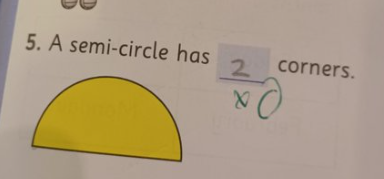
Being misled by a visual is not a necessary condition for answering the question wrong, evidently. For an experiment, I gave the question, with no diagram, to AI: How many corners does a semi-circle have? AI has picked this answer: A semicircle is a two-dimensional shape that represents half of a circle. It is formed by cutting a whole circle along its diameter. When considering the number of corners (or vertices) a shape has, we typically look for points where two straight edges meet. A full circle has no straight edges and thus no corners. However, a semicircle includes the diameter as a straight edge. Here's the breakdown: The curved part of the semicircle is smooth and has no corners. The straight edge (the diameter) connects two endpoints. Therefore, a semicircle has two corners, which are the two endpoints of the diameter. These points are where the straight edge meets the curved edge, forming vertices.
-
It was bad last time, I remember. They were detaining people in airports for idiotic reasons. I have canceled then my trip to the US with my wife, and lost hundreds of $$, because my passport says that I was born in Azerbaijan, which certainly sounds like a Muslim country.
-
But the question was about "a semi-circle." It's a math question. It is rather a student who "seems to miss that what is actually pictured is a partial disk and not a semicircle."
-
Because of the verbiage like this ^^^^, I think that by "abiogenesis" he means "spontaneous generation". Which it is not for a long time by now.
-
No, such definition is not necessary.
-
No, it is not. It is a dimensionless number. To help me understand this question, please answer this one: number 3, is this a "mathematical" construction, or does it have a physical meaning.
-
Re 'math for masses'... What do you think about this elementary math question: (Student's answer to math question sparks discussion after teacher marks it as incorrect - Scoop Upworthy)
-
OK. Good luck!
-
Since beauty is in the eye of the beholder, it cannot be shared. So, what is the purpose of this app?
-
It is rather a lousy way to sneak in the link at the very end of the 'essay':
-
Quantum entanglement does not involve information transfer in any way.
-
Isn't your model similar to one discussed here:
-
In your model, is the universe homogeneous and isotropic on a scale 100+ Mpc?
-
Is metric you use different from FLRW?
-
So, it is space expansion. Why do you call it spacetime expansion? What is 'fabric of the universe'?
-
Scientific writing guidelines, "Using Quotations in Scientific Writing": Etc. quotes_082014 _quoting_and_paraphrasing.pdf Using Literature – Write Like A Scientist
-
Depends. What is 'spacetime expansion'?
-
I maintain that this is preaching, which is against the rules.
-
No, we do not. We rather continue modifying our concepts and models and inventing new ones striving to make them fit signals we get from nature. One can call the latter, 'understanding' if one wishes so.
-
Solved. The leak found and fixed. Thank you to all for participation. If you wonder how I have found the leak, the hint is here:
-
The scale of this uncertainty is Planck's constant. It is too small to affect calculations for stars.
-
A star in position A has velocity V. This does not depend on when it happens or when we observe it.
-
See Relativity of simultaneity - Wikipedia.
-
It is all known for more than hundred years now and it is a part of calculations. After all the delays are taken into account, more mass is required for the motions to be what they are. Nobody calculates galaxy rotation "as if a fixed connected disk is rotating." You do not have any basis to claim that astronomers do not take distances and times into account. Can you show how your calculation makes a difference? I mean calculation, not words.