
Genady
Senior Members
-
Joined
Everything posted by Genady
-
No truth of a proven mathematical statement has changed.
-
It does not matter what it was called 600 years ago. It is not called so anymore. Regardless, the names of things are neither true nor false.
-
Mathematical truth is the ultimate and absolute truth. Mathematics evolves by better and deeper understanding of this truth. Whatever you are talking about cannot be "everything" because it has counterexamples. Math provides the counterexamples.
-
This is rather a no-example. It is not called so in math. And it is also a no-example. Your statement, "there's no truth without God" is refuted by the observation that there are irrefutably true mathematical statements without God.
-
Do you have an example of mathematical statement that was proved to be true and later became false?
-
Nobody has to agree or disagree with this statement. We know that it is true because it is proven to be true. The truth of this statement was known to Euclid although it has been discovered perhaps earlier, and Euclid's proof appears in his books Elements although there are many ways to prove it. This is example of a statement which is not true. No difference.
-
It is so because the statement is not about "number" of primes, but about set of primes. My use of the word "number" in the original statement was sloppy. Here is the statement stated formally: ∀ S⊆P, |S|∈N ⇒ (∃ p∈P, p∉S) where P is set of primes. In English, it says "for any S subset of P, if S is finite then a prime exists which is not in S."
-
Because you started playing with words which are not essential for the statement. So, I've rephrased it to avoid these words. It is the same statement expressed with different words.
-
It does not matter. We are discussing this statement: for any finite list of primes, a prime exists that is not on the list. It is true without God.
-
Axler, Sheldon. Linear Algebra Done Right.
-
No, it is not. Number is not a symbol, it signifies counting. We count, gods count, your book counts, "day 1", "day 2", etc. is counting. So, "primes" are counts that cannot be broken down into smaller equal counts. The statement we are discussing says that for any finite list of primes, a prime exists that is not on the list.
-
A concept of "number" is not questioned, and "rules" have nothing to do with this statement. Also, the concept of "infinity" is not needed, because the statement simply says, that the number of primes is not finite.
-
Of course there is. Here is one: the number of primes is infinite.
-
Implies. If ... then ... .
-
Some of the best advice my best math teacher gave me was to always write down your work as you go, to use one side of paper so you don't need to turn the page to see what you've written, to use pen and not pencil and never erase even mistakes.
-
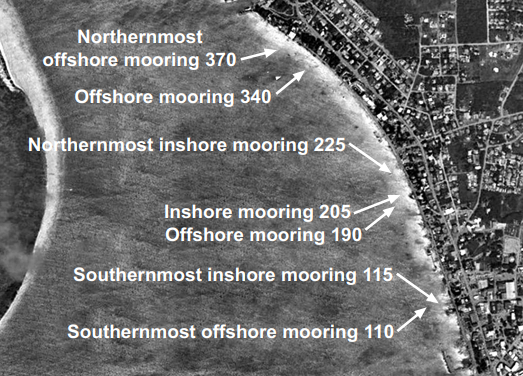
Some years ago, I investigated coral growth on concrete mooring blocks installed 30 years ago along the shore of our capital city, Kralendijk. I've discovered some puzzling patterns in the blocks' faces coverage by growing corals. If you are interested, I will provide details on the moorings, their location, the corals, etc. But for the starters, here is the first puzzle. There are moorings in the shallow waters close to the shore, "inshore moorings", and others in the deeper waters farther from the shore, "offshore moorings". See the pic below. It turned out that significantly different amounts of corals grew on the faces of these two types of mooring blocks. What'd be your guess, where did the corals grow more, on the inshore or on the offshore mooring blocks? Ask me anything about this marine biology research project🙂.
-
Externally imposed moral codes become genuine inner conviction with a right brainwashing.
-
For n=2 we get the angle 180(1-2/2) = 180(1-1) = 180(0) = 0 degrees. For n=1 we get the angle 180(1-2/1) = 180(1-2) = 180(-1) = -180 degrees. For n=2, I imagine a degenerate, flattened polygon with two sides and two vertices where the sides are on top of each other (Digon - Wikipedia.) The angle between sides in this case is indeed zero degrees. For n=1, there is no angle to measure.
-
Another question in addition to the one above: The group is a structure of a set. OTOH, you said earlier that Objective has no structure. Isn't it a contradiction?
-
Do I understand correctly that groups and vector spaces are Objectives, while rings and fields are Subjectives?
-
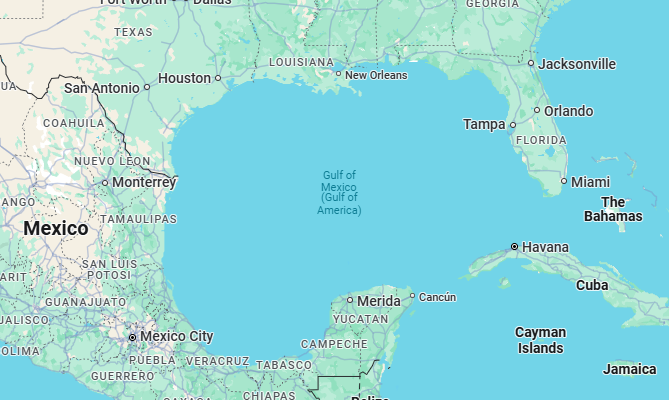
"The body of water formerly known in the United States as the Gulf of Mexico is now listed for US-based users of Google Maps as the Gulf of America." (‘Gulf of America’ arrives on Google Maps | CNN Business) I'm not US-based. This is how it is listed for me:
-
Why to compare it to stopping motion? Time is rather comparable to space. We can't stop space either.
-
"Time is defined so that motion looks simple." Misner, Charles W.; Thorne, Kip S.; Wheeler, John Archibald. Gravitation (p. 23). Princeton University Press.
-
Inspired by the discussion above, I've asked DeepSeek to write a short poem in style of Pushkin. It produced something in English, which I cannot judge. I've asked it then to make it in Russian. It failed miserably, albeit in Cyrillic.
-
"AG2 achieves an impressive 84% solve rate on all 2000-2024 [International Mathematical Olympiad] geometry problems, demonstrating a significant leap forward in AI’s ability to tackle challenging mathematical reasoning tasks, and surpassing an average IMO gold medalist." 2502.03544