
joigus
Senior Members
-
Joined
Everything posted by joigus
-
I think @studiot knows much more about projective geometry than I do. Also other members who are mathematicians, or much more educated in higher mathematics. The mass gap in YM is considered to be the toughest problem around concerning physics, BTW. Just saying...
-
That was I --speaking a la Gandalf. By the way, I still think @swansont's argument is the ticket here. @Lorentz Jr is right though. Any realistic situation will be riddled with turbulence. Still, you can concoct a non-turbulent system for which the energy/momenta analysis is equivalent. Crudely speaking, that's because you can picture all the molecules hitting the wall at speed 2v, and all of them bouncing off perpendicularly (to the wall) at speed -v, the wall absorbing the deficit of kinetic energy, and the flow of particles still being a stationary flow which on average has velocity v towards the wall. Momentum would be conserved, and the continuity equation wouldn't suffer in the least.
-
Mmmm. Sorry, I didn't see your factor 1/2. I don't think conservation of (kinetic) energy will give you the right answer here. There's no reason to assume collisions are elastic. OTOH, momentum is always conserved at a macroscopic level. That's why I think Swansont's suggestion is the most secure foundation for this kind of reasoning. Does that make sense?
-
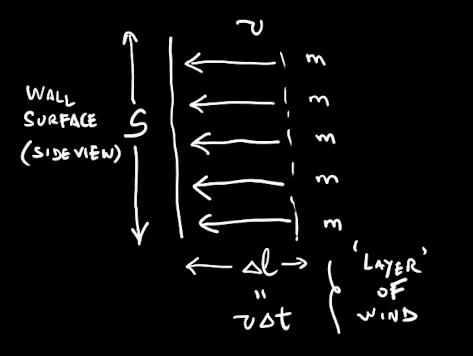
Agreed. You can get Seth's 'hydrodynamic' formula, from Swansont's suggestion. Consider some amount of time \( \triangle t \). With @studiot's suggestion of 1 second, the maths is slightly simplified. This defines a reference layer of wind. \[ \triangle l=v\triangle t \] \[ \triangle V=Sv\triangle t \] Every \( \triangle t \) seconds the corresponding layer of wind will transfer momentum to the wall by an amount, \[ \triangle p=v\triangle m \] where, \[ \triangle m=\rho\triangle V=\rho Sv\triangle t \] And the resulting pressure would be, \[ P=\frac{F}{S}=\frac{v\triangle m}{S\triangle t}=\frac{\rho Sv^{2}\triangle t}{S\triangle t}=\rho v^{2} \] As Studiot pointed out, momentum parallel to the walls is canceled out. While the air molecules bouncing back cannot transfer momentum back to the wind, so to speak, as we're assuming the gust of wind to be constant --it has reached some static regime. I forgot to mention my \( \rho \) is @studiot's d --the constant density.
-
I see no way in which anybody could disagree with it. And that's not good, I think.
-
The video certainly makes it looks as if it's the nuclei that are working as forced oscillators. Looking forward to your comments.
-
OK. So what I see here is: (1) Indeed Dr Lincoln says 'the photon absorbs the atom' at about 5.34. But I think that's just a slip of the tongue. (2) He doesn't mention the amplitudes, nor does he mention the frequencies involved. A forced oscillator responds with an amplitude that depends on the forcing oscillation frequency, the friction coefficient, and the natural frequency of the oscillator. But the frequency that survives, after the transient has died out, is the same as the frequency of the driving force. He omits those aspects, I think, for the sake of simplifying the explanation. He's mainly concerned with what he perceives as ongoing confusion due to flawed arguments on YT and the like. If you treated every single atom in the crystal as dipole, you could in principle calculate, by solving Newton's equation, how much it accelerates. You would need a formula to calculate the additional radiation, which is not easy at all. Of course, none of these details are dealt with in the explanation. And I understand why they aren't.
-
I think you're still confused as concerns 'fields' in algebra vs 'fields' in physics. Very different things. It's like 'dog' in 'hot dog' vs 'dog' in 'I'm walking my dog.'
-
What is a centripetal velocity? You mean angular velocity? Of what? Please, pick a scenario and stay with it for as long as you can. Reaction of a plane, Euler forces, now atmospheres... These are very different things. What's next? I don't see a circular argument. More like a Brownian motion.
-
Excellent idea. Thank you.
-
Might this be the only time you've specified an event? Even if it's only an impending one?
-
Oh, I missed that part. Sorry. I've started at about 7.05, as Lorentz Jr & exchemist said that was the juicy bit. Maybe it's worth a thorough look. I'll do that ASAP. This link @Lorentz Jr posted, https://en.wikipedia.org/wiki/Ewald–Oseen_extinction_theorem is worth a look or two. It's pretty much what I was fumbling towards.
-
Studiot's post already summarised at least part of the approach. At this point I think my explanation has lost interest TBH, because it's not so much one about 'mechanisms' as it is one about quickly and efficiently plugging in what we know, and simplifying the maths. I don't think there's any fundamental disagreement between one and the other, in spite of some sentiments expressed to the contrary. When you consider matter is made up of atoms, it's sometimes more convenient to package properties together in different densities, that's the essence of it. The main idea is that every time you have a material, it will react according to its properties, and those are --in the case at hand-- conductivity, polarisability, and magnetic properties. I'm busy trying to wrap up a quick explanation while simplifying the maths as much as possible, but it's turning out to be harder than it looked. Here's part of the reason: (from https://www.oceanopticsbook.info/view/theory-electromagnetism/level-2/maxwells-equations-matter#:~:text=ρ b %3D − ∇ ⋅ P,ρ f − ∇ ⋅ P .) I think I can do it, but please keep in mind, (1) I realise now that my explanation is not all that interesting --especially considering you're a chemist, and are probably more interested in the molecular mechanism. Also, I've finally watched the video, and it's more than good enough for me. (2) It's going to take some more time. I have to clarify notation, review the maths, and trim the whole thing down to what's of interest to us.
-
Hey, count me in. @Lorentz Jr is doing the thankless job of trying to see what's inside the cuckoo clock. (1) You never specify events, or are very ambiguous about it. You keep referring to frame-dependent quantities as if they must mean something to a 'super-observer' that's only in your mind. (2) You never specify reference frames, or conflate different frames in one sentence. (3) You systematically ignore, or make no reference, to experimental results which, needless to say, totally confirm SR in each and every instance that's been looked into. In summary, you don't understand SR, nor are you willing to learn about it --or so it seems. It's impossible to follow your logic because there appears to none. None that's worth considering, anyway.
-
If you mean the concept is that entropy is not conserved, and 'eventually' could mean 'infinitely far ahead in the future,' and that nobody is actually sure whether that will actually happen, among other things due to gravity being exceptional in almost every sense concerning entropy, and being the fundamental mechanism behind the evolution of the universe, I guess you're right. Indeedy!
-
What potential conservation of entropy? There is no such thing as conservation of entropy. You have a physical system. It has myriads upon myriads of microstates that have all the fine-detail distincions. Then you introduce coarse-grained distinctions, or cells, that include many microstates in them. That's information --of some kind-- for you. Perhaps because you don't know the fine details, perhaps because you don't care, or perhaps both, you don't know what's in the cells. No matter how you create the distinctions, if the system has the possibility to change --it hasn't reached thermal equilibrium yet-- your entropy will increase for the universe as a whole. It will also increase for an isolated system that hasn't reached thermal equilibrium yet. Example: A box, thermally isolated, with rigid walls. You have two different gases and a wall separating them. You remove the separating wall. The gases will mix, the system will reach a common temperature, pressure, volume, chemical composition, etc. All the information that you had stored in your system will have disappeared. Entropy has to do with information in the last analysis. Only when your system has reached thermal equilibrium, your entropy will stay the same. So no, there is no conservation of entropy, potential or factual. Entropy conservation would imply time, in a way, has ceased to exist. That's what people call thermal death of the universe.
-
Thank you, and no problem.
-
Like some kind of drag? Yes, that could do the work. I liked exchemist's analogy of the person trying to run on a trampolin too. I have to confess I've become sort of simplistic. And I'm far too fond of the formalism too. I think I understand polarisation well. I plug in the electric displacement, and that modifies the velocity constant. If the medium happened to be inhomogeneous, with regions of higher refraction index and regions of lower one, the explanation based on superposition of waves would be a mess. But you could still depart from the principle of least action and proceed from there. If one is happy with an intuitive explanation, the "drag" argument that you suggest sounds perfect. How natural that is in the mind of a person who wants to understand it crudely, I don't know.
-
The term 'attractor' or 'strange attractor' comes from chaos theory. Most dynamical systems follow chaotic trajectories in phase space --the space of all dynamical states of a system. Typically they evolve in an unpredictable way, and very close initial conditions differ wildly in very short times. However, they display some patterns, in that sometimes trajectories tend to cluster around certain regions and form certain shapes. Here's the Wikipedia article. https://en.wikipedia.org/wiki/Attractor They have indeed been compared to centres of attraction, although there is no force related to their being formed. It's considered to be an example of emergence, which is another concept you might want to take a look at. I hope that helped.
-
The sphere is not one of the platonic solids. Platonic solids are regular polygons: https://en.wikipedia.org/wiki/Platonic_solid Entropy is not a conserved quantity. See, https://en.wikipedia.org/wiki/Second_law_of_thermodynamics If entropy was conserved, time would cease to exist as we know it, and I would look exactly as I did 50 years ago, and 50 years before that, and..., and... There is. It corresponds to a hyperbolid, not a sphere: https://en.wikipedia.org/wiki/Spacetime#Spacetime_interval
-
Exactly. That's how I would explain it anyway. When the medium is linear and homogeneous, the wave equation has to be modified by including the electric displacement \( \boldsymbol{D}=\boldsymbol{E}+\boldsymbol{P}=\left(1+\epsilon_{0}\chi\right)\boldsymbol{E} \). It's only natural to assume that polarisation varies with the frequency, as how much it responds naturally depends on how fast I shake the atoms of the material. Which book is this? I don't know if Lincoln mentions that the material has to be a dielectric. If the material is a conductor, the wave will be damped, which can also be incorporated in the formalism with a complex refraction index --the imaginary part accounting for absorption. As usual, what's hard is trying to find an intuitive explanation with no maths.
-
I see. Thank you. @Boltzmannbrain. Sorry for the misunderstanding. You may find this YT function useful, Peace out. 🖐️

-
My apologies. The original sentence I was answering to was --I'd say-- ambiguous, I understood it referred to @exchemist and/or @studiot. In any case, it's wrong to say that the light wave and the 'electron wave' --which I understood as meaning 'the electron wave function'-- combine into another wave, never mind who says that. I didn't watch the video and wasn't offered a clear explanation of its contents. If that's what it says, I think the explanation can be made a wee bit simpler, but never mind.
-
No, no, no. That's not what they're saying.
-
The concept of a reversible heat engine does not occur in a conceptual vacuum, nor does it occur in a speculative space totally alien to physical reality. There are many concepts like it in science. Particularly in physics: Inertial frames, frictionless surfaces, point particles... The point is: You cannot attain them, but you can get closer and closer to the real thing. You cannot get gradually closer and closer to a leprechaun or a unicorn in any meaningful sense. You can, at best, make a visual mock-up of them. That's not a novel idea. As said: and certainly not one that affects the conclusions of Carnot's analysis. You've been told: Caloric is just a stand-in for something that was only understood after Carnot. But mind you: Understanding a concept better does provide you with a way to, eg, run some preliminary controls on your experiment: Minimise losses by somehow impeding the known mechanisms by which they might happen. An experiment is not just 'see what happens.' It's more like: Take a theory, think hard about what could affect your experiment. Run some controls. Then operate the whole thing and measure everything that could affect the results according to your theory. Use the data obtained from your previous controls as parameters that affect the workings of your experimental setup. Then run some error analysis. Then report. Something like that. I'm far from an expert on the experimental side of things, BTW. It's very hard, and I'm not good enough. That's one of many reasons why I don't do them. I've been scavenging for some material that might be useful to see what on Earth it could be that you're not getting, besides the obvious things. This could --hopefully-- be helpful: https://academic.oup.com/ijlct/article/11/2/141/2198425#36206861 You would need this, IMO, as you need to understand what sources of entropy you have besides those established in the reversible ideal design. It would also be worth reading some comments from here: https://physics.stackexchange.com/questions/78915/efficiency-of-stirling-engine-and-carnots-theorem It's a question about an ideal context, and nobody doubts Carnot's principle there. It's more about recovering Carnot's formula from an ideal --reversible-- Stirling engine. They should agree. And sure enough, they do. I don't know what else to say. I think I'm about done here. --------------------- * For an ideal --reversible-- Stirling engine. ** The isochoric legs PD: Did I forget? Very useful too: https://www.stirlingengine.com/