
Alex_Krycek
Senior Members
-
Joined
-
Last visited
Everything posted by Alex_Krycek
-
I mean, balloons have been used to infiltrate US airspace as far back as WW2 when the Japanese floated them over. So not exactly a novel tactic.
-
Could be the case. The cat got out of the bag.
-
I find it interesting what the US military chooses to show to the general public, and what it chooses not to show. First, we have the incident with the Chinese spy balloon. The spy balloon got significant press coverage: it was tracked flying across the continental US, there was the big debate about whether to shoot it down or not, we had photos of the US Navy recovering it off the coast near Myrtle Beach, SC, the FBI assembling the evidence in a warehouse. You name it - we were shown it. It's been made into a big spectacle and all have been invited to come and see. Now, this Chinese spy balloon could just have easily been kept quiet and classified. There are numerous other incidents of surveillance by foreign adversaries that occur on a regular basis which are not publicized. Why was the public given such a show with this one? The result of all his sensational publicity is that a clear and vivid perception has been created in the minds of the American public about what it is the US Military shoots down when it comes to unknown objects. The idea that these objects are Chinese balloons, adversarial surveillance craft of some kind, has really been hammered home these last few days in terms of imagery, narratives, press coverage, etc. Attention, time, and energy in spades. There is now an anchoring point that the public can revert back to when confronted with future unknowns. Then we have the Alaska object. From what's been described it's markedly different in terms of its size, shape, appearance, and flight characteristics. The US gov also won't attribute it to any country, as they so quickly did with the Chinese balloon. In all of the press coverage I've read about the Alaska object, the Chinese spy balloon story is woven into the same article. I haven't seen a single article about the Alaska object that hasn't in some way referenced the Chinese spy balloon story. It's a tactic of misdirection, the old conjurer's trick - where the idea or perception that you want someone to conclude is the fact is linked, or connected, with an objectively unknown situation. Those without strong critical thinking skills will subconsciously link what you have referenced from the past as the factual explanation for the new unknown scenario. In this case the American public will conclude that the Alaska object is the same as the Chinese Spy balloon; they won't give it a second thought. Meanwhile, whatever was shot down over Alaska can be quietly collected with little publicity or fanfare. I suspect that any future reports of objects being shot down or unknown aerial objects in general will be linked with the Chinese spy balloon story also, since that narrative has been effectively anchored already.
-
And no photos will emerge of this incident whatsoever. Interesting.
-
The Alaska object is described to be significantly smaller than the Chinese spy balloon with an elongated "tic tac" oval shape, and cannot be attributed to any country. Unlike recent days, I doubt we'll be seeing images of the Alaska object's debris broadcast all over the media...
-
True, but greed and selfishness by violent groups of people are omnipresent anyway in human society. The early middle ages, which was without question one of the worst times to be alive on this planet, was governed by such a power structure. I'm not entirely optimistic that such a tribalistic order wouldn't re-emerge should the world balkanize itself down into disparate, isolated societies again. What factors would prevent a regression to the dark ages of petty tribalism?
-
Russia seems to be making baby steps even with their mobilized forces. Then they get pushed back. Only so many times they can do that before they run out of soldiers. They need some sweeping, decisive gains pretty fast I think.
-
Then why hasn't it worked for Russia this far?
-
Yeah, "throwing bodies" at the problem may have worked during WW2, but warfare has changed quite a bit since then. Sending wave upon wave of troops makes no difference in the face of superior weaponry, positioning, tactics, etc.
-
Yes, and the point that many seem to be missing is that we take the myriad benefits of globalization for granted. None of us have any first hand experience living in a non-globalized system. As you point out, it's the interconnectedness of globalization, the ease with which goods flow between nations over long distances that affords us everything from sophisticated technology to food security to rising income levels and access to higher standards of living. Regarding food security, it's scary to understand just how fragile many countries are in the world when it comes to basic nutrition and sustenance. Vast swaths of Africa and middle east are net importers of food. The slightest disruption to global supply chains or shortages in commodities like wheat or rice cause widespread famine in these regions. Food insecurity was one of the trigger points of the Arab Spring uprising back in 2010. Turns out when people can't eat, they get pretty angry. This report from UNICEF has some good data on the current state of food security: https://www.unicef.org/media/72676/file/SOFI-2020-full-report.pdf What will happen to these countries when they get hit with the 1-2 knock out punch of climate change (which already exacerbates food security) and supply chain disruptions due to collapsing populations? Unless countries that are net importers of food rapidly, rapidly undergo revolutions in sustainable food production, they're toast. As a side note, most of the world's phosphorous for use in fertilizer comes from Russia and Ukraine, the flow of which has been severely disrupted due to the war. We've mentioned here how technology will come to the rescue in the form of robots, renewable energy, etc. We should acknowledge that advanced technology is massively energy intensive to produce, and can only be done with relative ease in a globalized system. If we want a global "green transition", this will require a globalized system to facilitate. Zeihan points out here how much energy it takes to create a product such as a lithium battery, or solar panel, or electric vehicle. Most of the world's steel for example comes from China and Russia, the two countries which are disintegrating fastest in terms of demography. Finally there is the argument that once the global system breaks in several key places it will be increasingly difficult to fight the avalanche of entropy that will follow. When critical infrastructure goes offline and there's nobody there to fix it, it's gone for good. Without an ability to produce advanced technology to save the day, the lights go out and stay out. Without an ability to make enough food to feed everyone, people begin to starve and then fight for what's left. Anarchy ensues. Then we're back to the stone age rather quickly indeed. But that's the pessimistic view. I'm sure we'll adapt, somehow. Hopefully... His latest book is worthwhile even if just to understand how technology has lifted humanity out of pure misery and suffering, and just how excrutiatingly long that process took. Most human decisions have been driven by pure practicality - how to move something in a way that doesn't use up too much energy (enter deep water navigation), how to stop the neighboring tribe from coming and killing everyone, how to get enough to eat, etc. For practically all of human history, more people meant a better life. More hands on the farm, more soldiers in your army, more workers in your factory, more consumers for your products. Now we're diverging from that trend in unprecedented fashion with no real understanding of what will come next.
-
I believe generally speaking it is urbanization: as people move to the city people see children as an expensive burden, not an extra set of hands like on a farm. So movement away from the countryside to the city would be one factor. Also a rise in intelligence. The smarter people get, the less interested they are in having kids until later in life, and generally they have less kids than in the past. Finally I would think sheer pessimism and gloom would be another component. With the state of many countries and how many people are struggling to make ends meet, having kids is the last thing on their mind (which kind of goes back to point 1: kids have become an expensive luxury). I mean, historically speaking the world has been in never ending crisis and upheaval for all of human history, just some places have it slightly better than others some of the time. Also we have to keep in mind that the norm for civilizations historically speaking is to rise and then collapse, so this might be an inevitable downward cycle. However, one achilles heel of analyses like PZ's is he doesn't take into account the unknowns. I know its obvious, but the development of human society isn't linear, that much is clear. The situation could diverge in ways we can't currently comprehend, especially with novel technology affecting the situation.
-
This is what I always thought too. Apparently rapid population decline is massively destabilizing though, according to PZ. China is going to be the "canary in the coal mine" to watch. However Japan has managed to do well.
-
I suppose it's not technically "irreversible" on a long enough timescale. A country just can't produce enough people overnight to regain the population levels that it needs. Decades are required. It's not like ordering a product where that product can be topped up in an inventory when the next shipment arrives. These are deep, seismic shifts that are occurring. The main point Zeihan makes is that globalization is necessary to sustain the critical infrastructure of most modern countries, and there is a necessity to maintain a certain amount of people to sustain most countries' ability to interact meaningfully within a globalized system. So without the people, a country can't participate in a globalized system, and if they can't participate in the globalized system, there will be massive destabilization in many sectors of that country due to the effect it will have on its critical infrastructure (due to its reliance on the interconnected relationships (trade, defense, transport, energy) that globalization affords. This explanation about the current state of the Chinese collapse illustrates the overall point of the population "death spiral": https://www.youtube.com/watch?v=0MSV2bh48MA
-
Recently I've been reading and watching some of Peter Zeihan's views, specifically in his latest book: The End of the World is Just Beginning: Mapping the Collapse of Globalization. Zeihan is an expert on demography and geopolitics, and combines the two disciplines to produce some sobering forecasts about what the world will look like in the coming decades, particularly as numerous countries suffer irreversible population implosions due to insufficient birth rates. China is possibly the most well known case, but many other countries will suffer exactly the same fate in the 21st century. A key point that Zeihan makes is it will be extremely difficult, if not impossible, for countries to regain their population levels after this happens, namely because it takes so long to generate, well, a generation. This article points out just how serious China's population decline is anticipated to be. Link to Article The United States, on the other hand, seems to be in a pretty good place, demographically and geographically speaking, to make the transition. Overall Zeihan has some interesting points. Many of his points are directly inferable from current events. For example, he points out that Russia is basically in its last generation before collapse, and Putin is only accelerating this. According to Zeihan, the planned 500,000 man onslaught, a result of Russia's winter-long mobilization effort which it will throw at Ukraine this spring, will be Russia's final ability to fight a conventional war (should they not have a resounding victory across the board). They just won't have enough people (in this case fighting age men) after this. Zeihan has a youtube channel and a website if you want to investigate him. His views are somewhat antithetical to the idea that less people in the world would be better. Zeihan is obviously an expert in his field, and his predictions are based on verifiable trends, and are quite pessimistic for most countries. He sees some countries regressing rapidly into a state of anarchy due to the breakdown of critical infrastructure and logistics, for example, triggered again by not enough people. However, I wonder what unforeseeable (or foreseeable) events might drive the world into an alternate state of reality other than the one Zeihan portrays. For example, I can easily see A.I taking over much of the human labor that will vanish as a result of the population collapse. Interestingly, the US and its allies strategy to control microchip and semiconducter production seems to be a very relevant gambit designed to prevent any adversary from developing a viable A.I. integrated military, or at least one that can compete with the West and its allies. Another example might be human cloning or so called "baby farms" where humans are produced en masse in a laboratory, not unlike the Institute in Fallout 4. In short there are many avenues for adaptation in a world with much less people. Finally, there's the viewpoint that population collapse for the world is long overdue, thanks to the threat to biodiversity and collapsing ecosystems caused by globalization. Zeihan points out that Japan has already reached a "post boomer" society, and has handled it rather elegantly. Perhaps the coming population decline and deconstruction of globalization will be a net positive for everyone. Thoughts?
-
"all knowledge is historically situated and is influenced by social power and politics" This phrase reveals that the course designer's epistemology is one of social constructionism. Social constructionism posits that there is no objectively true knowledge in and of itself; knowledge is inherently created and defined by the society in which it arises (and therefore is the offshoot of gender, race, class, etc). Therefore the body of knowledge that underpins all the scientific disciplines is subject to "re-interpretation" since it is inherently the result of a racist and sexist society. This epistemological outlook is Neo-Marxist in origin and in my opinion is nothing more than thinly veiled solipsism, fundamentally incompatible with science. The rest of the course description is just grandiose jargon designed to make it sound legitimate.
-
This aligns with the idea that Trump had plans to sell the secrets to the Saudis, who have wanted nuclear weapons for years. Remember, all Trump cares about is money. https://www.msn.com/en-us/news/politics/jared-kushner-theories-swirl-over-242b-saudi-money-after-trump-mole-claims/ar-AA10DUzU
-
Not to worry - none of the classified information had pictures so Trump wasn't interested.
-
Authentic dub. Haven't heard this in a while. Good vibes.
-
A Torsion Pendulum designed to produce thrust I suppose: Anomalous Thrust Production from an RF Test Device Measured on a Low-Thrust Torsion Pendulum This paper describes the eight-day August 2013 test campaign designed to investigate and demonstrate viability of using classical magnetoplasmadynamics to obtain a propulsive momentum transfer via the quantum vacuum virtual plasma. https://ntrs.nasa.gov/citations/20140006052
-
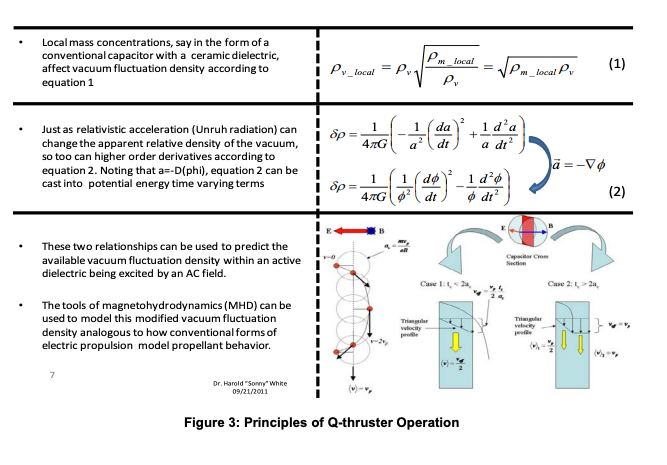
Recently learned of NASA's Eagleworks laboratory which is conducting advanced propulsion research. A waste of taxpayer money? Not in my view; we need more of this kind of research. https://ntrs.nasa.gov/citations/20110023492 ABSTRACT NASA/JSC is implementing an advanced propulsion physics laboratory, informally known as "Eagleworks", to pursue propulsion technologies necessary to enable human exploration of the solar system over the next 50 years, and enabling interstellar spaceflight by the end of the century. This work directly supports the "Breakthrough Propulsion" objectives detailed in the NASA OCT TA02 In-space Propulsion Roadmap, and aligns with the #10 Top Technical Challenge identified in the report. Since the work being pursued by this laboratory is applied scientific research in the areas of the quantum vacuum, gravitation, nature of space-time, and other fundamental physical phenomenon, high fidelity testing facilities are needed. The lab will first implement a low-thrust torsion pendulum (<1 uN), and commission the facility with an existing Quantum Vacuum Plasma Thruster. To date, the QVPT line of research has produced data suggesting very high specific impulse coupled with high specific force. If the physics and engineering models can be explored and understood in the lab to allow scaling to power levels pertinent for human spaceflight, 400kW SEP human missions to Mars may become a possibility, and at power levels of 2MW, 1-year transit to Neptune may also be possible. Additionally, the lab is implementing a warp field interferometer that will be able to measure spacetime disturbances down to 150nm. Recent work published by White [1] [2] [3] suggests that it may be possible to engineer spacetime creating conditions similar to what drives the expansion of the cosmos. Although the expected magnitude of the effect would be tiny, it may be a “Chicago pile” moment for this area of physics. https://ntrs.nasa.gov/api/citations/20110023492/downloads/20110023492.pdf Some diagrams from the research paper below: NASA Eagleworks.pdf


-
FINA got it right in my opinion. Transgender athletes like Lia Thomas are unfairly competing in the women's category. As FINA stated, this is about fairness. They will create an "open" category for all others to compete in.
-
Cool soundtrack, cool film.
-
Thanks. So probably the easiest way would be to examine physical materials from the affected environment. Would investigating anomalies in radiation levels be relevant or not really?
-
For areas of the Earth that have experienced significant impact events, something measurable on the Torino Scale, would there be any possible way to measure effects on the subatomic particles within the radius of the impact? If so, what effects might one be looking for? For example, how could one setup an experiment to measure possible subatomic effects of the Vredefort Impact event in Southern Africa? Stony asteroid impacts that generate an airburst[19] Impactor diameter Kinetic energy at Airburst altitude Average frequency (years) Recorded fireballs (CNEOS) (1988-2018) atmospheric entry airburst 4 m (13 ft) 3 kt 0.75 kt 42.5 km (139,000 ft) 1.3 54 7 m (23 ft) 16 kt 5 kt 36.3 km (119,000 ft) 4.6 15 10 m (33 ft) 47 kt 19 kt 31.9 km (105,000 ft) 10 2 15 m (49 ft) 159 kt 82 kt 26.4 km (87,000 ft) 27 1 20 m (66 ft) 376 kt 230 kt 22.4 km (73,000 ft) 60 1 30 m (98 ft) 1.3 Mt 930 kt 16.5 km (54,000 ft) 185 0 50 m (160 ft) 5.9 Mt 5.2 Mt 8.7 km (29,000 ft) 764 0 70 m (230 ft) 16 Mt 15.2 Mt 3.6 km (12,000 ft) 1,900 0 85 m (279 ft) 29 Mt 28 Mt 0.58 km (1,900 ft) 3,300 0 Based on density of 2600 kg/m3, speed of 17 km/s, and an impact angle of 45°
-
I think Greene's argument is logical. His argument kind of reminds me of my old boss, who was incredibly excited about his new BMW. He even had employees take a special break so they could come out and look at it. Nobody thought his car was special except him.