Ken Fabian
Senior Members
-
Joined
-
Last visited
Everything posted by Ken Fabian
-
A few nations do have the will to tax the windfall profits and use those for easing the short burden on the most burdened but also for supporting investment in longer term solutions. Others lack the will, whether genuinely believing only fossil fuels are good enough or politically beholden or cowed by the influence of this industry - which does appear capable of deliberately constraining supplies to keep high profits and using a sense of crisis to advance their industry. Apart from dealing with the short term harms of the current conflict induced energy crisis, that needs quick fixes, I would agree with carbon pricing at producer level and using other actions to reduce the hit passed on to consumers, especially for those at risk of hardship. Although I wonder to what extent high fossil fuel prices will work unintentionally as carbon pricing; it seems like greater commitment to renewable energy is emerging out of the current crisis, in large part because of an expectation that prices may never decline to pre-crisis levels. And climate change concerns are not going away. I see carbon pricing as about inducing investor choices and only about consumer choice indirectly, that framing it as about consumer choice misses the point that changing the supply of energy is the main point. And it probably couldn't do what we want until and unless there are other options that are approaching or have achieved some level of cost competitiveness; if the gap is too great (and not so long ago that looked like a given) the result will be the counterproductive outcome the economic alarmist fear of green energy targets, ie rising costs that hurt consumers but effect no change. If carbon pricing works then revenues should decline to zero, and carbon pricing should be designed to be avoidable, ie it should not be treated as an enduring source of revenue.
-
Whether it is wise will be in the detail. Mostly the gas suppliers apart from Russia are not supplying less and are not producing less. Their costs may have risen marginally but their prices and profits have gone stratospheric. They won't willingly cut their prices down to mere very good profits, not even to prevent global economic disaster, even though perceptions of them as greedy and careless of consequences could conceivably harm their businesses over the longer term. As global recession could too. Some nations are taxing the super profits, ie have made the cause of rising prices the source of some funding for price interventions, but where the gas industry has the ears of policymakers and influence they appear capable of turning this sense of crisis into an opportunity for growth, with taxpayer money flowing to them, rather than away, irrespective of their current extreme profitability. They will fiercely resist price caps at producer level - mostly successfully. It will be power companies that purchase fuels off them at inflated prices (some being subsidiaries and not actually separate) that will be needing assistance to prevent the costs flowing through - which may come directly or indirectly from funding support for price differences at consumer level. I think we do need to see this as short term. Longer term will see greatly increased commitment to renewable energy and to the things that weren't done to make it constantly available... because gas was, we were assured, able to do it much cheaper and more reliably, which everyone except Greens supported. I expect that their failure to deliver that reliable supply at low cost - plus global warming concerns not going away will only make them more determined to reframe this fossil fuel energy crisis into a 'green' energy crisis. With an overflowing abundance of financial resources to put towards lobbying, PR, advertising, strategic donations, tactical lawfare, post politics payoffs etc.
-
Yes, in the face of a fossil fuel energy crisis, where the fossil fuel industry promised gas would make the transition to low emissions easier, with greater reliability and lower cost - and failed to deliver - plus the combination of downward renewables costs and high fossil fuel prices, it is more important to them that it be reframed as a green energy crisis. They'll take the windfall super profits and fiercely resist reducing them to mere very good profits to save economies from disaster, whilst making out they are being badly, unfairly treated because of "unreasonable" climate concerns. I am not convinced people apart from the climate science and renewable energy deniers will believe them except that they have large parts of the media and mainstream politics - powerful influencers - onside. Not sure to what extent politicians are beholden or cowed or actually believe them but most seem unwilling to challenge them. I think climate concerns are not - and never will - go away. People know that global warming is real and what is responsible. And electricity grid operators like the Australian Electricity Market Operator - AEMO - aren't fooled either - and are calling for greater investment in renewables as the solution to energy supply, high prices and price volatility, even aside from emissions concerns. The arbitrary division between responsibility and accountability of end consumers and absence of it applying to producers (actually a full inversion of long established legal principles) allows a forked tongue approach for Australian politicians, where assurances that they will give full support for fossil fuels for exports are also assurances that miners that currently service local demand will have future opportunities even if domestic emissions reductions efforts succeed. In a way they are turning the efforts by environmental activists to urge personal responsibility and personal action back at climate activism by encouraging perceptions that it is consumers, not energy producers that have to embrace and lead the way with change - knowing most people will resist any change that appears to reduce their immediate prosperity and that resistance flows through to tolerance of commercial resistance to change. I don't think we can demand consumers change much until the low emissions alternatives are in place and available - ie following, not preceding, change at the supplier/producer level. It is institutional change that is pivotal; my climate activism is mostly about getting the economy wide changes in place rather than applying guilt to consumers who didn't choose the kind of society and economy they are part of or what it takes to be a productive citizen or decide what energy markets make available to them and to the companies that do the products and services they use.
-
We shouldn't assume continuity of energy supply cannot be plugged by other means than fossil fuels or fusion - especially when speaking in terms of even if takes a hundred years to achieve. We should be looking wider than that. Still a lot of potential gains in geothermal, tidal, pumped hydro and other gravity storage. Chemical batteries and capacitors are not truly out of the running for large scale, long storage. Cost competitive SMR's are still possible and nuclear will have it's place even if it remains expensive. There is perovskite solar that may make adding solar to any light exposed surface trivially inexpensive. There are nantennas that could make the IR from the ground below and the night sky above into electricity. Truly we have an abundance of potential clean energy options and science and technology is better placed than ever before to make them work. They are all worth pursuing but some that look a lot more achievable get a lot less funding than fusion. Not to take funding away from fusion but give more... everywhere. R&D is still showing itself to be a stunningly good investment. Surely it isn't in doubt that we can expect climate disasters from high CO2, nor that there is a sufficient abundance of fossil fuels to still take global warming into worst case territory. It is fortunate that clean energy innovation, which has surprised us more than once, has a lot of potential for major advances, is giving hope that it may surprise us again. Even as things stand now, with what is in the pipeline, there is hope that it isn't inevitable, that the worst cases are avoidable. Given Carbon Capture and Storage is intrinsically loss making and unscalable I think we have to accept we have to leave most of those fossil fuels unburned.
-
I'm not sure that domestic use is the biggest issue, rather it is burning wood pellets in power stations. It hasn't been increased domestic demand driving greatly increased forest harvesting; it doesn't help to lump them together. I see wood burning in power stations - like gas - as a compromise mainstream politics supporting specific commercial interests insisted on to support building renewable energy. Much was made of the dependable, reliability of burning of fuels as a the lower cost alternative to investments in things like pumped hydro and the industry successfully made themselves into an "essential" ingredient of a transition to low emissions; that it was supply of the "low cost reliability" element - natural gas - that failed makes it more important to those commercial interests to persuade the public that we are witnessing a profound failure of renewables and that this conflict induced fossil fuel energy crisis be rebranded in the public - and the policy maker - mind as a green energy crisis. Most of the "crisis" is soaring prices; I doubt overall supply of gas has diminished that much. These companies (apart from Russian ones) are making staggering hyper profits out of things going wrong in the world but fiercely resist bringing their prices down to merely very good profits to ease that sense of urgent crisis or prevent economies crashing and burning. It is the sense of crisis that lets them push for increasing overall supply and dependence and get government backing to do it. Climate concerns do count in this; this crisis is being used as an opportunity to sideline them. I boggle at the audacity - and the success - of blaming climate and emissions reductions as the cause of current woes and massive expansion of fossil fuel supply as the solution. Most Green parties have opposed large scale forest harvesting for wood burning and tended to promote things like pumped hydro - batteries really only finding a viable place quite recently - along with (less helpfully) energy frugality, with the unwillingness of the rest of mainstream politics to commit to climate action and need for blameshifting a large part of the framing of the issue as green "you care so much, you fix it" and blaming of green politics for the failures "not like that!". Promotion of energy efficiency and frugality was turned back against climate action advocacy as "they want to take us back to the stone age" memes. Alarmist economic fear - of losing prosperity by going without fossil fuels - remains one of the most potent messages deniers and fossil fuels supporter have. The sense of urgent crisis is temporarily overwhelming longer term climate concerns but I don't know those concerns or growth of renewables will ultimately be prevented but it can be slowed. I'd have thought the fossil fuel industry would be at risk of losing their social license - promising energy reliability and low costs and not delivering, making hyper profits out of economic instability, total disregard for climate consequences - but at this point they seem to be laughing their way to the bank, with a little bit of the windfall set aside for ongoing favorable political influence and publicity. In Australia our variant of this gas supply crisis has come from our gas industry focus on exports - much on fixed price contracts but still a lot at global market prices. Domestic supplies are at the "will be cheaper this way" global price; the projects and gas production were and are so large that it seemed like assuring domestic supply required no special planning - like trickle down - so none was done. Record flooding (with attribution studies showing they were worse because of global warming) put some coal mines out of action so coal plants shut off and more gas was needed, for which no planning was made, with Winter starting with a cold snap, that wasn't anticipated - like a cold snap in Winter was something no-one could anticipate! Even as the Australian electricity market operator (AEMO) calls for greater investment in renewables (including storage) as the longer term solution to price volatility and reliability the ongoing fossil fuel influence is getting politicians and governments to approve more mines and drill sites and make more dependence on fossil fuels the solution. It is incredibly frustrating - and dismaying.
-
I would say the resources of the greater society and economy rather than specifically capitalism; there is a significant amount of government run social democratic education, welfare and healthcare around here where I live. Which I approve of; it tends to be a good thing for people at large - and for capitalists too in indirect ways. I am also not sure the groups you name are actually convinced they are independent of that greater economy society or actually support or promote anarchism. I am not sure there is enough homogeneity to have a stereotypical punk or eco warrrior. Punk rebelliousness seems to have some vague connection to Anarchism but way short of it being any kind of ideology; I doubt many of them would know what Anarchism actually means. With eco warriors (or social justice warriors) the concerns they raise can be valid and mirror real concerns of large parts their communities even if some of the activists seem determined to raise awareness through their power to irritate. Anarchism doesn't have much going for it, even for attracting the disaffected; Libertarianism has a lot more popular appeal, often amongst people who support armed citizenry and don't pretend to the kinds of peaceful means that a lot of social justice and environmental advocates hold to.
-
I can see a how a small homogeneous group sharing the same beliefs can run on customs rather than institutions of government and laws. I have long suspected libertarians think it should work at larger scale because of that ability of homogeneous communities to uphold rules of behavior without resort to formal rules or institutions to do the enforcing at smaller scale. The dream is of a community of people who all agree and abide with the unwritten rules and are willing to step in and unite when they see them broken, so they don't need the institutions. But without the underlying agreement on what the rules are - or groups remaining small enough for everyone to know everyone else's business and cheating and getting away with it is hard - it doesn't hold together so well. These can be inclined to turn out or turn on outsiders with different customs and won't have the institutions to ensure the lynch mob holds a fair trial first. Likewise for anarchists.
-
If you start with hiring Shakespeare to write your speeches and tell him clearly what points you want to make (and why) that looks very different to reading aloud what Shakespeare wrote centuries ago. When the points matter and making them clearly and effectively is very important - more important than any satisfaction for doing it yourself (and you are very busy with other important stuff) - then having professional writers seems like a good move.
-
I think the totality of R&D is important - that achieving something very hard like fusion will come from advances coming out of a wide variety of disparate research programs. Did these better superconductors come out of ITER or any kind of dedicated fusion research or is it the beneficiary of research for different reasons by others?
-
"Mitigation" usually means prevention, or at least actions taken to reduce and minimise the problem, like emissions reductions - do you mean we're starting to do (by necessity) adaptation? I don't think urgent short term responses to climate enhanced weather disasters are above the threshold where longer range building of clean energy or other mitigation gets set aside (yet) but that has to be a real concern as global warming impacts become more common and more severe - that we will be too occupied cleaning up and repairing after the last disaster to apply ourselves to fixing the fundamental problem. We are still struggling to get that clean energy growth to levels where it not only covers all new growth in demand but starts eating into existing fossil fuel use but on the other hand clean energy growth remains very strong and crossed a threshold - cost - to where wind and solar the most built new electricity types. I think we will see it continue to grow strongly, with room for some cautious optimism. That the current global fossil fuel energy crisis is being reframed as a green energy crisis by climate science deniers and FF industry advocates and sympathetic big media - that the solutions to this and future energy crises should be greater use of fossil fuels - is dismaying but hardly new or surprising; gas use was promoted heavily as reliable, low cost and even as low emissions. The gas industry certainly appear unwilling to reduce their current war and misery driven hyper profits down to mere very good profits to prevent economies crashing and burning, let alone to keep those assurances of low cost. Support and investment in genuine clean energy solutions at the scales needed were set back by turning to gas - why spend all that money on pumped hydro when gas is so much easier and cheaper? But I think lots of people - experiencing record climate extremes - are not believing the denier line that it has been green energy policies driven by alarmists and extremists are the problem. I don't think people are as willing to turn to them for genuine solutions. ----------- I think it is good to follow through with fusion and see how far it can be advanced but it isn't something we can rely on for clean energy solutions within the time scales we have. Given how extremely difficult it is to do at all doing it reliably at low cost looks a big leap; it may never become a serious energy source but may find applications all the same. Success with perovskite or other potentially very low cost solar would probably have a greater global impact in shorter time. And better batteries - which I think we can expect to see, given the levels of R&D currently in play. Putting some efforts into things that have hypothetical potential but cannot be counted on besides fusion look worthwhile too; optical rectenna/nantenna tech is one I think worth pushing harder on, for all that the yields achieved to date are just barely above proving they can work. A LOT less funding for that than fusion but I am not quite sure why fusion captures imagination but something that could generate energy from waste heat and downwelling InfraRed from the sky, day or night, does not.
-
Probably one of Bacigalupi's least "real" stories. A lot of SF looks like fantasy to me and The Windup Girl tends towards the more fantastic. I generally find his bioengineering ideas less believable than the climate change and disparate ways nations and people cope or don't cope but I think they do make for good stories. "The Water Knife" was the one I found most plausible seeming - and is probably the most near future of them, apart from his contempory not-SF "The Doubt Factory". Which is amongst his more direct commentaries.
-
Was that an expectation of actual immortality or the immortality of enduring recognition and/or fame past their own lifetimes? Leaving an enduring legacy seemed to count for something.
-
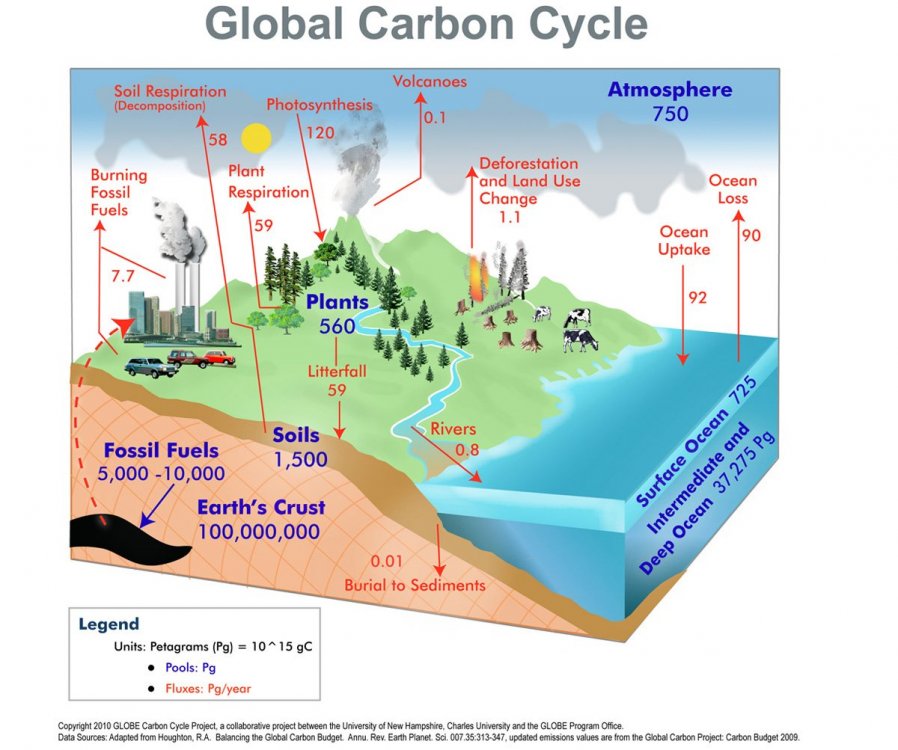
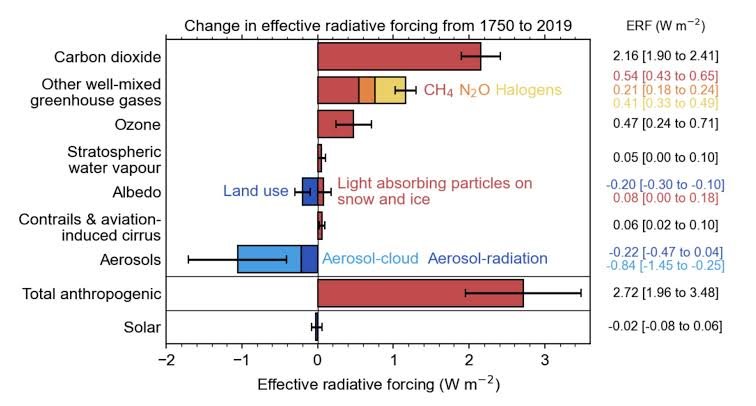
It has taken quantification of every possible influence and estimations of their interactions to reach the conclusion that greenhouse gases - CO2 mostly - are the biggest (but not only) driver of global warming. Some of those influences are considered too small to be significant over the time scales that are under consideration, like volcanic heat, waste heat, orbital cycles/changes. These are not excluded from consideration, just estimated to be of low signicance. Specific to the points you are raising the impacts of vegetation changes to albedo (how much change to reflection of sunlight, ie it's dispersion) are being estimated and included along with other things that affect reflectivity, like snow cover. As are the flows of carbon into and out of vegetation and soils and oceans. I don't think the energy flows/stores within vegetation are explicitly considered in climate modeling but are still intrinsic to estimations of changes to global biomass and could be derived from them. Global Carbon Cycle - (a bit dated but it gives a good overview) - Estimations of climate forcings (including albedo and other land use changes) -
-
Not sure they are precisely post-apocalyptic - more like set within ongoing regional disasters rather than total apocalypse, but I was impressed by the climate and bio-engineering catastrophes of Paolo Bacigalupi. Scarily plausible on some fronts - Arizona, Nevada and California warring over water whilst fighting off the waves of despised climate refugees... that keep coming from Texas (in "The Water Knife"), so desperate even heads hung on razor wire fences don't deter them. Living with the rampant diseases of crops that came out of the bio-labs of competing global food companies - the "calorie companies" - with bioengineered humans slipping their leashes in "The Windup Girl". The dystopian SE (formerly) USA with sea level rise, Cat 6 hurricanes and scavenging of raw materials the principle industry (scrap for guns and bullets) as brutal militias made up mostly of forced child recruits war against "traitors" (other militias) after the Chinese peacekeepers give up trying to help, take their supersoldiers and leave them to it - in the Shipbreaker trio ("Shipbreaker", "The Drowned Cities", "Tool"). As bad as the climate disasters are it is the human responses to it that make it horrific.
-
How are underground water and sewage lines managed and repaired in Winter? Buried deeper in colder parts but wait till Spring to do repairs? That trade-off between building better and the maintenance requirements and costs of outages will always be there. @Peterkin I do think long distance interconnectors are going to be increasingly important to decarbonising electricity - and electricity will be important for decarbonising other energy requirements. I am not familiar with Canadian conditions and am not claiming I know better but I am doubtful that local self sufficiency will suffice; I think improving reliability of interconnectors will matter a lot. The best positioning of solar farms for Canada may be in Nevada.
-
It sounds like Canada needs to put power lines underground because the costs of not doing so are so high. Self reliance for rural homes or communities is good but a different problem than reliable supply for urban centres and industry that are important too. To what extent can Canada's grid make use of US energy sources and interconnectors? And vice versa? The nearer to the Arctic circle the more seasonally limited solar is going to be. The more extreme the weather conditions the more significant the ways they are mounted become and more expensive. The concertina packs of solar above are going to work well in Australia and much of the world but not everywhere. Wind and hydro may always be more necessary for Canada than for nations like Australia. I'm not a big fan of nuclear but nor am I strongly opposed; it will have it's place too but it will be up to people who are it's fans to do the promoting - preferably with greater distancing from pro fossil fuels climate science denier politics, that turns it into an anti-renewables rhetorical position more than an actual emissions reductions option. I am not sure if State mandates and guarantees for nuclear are any more palatable to nuclear's more vocal backers than steep carbon pricing that will probably - inadvertantly - aid renewables more than nuclear.
-
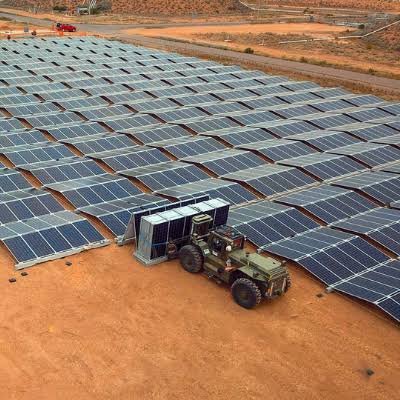
@swansont They unpack E-W, ie the peaks/valleys are running N-S, which gives good morning and afternoon insolation as well as middle of the day - though solar panels laid flat would get similar sun exposure. Better angled I think to shed rain (and dust?) and structurally stronger; the pic looks like a desert site. Not sure now where that pic came from or it's location. Apparently there are installations all over the Australian mainland and around the world already - one in the Atacama desert in Chile. Not all in deserts. It does look like the kind of innovation needed to grow clean energy fast enough to reach net zero goals in a timely manner. It's actually a portable solar farm system, easily moved from one location to another. The company is 5B, Maverick is the name they give their rapid solar deployment system - “100 kilowatts fully installed before lunch, and 1 megawatt in a week”. They pack more panels into a given site area which delivers higher output than fixed angled style - claimed at 180 - 200%, equivalent to single axis tracker systems but at the cost of more panels, made up for by big savings on installation. I assume they will work best nearer the equator; they will work at other latitudes.
-
Australia is seeing increased rainfall for the North-West but reduced rainfall for most of the rest, especially South, which looks related to changes to High pressure systems from Hadley Cells, ie they are tracking further from the Equator (ie South) due to global warming. Cattle grazing is likely to benefit in the near term but it is mostly not well placed for intensive agriculture. Not so clear about the longer term; it gets very hot there even without extra warming (Australia's hottest place is there) and extreme heatwaves could undo the benefits.
-
It becomes a trade-off between installation costs and maximising output. Cost usually wins out in the end. This style gains by reducing up front costs (but works best nearer the equator and will not support co-existence with livestock grazing) -
-
Enough magma convection and volcanic activity still goes on to keep bringing up some minerals from deeper down; it isn't a placid one way sinking of heavier minerals towards the core. I live on the remnants of an extinct volcano, on the rim of what was once it's crater. Whilst not a major deposit, it coughed up enough gold, copper and silver to attract the attention of gold rush prospectors in the late 1800's and mining companies ever since. Not a lot of actual, profitable mining but they keep looking, with hopes of prices going high enough to be economic. The last eruption was 23 million years ago - very recent in geological terms. Is this about the density of the mineral compounds they form or otherwise bind to?
-
I am a bit skeptical of the promise of large scale weather modification. I think the reason that central Australia is desert is a persistent lack of on-shore winds capable of carrying moist air into the interior, not lack of evaporation over oceans when we get them. There is a preponderance of high pressure systems due to Hadley cells, that drop dry upper level air down over desert areas, with prevailing low level winds blowing coast-wards and/or blocking on-shore winds as a result. I think that is the case for the Sahara and other desert regions too. Mountain ranges and their rain shadows can be a big factor for some deserts too. Greening desert fringes can have an impact but I suspect it works because human activities - introducing grazing livestock, including gone feral (goats, donkeys, camels and rabbits in Australia) - is why they lost their vegetation; in combination with managing those pest species it is possible to bring back vegetation. Whilst vegetation can increase local precipitation it isn't a huge effect; these regions are still highly dependent on occasional rainfall events. There can be - at least over the medium term - some regional greening from changed weather patterns; North West Australia is getting more rainfall out of those rainfall events when they occur - not necessarily more of them or regularly. How that plays out with much raised temperatures is still a question. Other regions of Australia - agriculturally productive ones - are getting less rainfall. I am seriously concerned about the longer term prospects with global warming; 1 C of global average warming is making about 1.4 C of warming on the ground in Australia, so 3 C (which we are on track for with us reaching zero net emissions from a lot more serious commitment than we are seeing) could mean temperatures rise over 4 C. I think we will reduce our emissions a lot but not enough reach zero within the timeframe needed, so 4 C or 5 globally averaged, with temperatures on the ground raised 5 - 6 C seem not just possible but likely; our greening efforts are going to be in big trouble, along with the health of economies capable of undertaking them. That is still assuming reality is nearer the mid-range for climate sensitivity; if it turns out higher it can be worse again. Arid zone plants and animals are only tough in comparison to those in milder conditions; in many cases their survival prospects have been borderline all along - surviving but only just is the rule.
-
I have read it, a couple of decades ago. I think some elements have found a place - identifying the highest elevation sites for on-farm earth dams, the contour ploughing to slow rainwater runoff and divert it into the soil, using ploughs that break up hard soils and aerate them but don't turn soil over. Swales - was that Yeomans? - likewise to slow rainwater runoff and soak it into the ground; there are some related ideas about making the ground itself the principle water storage around. This is mostly for grazing land rather than intensive cropping. Yeoman's irrigation ideas, not so much; I think in practice it only gave limited benefits and those only where topography and climate suited. High evaporation across much of Australia mean dams have to be deep to last more than a couple of years of drought, even without using any of the water, and irrigation uses a lot of water. It tends to cost more than most farmers or farm companies can afford or count on getting a return on investment. Where on-farm dams are used for irrigation they tend (as with most irrigators) to use drip lines, microsprays and other water saving rather than the ditches and flood irrigation Yeoman used - and it tends to be to some extent opportunistic, with irrigators accepting that the water won't last. Annual crops rather than long lived perennials.
-
Why do you think susceptibility to allergies of the distant past has not been bred out? We may well tolerate allergens now that our ancient ancestors were plagued with. I expect novel allergens keep emerging - other lifeforms keep evolving them - as well as expect the migrations and expansions into new territories exposed people to different ones. Some of those migrations were very recent. Is absolute immunity to allergies even possible? I am not sure it is something we can expect to evolve.
-
I think Mistermack has it right. I think it would make a significant difference to overall reproductive success - not necessarily to the birth rate but the group ability to support itself and provide well for the ones that are born. A prevalence of even low grade allergies will impact the group's success.
-
I would expect susceptibility to the more dangerous allergic responses have been weeded out by natural selection; we are descended from those that didn't die young from them. As medical intervention has become more capable and widely available it is more likely that genetic vulnerability is being passed along, which will be okay so long as the ability to provide medical care is sustained. Seems like increasing genetic variability is occurring but the natural selection part is being held at bay for a time. Some good points from others - we are more likely to face exposure to substances that we haven't encountered before and immune responses can be strengthened or weakened by exposure or lack of it during childhood, apart from genetic vulnerability. We are better at identifying the culprits as well, modifying our food choices and exposure to allergens to avoid problems.