

Eise
Senior Members
-
Joined
-
Last visited
Everything posted by Eise
-
Wow. Speaking words of wisdom... +1
-
It is in the wrong subforum, I think. This is politics. It's no fun at all, and I fully agree with the text. What could help against this 'loop'? I am not sure. Every action from 'the higher elites' to limit Trump's actions, would stimulate protests. It could be one step to a civil war (you may call me a pessimist...). And don't even imagine to impeach him. Maybe it is also too much for certain republicans (you may call me an optimist...). But no, that would be a huge step to a civil war. The only thing I can think of to stress again and again that the economy gets worse and worse, and people feel it in their pockets. E.g, one could say that 'just buy two dolls for your child, instead of 30." You may call me a cynic... Even that is already in the loop. But a +1 anyway, not because it is funny, it is not; but is a very good description of the situation.
-
I very much second exchemist's advice. Without the mathematical background needed (calculus, linear algebra, group theory), and basic knowledge of classical mechanics (Newtonian mechanics, especially in the Lagrangian and Hamiltonian formulation) you will not get very far in quantum mechanics. So yes, start with a book about the history of quantum mechanics. I liked Jim Baggot's The Quantum Story: A history in 40 moments very much. But you can take any quantum history book, just be sure to scan it on how much is explained mathematically. See if you could possibly understand it (many books have a 'further reading' section, that can be helpful). If you take any modern plain textbook, you will miss how and why quantum physicists got their ideas. Quantum physics is, so to speak, presented as a ready made building (only the deepest underground floors, and the highest floors are not quite ready yet...). You should 'spiral in' on the real substance of QM: from easy, to more and more advanced. Popular science books are OK, but you must realise that you only get the gist of QM. Often analogies are used to describe it, but analogies are not the real stuff. They give an impression of what QM is, not how it really works. A step closer you could get with Giancarlo Ghirardi's Sneaking a Look at God's Cards: Unraveling the Mysteries of Quantum Mechanics. It tries to give an overview of QM, with not too much mathematics, but minimising misguiding analogies. Another way, if you are highly motivated, is Leonard Susskind's 'Theoretical Minimum' series. It builds up from the ground, also of the mathematics needed. You should start studying (just 'reading' is not enough) Classical Mechanics', and only then study the 'Quantum Mechanics' volume. And then you can go on with Quantum Field Theory, AFAIK the most modern formulation of QM. Avoid the two Brians: Brian Greene and Brian Cox. They only entertain you with QM. They will not give you any real insight in QM. Sean Carroll is also not too bad, but you should be aware that he does not distinguish clearly enough between 'real QM' and interpretations of it. But the Brians are worse in this respect. And then there is an interesting website of Gerard 't Hooft: https://goodtheorist.science/index.html. Be sure to read this small foreword. HTH
-
Well, if circa 300,000 years is 'just after the big bang', then yes. The Cosmic Microwave Background (CMB) is the 'light' that exists in the universe since it was not opaque anymore. Just lookup Olbers' Paradox: your question is exactly the opposite of it, i.e. seen from the source of light, instead of the observer.
-
No, it is not. Rational thinking means you can give arguments that support your viewpoint. But 'support' is a broader category than 'logically stringent'. I think you've got enough examples here in this thread.
-
Thanks! Works.
-
Something that disturbs me: if I look at 'unread' content, and I click on the 'time link' left below, I get the first page of the thread, not the latest postings. Together with the slow rendering of Latex it takes pretty much longer before I get to the last page of a thread. Another small quirk: when I want to mark all posts as 'read', I get this:

-
Oh, look, one click less!

-
Hey! Capt'n, you did it! Thanks a lot!
-
I don't see the sense behind these icons either. I prefer the kind of layout we had: subforums just as a listing. Is this something that can be changed?
-
April, 1st?
-
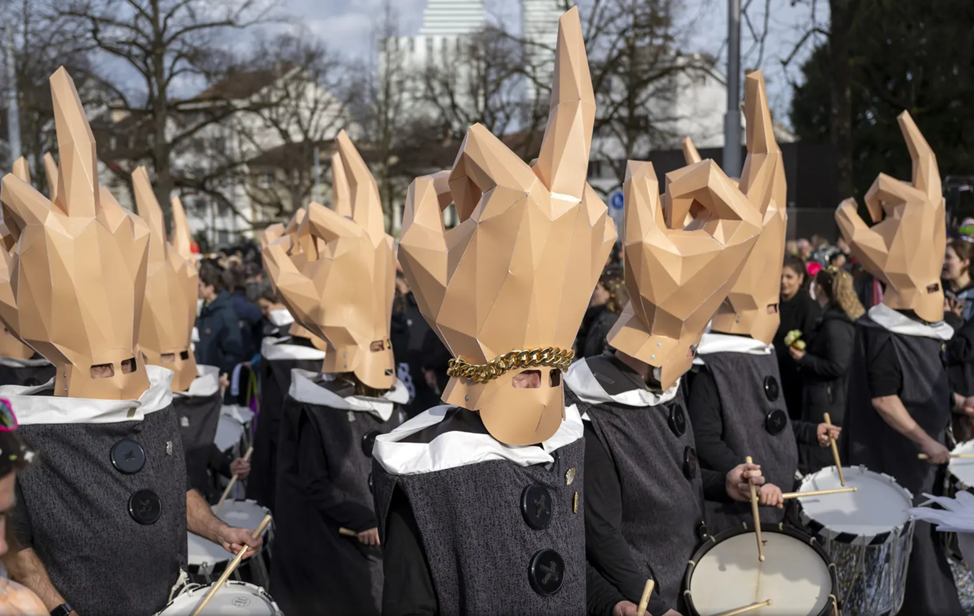
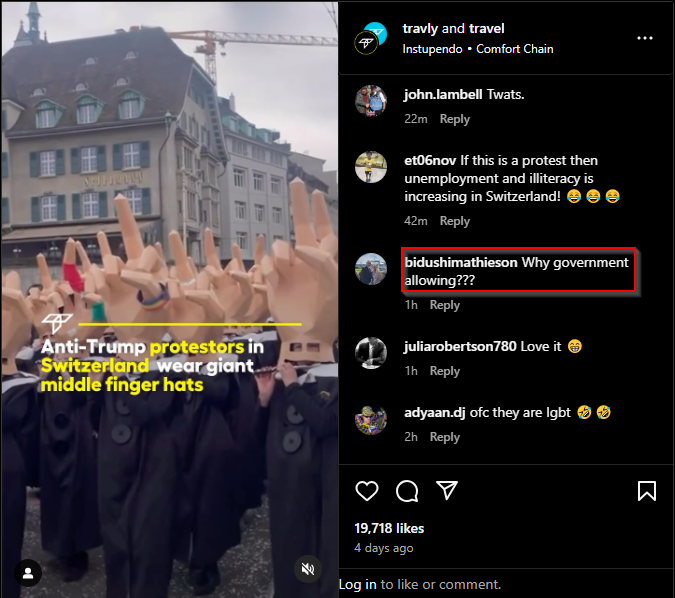
And now it was 'Fastnacht' in Switzerland. And it shows how just a small video/picture can lead to fake news: It was posted at Instagram, commented with 'protest against Trump': Link to the video. But the group itself meant it as a satire about our modern discussion culture. There was no reference to Trump at all. And yes, why does the government allow this? In the first place there is the "jester's freedom". And in the second place: because we have freedom of speech.
-
@gee: just to ask. Did you read Schopenhauer, 'The World As Will and Representation'?
-
And they lost the dinosaurs...

-
Nope. Since the fall of the Iron Curtain, and Thatcher and Reagan started economic deregulations, which opened the door for greedy capitalism. Might have some merit, yes. But my knowledge about economics is not deep enough to start a discussion about it.
-
And you don't know what an algorithm is.
-
There is a reason that Ayn Rand is not taught in academic philosophy. @exchemist said it very well: And there is a discipline in philosophy that often is called 'practical philosophy': ethics. For the rest the main goal of philosophy is to understand our own thinking about different subjects in the world. That is not directly practical, but it can have practical impact, indirectly.
-
Jester's license in Germany: Zölle = Trade Tariffs Klima ... = climate change(?) Massendeportationen (?) = Mass deportations And no, Annex-Ionen are no ions of annex, but annexations It is said jesters say the truth... And yes, I am very angry and very worried. WW2 is forgotten...




-
99% of the lawyers give the rest a bad name.
-
Seems bad luck. I have an Ubuntu Long Time Support (LTS) 24.04 on my more than 10 years old notebook (along with my Windows, which I nearly never use anymore). Besides a few quirks (probably because my old hardware), it works like a charm. None of the problems you mention. I had a quick glance at Ubuntu Studio, and I think it is not of Canonical (producer of Ubuntu) itself. It means you do not know what they have changed compared to the original Ubuntu Desktop Version. So some suggestions: Install Ubuntu from the Canonical Website (https://ubuntu.com/desktop), or Use Linux Mint: based on Ubuntu, I heard only positive about it. It should be one of the most user friendly distributions Then add the programs you need (is pretty easy with the Software centre)
-
That you should be careful with fire...
-
Epigenetics does not mean that the genotype is changed. It means that there are changes in how the genotype is expressed. This can be acquired during a lifetime, and it turns out, that some of these changes can be given further to the offspring.
-
You don't understand: as c is defined as an exact value, there is no need to measure the speed of light anymore. Yep. By fixing 2 of them the third rolls out automatically. The invariance of c makes it the perfect constant to define a distance unit, the fact that all atoms of one element are identical makes such atoms perfect to base the definition of the second on. Yep. See above. Of course there is: just make the distance between the detectors big enough. Let the photons pass, then block any communication between the detectors, and then measure the polarisations. It is not that different from Alain Aspect's experiment, where the choice of polariser is done after the photons left their source. First you only state that entanglement is a violation of causality, you give no argument. Second, with EPR you have it upside down. E P, and R believed that nature could not be so absurd. Bell tests proved them wrong. What has 'swapped'? Two entangled photons measured parallel both pass the polarisation filter. What has 'swapped'? And exactly under 90o, always one passes, then the other doesn't. What has 'swapped'? Simultaneity is often not observed, but concluded from time and distance measurements. If I get a light signal from an event close by, and a signal from another event at 300,000 km exactly one second later, I know the events were simultaneous. SR is not about signal delay. The ground state of an atom is the state where no electron can change its orbital to a lower energy state. You do not understand enough about QM and SR to have a meaningful opinion about these matters.
-
Yes, that is exactly the problem with such standards. Therefore the physics community looked for physical phenomena that always result in exactly the same values. So my 'historical reconstruction': Once, the metre was defined as "one ten-millionth of the distance from the North Pole to the Equator, determined through measurements along the meridian passing through Paris". Not very practical if a laboratory wants to construct a precise metre. So the idea of the standard metre was born: a metal bar in Paris as standard. From there copies were made and sent to everywhere in the world. But then after a while the problem appeared as you mention here: some copies were not exactly as long as the original. Which one(s) changed? In the meantime, physical constants like c, u0, e0 were measured with ever more precision, but the precision needed in modern physics (and its derived technologies) became bigger than the deviations of the old standard definitions. However, these constants are dependent on each other: define two, and the third can be calculated. Now given the invariance of c there was a good way out: take the most precise measurements of c given the old definitions of metres and seconds, and turn the definition around: define c at a fixed value based on these measurements, and the others follow from that. It doesn't matter logically which constants you define, and which you derive there from. But practically, it is much easier to define the metre based on c, and the second on a fixed natural frequency. As said before, every sufficient equipped laboratory can now 'construct its own metre and second', and it will be exactly the same between all laboratories. Now the other constants can be either derived, or measured according the new units. Your 'problem' simply does not exist. In Cramer's TIQM and similar models, it is an information exchange. An electron in one atom is allowed, by its nonlocal resonance with an electron in a remote atom, to drop to a lower energy orbit while simultaneously an electron in its entangled partner atom rises to a higher energy orbit. Energy disappears from one atom and remotely appears in another atom without passing through the space between. One electron goes down while the other goes up. Nothing passes through the space between but information. This is a stronger correlation than can be classically explained. Nope. What this is about is that it makes no sense to ask 'which path information' between the 2 events. So yes, there is information exchange in this example, and energy is sent from one atom to the other. But this is not entanglement. It is simply the QM description of how a photon is emitted by one atom, and absorbed by another one. Imagine the absorbing atom behind a double slit: we cannot say through which slit it went. And as Swansont also remarked: if you block EM radiation completely no energy, and so no information will arrive at the absorbing atom. In entanglement however, after the photons have passed, you block whatever interaction, it makes no difference, simply because there is no energy exchange, no information exchange, between the distinct detectors. One can even turn e.g. the polaroid filter(s) afterwards, you will find the correlation that QM predicts. Then you have always been wrong. It is not an interaction, it is a correlation. So no violation of causality. No information or energy exchange. Wot? This is energy transfer (see above). And instantly? How so, when we could measure that there is a time of d/c (d=distance between the atoms)? How does SR account for that, where in fact it forbids energy exchange faster than c? Below the ground state? How is that possible?
-
@bangstrom Your are confusing 2 things: dimensions and units. The dimension of speed is distance over time, independent of which units you use: miles/hour, meters/second, feet/minute. For every different unit the value of c is different. If the units are fixed independently (with feet or arms of kings e.g.), the value of c is a measurement in terms of these units. But now physics has turned the definitions around, because of the rock solid empirical evidence that the speed of light is invariant. So now it is possible for every sufficient equipped laboratory to 'create their own meter or second' which will be exactly the same as in any other laboratory. Similar for u0 and e0. Because of the relation between these and the speed of light, and light now has an exactly defined speed, one can define the value of one in terms of the other. Further, let's go with your idea of a 'dimensional ratio': speed is a perfect example of such a ratio. It is the ratio of distance to time. So take my favourite definition of c: it is the conversion factor between space and time if one wants to unite space and time into spacetime, so if you want, a ratio (like an exchange rate of currencies). Now physics shows that this c is the limiting speed of causality: massive particles can never reach this speed, but can come as close to it as you want, given enough energy. Phenomena like light, gravity (and as I recently realised, the gluon field (gluons are massless too)), have exactly this speed. So we get that this ratio dictates the exact maximum speed of causality: a causal relationship involving massive objects can never be faster that c a causal relationship involving massless particles is exactly as fast as c a causal relationship involving 'just information' is dependent of the previous two. Information needs a medium, be it massive or massless particles. So 'information' is also bound to the limiting c. So this means that in entanglement, no information can travel fast enough to inform the other particle what e.g. its spin must be. So there is no information exchange, no causal relationship between the two particles, no action. And this is also not what follows from Bell's theorem. Two alternative formulations of what follows from Bell's theorem: If you measure the spin from 'your particle', you immediately know what the spin (measured in the same direction) is from its entangled partner. (Similar as the example of a left and right hand glove. Nothing travels from London to Sydney to 'make' the other glove a right hand glove.) But is only your knowledge of a remote event, and that has no limiting speed. Nothing in the measurement of the other particle shows that the first was measured. Only by comparing the measurements one notices the correlation. If you want to model entanglement with classical means, you would need faster than light communication. However, the quantum mechanical description does not need any communication. As said before, the reason is that the measurements of the spin of the two entangled particles are correlated: the interesting thing is that they are stronger correlated than can be classically explained. Given our daily classical conceptions, quantum entanglement is an astonishing phenomenon. But it follows directly from quantum mechanics itself, without needing information exchange. Do you see now that this problem does not exist? It is not an action, as explained above. It is both, as explained above. It is correlation, as explained above.
