
studiot
Senior Members
-
Joined
-
Last visited
Everything posted by studiot
-
This is where you should go back and read up on the HUP. I also recommend you read more carefully exactly what swansont said. (Hint "specific") Conjugate variables for the purpose of the HUP have dimensions ML2T-1 when multiplied together So Momentum times Position MLT-1 x L = ML2T-1 Energy times Time ML2T-2 x T = ML2T-1 But you also said So Pressure times Volume ML-1T-2 x L3 = ML2T-2 and Space times Time L3 x T = L3T Neither of which satisfy the HUP conditions of conjugate variables.
-
What I actually said was Complaining that GR is flawed is a bit like trying to put a screw in with a hammer and complaining that the hammer is flawed. When you offered this were you confusing the mathematic process of taking a limit with limitations such as the limitation on square roots "There are no real square roots of negative numbers" ?
-
Yes and that position is that you are unwilling to correctly read what others tell you or even to ask them what they mean by a statement. You seem to prefer immediate outright denial. If you are saying that I did claim that GR is flawed pleased post the quote . Otherwise reread what I actually said about about GR and apologise.
-
Go on ? And what about your misreading of my previous posting ?
-
Instead of shouting everybody else down how about you try listening? In particular I didn't make this an argument. That is most definitely not what I said. I will ignore the first sentence as you clearly do not know what conugate means in the context of QM. But I do agree that you can labe the axes any way you like. If you lable them as you describe in the underlined sentence, it becomes impossible to plot any points at all using those axes. That is a direct result of the uncertainty principle. On the other hand if you prefer to hold a civilized discussion then I am quite happy to expand on my explanations further.
-
I don't call that a flaw for the reasons I have already outlined. Yes it limits the applicability of the model, as does any form of linearisation of non linear equations.
-
I suppose it rather depends what you mean by fundamental flaw. GR is just a model. Reality is under no obligation to follow it exactly. In fact no model is exact. But so far as we know there is no self inconsitency. There are also several 'solutions' to the equations of GR. So in this respect the GR model has no flaw. As regards your proposal, I think you have the idea a little mixed up. What meaning do you attach to this claim and what (mathematical) proof do you have of its veracity ? Mathematically we have learned to handle the 'impossible' division by zero. For instance the point scalar density has a definite and measurable value which coincides with the scalar limit of Mass / volume as the volume approaches 0. Similarly, but in a more complicated fashion, vector flux reduces to a limit of flux over area as area approaches 0. This applies to pressure at a point (force over area), magnetic, gravitic or electric field density etc. Mass has zero dimension, force has one dimension, area has two dimensions and volume has three dimensions. If time is involved it adds at least one more dimension. When we set a quantity in a multidimensional universe of greater dimensionality, eg force divided by area we introduce at least one extra degree of freedom. With force over area the area has two dimensions curvature or rotation has one of these. But we are setting this ratio in a three dimensional universe so we immediately introduce a second degree of freedom and a second direction for the curvature. If we want to go to a GR universe we enter a four dimensional mathematical space. How many ways can curvature operate in this space ?
-
For the benefit of those in Europe or the UK who might also like to know their answer to this question, here are some instructions. https://www.aico.co.uk/waste-electrical-and-electronic-equipment-weee/ https://www.cornwall.gov.uk/rubbish-recycling-and-waste/recycling/recycling-items/smoke-alarms/
-
The Periodic Table Hmm - An interesting place to start your study of chemical bonding. To have any sort of periodic table at all it was necessary to identify enough different 'elements' to arrange. This was achieved between the late 17 hundreds and the early 18 hundreds. At that time there was no such idea as 'atomic number' (ask if you need to know what this is). Known elements were arranged by atomic weight - although this was not as easy as it seemed and the first Internation Conference in Chemistryheld in 1860 was intended to produce proper definitive definitions for 'atom', 'molecule', 'radical' and 'equivalent' but ended without achieving this. However some of the participants, including Mendeleyev, left with the the suggestion by Cannizzaro to abandon the weight order. Chemists up to that time has followed the classical mathematical connection between music (yes music in the guise of harmonic scales) and science. There was Dobereiner's triads or rule of 3 Triad 1. Lithium: Sodium: Potassium: ... Triad 2. Calcium: Strontium: Barium: ... Triad 3. Chlorine: Bromine: Iodine: ... Triad 4. Sulfur: Selenium: Tellurium: ... Triad 5. Iron: Cobalt: Nickel: and Newlands rule of rule of octaves which led to the first 'periodic table' https://byjus.com/chemistry/newlands-law-octaves/ https://www.simply.science/images/content/chemistry/structure_of_matter/dev_of_periodic_table/conceptmap/Newlands_Law.html Following the switch to 'atomic number' Mendeleyev was able to place the 63 known elements in their proper position in a table. But they did not know why or about the other 55 naturally occurring elements ( or the radioactive ones). Since that time there have been many attempts to extend the table and it has been found necesary to split the original 8 columns to incorporate new subcolumns. Different arrangements do this differently. Have you ever been to the Science Museum ? It is really worth a visit if you can get there, here is their offering on the subject. https://www.sciencemuseum.org.uk/objects-and-stories/chemistry/developing-modern-periodic-table-spirals-stars OK so where are we today ? Well we are moving away from periodic tables of chemical properties alone, bearing in mind radioactivity and what we now know about the structure of the atom. A new term 'nuclide' has entered the scene and the 'table' often now takes the form of a plot N (the number of neutrons) against Z (the number of protons) This is known as a Segre Chart https://www.radiologycafe.com/frcr-physics-notes/basic-science/atomic-structure/ https://en.wikipedia.org/wiki/Table_of_nuclides
-
I seriously suggest you satrt a new thread to ask about bonding. There will be plenty of help there available and worthwhile descrepitions can be offered at your level. Remember bonding is a Chemistry subject, so you should post there.
-
There is nothing arbitrary about the names dark energy and dark matter. Both matter and energy have definte definitions and are measured in definite units in Science. Dark energy and dark matter conform to these definitions. The use of the term dark is an acknowledgement by Science and scientists that we know less about these quantities than other forms of matter and energy. Speculators should also acknowledge this and demonstrate how their speculation fits in with what we do know. Can you start by showing this ?
-
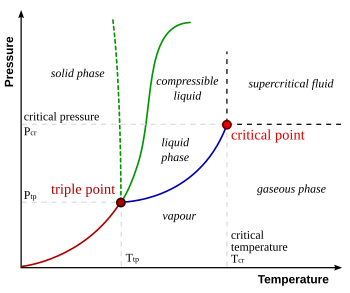
The definition of steam is a bit variable. Engineers talk about wet steam (as with KJW's explanation), which is visible, and dry steam with no condensate and is invisible. Physicists and Chemists talk about vapour as a more specific phase or state of a pure substance (water in this case) and may be at any temperature. Even ice exerts a vapour pressure. There are also critical points on a phase diagram. The triple point where solid, liquid and gas (or vapour) can all coexist. For water this is 0.01 C And the other critical point where the pure substance only exists as a gas or vapour. https://en.wikipedia.org/wiki/Triple_point
-
'Boiling point temperature' of any pure liquid depends upon the local atmouspheric pressure. This is one reason to put lids on saucepans when cooking as the increase in pressure raises the BP a degree or two, leading to more efficient cooking. At the top of everest it is 68C or 154F for pure water. Impurities in a liquid also change boiling point. Thus salt, sugar etc in the saucepan water also raises BP, thought he rise is much less for this mechanism.
-
Group V elements (Nitrogen, Phosphorus, Antimony, Arsenic and Bismuth) have allotropic forms. The Antimony in particular that exists in its common most stable form at room temperature is called alpha Antimony and has a boiling point of 1587o C In addition there are 5 other forms of Sb, two of which are formed at higher pressures and show the higher BP of something over 1600oC, depending upon the pressure. So Greenwood and Earnshaw have the alpha form (Chemistry of the Elemnts) - 1587o C Lange has the types I and II forms - (Handbook of Chemistry) - 1640oC Yes metal vapour is given off by the boiling substance. Antimony also exhibits an unstable form which gives off an explosive gas form.
-
-
indeed But I thought it was programmed with white noise on the GIGO principle. 😀
-
I don't think it is a temporary problem at all. Further I do not think it helpful that those living under north american rules seem to me to be trying to argue for their 'rules' to be universally adopted. These rules seem to me to be quite contrary to the european rules in general and UK rules in particular. Since this time we have seen the introduction of electric scooters and electric bikes onto our overcrowded streets. The result has been s spate of collisions with pedestrians, some fatal, particularly when the electric vehicle comes up behind a pedestrian. The standard of driving of these vehicles and lack of consideration for others has left much to be improved. So now we are introducing electric cars, vans etc, which are bigger and travel faster than these scooters (though some of these have been done for speeding) so any impact has a far greater likelehood of causing serious damage. As regards our duty of consideration towards others this comment disturbs me and runs completely contrary to european law. The question of pedestrian safety has always been in the UK Highway Code from the first issue. But it waas strengthened considerably when a new formal heirarchy was introduced. Remember that the woman in the picture might have been a small child or disabled person. Remember that if you choose to introduce a hazard to others, yours is the primary responsibility to make sure that the danger is not realised, even if they are a bit irresponsible in their actions.
-
Amongst other things my brother worked on the RB211 jet engine development. I remember him telling me how they used frozen chickens, fired from a cannon into the intake, to test the impact resistance of jet engines.
-
Whilst I definitely see your question as a scientific subject, not a gardening one, I don't see at as a Chemistry one here either. Perhaps the ecology section of earth scinece or the biology section (thoug that is a bit specialised). You refer to the scientific method but you don't seem to be employing it. What you are doing is to have an idea or a wish and to be looking for reasons to support it. Employing the scientific method would be to sum up all the known pros and cons, if necessary doing further research into issues with unknown detail. One aspect occurs to me is the effect of population density. Take the US Eastern Seaboard conurbation. Where (and how) are you advocating collecting distrubuting the waste from 50 million people ? This same area had the highest polio incidence in the world until proper waste treatment was introduced. Have you asked science about the details of killing virus polio ? - It is not an easy task. Or are you advocating some form of composting toilet without or permaculture ? Raw cattle effluent (slurry) is already sprayed thinly onto arable land, so by the time it has passed through a year's crop cycle it has effectively passed through a reed bed type filter. But this is done (in England anyway) only in relatively low population density areas. Moving all that slurry very far is expensive and ecologically unsound. I really hopw this thread is not an excuse for the 'let some other blighter clean up after me' brigade that throw their fast food containers, covid masks, and other trash anywhere as soon as they have finished with it. Man has found out to his cost that 'let Nature clear up after me' brings more disbenefits than benefits. Moreover the disbenefits are usually felt by all, but the befenfits only felt by a very small minority, perhaps even a single person.
-
Whilst this is quite different from your original claim, where exactly in QM is the requirement for any wave function to exist at all ? what is preventing an entire region or universe being totally empty ? Yes there are formulae such as you have quoted if and only if there is a particle with a wavefuntion and those formulae have been found to be quite accurate. But what pray is the wavefunction for such a region ? what exactly is the wavefunction for a non particle in that region ? And further i have already asked where exactly in QM are the theorems, formulae etc which require virtual particles ? Yes QM allows virtual particles and offers a credible mechanism for their operation. But for this you need to go back to Goldstein, and Higgs. And this business of suddenly introducing local and global and trying to wriggle out of admitting your original claim went too far. That claim is rather like two men in a bar. One has finished his beer the other still has some beer in his glass. So he claims there is beere somwhere (in my glass) and there are no such things as empty glasses.
-
Thanks Interesting that your field now allows (0, 1). 😀
-
Thank whoever liked my last post. In point of fact, I think the idea refutes your basic premise as follows. Since probability is always strictly less than 1 it is nowhere = 1. This must be so for the inergral over all space to equal 1. This means that every point has a probability that it is empty or contains nothing at all.
-
x4 + x2 + 1 = (x2 - x + 1) (x2 + x + 1)
-
Of course it is in the nature of probability, which is a point function, for the following statement The probability of finding a particle at this point is 0.6 to imply That the probability of not finding the particle at this point is 0.4 This of course must allow for the possibility and probability that there is / is not something else there.
-
This unsupported calim is as wrong as the previous one that you made about wave functions and I challenged. This is a different, weaker statement than the absolute one you originally made once again please respond with a proper chain of reasoning rather than a bald unsupported claim