
studiot
Senior Members
-
Joined
-
Last visited
Everything posted by studiot
-
I find it interesting that knowledge of timezones was required in 1859, which was just after the Crimean War and just before the Jules Verne book "around the world in 80 days."
-
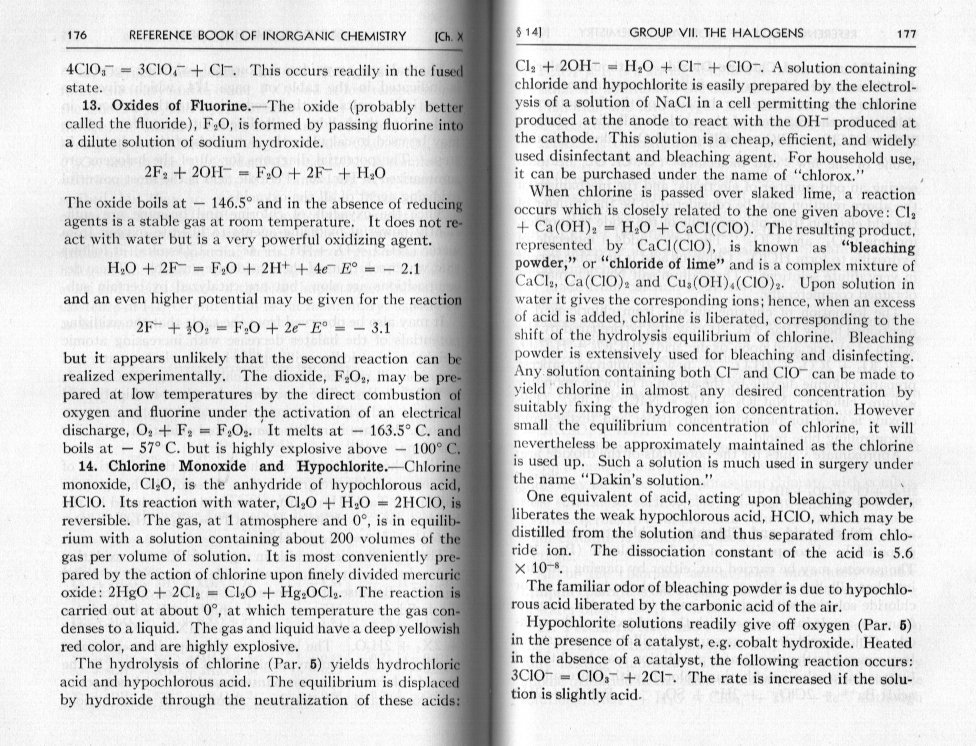
I wonder what temperatures you are working at ? The old DeaconProcess operated at 450oC. Here are some facts and figures about hypo.
-
Yes I am a musical dunce too, so I had no idea at all. Thanks for the comment on the order. I did find the range of subjects interesting though.
-
There are 8 questions, click the orange button under the photo in the link to start. I got 7/8 as I didn't know anything about the last one. https://www.bbc.co.uk/bitesize/articles/z8mvhcw?at_mid=n1brDq52Z7&at_medium=display_ad&at_campaign=Victorian_Exam_Paper_Quiz_NewsPromo_PNC&at_ptr_name=bbc&at_campaign_type=owned&at_objective=consumption&at_ptr_type=media&at_link_origin=promo_box&at_format=image&at_link_title=Victorian_Exam_Paper_Quiz_NewsPromo_PNC&at_bbc_team=BBC
-
Also Nice list Markus, +1. Try this
-
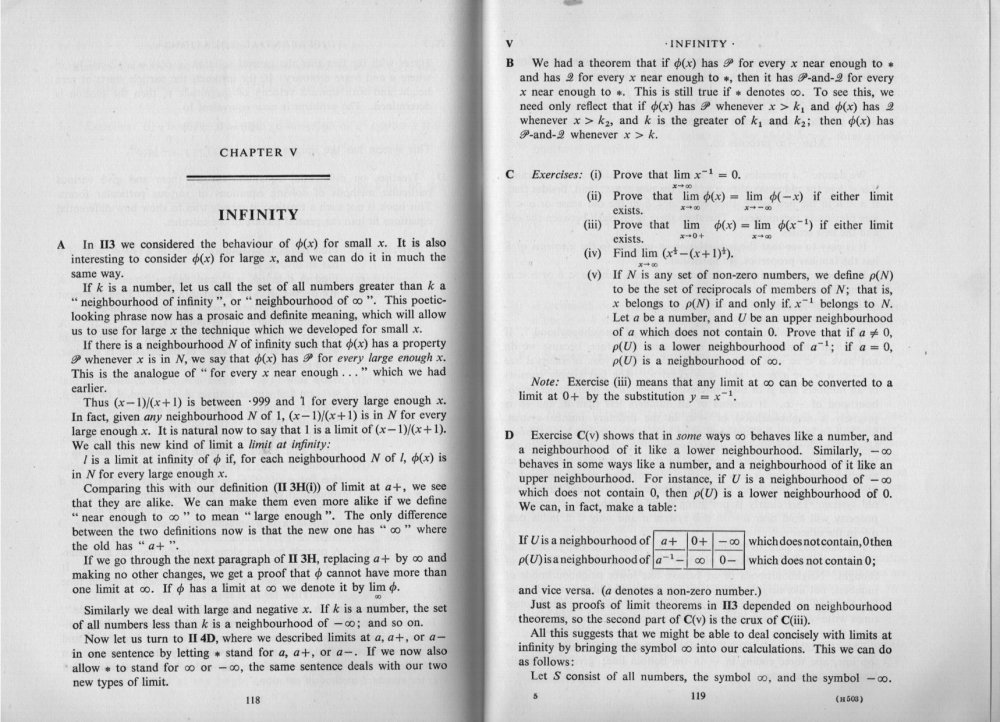
This notion has already been posted and ignored. However there is more mileage in the reciprocal idea if we perform our analysis in terms of neighbourhoods. We can, for instance introduce the "neighbourhood of infinity". Backtracking and side thoughts apart, there is much to be said for the concept of neighbourhoods, in particular the neighbourhood of infinity as noted above. This helps avoid making ridiculously self contradictory phrases such as "infinite number". Paragraph D from Thurston below takes pains to point out that infinity only behaves as a number in some ways
-
[math]\frac{{1 - x}}{2}[/math] math]\frac{{1 - x}}{2}[/math [math]\frac{{\left( {1 - x} \right)}}{2}[/math] math]\frac{{\left( {1 - x} \right)}}{2}[/math
-
As this is outside my experience, I am simply going to add @exchemist , @OldChemE and @sethoflagos who may welll be better placed to help you.
-
I see that you have just joined SF and offered us a couple of good posts, so welcome. Please note that you can only make a total of 5 posts in your first 24 hours as an anti spam measure. After that you can post at will. Don't you think that your view of Physics is a little narrow ? Much of Physics is concerned with observation and measurement. More is concerned with collating, cataloguing, classifying and correlating theory and observation. And some lines of physical thought are certainly rational but they are not mathematical. Go well in your membership.
-
This is a strange question, let's look into it further. If you take a helicopter and and hover above the surface - what do you mean ? If you take a helicopter and hover above the helipad for 12 seconds, 12 minutes, 12 hours or 12 days you will still be abov the helipad and not above the other side of the world. If you fly the helicopter so you have some forward or backwards speed we distinguish two speeds Ground speed And air speed The ground speed is of course zero when you are hovering over the helipad. But the airspeed is only zero in 'still air'. Still air means the air is actually turning with the Earth at the same rate as the ground. Otherwise it needs to be enough to counteract the tendency of your craft to move along with the wind and then needs to be some more if you actually want to go anywhere. However the Earth's rotation does play a part since the flying time London to New York is 8 hours, Whilst the flying time New York to London is only 7 hours. Is this actually the phenomenon you are actually thinking of ?
-
Impressive and patient replies. +1
-
Thanks that useful. I can expand the explanation in the light of this. Also I added the comment about the old name as it is an example of old use that people still come across in life or literature. For example many still use weight (eg the pharmaceutical industry) not mass, as of course they weigh things to get the mass. They still use W, not M is mass ratios. Also M can be used for the mole ratio, which is also fundamental. There you are then. How much do you know or need to know about concentrations and dilutions ? Yes, although I didn't change the volume formula to suit. So long as you use the same units for all the quantities it doesn't matter. But there is an added twist with volumes as you may need the densities to make the calculations work properly. The mass ratio is the fundamental fraction. You may have noticed that it is easier to use the fact that sum of the % masses of the two substances in the mixture must add to 100% than to use my fraction. It is not necessarily the case that when you add two liquids together the resultant volume is the sum of the individual volumes, the volumes must be corrected to the mass ratio (using the densities) as this is the always true for masses or fore mole counts. In fact at normal temperatures HCl is a gas so will dissolve without much volume increase and you may have pressure as a measure and need to use the gas laws to get to the mass or mole ratio.
-
OOPs I posted the wrong equation for the mass ratio. [math]\frac{{18}}{{100}} = \frac{{{M_{HCl}}}}{{{M_{HCl}} + {M_w}}}\quad where\;{M_{HCl}} = 18[/math] is correct
-
Looks like a worthwhile resource and a prime example of that part of science ( all the grunt work of filling in) that doesn't attract the glory. +1
-
Wishful Thinking seems to be buried deep in the human psyche. Most folks seem to be happy to keep it in its place, so people don't really believe in Santa Claus or Harry Potter. Huge industries, some legal some not and some a bit iffy, are based on this. It seems to be a double edged sword as some of the best of human endeavours and aspirations are the result. But also some of worst and of course the boring inbetween such as science deniers.
-
Good morning. What subject are you studying this in, and at what level ? Is it General Science or something at higher level ? Muriatic acid is a very old name - in all the 60 years since I have known anything about it I have never seen the name used. So I will try to address other older conventions in my reply as well. The quantity of substances can be measured in several ways : weight, mass, volume (also called capacity) count (eg gram-moles) or pressure. Since the substances may be in any of the three normal states of matter (solid, liquid or gas), or the dissolved state some measures are more convenient than others. When you come to mixtures there is a comparison of more than one substance quantity and the units of measure can themselves be mixtures of the above listed measures. Common measures are weight per volume (w/v) ; volume per volume (v/v) ; weight per weight (w/w) ; and moles per volume (mol/litre) So you should look carefully at the labels for one of the above abbreviations on the labels you are told to read. Without this information you cannot answer the question. When it comes to percentages, unfortunately different industries use the % in different ways so my preamble is important. Here are two different listings for 18% HCl - one is w/w the other is v/v Either way the % is a fraction of the total amount - which is the sum of the water and the HCl in a given mass or volume Your 18 % Hydrochloric acid is a common cleaning concentration in engineering and often refers to what is called the mass fraction - a w/w measure. It means that of the total mass, 18% is HCl and the rest is water. So Mw is the mass of water and MHCl is the mass of HCl then [math]\frac{{18}}{{100}} = \frac{{{M_w}}}{{{M_w} + {M_{HCl}}}}[/math] or [math]\frac{{18}}{{100}} = \frac{{{V_w}}}{{{V_w} + {V_{HCl}}}}[/math] for the volume fraction You should be able to solve this for the mass of water. Does this help ?
-
This is a beautifully crafted paragraph that should be studied very carefully as it contains lots of useful and important information. +1
-
So which is it - countable or uncountable ?
-
Nice. +1 Good Infinity is not a number. So it cannot be a member of either the set of reals or the set of naturals or the set of rationals or the set of integers. So why do you claim infinity is a number ? None of the elements of set of reals or the set of naturals or the set of rationals or the set of integers are infinite. You are confusing the sets themselves which are infinite, whith the elements of those sets The elements (ie the numbers themselves) are all finite, without exception. You misuderstand what is meant by infinity. So it is as pointless to want to use ZF theory as saying "I have never used a chainsaw, but I am going to take one, climb a 30 foot tree and start cutting". I was so very disappointed with this response that I considered your 'bail' option as I am no longer sure whether you are only trying to find fault here or actually trying to understan. Understanding takes effort on the part of the student. Yet you have uttered not a single word about inheriting key properties. Have you tried the simple proof I suggested ? You suddenly mention continuums. These are not like continuums in 'continuums' in physics or 'continuum mechanics'. The 'Continuum Hypothesis' is suprising in what is actually hypothesised, Just as the ZF axioms are suprising in their names and statements. Have you ever worked with any ?
-
The point here is that, after we go beyond the integers, we are never looking for a 'next' number because we never start with just one number. We need to employ two numbers. It works like this. All number systems inherit properties from simpler systems from which they are built. We cannot build the integers without the natural numbers. We cannot build the rational numbers without the integers. I will take these as read and proceed to the rational numbers. We define a rational number as the ratio of two integers. It has to be integers since we are defining 'fractions' so we cannot employ fractions in our definition or it would be a circular definition. We define one rational number a/b as being greater than another , c / d, where a,b,c,d are all integers [math]\frac{a}{b} > \frac{c}{d}\quad if\quad ad > bc[/math] We can use this to find a third rational number between any two rational numbers as [math]\frac{a}{b} > \frac{{a + mc}}{{b + md}} > \frac{c}{d}\quad if\quad b,d,m\;are\;positive\;{\mathop{\rm int}} egers[/math] I suggest you practice some algebra by convincing yourself my formulae are good. We can repeat this process indefinitely, placing a fourth rational number between our first and third or second and third rational numbers. This leads to the conclusion that between any two rationals there is another and by extension infinitely many other rationals. This density property amounts to saying that, for the rationals, there is no 'next' number to any rational since given any proposed next rational we can place another closer, by this process. So let us move on to the set (I learned class) of all rational numbers and divide it anywhere into two subsets. This is actually where a number line comes in handy since we can call the subset to the left of our dividing line L (with typical element l) and the subset to the right R( with typical element r). Because we have divided the line to the left and right, any l < any r. Now for the clever bit. If we pick one rational from each of L and R, say l and r then we can examine the infinity of rationals between l and r according to our formula above. Each and every one of these must individually belong to either L or to R, but not to both. There can be no rational numbers belonging to both L and R. This means that we have an infinite sequence of increasing rational numbers greater than l in L And an infinite decreasing sequence of rational numbers less than r in R So L has no greatest element And R has no least element So we have created two open sets and sequences a la Genady. This density property is inherited by the reals from the rationals, as noted at the beginning of this post. As also noted the fun starts when we try to incorporate irrational numbers into the scheme as the next post will show, with the story of root2 - the first irrational to be discovered. Again this is where geometry helps explain things.
-
Since I first mentioned Lorenz I should point out that I was talking about the Lorenz Transformation, not the Lorenz force , which is an entirely different phenomenon.
-
Good one, thank you. +1 But remember that sometimes only one or two are satisfied for example Newton's third law. Ths can be equally interesting, as in maths.
-
The point is that you need to set the stage you are working on. That is the point of all the different offereings about open and closed sets, squences and so on. In what circumstances are you looking for a next number ? My stage is concerned with what are numbers? and what properties do we want them to have ? Thank you that I hope that is useful information to everybody. I expect he alsotold you that each Aleph is the cardinality of a particular infinite set of numbers. And perhaps he also made the point that it is not necessary for the cardinal number of the set to be an element of that set. I can be for finite sets, but it can't be for infinite sets. So often we all read something into what someone else has said, that was just not there. I do it, though I try to guard against it. In this case I specifically said the opposite To return to my stage. The thing about the rational numbers is that they have the same property we are examining as the reals, which is called density or denseness. Density should not be confused with completeness. In colloquial terms density means that between any two rational numbers we can find another rational number. This is an easy 3 line algebraic proof/demonstration if you want it. So the rationals also have this property of no nearest neighbour, assuming you have decided what you mean by 'nearest'. So what is the difference between the rationals and the reals ? Understanding this difference is the great step forward that Dedekind took when he published Stetigkeit und irrationale Zahlen, Braunschweig, in 1872 Yes WTF is correct in that Dedekind Cuts (Schnitt) divides the entire set of numbers into two subsets, but there is more to Dedekind than that. The fun begins when you try to determine which of the two sets a particular number belongs in. I was trying to avoid implying that 'isolating' every number in its own partition means just two partitions, I simply thought that perhaps you were half remembering something like this.
-
Thank you, I was referring to Rutherford's experiment, conducted in a single frame. https://chem.libretexts.org/Bookshelves/General_Chemistry/Map%3A_Chemistry_(Zumdahl_and_Decoste)/02%3A_Atoms_Molecules_and_Ions/2.04_Early_Experiments_to_Characterize_the_Atom
-
Thank all you good folks for your thoughts. I fear this is becoming a semantic or interpretive issue as to whether or not there are mathematically defined equivalence realtions is Physics, and this was not what I meant when I posted My main point is that reflexivity, symmetry and transitivity are valuable notions that could have wider applications regardless of whether we are talking about interactions, relations or some other phenomenon. I would also remind you that the zero interaction, relation, whaterever is acceptable in maths so should the zero interaction be acceptable in Physics ? E.G. Gamma ray do not interact with electric fields ? I am suprised that @swansont doesn't appear to have a view on this, as I would value hearing it.
