swansont
Moderators
-
Joined
-
Last visited
Everything posted by swansont
-
No. You detect the photons coming from a particular direction. And notice that it’s the same as any other direction. As MigL said, it was a square horn antenna, which is a directional antenna, so it detects a signal from some (small) solid angle of sky.
-
! Moderator Note Note: sweetque and molbol2000 are the same person. Both accounts have been banned.
-
How is that connected to lensing? Lensing requires a source in a particular direction. The isotropy means that there is radiation from all directions. The signal to noise would be tiny.
-
! Moderator Note Complaints about the rules or actions of another site/organization in this way is an inappropriate topic for discussion here.
-
DraftScience has been banned. Frankly, sports fans, he used a phrase that's a no-no with umpires.
-
Because some devices are on, 24 hours a day. Not necessarily individual devices, but in aggregate, something is on, even at night. e.g. refrigerators. Wall clocks. Certain lights. Computers. Demand varies over the course of a day, but it doesn’t drop to zero at night. Continuous is not the same as constant.
-
! Moderator Note Your idea? Do you have something to post in speculations, that would comply with the rules, or are you asking questions? You can’t do both at once.
-
! Moderator Note Your topic is length contraction and refraction. In case it hasn’t been made clear: length contraction (a phenomenon from relativity) is not caused by refraction (an optical effect). Which of these two topics do you wish to discuss? (and no, light is not frozen)
-
I’m not sure lensing would be detected. The radiation is isotropic, and it’s not obvious to me there would be any wavelength changes.
-
You have wavelength in the denominator When wavelength increases, the fringe spacing must decrease, according to your formula. ! Moderator Note Your proposal is wrong, as demonstrated, you have not complied with the requirements of the speculations section (no derivation, no evidence), and since I have no interest in your inevitable arguments based on not understanding math, I'm closing this. DO NOT open a new thread on the topic. You're fortunate this nonsense was left open this long. ! Moderator Note As I suggested earlier, we don't care what happened elsewhere, and litigating such actions here is decidedly off-topic. Don't do this again.
-
! Moderator Note I asked that you stay on topic, and you’ve been posting other material. As iNow suggests, it looks like you’re blogging. Please do that somewhere other than the forums This suggests you’re done discussing the topic of the thread.
-
Any “background” DM would likely not have the same temp as the microwaves, just as background neutrinos have a different temperature. I suspect that DM never decoupled, or did so a tiny fraction of a second after the BB. Unlike photons and neutrinos. https://en.wikipedia.org/wiki/Cosmic_neutrino_background
-
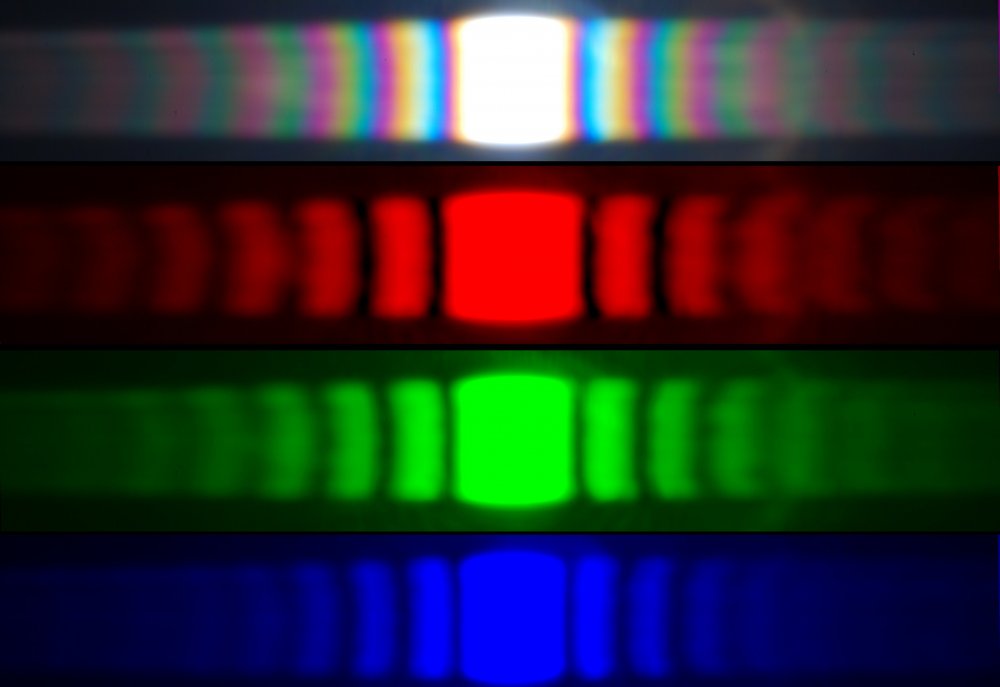
You still haven’t explained what you mean by “shortest distance between two surfaces” I assume this is the slit separation, or related to it (since d is measured center-to-center) Diagrams help. Being vague does not. I don’t know what two/four source math means. My assertion us clearly true. The equation works. I’ve done the measurement, as have countless others. It would seem you have not. Asserting otherwise is not an argument in good faith. Do you have data and experimental results to share? Better still, it shouldn’t be hard to find a data set from an independent source, like an online lab course. That’s the wave description, which you reject. Path length differences causing interference, with constructive interference where the path length is an integral number of wavelengths. But if the wavelength is shorter, the fringes get closer together, because this path difference is achieved at a smaller angle. The opposite of what you say. Where did I say anything about golf balls? I said wavelength means there is wave behavior. Being ignorant of the physics experiments that have been performed is not a winning strategy. You have presented no evidence of your assertion. You haven’t derived your formula. If you don’t fix this, the thread will be closed. An image from https://physics.stackexchange.com/questions/421688/white-light-instead-of-monochromatic-light-in-interference Red fringes have greater spacing than blue, or green. As the standard equation predicts, and opposite of what you predict. I was thinking the bet could be a cool million US dollars.
-
! Moderator Note Not to worry. We have every intent to enforce our rules, but it’s also our policy that we don’t apply them for actions that took place elsewhere
-
A sail exerts a force from an external source (the wind) This works by taking the emanations of the sun and pushing them back onto the sun.
-
And your point is...?
-
But there's no guarantee you will be able to develop the product. What if you spend $10 million and your new widget doesn't work? Nobody will pay for it. Who do you think pays for university research? And what class of research do they do? In the US: "The Department of Defense divides development further, giving each category a code: 6.1 is Basic Research, 6.2 is Applied Research, 6.3 is Advanced Technology Development, 6.4 is Advanced Component Development and Prototypes, 6.5 is System Development and Demonstration, 6.6 is RDT&E Management and Support, and 6.7 is Operational Systems Development" https://en.wikipedia.org/wiki/Science_policy_of_the_United_States Universities do mostly 6.1 and 6.2 research. They don't really have the capability of doing much of anything further along the chain. Pharmaceutical companies leverage university research, but doing the development and the drug trials is expensive and well beyond what a university could do. And to use a recent example, a lot of COVID vaccine research relied on government support, incentives and/or guarantees. I don't really have a problem with the government picking winners in fighting against COVID.
-
A big problem here is when there is a gap between what industry can do, and what the government or country needs them to do. It costs money to develop products. There is risk involved. The government can mitigate this risk by subsidizing (sometimes at 100%) the companies doing the research and development. Companies aren't going to do that work on their own when the risk of failure is large. There's only so much unsuccessful R&D you can do before you go out of business.
-
It's slightly easier for areas that are not replacing infrastructure because they don't have the limitations in place from legacy systems (similar to areas that installed wifi from the start, not having to replaced wired systems). Distributed generation, for example, is probably easier when you don't have a centralized distribution system already in place. (easier both logistically and politically) That means that the folks who aren't currently part of the problem are less likely to become part of the problem.
-
So much for the ideal gas law, then No, it's as settled as it gets. Relativity works, and relativity has massless photons. Your "theory" needs to predict correct results, and it doesn't. That's the first thing to check. Because it's game over when it doesn't. Just about every college freshman doing a physics interference experiment has debunked your claim.
-
Fringe size is fringe separation? So is it (1) d/(lambda * pi * D) or is it (2) (d * D * pi)/lambda (this is why you need to write out the equations) Equation 1 has units of 1/distance, so it can't be right It also disagrees with the accepted (and experimentally confirmed) equation, (m * lambda * D)/d, and if it disagrees with experiment, it's wrong Your equation doesn't trend properly with slit separation and wavelength. Also, where would the second or third order fringes appear And why would they be there for particles? As I already said, you would need to provide a derivation (physical reasoning) for this equation. But as it's demonstrably wrong, that's really not necessary. No, if it has a wavelength there is some wave behavior Incorrectly predicts.
-
Up front, perhaps, but what about lifetime costs? And I was talking about energy generation. So in ~20 years when you want to replace solar panels, will solar be cheaper, or more expensive than it is now? Will fossil fuels be cheaper or more expensive? Further more, what will be the incentive to go back to e.g. internal combustion engine vehicles if a robust EV infrastructure is developed in that time? Why would companies resurrect such manufacturing? Already we're seeing the shift to electric vehicles from major automakers. This particular dystopian scenario is purely guesswork. Not seeing the connection with climate change. Subsidies have been getting reduced in the US, AFAIK, and we have no carbon tax. Fossil fuels are still subsidized. It's not clear that a carbon tax would subsidize solar or wind, but it would make the hurdle for fossil fuel even higher
-
This is fine. You've clarified it. Companies have a limited amount of money on hand, and there is finite capacity to make solar cells. In the US, solar is being rolled out but it's mostly displacing coal plants that are being shuttered, as well as adding new capacity. So it is a matter of when. The US has been adding > 10 GWp of solar PV per year for the last several years. The general trend has been an increase (in 2010-2011 it was about 1 GWp) but solar still only represents <2% of electricity generation. To go faster requires money and solar cell production capacity. Capacity won't expand unless there's a demand. Companies won't shutter production unless they can replace the capacity, and not lose money. Other countries have done better with solar installation, because there is political will to do so.
-
Then post it here. The rules require it; videos can't be the primary source of information for your proposal (see rule 2.7). I'm sorry - wavelength? I thought we had particles here. Why would you do this calculation? What's the physical justification for it? Which surfaces are these? Shortest and longest distances - can you put this in terms of the slid width and separation? i.e create a proper equation for the location of the fringes?
-
Doubtful. There is a financial incentive to get away from fossil fuels - "green" energy is cheaper.