swansont
Moderators
-
Joined
-
Last visited
Everything posted by swansont
-
! Moderator Note No, it doesn’t. And making claims like this without evidence or a model means this does not fulfill the requirements of speculations. And this has been pointed out to you before
-
What mathematical model is the basis for this conjecture? Is there any independent evidence that any of these effects will happen?
-
It could be coherent if a resonant cavity were used. It’s how dye lasers work.
-
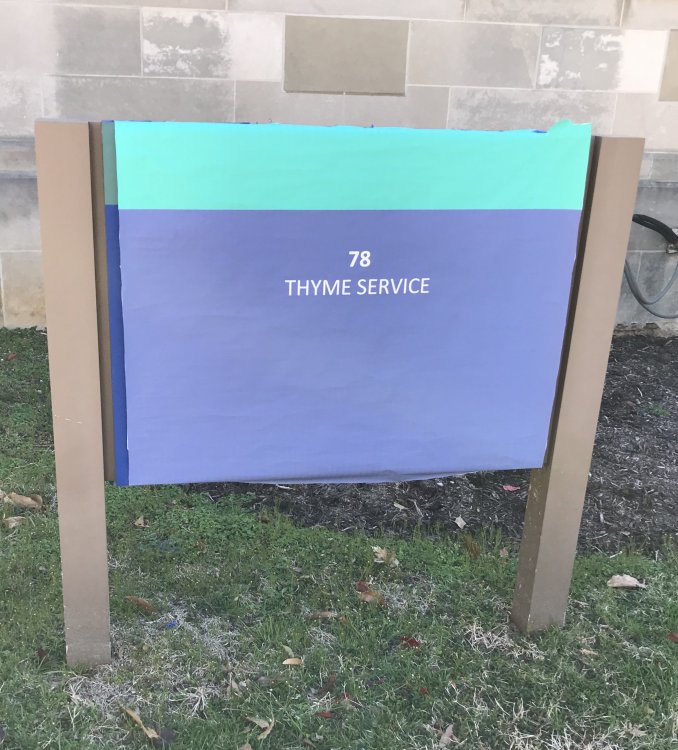
I put this up a few years back, over the “Time Service” sign at work. Not many people noticed. Had to wait a year from my original plan, owing to rain. (paper sign) I got rained out again and couldn’t do a “Navel Observatory” one last year.
-
The kinds of crystals, or the general name? Wavelength conversion crystals, nonlinear crystals, or photonic crystals for four-wave mixing are some descriptions There are a lot of different crystals https://www.unitedcrystals.com/NLOCOverview.html https://www.rp-photonics.com/nonlinear_crystal_materials.html
-
You don’t save energy by doing it in stages, and assembling everything in space has the overhead of launching all the parts - including spare parts - into orbit. Plus, as the recent launch showed, launching can be fairly destructive to the surroundings, so you wouldn’t want to do that anywhere near a space station.
-
People keep kicking them. They handle one more than the other.
-
Neener neener


-
Except you didn’t/won’t actually answer the question, and just restate your assertion that it’s not rare. Note that “medical intervention” is not synonymous with reassignment surgery OTOH, there’s this Genital surgeries performed on minors are rare, but surgeons say interest is growing. The Komodo analysis of insurance claims found 56 genital surgeries, including vaginoplasty and other procedures, among patients ages 13 to 17 with a prior gender dysphoria diagnosis from 2019 to 2021. https://www.reuters.com/investigates/special-report/usa-transyouth-care/ Less than 20 a year in the US. If you read past the headline you’ll find that they say “The survey of 1,655 parents, published in the Archives of Sexual Behavior, found that more than half of the parents who were referred to gender therapists said they felt directed to put their kids on medical treatments or change their wardrobe.” (emphasis added) Further, if you read the paper, it says Parents were asked whether they had felt pressure from a “gender clinic or specialist” to transition their child socially or medically. Of the 390 parents who answered this question, 51.8% (N = 202) answered “yes,” so that article claim is a lie (color me shocked) - it’s not half of the 1655, it’s half of 390, and so it’s less than an eighth of the number surveyed. And we don’t have an indication of how many just bought new clothing. (New clothing, to me, doesn’t seem like a big deal.)
-
Something to consider…
-
Not to mention internet archives. Deleting all instances of a post means deleting where someone quotes the post, and asking that these be deleted means one is saying that their request supersedes anyone else’s desire to preserve their posts. No, that’s not going to happen.
-
Sex change industry? How old is “old enough”? How many reassignment surgeries are done on minors? Compared to, say, breast augmentation surgeries? There doesn’t seem to be any uproar about the latter. Do you have evidence that this happens?
-
OTOH, if you’re not built for a position, or the sport, you tend not to play it. (That doesn’t just apply to gridiron football)
-
What, specifically, is the problem?
-
Good point - it’s in Leviticus, which forbids a whole craptonne of things that are ignored.
-
It’s an antacid, but not particularly soluble. But they don’t say specifically what happens to the carbon. If it precipitates out (Magnesium bicarbonate?) then the ocean can absorb more CO2.
-
That would be nurture, then, right? If you have to be told not to do something you might be inclined to do otherwise…
-
The main point was that you did not substantiate your claim - a long-standing pattern - and stated a conclusion without actual evidence or eliminating other possible explanations. IOW, not providing any proof and yet claiming that something was proven. No links, not even to the infographic you pisted.
-
Links? Citations? Pretend this is a scientific discussion. No mention of Iceland in your link.
-
Or that boats dock on the coast, and that the EEZ is 200 miles.
-
The negatively charged particles aren’t atoms, they are electrons. The fission fragments are the positively charged atoms.
-
gamer87 has been suspended for repeatedly bringing up a closed topic.
-
! Moderator Note Your silica gel discussion privileges have been used up.
-
It depends on how highly ionized they are
-
They have a magnetic moment, though, so they can be affected by a magnetic field and have been confined in a magnetic trap. But these neutrons were slowed by other means.