swansont
Moderators
-
Joined
-
Last visited
Everything posted by swansont
-
Well-established? Where and when did this happen? Why do I find things like this, if it is well-established? "Is there evidence that transgender women athletes have a physiological advantage? Not according to Eric Vilain, a geneticist at the University of California, Irvine, who specializes in gender-based biology. Very little research has been published on transgender athletes, and what has been published didn’t provide enough results to create evidence-based policies, says Vilain, who does not identify as transgender. “It’s not black and white.”" https://www.science.org/content/article/world-athletics-banned-transgender-women-competing-does-science-support-rule (from April 2023) "The research findings in the biomedical area are inconclusive. Studies which make conclusions on pre- and post-hormone replacement therapy (HRT) advantage held by trans women athletes have used either cis men or sedentary trans women as proxies for elite trans women athletes" ... "Available evidence indicates trans women who have undergone testosterone suppression have no clear biological advantages over cis women in elite sport." https://www.cces.ca/sites/default/files/content/docs/pdf/transgenderwomenathletesandelitesport-ascientificreview-e-final.pdf (2021 or later)
-
This scientist didn’t.
-
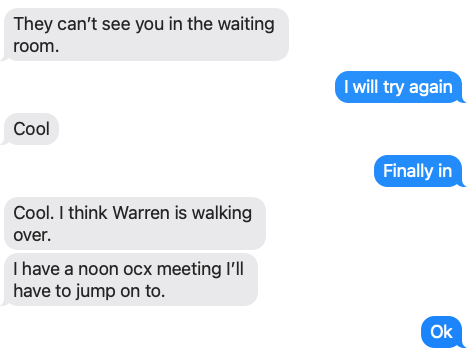
A screenshot of the Message app on a Mac. It looks like what I have on mine. edit: here's a screenshot from Messages on my computer The header, though, suggests the snapshot is from an iphone or ipad
-
Video of an unidentified falling object An example of why eyewitness testimony is unreliable
-
It’s not just life sciences. The DoD’s position on information is in a long-standing and widespread conflict with the academic position on openness and sharing. Even if they have top men working on it. Top. Men.
-
It’s the survey in the source you cited for your claim that Ukraine is the most corrupt country in Europe. “We are independent, non-governmental, not-for-profit and work with like-minded partners across the world to end the injustice of corruption.”
-
So it doesn’t count, because it’s war time? Russia hasn’t shown such improvement, despite waging war.
-
You need e.g. a minimum of 22 people to have a soccer/football game. You need many times that to have a league. One-on-one is not really compelling.
-
There’s a critical mass required, in any competitive sport.
-
It says non-human biologics, but says nothing about them being extraterrestrial in origin. Technically, recovering a human-made craft sent up with a dog or a chimp would qualify. I’m curious that he’s termed a whistleblower; that’s a term for someone who reports some kind of wrongdoing to some designated person or group within the government. edit: “Sec. 1673 within the compromise bill language, titled “Unidentified anomalous phenomena reporting procedures,” outlines an original House provision related to reporting procedures for government employees related to UAP involving a secure method for authorized reporting (i.e., for “whistleblowers” possessing knowledge about past or current government programs related to UAP)” https://thedebrief.org/compromise-2023-ndaa-outlines-provisions-for-military-disruptive-tech-uap-and-more/ So I’m guessing it relates to his knowledge of UAP programs
-
Except that was the question that was asked. Is the production cost of beer greater than sugary drinks.
-
“Corruption reforms have seen some successes in Ukraine since the Revolution of Dignity. Police reform, public procurement, and dissolution of state owned industries since 2014 have led to reduced waste and corruption” … "Although it still scores low, war-torn Ukraine is one of few significant improvers on the CPI, having gained eight points since 2013." They are rated as less corrupt than Russia (116th vs 137th) https://www.transparency.org/en/cpi/2022/index/ukr
-
You were claiming this, not me. “No round for me.”
-
empleat has been banned at their request
-
! Moderator Note OK
-
Mac computers have a messaging app that syncs with your phone’s text messages, if everyone involved has an iphone. That’s what this looks like. There might be such capability for Android. One would have to avail themselves of a search engine to find out.
-
That you would not qualify for your country’s olympic team doesn’t mean you can’t attempt to do so, and that’s what access is, and we’ve seen transgender people lose access is some places in the US, which means they would probably quash any chance of making an olympic team, even if they had the raw ability. Access is not the same as competitive fairness.
-
Also consider that he’d be subject to prosecution if he divulged classified information, and several things he alleges would likely be classified if they were true.
-
Access is opportunity to compete. Nothing guarantees you advance to a later round.
-
“stealing” gravitons sounds like a reduction in gravity. That’s shielding. Without a model, there is no discussion that is allowable in speculations. This isn’t the WAG forum.
-
Fig 1 in this paper has a category for > 1 in 10 (very frequent), so there are some side-effects that happen a lot. https://www.nature.com/articles/s41467-020-18305-y But, as CharonY has noted, it depends on the seriousness of the side-effect vs untreated outcome. Nausea from cancer meds is common, AFAIK, but that’s accepted because the affliction is fatal. But a fatal side-effect from a nausea medication would probably not be tolerated.
-
I was referring to a mathematical model - a way to make quantitative predictions Classically, there is no way to shield gravity. This implies you think there is.
-
What is your model?
-
It appears that US high-school sports do not have any such requirements. Canadian sports, too https://usports.ca/uploads/hq/Media_Releases/Members_Info/2018-19/Press_Release_-_Transgender_Policy.pdf
-
! Moderator Note Don’t hijack threads with your pet theory