
Genady
Senior Members
-
Joined
Everything posted by Genady
-
Fine. What I don't understand though is, when an interest is moral and when it is not. IOW, when an interest constitutes a fair compromise vs the money earns money issue.
-
OK. In the above scenario, doesn't your money earn money, namely, the 5%?
-
I agree with this. However, there is a subtle point. You want 10% interest, but the other party agrees to pay only 5%. You accept. Are you forced to accept in this case?
-
Yes. "You work today, but you don't need money today. So, you agree to get paid later, with interest." Is this deal free and moral?
-
But I don't have one myself. Will start practicing tomorrow . I will go for this, I think. (I am getting desperate.)
-
[repetition] You didn't comment on @TheVat's other suggestion. With a little modification, something like line 'n' grid ?
-
Very impressive! These threads could be merged:
-
I came from a handshaking culture. Men, women, children greeted each other by shaking hands, unless they were family. We used to make fun of kissing Brezhnev (brezhnev kiss - Bing images). Then, I started moving from place to place and met other kinds of bodily touching between strangers: a kiss, cheeks touch, three touches, hugs, hugs and kisses, etc. I feel very, very uncomfortable with all of them. I was so grateful to covid for stopping people doing this, but now it is coming back. I don't want to offend others, but I also don't want their bodies to come too close to mine. Any suggestions?
-
Forget about it. I've lost interest (pun intended).
-
Right. There are only 18 distinct possibilities for this, if I am not mistaken.
-
Maybe they want something that is 'meaningful' horizontally and vertically? What is the 'meaning' of the 3x3 arrangement?
-
I've asked for clarification, but you're clarifying something that I didn't ask for.
-
Here we go again. Thank you for participating.
-
I know it is the start. That's why I have mentioned it. But you didn't answer my question. If so, why do you think that I think money is valuable?
-
Sure. How about a delayed pay? You work today, but you don't need money today. So, you agree to get paid later, with interest. Is it acceptable?
-
Do they need to stay in the 3x3 configuration?
-
Work doesn't have to be hard.
-
Yes, I misread their post.
-
Yes, I'd like to know such a way, too. However, Windows' Snipping Tool is quite convenient, copy and paste.
-
Quantum mechanics and special relativity have been happily merged more than 70 years ago. The marriage is called, Quantum Field Theory.
-
No, it was not. Partially, yes. It was not. You can calculate maximum mass that could be converted into energy as follows. Surface area of a BH is proportional to its mass squared. One BH has mass M1 with surface area A1, the other M2 with area A2. The surface area of the resulting BH cannot decrease. So its surface area A >= A1 + A2. Thus, its mass M is such that M2 >= M12 + M22. This means that maximum mass that could be converted to energy is M1 + M2 - M = M1 + M2 - sqrt(M12 + M22). For example, with your numbers, 100 and 9 solar masses, the maximum was 109 - sqrt(10000+81) = 8.6 solar masses.
-
Sorry, but we can:
-
-
It was about 30 years ago. Might be irrelevant now.
-
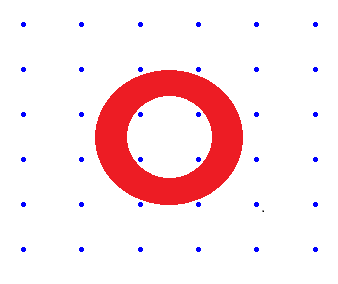
I thought of a way that might make this puzzle a bit more transparent (pun intended, see below). You have a plane with the grid points on it as described in the OP. Somebody gives you a transparency with an inkblot on it. You position the transparency on top of your plane in such a way that the inkblot does not cover or touch any of the grid points. Prove that this positioning can be done for inkblot of any shape as long as its area is less than unity.