
joigus
Senior Members
-
Joined
Everything posted by joigus
-
I would try not to overthink it, as it's an analogy after all. As Swansont said, in the end there's no information that can tell you how it's going to end up, really, only the odds.
-
It's taken from Swansont's toolkit. I liked it too. I've just added a couple of pictorial features. I'd rather you included dissipative forces coming into play, and that's because they replicate this "effective loss of unitarity." But what happens when the environment selects a particular projection, how the environment selects that particular projection? In still other words: What physical variable tells Nature "this is what happens," and "not the other," and effectively interrupts the causal and reversible course of Schrödinger's equation, that's up for grabs: Many universes... meh! Empty waves... mmm --this is the one I like more. TIQM... eew! Superdeterminism... eeeeew!!! ... You can say --semantically totally equivalent to the former-- the measured component becomes "green," and we can only see "green" things. The non-measured components become schmancy, and we can only see non-schmancy things. An angel told me this is the one and only etc.
-
The EPR argument is really a bit complicated historically. Einstein did not think of entanglement right away when he co-authored that paper. He was more concerned about completeness at that point in history. Schematically, he said: If I can predict with 100% accuracy the result of an experiment without actually measuring it, there is a something, there is a presence, there is a variable, real as can be, (a value of momentum in his case; he very shrewdly used a conserved quantity of which no exception is known) which must somehow be there. Therefore, your theory (quantum mechanics) must be incomplete. If your quantum mechanics purports to insist on incompatibility of certain variables, your quantum state must be updated by means of an outrageous violation of relativistic causality. There's no other way. In other words: He was pushing QM's completeness claims against relativistic causality --a principle that he knew better than any other was "sacred"--. Both of them, completenes of QM, and relativistic causality, cannot hold at the same time. It's one or the other. But he (and Rosen, and Podolski) missed a couple of tricks. 1) You cannot prepare a bipartite quantum state in which the momentum is zero in the CoM system with total accuracy. So momentum is actually always indefinite. 2) The state is actually entangled: (momentum p)particle 1(position x)particle 2-(momentum -p)particle 1(position -x)particle 2. Here, David Bohm enters the story. He took the whole discussion to the case of spin. Why? Because angular momentum is exactly conserved, but for angular momentum (spin is a particular case) you can actually prepare states that are totally indefinite in each variable, while completely definite for the sum of both. Then you can do the correlation analysis very cleanly, and reasonably clearly. Then comes John Bell, and for some unfathomable reason --IMO-- rescues a word from Einstein's old toolbox that had better been left out, because --again, IMO-- plays no actual role in the argument, except indirectly. Namely: "locality." In fact, if you go over Bell's papers on the subject, and its antecessors: V. Neumann, Gleason, Jauch and Piron, etc., and its sequel: Clauser, Greenberger, Horne, Zeilinger; the position of the particle plays no role in the theorems. It's not even mentioned in the axioms. It's only there because these great physicists mention it over and over. Why? Because Einstein mentioned it in his original argument. And they have deep respect for Einstein. And they don't want to be wrong. They all knew in their heart of hearts they were doing a theorem about realism, but didn't want to drop this word "locality," --IMO-- only just in case they missed something essential. But all those theorems about "local realism" were actually theorems about "realism." If I disprove local realism, it's just as good to disprove realism. If there isn't any realism, there certainly won't be any local realism. Imagine a modification of reality as we know it by means of some kind of "ghostly presence" of every which property of a composite system. A glove can be black and not black at the same time, a glove can be left-handed and right-handed at the same time. Etc. But in such a way that the "potential right-handedness" is equally likely than the "potential left-handedness," and so on. But the total handedness is zero exactly, the total color is grey = black + white exactly, etc. Holding these two experimental truths in your mind is what's very, very hard. When you measure, the system filters, selects, shows, highlights... whatever you have decided to see, and it shows the correlations that were there all along. You select a "component of reality" and bring it onto reality. Something like that, for lack of better words. Does that help at all?
-
I like this analogy better: A coin tumbling and wobbling with no significant amount of dissipation of energy would be the equivalent to a quantum state being in a superposition and "rotating" according to the Schrödinger equation. Not heads, nor tails. Not yet. At some point, the dissipation comes into play --equivalent to the projection postulate = measurement = formal violation of unitarity-- and the coin has to "decide" whether it's heads or tails. The problem I see with your analogy, which is otherwise as valid as any other --with the natural limitations that no classical logic can totally reproduce the quantum-- is that it assumes the "observer effect." The result is brought about by the act of measurement (different people seeing different things, as they measure.) There are many things I like about this example of the wobbling coin.
-
LOL. I'm passionate about arguing, and I can't hide the fact that I'm loving this particular debate. But in the end it's about learning, not about winning. I've tested your patience in the past, haven't I? I learnt a very important observation back then from our debate on free will. Namely: The fact that a property is emergent doesn't make it any-the-less factual, any-the-less consequential. It was so important to learn that I may have missed other, more subtle points you were making. But I'm thankful for having learnt something from that debate. If the landscape of ideas eventually gets cleared up in this debate, then perhaps we will be able to tackle the "crowding of information" that @hoola was talking about, with interesting advances like, eg, https://phys.org/news/2021-08-critical-advance-quantum.html Which go right to the heart of the matter as per OP question. The crowding of millions of qbits. Or perhaps we will be able to discuss what happens to the wave function when measurements are performed, or whether the state vector is a figment of our imagination or not. Or whether we should consider the quantum phase as a placeholder for beables. Or...
-
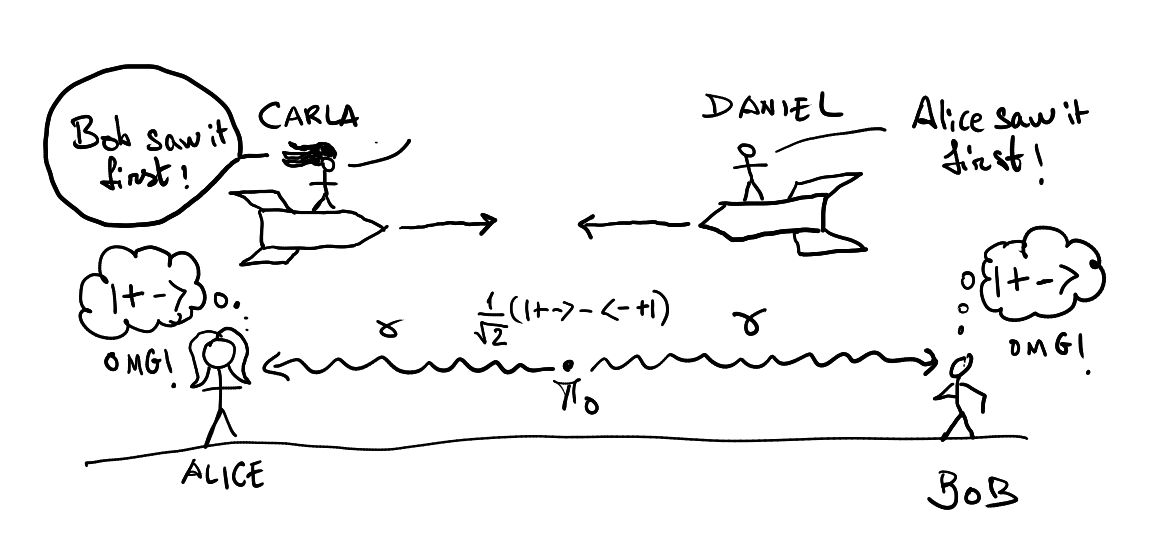
The properties of the entangled particles are established from the start. When a neutral pion decays into two photons, all the correlations are there from the start. Both measurements are random. But any observer that has access to both results, once information from both Alice and Bob is gathered and "centralised" --and therefore the criterion for FTL or not FTL will long have been outdated-- will discover eventually that the results were anti-correlated, if they happened to measure the same projection of spin. And they will be totally non-correlated, if they happened to measure different projections of spin. The tenses in "will" and "were" are essential here. At the moment they measure spin, either Alice or Bob, they write down the result, but they have no way to know whether: 1) The other one measured the same projection of spin, and their result is anti-correlated with theirs. or, 2) The other one measured another projection of spin, and their result is totally non-correlated with theirs. I told you, it's like a house of cards. If you drop randomness but keep quantum superpositions, sending FTL signals would become possible. That doesn't happen. If you drop quantum superpositions and non-commutativity, it becomes like a pair of gloves dice that are totally correlated (or anticorrelated, as the case might be) for every observable. It's random, totally, unmistakably. And it's superpositions (no internal reality.) It's impossible to explain this to you with firecrackers, boots, dice, or little leprechauns that take decisions. Firecrackers don't have internal non-commuting variables. There is a fathomless void, and impossibility, an insurmountable logical obstruction here in the space of classical analogies. There are no classical analogies. Local, totally. But random, not because, but because: No. No internal mechanism, no manufacturing differences, no internal switches. Nothing. Niente. Nada. Nichts. Zilch. Quantum mechanics! Quantum mechanics! Quantum mechanics! Oh, no matter, you can say that they broke me. I was playing this ping-pong match Nadal style, until I finally went all Djokovic on Bangstrom. It's not a totally bad analogy. But all our classical analogies are doomed in the end, because classical tethers cannot reproduce non-commutativity: Say, eg, in the case of the astronauts, (nationality)x(handedness)-(handedness)x(nationality) = i x (gender) What the hell does that mean in terms of tethers, coins or dice? Systems that behave this "crazy" deserve the name of "quantum." The intermediate tether holds the anti-correlation, but in such a way that, while it's evolving, following the Schrödinger equation, it cannot be said --without falling into inconsistencies-- that the astronauts are this or not this, that or not that. They are in a quantum superposition of all the "this" and "not this" possible questions. Being American or not, lefty or not, woman or not, equally likely. When you put two astronauts inside respective space pods, you want to believe they either are American or not American, lefty or not lefty, and a woman or not a woman. You want to believe, eg, the American is, say, left-handed, and a woman. She must have been!! She was all that from the get go!! Then the other one is not American, right-handed, and a man. You want to believe that, naturally! Why, they are real astronauts, right? If the American is a woman, she must have been a woman all along. If she's right handed, she must have been RH all along, etc. That's what doesn't work with quantum systems. The system "selects" the pairing of results --corresponding to one property-- only after you perform your measurement, and not before. And I say "pairings of results" knowing full well what I mean. According to QM, if I want to know if the astronaut is a woman, I must give up knowing whether she's LH or RH, or her nationality. The reason is they are incompatible properties. If you "measure" the gender, one space pod has a woman in it, and the other has a man. If you measure the nationality, one space pod has an American, the other not. What if you "measure" the handedness in one and the gender in another? Then anything's possible. You sometimes get a lefty here and a woman there, a right-handed here and a woman there, etc. All combinations equally likely. It is an intimate connection between the astronauts, much more intimate than you could get with any classical bipartite system. It's as if they both were just one thing, and you could only look at each of the "parts" through one filter: nationality, or handedness, or gender. You must decide which one. I don't know how to package that into a single analogy. The best I can do is: Try to picture a reason why, if you want to know my gender, you absolutely cannot say anything about my handedness, or my nationality. In fact, if I'm a man, I'm absolutely neither right-handed, nor left-handed, neither American, nor not American. This is as weird as can be, but not because of non-locality. It's because of non-realism. Because gloves, and dice, and coins are real --whatever that means--, they hold all their meaningful properties at once --yeah, that's what it means!!--, they can't illustrate anything deep about QM one hundred per cent. Little leprechauns that take decisions would actually be possible to accomodate to superdeterminism.
-
Some cleaning up of silliness seems necessary. I can't let this go. I don't know who said it, but it's sooo foolish... Bell's inequality is certainly not the weirdest theorem in the world. It represents the common world. The world of "yes" and "no." I'm not responsible for stupidity propagating around, nor is @Eise, nor is @MigL, nor is @swansont, nor is @Ghideon. Bell's theorem is about classical propositions. How could it be "weird"? What's "weird" is, perhaps, its violation. A = My cat is alive Not A = My cat is not alive B = My sweetheart is happy Not B = My sweetheart is not happy C = the kid is a girl Not C = the kid is not a girl Probability(A, not B)+Probability(B, not C) is greater or equal than Probability(A, not C) The CSHS inequalities are are more suitable version for experimental verification. Thanks to @Ghideon. +1 How is that strange? It's far from obvious, but not strange at all. What's strange is that (colour for dramatic effect), Quantum mechanical probabilities violate this!!! This is because, for quantum mechanics: Probability(Sx=up,S45º=down)+Probability(S45º=up,Sy=down) is less than Probability(Sx=up,Sy=down) And how could that be? Only because a premise of the theorem is wrong. Which one? The assumption that variables are either this or not this. (The assumption of realism.) The premises of the theorem are so weakly-assuming that there is no other option. IOW, there's barely any other premise. It even includes as a possibility statistical dependence: A totally contained in not B, etc. Because quantum mechanics allows for states for which my cat is neither alive nor dead, etc, with a probability amplitude that the cat is 1/sqrt(2) alive and 1/sqrt(2) dead, QM violates the otherwise simplemindedly-true, but devilishly astute, theorem due to Bell. And that's almost all there is to it. What are classical data? What happens when my sweetheart is definitely not happy? That's another matter. Does decoherence arise "instantaneously"? (whatever that means.) That's another matter too.
-
Jawohl! Es macht sinn!
-
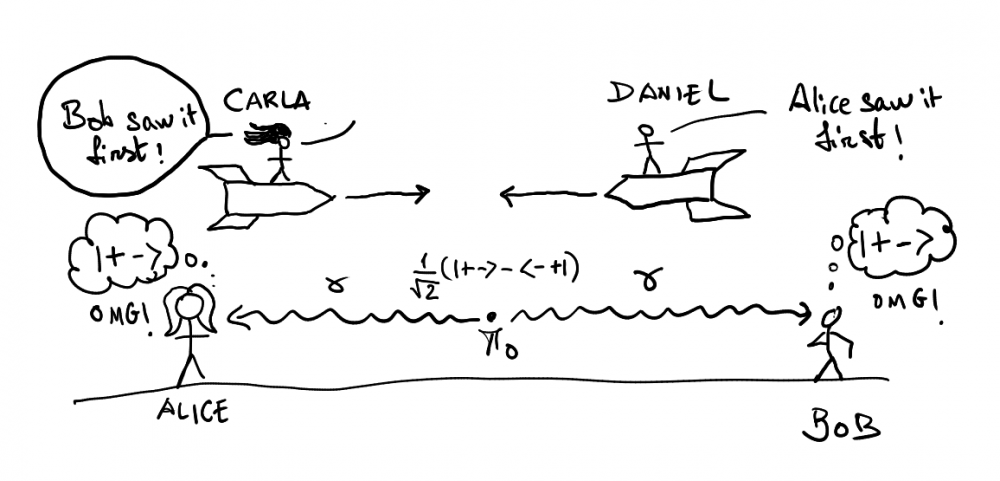
No!!! Is there any single statement about this that you can get right? Alice and Bob are sitting in the same reference frame. They can use laser to determine they saw it at the same time. They determine they saw it at the same time!!! (In their common inertial reference frame.) Carla and Daniel, on the other hand, equipped with lasers too, are sitting each one on yet two more inertial reference systems. They infer different coordinates for the reception. From the POV of Carla, Bob's photon reaches Bob before Alice's photon reaches Alice; from the POV of Daniel, Alice's photon reaches Alice before Bob's photon reaches Bob. Why do I think you don't understand? Because you don't. You simply don't understand it. You don't. You don't. You don't. You don't. You don't. You don't. You don't. You don't. You don't. You don't. You don't. You don't. You don't. You don't. You don't. You don't. You don't. You don't. You don't. You don't. Don't. Don't. Don't. Don't. Don't. Don't. Don't. Don't. Don't. Please do. Please do. Do. Do. Do. Do. Do. Do. Do. Do. Do. Do. Do. Do. Do. Do. Do. Do. Oh, please, do.
-
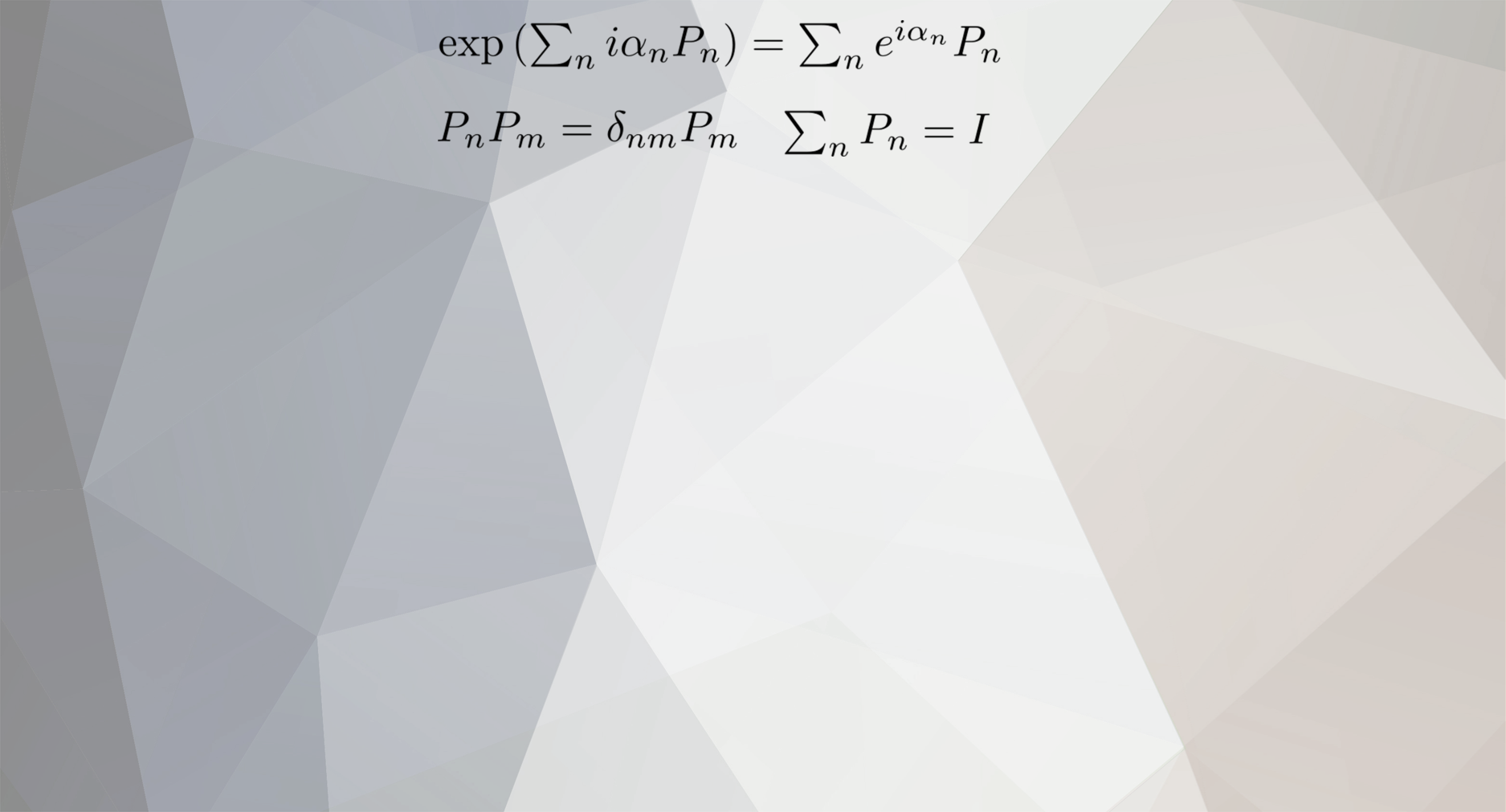
Nope! I think these comments get to the heart of the matter from a philosophical POV. My take on it is the wave function represents infinitely many occurrences we simply cannot tell apart from each other. IMO, up to a certain point, to the extent that the theory has been mathematically understood, choices may open up. Don't forget that, even when quantum mechanics has given you a valid choice for your \( \left|\psi\right\rangle \), there are infinitely many prescriptions equivalent to each other. Once we've written the state vector in the so-called position representation, \[ \left\langle \left.x\right|\psi\right\rangle =\psi\left(x\right) \] we can still change the prescription point-wise as long as there is a gauge field accompanying it, \[ \psi\left(x\right)\rightarrow e^{iq\theta\left(x\right)}\psi\left(x\right) \] \[ A^{\mu}\left(x\right)\rightarrow A^{\mu}\left(x\right)-\partial^{\mu}\theta\left(x\right) \] So right there gauge ambiguity is telling you your state object is very, very far away from being determined. If I had to bet, I'd say the "mysterious part" --the persistent thwarting of any attempts on our part to determine the system-- is hidden under the carpet of gauge ambiguity: From: https://en.wikipedia.org/wiki/Introduction_to_gauge_theory#Gauge_invariance:_the_results_of_the_experiments_are_independent_of_the_choice_of_the_gauge_for_the_potentials The spin factor of the state being even more deeply non-realist than the space-time part. IOW: Spin variables cannot even be represented by commuting variables.
-
In early Christianity the sharing of the food was the real deal, more similar to what you tell me about the Presbyterian church. From the point of view of healthy practices, holy water at the entrance of Catholic churches must bee teeming with bacteria. So ... eew. I don't think it's very sanitary. Anyway, trying to answer to the question of where it comes from, I've found this, From: https://www.stmarybasilicaarchives.org/archives-desk/history-and-usage-of-holy-water/ But given the role that water played in ancient Judaism, I think we shouldn't completely rule out the possibility that the origins of the practice go as far back as the Essenes, or perhaps earlier.
-
Instant in one reference frame is 1 to 2 in another, and 2 to 1 in yet another for space-like intervals. The order of events is frame-dependent. Please, oh please, do learn some special relativity. At least the basics. "Instant doesn't mean anything in special relativity. That's the point. (Ahem, ahem, sigh.)
-
As a person raised in the Catholic tradition, water was never very high on my agenda. The Church offers you as many servings of it as you want when you enter or leave their offices. What always kept me wondering was why wine was a privilege for the Father only, who did the consecration of bread and wine into the body and blood of Christ. You could have the (sorry excuse for) bread they give away, but never the wine. I've been blood-thirsty ever since. Red wine is a miracle.
-
Yes, but I should have read the post more carefully. I just hope new comments draw attention so that OP can get a proper answer. My idea of American education is that knowledge is more practical than in Spain. I've seen courses in Britain which, even on the theoretical side, go more from example to theoretical idea. I'm more familiar with Britain than America. We have six primary-education courses, then four secondary education courses, and then two pre-universitary courses we call "Bachillerato." I always say any person who would assimilate all the the Bachillerato courses (Science, Human Sciences, Social, and Arts) would --potentially-- be a modern Leonardo Da Vinci +. The unfortunate result is that most people don't get a proper education in any of them, probably due to excessive emphasis on theory, to the detriment of practical knowledge.)
-
It was you who started talking about neutrinos. From a classical POV, neutrinos would have zero magnetic moment. Magnetic moment doesn't come from mass, but from circulating currents. In the context of the Standard Model, they're expected to have a very small magnetic moment, no doubt due to radiative corrections. AFAIK, only upper bounds to magnetic moment of neutrinos have been experimentally determined. It would be a good idea to read what I posted above.
-
Thanks. Usually, I don't allow myself more than 5 min of stupidity a day.
-
Sorry. What is K-12?
-
If you want to go from A to B, it's only natural that the answer will depend on where's A, and where's B. Are you already fluent in algebra, geometry, and analysis? (where's A?) Do you intend to tackle very sophisticated and recent mathematics, like ,eg, Grothendieck's Motives? (where's B?) If you already have a reasonable A, are not too ambitious about B, and also perhaps are relatively young, I see no reason why you wouldn't get there with the sources you propose by following your nose, and intuitively finding where the boundary between what you ignore and you already know actually is. I hope that was helpful.
-
By the way, @computer. Your idea is a noble one, and I want to pay respect to it. It's such a pity it doesn't work, at least not directly, because... Well, because you need quantum mechanics at some point. To prove to you how intelligent an idea it is, I'll let Einstein do the talking. (My boldface emphasis.) From: Autobiographical and Scientific Reflections; A. Einstein https://ebin.pub/einstein-on-einstein-autobiographical-and-scientific-reflections-0691183600-9780691183602.html I read this little book about 41 years ago. Many of the comments went over my head those many years ago. But that observation, and a couple of other ones, deeply impressed me, and have always stuck with me.
-
My intuition is that it would have to do with a kinematic (Doppler-like) effect, rather than a dynamical one (energy-momentum.) From: https://en.wikipedia.org/wiki/Relativistic_quantum_chemistry#:~:text=Gold appears yellow because it,compared with the incident light. (My emphasis in boldface.) Clarification: By Doppler-like I don't mean that reflected light gets Doppler shifted, but that it's kinematic (like Doppler effect), in this case because orbitals appear compressed, which affects the absorption properties. I hate being vague, but I hope it makes sense and is intelligible.
-
Nice account of how it is not spooky, it is not an action, and it is not at a distance. And the reason for the quotation marks in the title: You have to actually read it to see that, of course: IOW => NOT(LOCALITY AND REALISM) => NOT (LOCALITY) OR NOT (REALISM) Quantum mechanics has no underlying realism. Are we there yet? Let me guess: No. Silly me for believing you were in a superposition of yes and no. Funny. I did say exactly that. Only, I dropped the "as if." And was I right, oh man, that it would fly over your head.
-
Lesson number 1 in quantum mechanics: The quantum properties of B are not fixed. They're sure to produce the previous result if you happen to measure the same projection of spin. If you measure another projection of spin, they're completely random (equally likely to give + or -) and, in this case totally uncorrelated with the other particle's values. I told you, "random" doesn't mean much in itself. Give me a probability distribution. Have you ever heard of Bertrand's circle paradox? I propose the game of spotting your most embarrassing mistakes in each of your entries. It would be a fun game. There's no other interest in this thread now.
-
Today I learned gold is not silvery-shining and reflected light from gold gets more reddish because relativistic effects contract the interior shells. Thanks to @exchemist
-
Fearful symmetry. https://en.wikipedia.org/wiki/Ural_owl
-
In what frame are they simultaneous? For spacelike separated events, simultaneity relations depend on the observer, as you should know. And now I understand that's what @MigL was trying to say. IOW simultaneity is frame-dependent. No. Alice and Bob are not imaginary. They are detectors. Don't dodge the question.