
joigus
Senior Members
-
Joined
Everything posted by joigus
-
 The term 'attractor' or 'strange attractor' comes from chaos theory. Most dynamical systems follow chaotic trajectories in phase space --the space of all dynamical states of a system. Typically they evolve in an unpredictable way, and very close initial conditions differ wildly in very short times. However, they display some patterns, in that sometimes trajectories tend to cluster around certain regions and form certain shapes. Here's the Wikipedia article. https://en.wikipedia.org/wiki/Attractor They have indeed been compared to centres of attraction, although there is no force related to their being formed. It's considered to be an example of emergence, which is another concept you might want to take a look at. I hope that helped.
 -
The sphere is not one of the platonic solids. Platonic solids are regular polygons: https://en.wikipedia.org/wiki/Platonic_solid Entropy is not a conserved quantity. See, https://en.wikipedia.org/wiki/Second_law_of_thermodynamics If entropy was conserved, time would cease to exist as we know it, and I would look exactly as I did 50 years ago, and 50 years before that, and..., and... There is. It corresponds to a hyperbolid, not a sphere: https://en.wikipedia.org/wiki/Spacetime#Spacetime_interval
-
Exactly. That's how I would explain it anyway. When the medium is linear and homogeneous, the wave equation has to be modified by including the electric displacement \( \boldsymbol{D}=\boldsymbol{E}+\boldsymbol{P}=\left(1+\epsilon_{0}\chi\right)\boldsymbol{E} \). It's only natural to assume that polarisation varies with the frequency, as how much it responds naturally depends on how fast I shake the atoms of the material. Which book is this? I don't know if Lincoln mentions that the material has to be a dielectric. If the material is a conductor, the wave will be damped, which can also be incorporated in the formalism with a complex refraction index --the imaginary part accounting for absorption. As usual, what's hard is trying to find an intuitive explanation with no maths.
-
I see. Thank you. @Boltzmannbrain. Sorry for the misunderstanding. You may find this YT function useful, Peace out. 🖐️

-
My apologies. The original sentence I was answering to was --I'd say-- ambiguous, I understood it referred to @exchemist and/or @studiot. In any case, it's wrong to say that the light wave and the 'electron wave' --which I understood as meaning 'the electron wave function'-- combine into another wave, never mind who says that. I didn't watch the video and wasn't offered a clear explanation of its contents. If that's what it says, I think the explanation can be made a wee bit simpler, but never mind.
-
No, no, no. That's not what they're saying.
-
The concept of a reversible heat engine does not occur in a conceptual vacuum, nor does it occur in a speculative space totally alien to physical reality. There are many concepts like it in science. Particularly in physics: Inertial frames, frictionless surfaces, point particles... The point is: You cannot attain them, but you can get closer and closer to the real thing. You cannot get gradually closer and closer to a leprechaun or a unicorn in any meaningful sense. You can, at best, make a visual mock-up of them. That's not a novel idea. As said: and certainly not one that affects the conclusions of Carnot's analysis. You've been told: Caloric is just a stand-in for something that was only understood after Carnot. But mind you: Understanding a concept better does provide you with a way to, eg, run some preliminary controls on your experiment: Minimise losses by somehow impeding the known mechanisms by which they might happen. An experiment is not just 'see what happens.' It's more like: Take a theory, think hard about what could affect your experiment. Run some controls. Then operate the whole thing and measure everything that could affect the results according to your theory. Use the data obtained from your previous controls as parameters that affect the workings of your experimental setup. Then run some error analysis. Then report. Something like that. I'm far from an expert on the experimental side of things, BTW. It's very hard, and I'm not good enough. That's one of many reasons why I don't do them. I've been scavenging for some material that might be useful to see what on Earth it could be that you're not getting, besides the obvious things. This could --hopefully-- be helpful: https://academic.oup.com/ijlct/article/11/2/141/2198425#36206861 You would need this, IMO, as you need to understand what sources of entropy you have besides those established in the reversible ideal design. It would also be worth reading some comments from here: https://physics.stackexchange.com/questions/78915/efficiency-of-stirling-engine-and-carnots-theorem It's a question about an ideal context, and nobody doubts Carnot's principle there. It's more about recovering Carnot's formula from an ideal --reversible-- Stirling engine. They should agree. And sure enough, they do. I don't know what else to say. I think I'm about done here. --------------------- * For an ideal --reversible-- Stirling engine. ** The isochoric legs PD: Did I forget? Very useful too: https://www.stirlingengine.com/
-
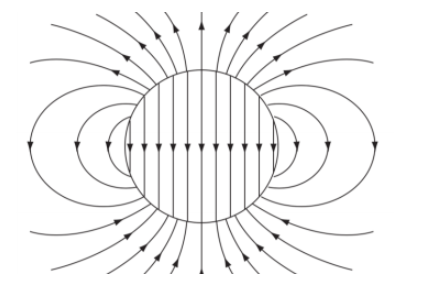
? Not the case for the Earth, though. It's more of a conductor than a dielectric. And it's one of those cases in which the electrostatic force is orders of magnitude weaker than gravitational force.
-
https://www.nature.com/articles/s43247-021-00313-5 (My emphasis.) This is what I meant. Graphite is one of the best lubricants, therefore reducing dissipation.
-
Not at 30'000 degrees --never mind Kelvin, centigrade or Fahrenheit.
-
Fair enough. Thank you.
-
I would say this is more or less a correct statement. Where do you think it's wrong, @Genady? Have I missed something?
-
This has become an escape clause - used too lightly. Common sense derives from experience. Subatomic world is far removed from common experience. How lightly is too lightly? That's your definition. 'Oblivion' Oblivion is something --according to my definition--, yet, it doesn't occupy any space. The word 'oblivion' is also something --according to my definition--, but it doesn't occupy any space. The concept of oblivion is also something --according to my definition--, but it doesn't occupy any space. And so on. No danger of incurring use-mention fallacy.
-
One exception to this is perhaps photons. But photons require a very special quantum treatment. Number of photons is not a conserved quantity, for example. They can interfere with each other[?] through a very big common 'wave function' if you want to call it that. But properly speaking, there is no wave function of a photon in the sense of something that gives you the probability for localisation of a photon. I'm overstretching the limits of language here. There are even states with no definite number of photons --coherent states.
-
They could form a very ephemeral state called a di-neutron and then decay to two neutrons. You could say that Higgs multiplets --which are neutral-- do combine to alter space, but with no changes over time. They fill up all of space with the result of giving every massive particle a mass. Neutrinos, OTOH, would do nothing much... You see, it depends on what neutral particles, and the couplings --interactions-- they have with each other and other particles. That's a very nice way to hit someone with protons...
-
LHC? Large hadron collider? 🤔
-
Legal and Human Rights Centre?
-
You said two protons, so they would repel each other and wouldn't likely ever meet. There are several factors that tell you so: 1) Electrostatic repulsion 2) Pauli's exclusion principle 3) No p-p bound state in QCD 3) already answers this, And as to, No. Interference in quantum mechanics only refers to different alternatives relative to one system. Example: The double slit experiment. Different components of one wave function interfere at a point. It's never about two distinct electrons, or two distinct protons, etc, interfering. Having said all that, if you chose to throw the protons at each other --instead of them being initially at rest-- they will scatter off each other, as happens in the LHC. The expectation of distance btw 2 protons is indeed a function of their mutual probability waves. They will be more likely to get farther apart as time passes. Did that help?
-
You are starry-eyed by ontology. IMO, that's standing in the way of your getting the point of physics. Physics is about what Nature does, and how it does it. In the process of understanding what it does, different apparent levels of 'is' show up.
-
Not the first thread I see that turns out to be a booby trap.
-
You're right in that it's not just a matter of hinging together a bunch of qualitative concepts. I'm sure it depends on how much dissipation, gravity, tectonic energy at play... So the quantitative argument is lacking there. The case of Mars is interesting because of the relatively low gravity, as compared to Earth. That's probably why Mount Olimpus and Valles Marineris are so huge when considering them with some kind of scale law in mind. Even though Mars has strong dissipation in the atmosphere*. It doesn't have that much dissipation underground --if at all--, as it has no plate tectonics. So in my mind, lower gravity and tectonic dissipation could easily account for it. It's interesting to notice though that minuscule satellites, like Phobos and Deimos, look more like potatos. Very low gravity and practically no dissipative processes. Seems to bode well with the qualitative idea. There must be a scale law involved, no doubt. I'm being quite vague though, I'm aware of it. ------- * But having had active geology and erosion processes in the remote past. (EDIT)
-
Good thinking. +1 In recent years, a cosmological theory to explain why the cosmos looks so flat --up to very large scales-- is being developed --Latham Boyle, Kieran Finn, Neil Turok, and others. The mechanism they propose is similar to what you're saying here. In fact, they use the Earth as an analogy. It's a combination of gravity and dissipative processes that does it. You need some fluidity, as Genady and Swansont said. So you need temperature, as J.C.Macswell pointed out. Because of plate tectonics, it would appear that bulges could potentially regenerate, thereby frustrating this process, and perhaps --from constant cooling of the Earth-- grinding the process to a halt. But dissipative mechanisms are constantly counteracting this tendency, with the result of flattening it out. Gravity does the final trick, depositing the ground pieces as close to the centre as it can.
-
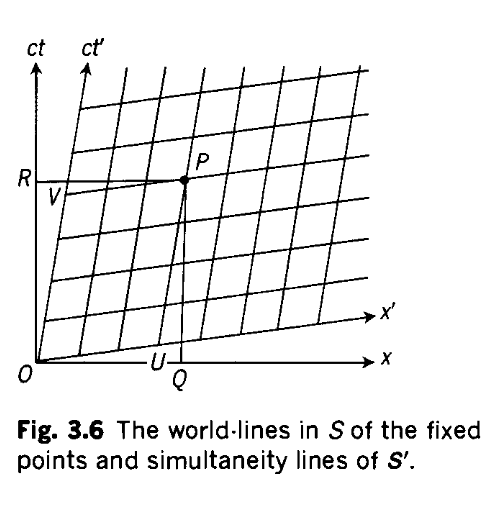
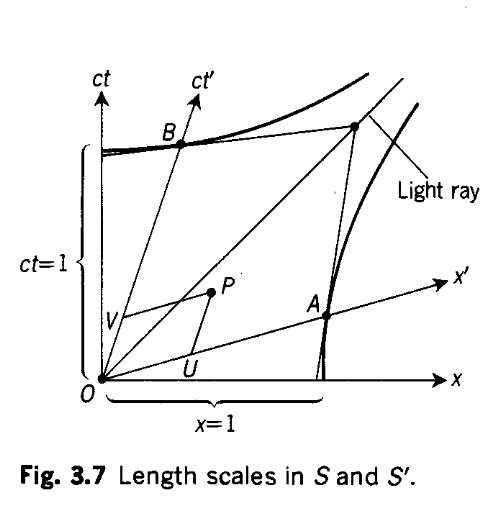
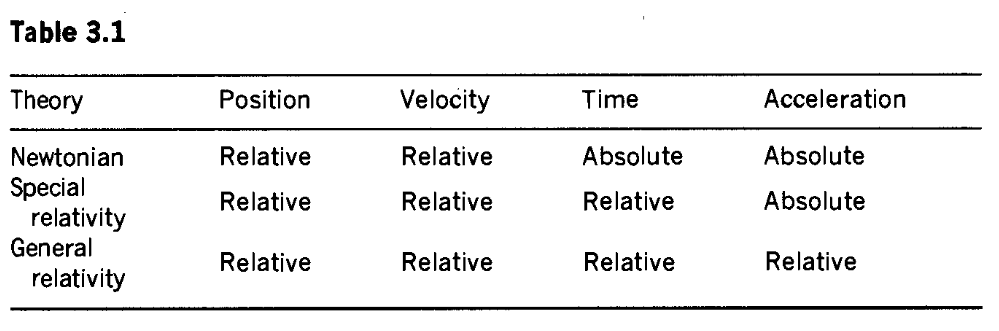
This is not a chauvinistic society. It's a science-discussion network. You're thinking Euclidean. Your diagram shows only too clearly that you are. Because you're thinking Euclidean, there's a rigidity of sorts in your mind that forces you to conflate different reference frames --as you've been told here and elsewhere-- in order to shoehorn your picture into the Pythagorean theorem. Here's a series of pictures that tell you why: (from Ray D'Inverno, Introducing Einstein's Relativity, Oxford University Press.) So, again, IOW, who are the S and S' on diagram 3.6 and 3.7 from D'Inverno? If you dodge the question again and throw brand new Euclidean diagram, there isn't much else to talk about, is there? One final word about 'sentiments.' This is a recurring theme in science discussions. People often mistake dead-seriousness about the subject with grumpiness, or even anger. Nothing of the kind. I personally sympathise very much with everyone who's interested in science. People who know about the subject would be doing you no favour by indulging in a logic they know to be flawed. They would be doing themselves no favour either. Sorry, I forgot: My sentiments are in the right place. No sentiments about space-time, really. Only perhaps longing for a space-time that allows to go backwards in time. I have some unfinished business in the past.
-
I blame Star Wars...
-
Also, as pointed out above, no experimental exception to it has been found.