
joigus
Senior Members
-
Joined
Everything posted by joigus
-
@MigL: I meant 'that's quite common among men my age.' Never a bad choice of preposition was as open to misinterpretation as this once.
-
Thanks a lot. Today has been a good day for beauty and wonder.
-
That was amazing.
-
That's quite common between men my age. You just made me a primate, @MigL.
-
Neither have I, but it's just because of the lack of information about that lovely fellow.
-
I tried to make them smaller or link to thumbnail versions... I would've thought you'd like them, given how fond you are of science fiction.
-
Treehoppers!! (from Wikipedia.) https://en.wikipedia.org/wiki/Treehopper Oak treehopper: https://insider.si.edu/2017/08/beautiful-bizarre-treehoppers-suck-sap-can-spread-disease/8577969459_49866036ff_b/ (from Smithsonian Magazine online.) https://www.smithsonianmag.com/science-nature/treehoppers-bizarre-wondrous-helmets-use-wing-genes-grow-180973713/
-
Yes, that's what I would expect from the acolytes. I suppose people elbowing for position are calculating their moves. That checks with what I was thinking. You're right that I don't know the American political landscape very well. But if I remember correctly Mitt Romney has presidential aspirations...
-
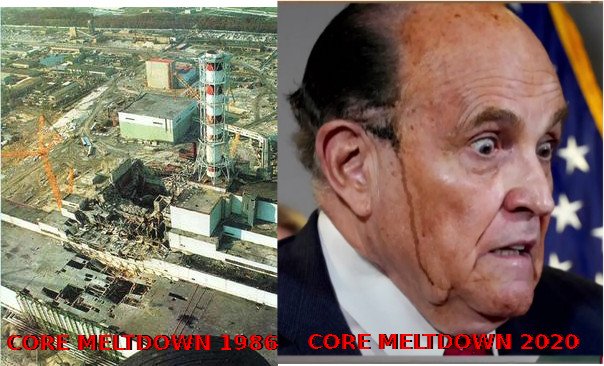
No serious Republicans taking positions to save face when all this pissing in the wind blows over? I'm sure it must be embarrassing for somebody in their ranks. Just curious.Clinton and JFK are not precisely the spitting image. Although both have the facial expression they're best remembered for. The only one that came out perfect is Bozo!Very interesting topics. Looking forward to seeing them posted. I've got some other historical topics to suggest. I'm glad to have you back, @MSC, after the pachi-dermatological treatment.But his is a denial on steroids. What if he doesn't realize he's dead? He would be the first political zombie in history. I picture him giving orders from his twitter account and letting Giuliani loose on passing 'trolls.'Sweet deal. Plus they would be in charge of vaccination.My feelings exactly. The average inter-species behaviour in this planet is trying to either outwit or outrun your predator or your prey. Other interesting possibilities are host-parasite, pet-master...Try with, \[\det\left(\frac{\partial f_{i}}{\partial x_{j}}\right)=0\] Now that I think about it, the fact that the \( k \)'s don't appear linearly is not that bad. You would obtain critical values for such non-linear functions \( K\left( k \right) \). So it's a matter of re-defining the \( k \)'s. What would be more involved is if the \( k \)'s appeared mixed with the \( x \)'s.Easter Island is a microcosm of what could happen here. But still, back then you could make do with a catamaran before the last tree fell and start afresh. I don't see any chance of anything like that happening any time soon. What you see is what you get.There was a time when the issue of who's the master of puppets was only of concern to those directly affected. Now it is a global issue. The situation has no historical precedent. Empires have come and gone, but now what's a stake is both management of the whole planet and a model of hierarchy and societal organization that's not just for restricted import-export, while keeping the balance of masters and underdogs; it's the way the world is going to be defined by, politically, economically, in terms of population dynamics... Never the stakes have been so high. And I can't deny that I'm worried. Paraphrasing @Alex_Krycek --if I remember correctly--, this is not empire business as usual. Communication bridges between similarly-minded people around the world will become essential. The concept of a nation in the usual sense is doomed. And we should be glad that it is. I hope it's for the best. That's what I think, anyway.Right. He's an elephant-in-the-living-room kind of president we've never seen before. Literally and metaphorically.I hope you're right. And your prediction seems very likely to come true. But another very worrying matter at issue should be the damage that the incumbent is doing by deciding not to brief the President elect on matters which are extremely important in a situation of national emergency. It seems to me that smooth transfer of power is not just a question about healthy institutions, important though it is. If national security weren't enough, there is an ongoing pandemic and it seems to be beyond his concern. I'd like to hear your --and everybody's-- thoughts about that. I have. I've just watched his reaction to Trump's tantrum and he was nothing if not reassuring.Thanks a lot, Airbrush, for amazing pictures and captions with info.Bouddi National Park (New South Wales, Australia.) This Australian National Park features the presence of sandstone, coloured by haloes of chemical change, brought up by differential oxidation of iron minerals in the presence of moisture (Liesegang rings*) as those in Maria Island presented in the previous series of photographs. ---------- (*) Liesengang rings are rings of chemical change that colour the interior of certain rocks. They are formed by oxidation of iron minerals due to moisture penetrating the rocks through their porous structure. Generally that moisture filters through fracture lines in the rocks, thus producing concentric rings towards the centre of the blocks that the fracture lines define. CREDITS: https://www.facebook.com/Geomorfologia.Para.Todos/posts/4021501111197661 (Translated from Spanish) (Geomorphology for everyone) https://forum.xcitefun.net/bouddi-national-park-australia-t83280.htmlThanks for keeping me informed, Mattiao. Yes, I think I do. I've got a couple of questions for you, though. Are you always working with one parameter, \( k \), and arbitrary number of equations? Are the equations always linear in \( k \)? I'll get back to you as soon as I've got more time to spare. Well done!I'm waiting for the REAL religion to come around. So my faith is postponed. But he's building a temple, made of styrofoam. I'm looking forward to worship.

Important Information
We have placed cookies on your device to help make this website better. You can adjust your cookie settings, otherwise we'll assume you're okay to continue.