Ghideon
Senior Members
-
Joined
Everything posted by Ghideon
-
I usually copy/paste or drag and drop images into the edit box. Works fine from computer. Ok. Do you mean cosmic inflation? Cosmological inflation, or just inflation, is as far as I know a theory of exponential expansion of space in the early universe.
-
Hello. Can you post something more than just a link?
-
Not sure that I agree. Is c really the base for all languages, including functional programming languages (for instance ML) ? I believe it is quite possible to understand the concepts of for instance Java or C# without first learning c.
-
I would want to participate in discussing of your findings, initially to see if your ideas and arguments are supported by mainstream science. This is a discussion forum, so your discovery will be discussed. The outcome of such a discussion will partly depend on what and how you choose to contribute. (Side note: My first language is not english, but on this forum language is seldom a problem. General attitude of most members is helpful; language issues are identified and overcome)
-
I briefly did before moderators removed parts that are not needed to start a discussion. I dont think Phi’s question was answered. can you post (a less detailed) answer how evolution is fundamentaly different for humans?
-
Even if the idea does not work I think the presentation deserves some credit; it allowed for a proper analysis to identify issues and opened for a fruitful discussion. And also credit to @Janus for the clarifying!
-
Thanks for the reply. I think I might need to clarify; the exhaust leaves the the engine in the y (vertical) direction. Unless the exhaust is slowed down in y direction, relative to the engine, the fuel will not be recovered. Since the exhaust has mass the change of velocity in y-direction (=acceleration) will require energy. If you check the setup for conservation of momentum for instance I think you could spot the issues that emerge?
-
Hello! I have not yet analysed all details but initially this looks like a variant of reactionless drive. It is not possible to recycle the fuel. Slowing down the exhaust to recycle fuel will halt the rocket.
-
(1): [math]t'= \gamma (t- \frac{vx}{c^{2} } )[/math]
-
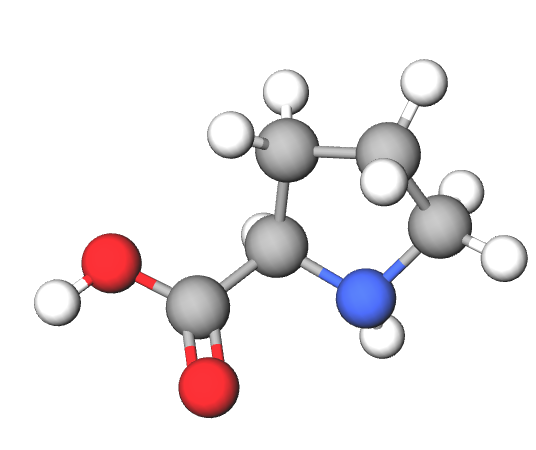
Good point! It was some decades ago but I still remember how cool it was to build stuff. I think the ball-n-stick model could be fun to combine with a (free) online tool such as Molview. I'll use Sensei's picture as an example. If kid asks "what have I built? What does it do?". Personally I couldn't identify the compound in the picture but a few minutes in Moleview tells us that it (likely) is "Proline, an alpha-amino acid" and "Amino acids help break down food, support growth, and repair body tissue." http://molview.org/?cid=614 There are of course other methods. Personally I don't know much chemistry so this is a quick method to be able to tell some basic facts.
-
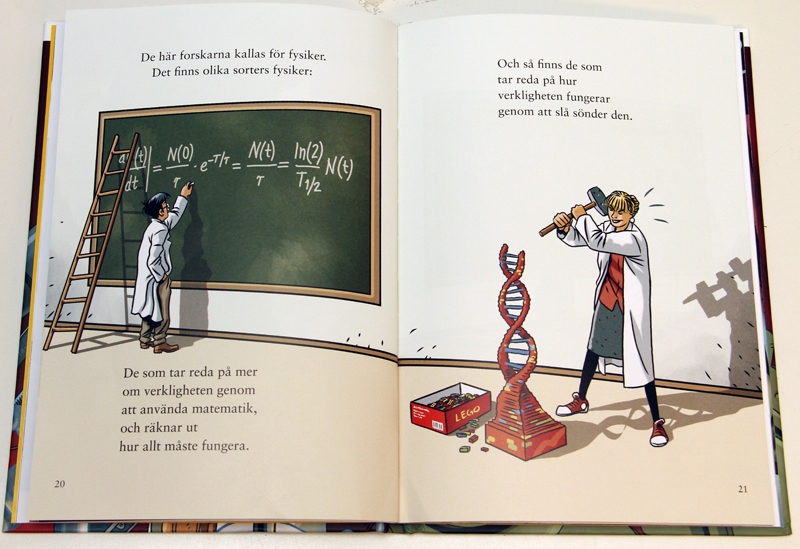
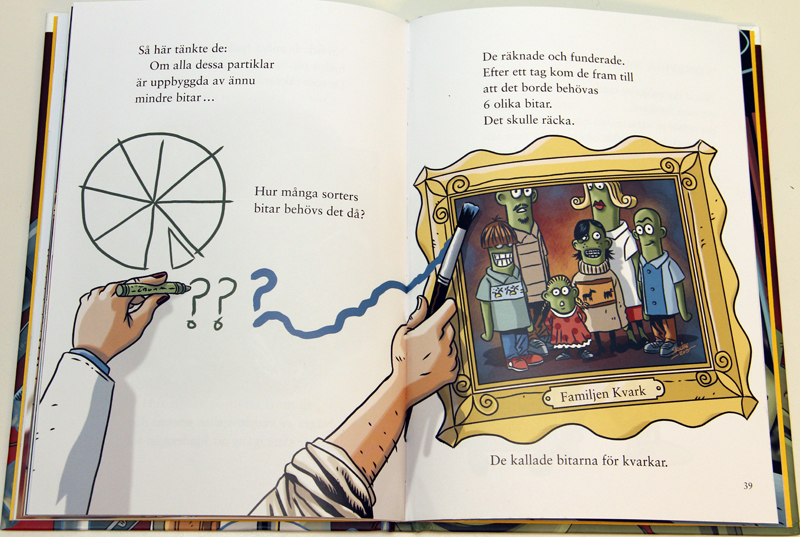
Cool! For atoms and particles (and science in general) I have used books with lots of pictures so that we can both read together and/or kids can explore the book and ask questions later. Here is an example, the author explains that there are two types of scientists within the physics, the physicists who calculate mathematically how things work and the physicists who break things down so that the counting physicists can figure out why. The book* is excellent but I've not been able to find a translated version. I post it as an example even if it is not in english. Introduction to standard model; how many types of Quarks are required? Your kid is probably already past this stage already but others might find it useful. I've used Toca Lab which focuses on playing around with the elements and the periodic system. pros: All 118 elements can be "discovered" in a periodic table focused layout. Some basic behaviour included; gases "hover", solids drops down on the table. Opens for discussion based on periodic system and elements. AFAIK no commercials Cons: Focus is on playing, not scientifically correct details. Example: new elements can be "created" from other elements. Kids won't learn detailed scientific information without interaction with an adult or older kids. Here is a review: https://www.commonsense.org/education/app/toca-lab-elements Here is a PDF with all elements already "discovered": https://s6.pappasappar.se/wp-content/uploads/TocaLab_PeriodicTable.pdf. The app starts with an empty one. *) https://www.bonniercarlsen.se/bocker/163790/om-pyttesma-partiklar/
-
Hello @Owen Martin Ok! Your suggestions does not seem intuitive to me, even without using math i get: -If the goats were identical and not possible to tell apart, would that change the possibility to win a car? No -If instead of goats there are nothing behind the two doors so that an example is Car/Empty/Empty, would that change the possibility to win a car? No The 4 possible outcomes does not have the same probability. It seems you think it is a 50/50 chase of picking the car in the first selection. That does not seem intuitive since there is one car and two goats. I prefer to use math to show that 50/50 is incorrect. But I think it is can be fun exercise to see that by intuition a 50/50 answer seems incorrect. Try this thought experiment: First change the rules as a comparison. Let Monty do the first move and open a door showing one of the goats. Monty must pick a goat, he is not going to reveal the car. Your chance is now 50/50 to get the car from behind one of the two remaining doors. Compare to the original rule is that you must choose first. Monty must now show a goat, he is not going to reveal the car. Now is it intuitive that the outcome is not 50/50 in this case? Intuition may not give the correct answer, but it tells that 50/50 seems wrong since the rules are changed from the case above where the outcome was indeed 50/50. It does not seem intuitive that you have the same chance as in the case where Monty had to remove one of the goats first. Logic and "intuition" can help in the analyse but to get the correct answer I prefer math.
-
Just trying [math] for the first time... (Vfy)^2=(VisinΘ)^2+2ay⋅Δy [math] V_{fy}^{2} = V*sin( \phi )^{2}*2a_{y}* \Delta _{y}[/math]
-
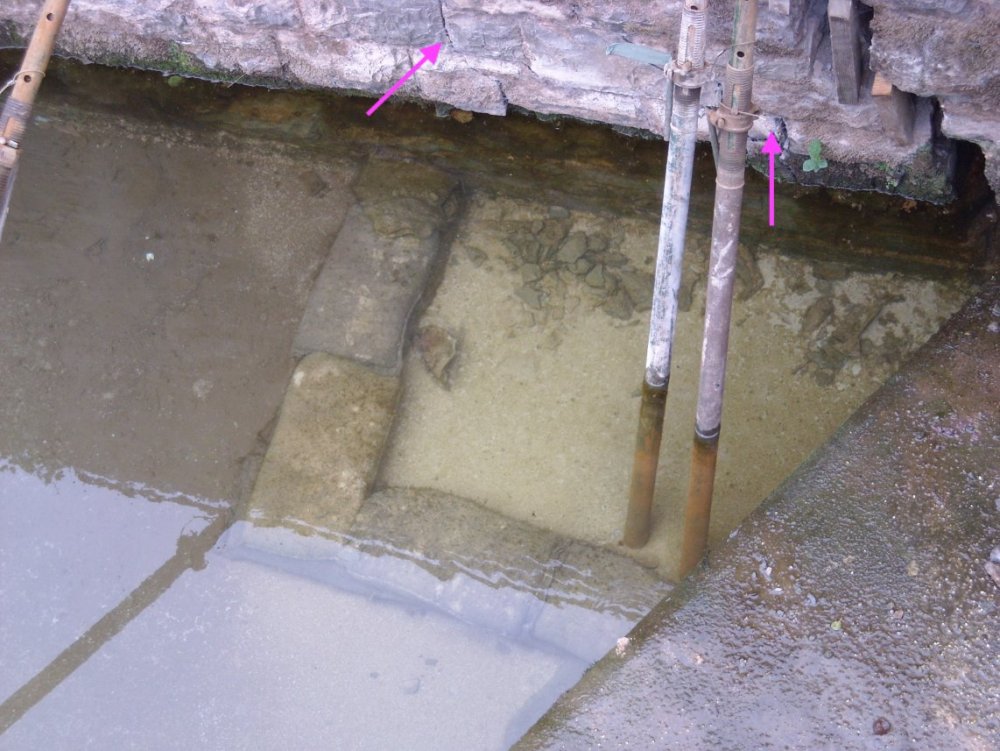
Agree, I can't see anything new. Not sure if it means anything but are there other cracks than the large one?
-
If I put my pedantic head on for a while then your comment dimreepr actually seems like scientifically sound reasoning and not a joke One reason why I asked about freezing in my first post. In the area where I grew up it was not uncommon for subsurface ice to push stones upwards: ref https://www.skogskunskap.se/vagar-i-skogen/drift-och-underhall/slitage-nedbrytning-och-skador-pa-vagen/skadekatalogen---vad-kan-vi-gora-at-vagskadorna/
-
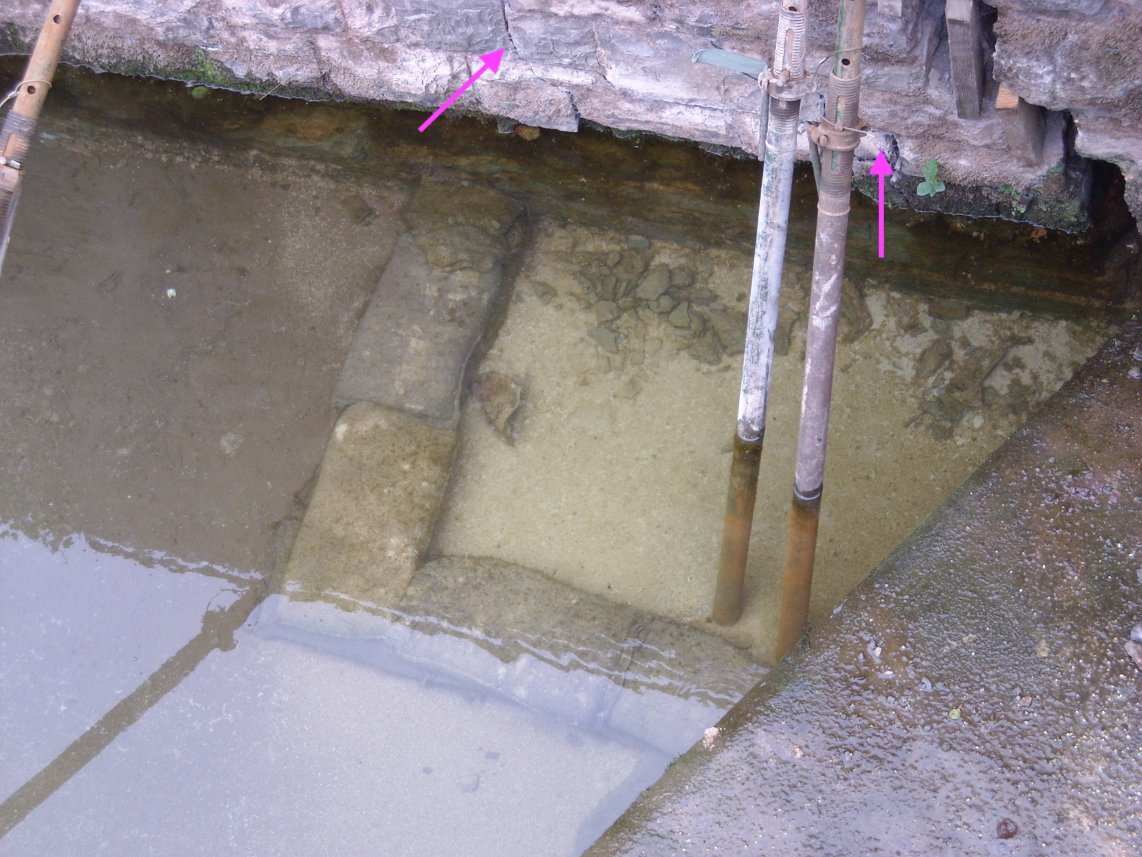
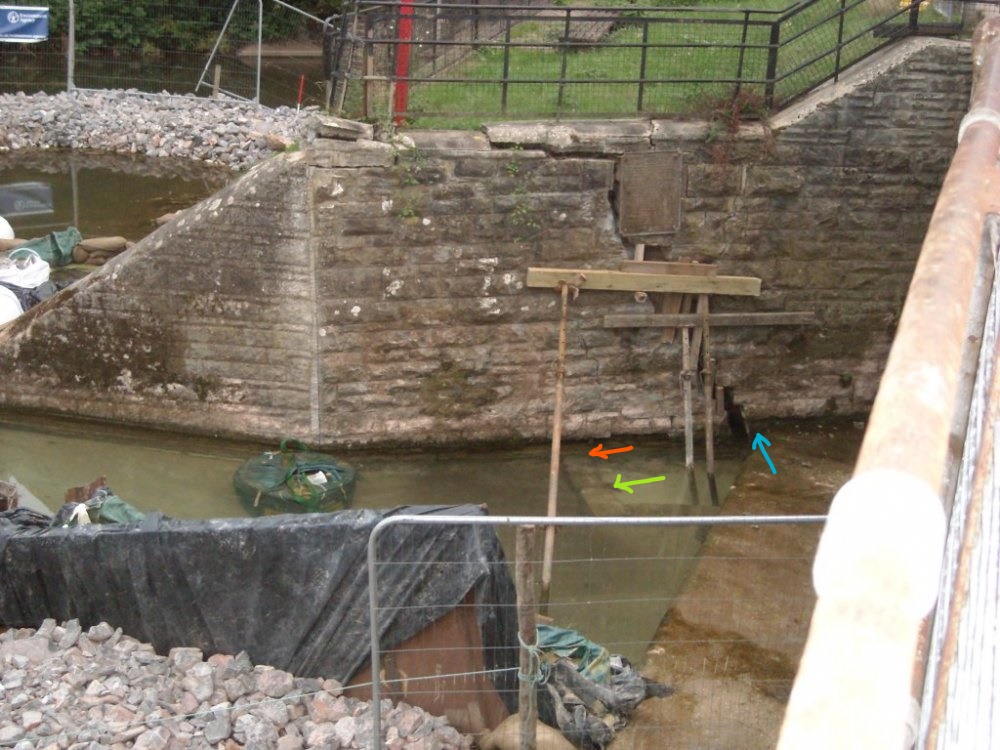
Some thoughts: The bottom of the crack is very close to what looks like a solid construction not covered by water. Is the part of the wall (that has not failed) resting on top of this structure? See blue arrow in picture. The red arrow shows some sort of structure under water. Does that continue in under the failing part of the wall? If so, is the gap at the green arrow a crack? Does it look like the thing underwater at the red and green arrow has moved down?
-
Thanks for the update! +1
-
I am curious; did you find out what happened?
-
Guesswork from what we have so far: If there was an old wooden wall built before the current one, is it possible that the stone wall was build at exactly the same location? Since the wood under water may have been well preserved it was used as a foundation. Now, after hundreds of years, the old wood is decomposed and cannot support the stone wall. This caused the stone wall section to move almost straight down.
-
Was the wall built on top of parts of an older structure? An old wooden construction could possibly have supported the wall for a long time. Here is an example; oxygen-poor and humid environment slows down decomposition of organic material.
-
Is the water frozen in winter? (If the river is near your location in your profile then I guess not, according to a quick googling)