
Mordred
Resident Experts
-
Joined
-
Last visited
Everything posted by Mordred
-
Agreed that wiki article is lousy on the correct details. It's almost as if someone who wrote it was half guessing what's involved. It's likely that it was written by someone who knows how an engineer uses it but doesn't understand how it's used in particle physics.
-
I think your issue is not realizing that the linear translations are between groups. For example the last example I gave is translating between SU(2) to SU(3). The original groups contain the information your looking for. The LCTs is how to take that information from one group to another group. Correct and what you are doing is using the correlations to establish how to transform from one group or map to another.
-
That description above isn't too bad you have the basic idea. Lets expand on it the BB at \(10^{-43}\) s was in a hot, dense state. Now the FLRW metric uses those equations of state above, which are thermodynamic relations between the kinetic energy and pressure terms of the multi-particle field. Matter has no pressure term as it doesn't have sufficient momentum to generate pressure. However relativistic particles do have the momentum terms. ie photons and neutrinos. The FLRW metric treats expansion as an ideal fluid with adiabatic and isentropic expansion. The Cosmological principle tells us this state is homogeneous and isotropic. as the universe expands then accordingly the temperature and pressure decrease as a result. In point of detail the inverse of the scale factor will give you the CMB blackbody temperature at that value of "a"=scale factor. The equations of state in the above link give the different momentum to pressure relations for radiation, Lambda and matter.
-
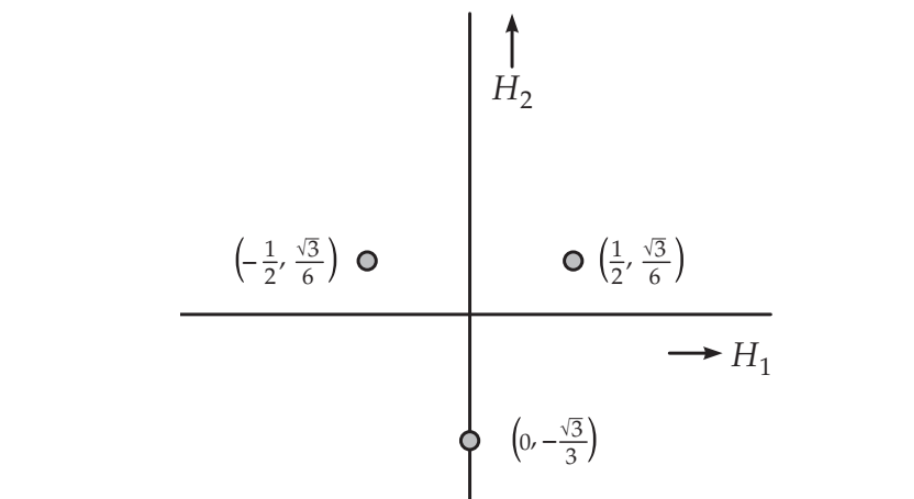
Understood and I'm glad you recognize that these symmetry relations are internal symmetries and not spacetime symmetries. To understand spin I would recommend taking time studying Cartan subalgebra. Here is the trick The synmmetry representations are expressed according to weights which correspond to eugenvalues. For example the quantum numbers of angular momentum all have their own weight under lie algebra however they also have their own weight diagram. (aka root diagram) for example the spin j of a particle is given by \[U(\vec{\theta})=e\frac{i}{\hbar}\vec{\theta}\cdot \hat{J}\] where \(\hat{J}\) is the three angular momentum operators whose representation will be given by \(2J+1\) dimensional and \(\vec{\theta}\) are the 3 parameters gives \[e^{\frac{i}{\hbar}\vec{\theta}\cdot J}|jm\rangle=\sum_{n}=-jC_nJn\rangle\] imposing \[U(\vec{\theta-1})U(\vec{\phi}(\theta_1\theta_2))\] results in subalgebra SU(2) \[[J_i,j_j]=i\hbar\epsilon_{i,j,k}J_k\] where raising and lowering operators are defined \[J_\pm=(J_1\pm iJ_2)/11/2\] there is the spin operations you mentioned. for SU(3) Now the Gell Mann matrices above has three basis states. \[|\Lambda\mu_1\rangle=\begin{pmatrix}1\\0\\0\end{pmatrix}\] \[|\Lambda\mu_2\rangle=\begin{pmatrix}0\\1\\0\end{pmatrix}\] \[|\Lambda\mu_2\rangle=\begin{pmatrix}0\\0\\1\end{pmatrix}\] where \({\mu_1,\mu_2,\mu_3}\) are called two component weight vectors given by eugenvalues \(H_1=\lambda_3/2\) and \(H_2=\lambda_8/2\) see Gell-Mann matrices above \[\Lambda \mu_1=(1/2,\sqrt{3}/6):|\Lambda \mu_2\rangle=(-1/2,\sqrt{3}/6):|\Lambda \mu_3\rangle=(0,-\sqrt{3}3/3)\] the above is your Dynkan spin representation of SU(3) SU(3) has an eight dimensional root diagram which is an adjoint representation not shown above https://en.wikipedia.org/wiki/Adjoint_representation#Structure_constants for the OP understandably this will likely be over your head but also for other readers Group theory is a theory of representations these representations gives us tools to find and organize symmetry relations and antisymmetric relations. These representations have their own algebras (lie Algebra, Clifford algebra, Cartan algebra, etc,etc). They often use internal symmetries which can be thought of as (mathematical symmetries) though these can be also be physical quantities or probability quantities. In particle physics the state is a typically a probability wavefunction same for QFT. Lie algebra involves raising and lowering of Operators an operator has a requirement of being a minimal 1 quanta of action. (Langrangian) Now we also have group symmetries homomorphism> a linear map between two lie algebras is homomorphic if it is non invertable.(useful for bosons aka symmetric) An isomophism is invertable (fermions aka antisymmetric). Now lie algebras have subalgebras. Dynkin diagrams help us organize all the simple and semi-simple representations. In a sense it forms an atlas of our mappings. So SU(3) has 8 generators The Gell Mann matrices above. Each matric has its own root and hence its own weight that has its own weight diagram (aka root diagram which is a map). These maps can be a sub group of a larger group and vice versa. Dynkin diagrams also provide these details.
-
Wouldn't change anything as SU(n) is a subgroup of Sl(n,C) which is a subgroup of GL(N,C). The problem with renormalization for gravity isn't that we cannot renormalize for normal gravity ranges. You have two types of divergence. IR (infrared) ie divide by zero. This is easily fixed and already implemented. The other end of the spectrum is ultraviolet divergence. (We don't have any known limit to the mass term ) so the singularity condition of the BB and the singularity of a BH. This is where the problem occurs. In math speak via QFT we can renormslize for 1 loop integrals but cannot renormalize for 2 loop liberals and higher. The mathematical method used won't change this as the problem is where to set the upper limit.
-
So let me understand this correctly you have some physics idea but when you attempt to apply known physics find that you cannot do so which technically should invalidate the idea but you also consider that a form of bias as opposed to proper methodology. Do I have that correct ?
-
Your welcome I wouldn't use the reference 6 it's not a method to learn particle physics from. While the LCTs and the SL(2C) group is part of particle physics the chart in reference 6 was generated using the SM Unitary groups. The groups the SM model primarily uses is U(1), SU(2) and SU(3). Focus on those groups first as well as the Poincare group. SO(3.1). The above is the groups for the SM model the LCTs while has uses that wiki page doesn't describe correctly where they are used in particle physics. Instead it's reference is a method in development It is the Unitary groups mentioned above that you will find in any particle physics textbook and not what is described by the LCT wiki link. Dynkin diagrams are advanced beyond the introductory level. While the Unitary groups will provide the details for another representation (Feymann path integrals)
-
for reference https://www.tigercheng.xyz/Dynkin_Diagrams.pdf see 4.2 for rank 2 roots. which I supplied the relations above. The roots can be thought of as 2 dimensional vectors in a plane some other helpful diagrams involving other groups as well. https://web.ma.utexas.edu/users/vandyke/notes/261_notes/lecture19.pdf this one includes the Coxeter diagrams (they act as symmetry reflections ) well explained in this link https://math.ucr.edu/home/baez/twf_dynkin.pdf hope that helps Edit I too find the 5 dimensional part used in reference 6 of the OPs link a bit fishy going to look into that particular article in greater detail
-
Lol I think you became too used to Unitary and orthogonal groups. Joigus Would it help to know SO(3.1) and SU(n) are both subgroups of SL(2,c)/Z_2 ? lets start with the following \[sl(2,\mathbb{C})=su(2)\oplus isu(2)\] generators denoted e,f,h [e,f=h] [h,e]=2e [h,f]=-2f the 2C is the linear combination of e,f,h \[\pi (h)=\begin{pmatrix}1&0\\0&-1\end{pmatrix}\] \[\pi( e)=\begin{pmatrix}0&1\\0&0\end{pmatrix}\] \[\pi h=\begin{pmatrix}0&0\\-1&0\end{pmatrix}\] \[f_i,h_i,e_i\] i=1,2,3....r however the set of complex cannot all commute so you need commutations \[[h_ih_j]=0\] \[[h_i,e_j]=A_{ji}e_j\] \[h_i,f_i]=-A_{ji}f_j\] \[[e_i,f_j]=\delta_{ij}h_{ij}\] where \(A_{ij} \) is the Cartan matrix ( I won't go through the ladder operators as they are fairly lengthy) however it can be expressed as \[[h_i,e_i]=\langle\alpha_j\rangle=\frac{2}{\langle\alpha_j,\alpha_j}\langle\alpha_j,\alpha_i\rangle_j=A_{ji}e_j\] \[\begin{pmatrix}2&-1\\-1&2\end{pmatrix}\] the above is for SL(2C) for sl(3,C) the Cartan matrix is an 8 dimensional algebra of rank 2 which means it has a 2 dimensional Cartan sub algebra given as follows \[\pi(t_1)= \begin{pmatrix}0&1&0\\1&0&0\\0&0&0\end{pmatrix}\] \[\pi(t_2)= \begin{pmatrix}0&-i&0\\i&0&0\\0&0&0\end{pmatrix}\] \[\pi(t_3)= \begin{pmatrix}1&0&0\\0&-1&0\\0&0&0\end{pmatrix}\] \[\pi(t_4)= \begin{pmatrix}0&0&1\\0&-1&0\\0&0&0\end{pmatrix}\] \[\pi(t_5) =\begin{pmatrix}0&0&-i\\0&0&0\\i&0&0\end{pmatrix}\] \[\pi(t_6)= \begin{pmatrix}0&0&0\\0&0&1\\0&1&0\end{pmatrix}\] \[\pi(t_7)= \begin{pmatrix}0&0&0\\0&0&-i\\0&i&0\end{pmatrix}\] \[\pi(t_1)=\frac{1}{\sqrt{3}} \begin{pmatrix}0&1&0\\1&0&0\\0&0&-2\end{pmatrix}\] You may note the last is the Gell-Mann matrices if we take the commutator between \(\pi(t_1)\) and \(\pi(t_2)\) we get \([\pi(t_1),\pi(t_2)]=2i\pi(t_3)\) which is familiar in the su(2) algebra. Thus we can define the following \[x_1=\frac{1}{2}t_1\] \[x_2=\frac{1}{2}t_1\] \[x_3=\frac{1}{2}t_3\] \[y_4=\frac{1}{2}t_4\] \[y_5=\frac{1}{2}t_5\] \[z_6=\frac{1}{2}t_6\] \[z_7=\frac{1}{2}t_7\] \[z_8=\frac{1}{\sqrt{3}}t_8\] with change in basis \[e_1=x_1+ix_2\] \[e_2=y_4+iy_5\] \[e_3=z_6+iz_7\] \[f_1=x_1+ix_2\] \[f_2=y_4+iy_5\] \[f_3=z_6+iz_7\] Now I should inform everyone that the basis and coordinates I am describing apply to Dynken diagrams and what I am describing apply to the root diagrams... https://en.wikipedia.org/wiki/Dynkin_diagram the basis above in matrix form is \[\pi(e_1)=\begin{pmatrix}0&1&0\\0&0&0\\0&0&0\end{pmatrix}\] \[\pi(e_2)=\begin{pmatrix}0&0&1\\0&0&0\\0&0&0\end{pmatrix}\] \[\pi(e_1)=\begin{pmatrix}0&0&0\\0&0&1\\0&0&0\end{pmatrix}\] \[\pi(f_1)=\begin{pmatrix}0&0&0\\1&0&0\\0&0&0\end{pmatrix}\] \[\pi(f_2)=\begin{pmatrix}0&0&0\\0&0&0\\1&0&0\end{pmatrix}\] \[\pi(f_3)=\begin{pmatrix}0&0&0\\0&0&0\\0&1&0\end{pmatrix}\] \[\pi(x_3)=\frac{1}{2}\begin{pmatrix}1&1&0\\0&-1&0\\0&0&0\end{pmatrix}\] \[\pi(z_8)=\frac{1}{3}\begin{pmatrix}1&0&0\\0&1&0\\0&0&-2\end{pmatrix}\] @joigus That should help better understand the special linear group of Real as well as complex. Now knowing the above applies to Dynken diagrams will also help better understand the validity of the OPs link as well as the methodology. @TheoM Hope this answers your question as well on the validity behind the LCT's and where they are applied in particle physics so yes the link overall you provided is valid
-
ok well as far as the chart goes the details are correct the main reason why the SM model uses the SU(n) groups is that tis group is compact which becomes important for renormalization as well as Feymann path integrals. the SL(n) group is not compact which can lead to issues with renormalization even though both groups are closed groups the isomorphism for the Lorentz/Poincare group for example is \[S0(3.1)\simeq Sl(2,\mathbb{C})/\mathbb{Z}_2\] spinors are defined to transform under the action of the \( SL2(\mathbb{C}\) group. So yes that link is accurate where it gets used as opposed to other group types depends on the state being described. However as shown here \[S0(3.1)\simeq Sl(2,\mathbb{C}/\mathbb){Z}_2\] you can have isomorphisms with other groups the isomorphisms for SU(N) to the SL(2,c) group can be found here which is what reference 6 of the link you gave which corresponds to the chart you posted employs further details here https://diposit.ub.edu/dspace/bitstream/2445/121903/2/memoria.pdf I should also forewarn you though that the Schrodinger equation of QM is not Lorentz invariant although the Dirac equations are. The operators used in QM (position and momentum) are not employed in QFT (field and momentum). QM uses the Klein Gordon equations which are Lorentz invariant. This is the purpose of reference 6 ": Linear Canonical Transformations (LCTs) are known in signal processing and optics as the generalization of certain useful integral transforms. In quantum theory, they can be identified as the linear transformations which keep invariant the canonical commutation relations characterizing the coordinates and momenta operators. In this work, the possibility of considering LCTs to be the elements of a symmetry group for relativistic quantum physics is studied using the principle of covariance" reference 6 here https://arxiv.org/pdf/1804.10053
-
As someone who develops physics theories I employ known physics in 35 years I have never found any need not to employ known physics. If I cannot employ known physics to develop a theory that tells me there is something wrong with my theory. Do you consider that a form of bias ? (Keep in mind I am a firm believer that any theory I develop I put every effort I can to disprove my own theory) lol in point of detail I am extremely good at proving my own theories invalid or inaccurate.
-
So what is your question ? The group is often useful for linear symmetry relations.
-
Well in terms of emergent there are numerous papers of emergent spacetime as well as emergent quantum fields. However how emergence is typically treated is from other field geometries example Calibi Yau spacetime from string theory. The more typical papers for emergent spacetime are typically string theory or ADS/CFT formalism We have to be careful here as emergent doesn't necessarily mean come into existence but rather specific relations and dimensionality ie 5d or higher dimension models leading to emerging 4d spacetime relations. The same can result from lower dimension theories emerging to higher dimension relations. I should add a field can be any collection of values (mathematical or physical) under a geometric treatment. In QFT for example the creation/annihilation operators employ the field as an operator. In a sense the field can propagate the creation/annihilation operators. The operators operate on the propogators. (An operator is has a minimal of 1 quanta of action ) this is the minimum energy level for an operator. (A propogator can have any value but can be below a quanta of action ) example virtual photons and gauge bosons. Aka the internal wavy lines of Feymann path integrals. The operators would be the external lines.
-
No time dilation would not explain dark energy but don't feel bad this conjecture has already been considered and tested for. Back when we first discovered the accelerating expansion physicists looked at the possibility of being observer effect due to time dilation. The problem is the cosmological constant is too constant to be explained by the non linear curve of time dilation formulas. This turned out not to work but at least the good news is that your idea had merit. To add detail it was low redshift values for the late time accelerating portion of expansion ( Lambda dominant era) compared to the deceleration portion(matter dominant era) that showed that time dilation could not explain the cosmological constant. ( the transition between matter dominant and Lambda dominant occurs roughly when the universe is between 6 and 7 billion years old.) It is the redshift variations (which incorporates time dilation effects) that showed that time dilation could not explain the cosmological term w=-1. In point of detail it was the redshift data between this transition which became further evidence supporting the existence of the cosmological term when initially it was felt it would support an observer effect due to time dilation. ( you get similar results from luminosity distance and angular size via distance relations ). We have used all three methods above to try to eliminate or validate the cosmological term at various redshift distances and at different matter/radiation densities
-
As I understand it, it's due tonhigh fat and low moisture content.
-
No problem it's easy to forget details when thinking of GR QFT etc lol. It may help to recall that it is the stress energy momentum tensor that spacetime how to curve and that spacetime curvature describes particle paths (geodesics). Hence the use of the (ct) interval is incredibly useful.
-
A common misconception spacetime isn't really something that forms spacetime has no fabric like substance. It's simply a geometric volume with time having dimensionality of length via the ct interval. So in order to have fields you require a volume for the fields to reside in. All forms of mass energy contribute to spacetime curvature. If there is no curvature spacetime is still just the 4d volume.
-
I seem to recall someone mentioning a reference for the nuke method in regards to the radiation vs kinetic shock wave you get for atmospheric explosion that last link highlights thar detail. Just in case anyone missed that.
-
Both the use of nukes and impactor method has the risk of breaking apart the asteroid. Asteroid composition being a factor for the likely hood. Even though you only get the radiation portion and not the kinetic shock waves from the nuke. There is still a risk. One risk is thar if you have non uniform outgassing this can lead to breakage.
-
Ordinarily if the mass/energy density distribution was non uniform you would get different regions with different time rates as per GR. We see that today with large scale structure formation, galaxies stars etc. However the Cosmological principle of a homogeneous and isotropic uniform mass distribution still occurs at the large size scales. It's like looking at the waves of a lake as you move further from the surface the more uniform the lakes look. The uniform mass distribution becomes apparent on a scale of 100 Mpc (megaparsec) at the time of the CMB that scale is greatly reduced. However we cannot forget that dark matter fills up most of the universe and baryonic matter is only 3 percent of the mass. Gravity itself However only attracts it doesn't expand. We also already take into account the result from matter forming into stars galaxies etc in the matter only solutions of the FLRW metric. This is rather complex to understand but essentially a matter only universe can expand due to structure formation because the global mass distribution reduces due to matter forming those structures on the local scale. So yes the mass distribution does contribute to expansion However that isn't the same as being due to time dilation ( I'm going to assume the time dilation statement is more a poor choice of descriptive for non uniform mass distribution). Now dark energy is not the only contributor to expansion it's the current most dominant contributor.. Expansion also can be caused by matter, radiation (relativistic particles photons etc) spacetime curvature as well as the Cosmological constant. At one point (except the curvature term as k=0 for the near flat universe we see) each of these contributors was dominant. The three eras are radiation dominant, matter dominant and Lambda dominant (Cosmological constant aka Dark energy). In essence yes non uniform mass can cause expansion so you are correct however we already factor that detail in the FLRW metric via the equations of state See here for the equations of state https://en.m.wikipedia.org/wiki/Equation_of_state_(cosmology)
-
That answer depends on the model of how the universe started which we do not know. For example if the universe started from nothing then it stayed immediately after T=0. If our universe was due to a bounce from a previous universe then you would have the spacetime from the previous universe ( the portion of the previous universe that bounced to form out universe.) In short we do not know previous to 10^{-43} seconds. We can only accurately extrapolate to that time. Any process prior we can only speculate.
-
They gradually change as well though interpretations is more the realm of metaphysics which is more philosophy than physics. Truth be told as a physicist I honestly don't waste much time with interpretations. I've always been more concerned with mathematical to observational accuracy. The interpretations particularly those involved in QM and entanglement too often get in the way. Lately I've found metaphysics argument has all too often become a tool for those that try to change physics without understanding the mathematics. So you see far too many posters in Speculations arguing against main stream and we'll tested physics based on personal feelings and interpretations.
-
The other factor we are missing is that certain universities are better at one program but fall behind in other programs. So depending on the area of study one University that may be top ranked may be behind in the area of study. For example a university that focuses of trade schooling may be lacking in hard sciences.
-
There is one example of the scientific I can provide with regards to Cosmology. At one time the FLRW metric did not have a cosmological constant term. This went on for roughly 40 to 50 years. Later findings and research found that universe expansion was accelerating. So the FLRW metric was repaired with the new findings. The Cosmologicsl constant term was then added. That's just one example. If later research shows an inaccuracy or a better method then the theory either gets a modification or revamped entirely. Another example is just prior to Higgs at one time the neutrino was considered massless later findings showed it has a miniscule mass term. The Higgs research showed how the neutrino acquires mass. Research and observational evidence will trump any theory or bias once the evidence becomes sufficient
-
One misconception that's rather common. Science never states something is the truth. Every theory or model is " to the best of our understanding" due to observational and experimental evidence. This includes the various laws such as the above mentions laws of thermodynsmics. The only truth behind them is their success rate to match observational evidence.