

CharonY
Moderators
-
Joined
-
Last visited
Everything posted by CharonY
-
! Moderator Note Please discuss the topic without referencing other off-topic discussions.
-
Do you have source or some more detailed description that substantiate your claim. How was the blood fully drained from the brain and how did they ascertain consciousness while it was drained?
-
First, please provide specific cases what you are referring to. I am particularly curious about the patient having a form of consciousness with the brain fully drained of blood.
-
The question is more how you define mind. And if we use the various definitions and concepts of consciousness and cognitive abilities, we do have a good idea where things located in the brain. In part from lesion studies (i.e. parts of the brain that have been damaged and resulting in cognitive changes), but also with animal models and other approaches (e.g. fMRI). These includes functions like memory, reasoning, recognition, emotions, and so on. We also know that these are dynamic processes, more related to activity than just localization. And due to the complexity we have not (afaik) a unified view how these components all work together. But even if I do not know how car works in detail, I can see that it does not work without a motor.
-
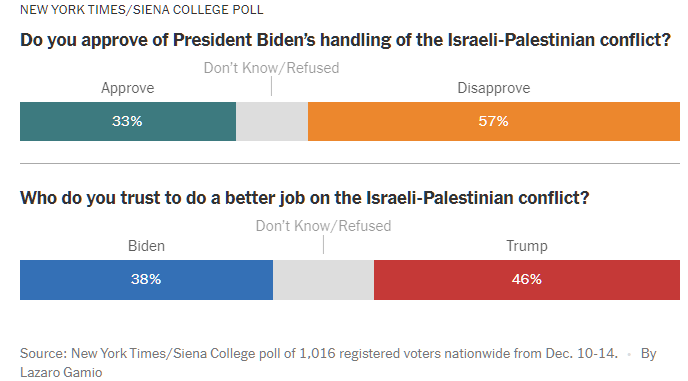
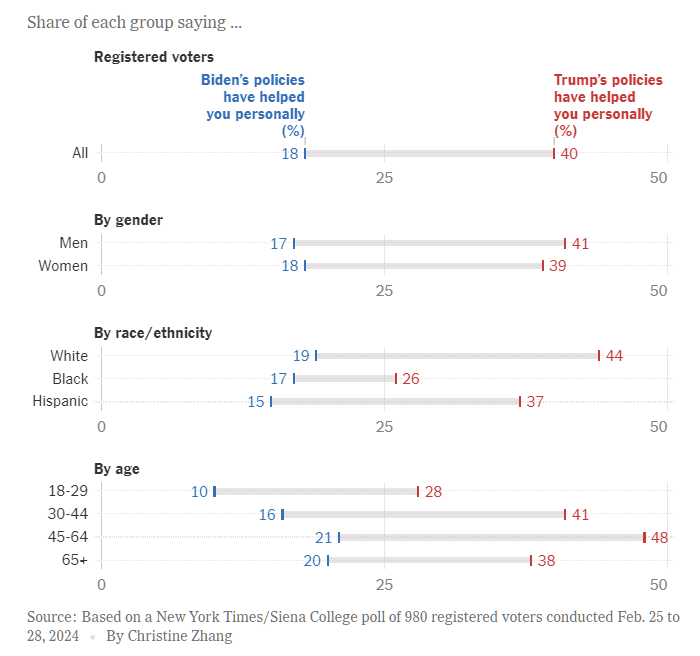
Just to add to that, folks also seem to have a worse memory and attention span (not to mention internal inconsistency). For example: The assumption that Trump would do a better job or even side with Palestinians appears preposterous (they haven't given him enough money to warrant that). Folks in various groups are more likely to think that Trump's policies have helped them more than Biden's policies: At least based on sentiments alone, Trump has a rather clear path to the presidency (and this time he is motivated by the fact of not wanting to go to jail).
-
I think this is a very US-centric view. I am fairly confident that internationally, critical thinking ability of college students have declined. And those are the ones who are supposed to hone this skills during their studies. There is likely more than one cause but the decline is changing the face and curricula of colleges. Unfortunately not for the better.
-
It goes back to a discussion we (the forum) had back in 2016 and IIRC, we kind of formed a consensus around assumption that as long as Trump hires competent folks and keeps his fingers from important stuff, all will be fine. And for a while it was, until crises hit (e.g. COVID-19) and he started replacing competent folks. Now he has made it pretty clear that he won't even try to govern normally. Given the whole package and all we learned about him, it is horrifying. And while Biden is a bit older (and let's face it, neither is at peak mental capacity, though one started with a disqualifying baseline), he has got connections and staff who are not sycophants and are able to provide the needed talent and expertise. Heck, if it comes to the worst, Harris would be a good substitute, whereas Trump might run with moldy ham, if it he saw an advantage for himself.
-
I mean, there were many contributing factors, and while lead certainly would not help, it is questionable to cite it as a major factor. I suspect you might have read either the paper from Jerome Nriagu, or perhaps someone randomly citing it. There have been many papers from various directions showing that it likely wasn't very important. A paper from Delile et al. for example conducted isotope analyses that showed that while domestic water had elevated levels of lead, the concentrations were likely not harmful. https://doi.org/10.1073/pnas.1400097111
-
I actually thought that I OP was a satire post that I just didn't fully get (based on calling something an a-hole). Still not sure that it isn't, actually.
-
Not a direct continuation there are obviously a range of successor states who claim legitimacy by invoking the Roman empire. This in itself is in indication of the continuing influence of the Roman empire. Defining when something ends or starts is often based on the historical, social and cultural context of the historians defining it. What is proposed in OP is, for example an example that were brought forth by scholars in the enlightenment era. Historiography becomes relevant and can identify gaps in those arguments. The continuation of the Eastern Roman Empire, which was Christian, does not align with an assumption of universal erosion of power due to increasing Christian influence, for example. Or one could argue what the most important characteristics of a "true" successor should be. Is it the geography? Is it the political system? The military system? Bloodlines? For example, during the third century, Rome lost much of its role as political center with power shifted to the military and other cities becoming important administrative centers (such as Milan and Trier in the west and eventually Constantinople in the east).
-
How about bad news? Siena/Times poll finds Trump leading by 5 points with 10% not responding. They report that 10% of Biden voters swing to Trump. Interestingly, although the US has one of the best recoveries, folks indicate economic woes.
-
That is your interpretation. Here a couple of quotes in addition to the one provided above: But on its face it does seem to want to demand payments. Of course one could argue (and it has been done a lot, much to the detriment to public discourse) that of course he meant things differently than what he said. In isolation one might want give someone the benefit of doubt, but this guy has been freaking president of a country and all the stuff he said is on record. Together with shining UV light into your arse, it is not really that far off to believe that yes, he would like to see a billion dollar cheque.
-
The fall of the Roman empire is therefore a rather ambiguous term as you and MigL have pointed out. As a whole, the fall was a (very) slow decline first of the Western parts of the Roman empire but over a period of centuries. And even while the central power in the Western Roman empire waned, there was still cultural and structural influence over the region. It just never reclaimed anything approaching the influence it had. In these long periods of time there was a space for many, many things to happen and trying find a singular or even dominant cause is going to be mostly futile. There are a confluence of economic woes, cost and effective maintenance of military power, internal struggles and unrest, disease, and so on.
-
It is basically the "eat your salad" approach to infectious diseases.
-
The issue here is the the left-right axis assumption. As you rightly indicated, Putin clearly adores the authoritarian history of communism, yet not the ideologically defining part of collectivism and economic system. And this is essentially what folks criticize regarding the horseshoe model. If you simplify anything enough, it becomes easy to draw parallels between almost arbitrary points.
-
It has always been a mix, and there is indeed a bit of a clash with elitism. I.e. ordinary people in opposition to an elite establishment, as you mentioned. The issue is that there always has been a school of thought that governance needs to be based informed decisions (ideally evidence-based). Thus in a perfect world, the population would be mostly rational, well-informed and fight for their rights, which is a "good" form of populism. The other side, however, which arguably is more common, is that elites are directing populist sentiments, i.e. fostering fear regarding crime, economic woes, cultural changes etc. I understand that this is not easily resolved, but in my mind the fundamental difference is the presence of evidence or at least some level of analysis on given claims. While that might sound elitist (and to some degree it is), I will also note that populism thrives in a fact-free space and historically has led to rather problematic outcomes. It is not an issue of being corrupted, but an inherent weakness in the system. I am a bit skeptical regarding the horseshoe theory of politics. Mostly because of the simplification, I suppose. They are probably only similar for some traits, but rather heterogeneous in others. I.e. you can split extremists in many camps and trying to find a singular trait that organizes all of the in a particular way is difficult. And looking at sentiments, these will also be very different depending on the population. I would probably add that US cultural influence is dripping across the border and politicians are taking lessons. Not the good ones, unfortunately. It seems more like probing, but some provincial governments are or are enacting laws regarding transgender persons. Some of them are posturing (e.g. legislating procedures that are not done in the first place), or pandering to the parental rights movement that (AFAIK) has US origins. Then there were the US style convoy protests which some conservatives tried to leverage to gain points and so on. Crazy is contagious, I tell you (but then we now know that we cannot handle contagions).
-
Slogans over analysis has always been a problem in politics. It may have been supercharged by the way social media short-circuits memory, but it is interesting (and somewhat frightening) to see how superficial discussions go. Also it is weird that folks think that slogans are universal creating a very weird globalized perception of politics. I do think that to some degree that is strategic, as it helps populist sentiments by creating simple paths to become afraid.
-
A couple of thoughts here. There is vigorous debate regarding the power system in the world, and while the US is still a super power, but it is not clear whether we are still in a unipolar world. Many scholars have argued that we are either moving or already are in a multipolar world where international power is far more fractured. I understand that this is not the gist of your question, but I think is relevant context. It is also relevant to note that not only military is relevant, but increasingly access to critical resources, economic power and economic connections. Strong economic interdependency can be a powerful weapon, too, for example. A big issue in the statement is the level-headed democracy aspect. While the US has a special outspoken brand of crazy, Europe for example has similar questions, all connected to populism and mostly right-wing populism right now. In general, populistic streaks have always been a danger to democracies, as they promise easy and quick fixes to real or perceived grievances. However, as part of their anti-establishment appeal, they often popularize circumvention of procedure, frequently scapegoat vulnerable (especially non-voting) groups and are at least friendly with authoritarian ideas. We have seen how vulnerable populations are whenever something happens leading to arguably self-destructive behaviour (e.g. Brexit). Even worse, it does not really seem that negative consequences borne out of this sentiments are necessarily penalized. Even after the rather egregious attempt by the far right to dismantle democracy, the party still obtained the plurality of votes (but lost the majority). Some called it a win for democracy, but really it is more a near miss. Likewise, in Germany the far right party is likely to become second-strongest party and even after the meeting of some of their leadership with (other) self-confessed nazis, regarding the deportation of immigrants and other desirables (Wannsee, anyone), they are only dropping a little bit in polls (which should be unthinkable, given Germany's past). Anyway, the gist of it is that it is difficult to find an strong coalition of enough level-headed democracies, level-headedness goes out of the window the moment folks feel somewhat threatened (and I am almost certain that during uncertain economic times, folks will feel more threatened by e.g. immigrants than, say, Russia). But maybe I am just getting increasingly disillusioned.
-
No. Such a discovery would be contingent on vague definitions. And in Biology we do not prove things in the first place.
-
Well, you can and you would deservedly be mocked for having an idiotic idea. Either that or a career in politics.
-
Yeah and only adjusted for similar positions. In some of the lawsuits specifically the lack of advancement was criticized, so there is a bit of an open question that is not clearly addressed in that snippet. But yeah it is a perception isn't it? If if the balance is in favour of the dominant group, others have just to work harder to catch up. But if the balance does not do a hard break at parity, then the world is collapsing.
-
Even if not, a swing of 0.3-0.7 % looks like random noise to me. The only outrage here seems to be that the swing is not consistently toward the white male segment.
-
So the difference now is down to less than one percent, which is horrible why?
-
I fear the issue is that the norms have shifted so much, that removal of that particular guy might not change future trajectories.
-
I think it is in direct comparison to the more common brick houses in Europe. In comparison, the wood frames in North America do appear quite flimsy.