studiot
Senior Members
-
Joined
-
Last visited
Everything posted by studiot
-
So has the book. Wikipedia Note quite, but different yes. Orzel's book is a lot more up to date and tells you a lot more about clocks and time itself, and a lot less about cosmology. But relativity, QM, the double slit, Pound Rebka, are all well explained.
-
While you are thinking about Markus' questions ( and actually answering mine), and since I am an Applied Mathematician here are a couple of tongue in cheek questions. Are you suggesting that c = -(eπi) ? or any of your natural constants, set to unity ? Since you are listed as living in Brisbane I am suprised you need AI to write English for you. Do you not speak English ? If this latter is true, fair enough, we at SF often need to help folks over a language barrier.
-
Suit yourself.
-
This is a much better book. I think the title was inspired by the Hawking book.

-
My apologies, I forgot to include the link to my quote. https://blog.waikato.ac.nz/physicsstop/2011/08/01/natural-units/
-
good faith ? something a bit ironic there. 😄
-
Great summary +1 The only thing I would add is not only is the 'Bible' a folder containing several books from disparate sources, there are different versions with a different selection of books.
-
Considering the rant from a few days ago I don't see why I should help you but I am not like that. The forum uses Mathjax. Mathjax also allows MathML I use this. The following code appears as [math]{z^2} = \sqrt {{{\left( {\frac{{\Delta y}}{{\Delta x}}} \right)}^2} - {{\left( {\frac{{\Delta p}}{{\Delta q}}} \right)}^2}} [/math] As a model I have removed the leading and trailing square half-bracket math]{z^2} = \sqrt {{{\left( {\frac{{\Delta y}}{{\Delta x}}} \right)}^2} - {{\left( {\frac{{\Delta p}}{{\Delta q}}} \right)}^2}} [/math What is in between the mathml tags is pure Latex others will perhaps offer other methods such as using the backslash, I am not so familiar with that. Due to other vagaries of this forum you may have to either refresh the page or the go to another page and then return. Finally I told you right at the beginning you are hiding some Physics by using natural Units. Here is a useful explanation from the University of Otago Physics blog. I have emboldened the most important part. Finally I amstill waiting for a response to my previous post.
-
Interesting subject geordief. Is your question asking about the misinterpretation of the flash of light or something else ? There was a most interesting discussion, with plenty of examples, in Stafford Beer's book in the late 1960s of such situations. Unfortunately my copy got lost in one of my many moves and I can't trace it on Wikipedia (he has written quite a few books). This is sad, not only because it contained lots of cogent thinking, but because his books are now fetching hundreds of £s S/H. The book I am thinking of I'm pretty sure was a Pergammon publication.
-
Thanks for the quick answers folks. The only person I know (and who made a pretty good living out of being one 1975 - 2005) sort of fits CharonY's first definition. But her research was conducted at the Bodliean on a self employed basis, mostly for specific topics on contract.
-
A number of new members recently have arrived describing themselves as 'an Independent Researcher' It would be interesting to hear what other members understand by this self reference.
-
I find the term 'unbeliever' to be perjorative.
-
I agree that practicve has defoinitely crossed the line. We are meant to be discussing extremism here, not benign exceptions.
-
Unless of course a or m or both = 0. Which also applies to anything Anton Rize writes. Nor do I accept his use of 'emergence' or we could be saying things like if 2p + 3q =7 and p + q = 1 then it emerges that p is -4 and q is 5. That is not what I understand by emergence. Nor can nabla 'emerge' from anything.
-
I must say that since you came here to discuss the relationship between science and your beliefs, you have show remarkably little interest in what they have to say, despite starting several threads and posting a great deal about what you think. I don't see how that can lead to sustainable discussion.
-
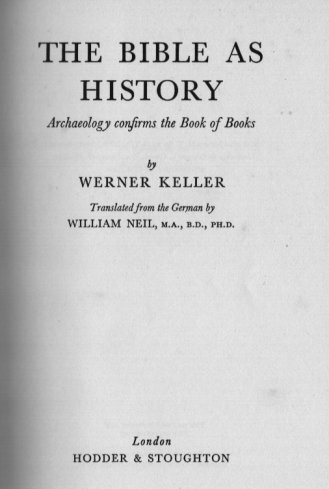
Not too sure who 'they' are. However 'they' clearly are those who are ignorant of all science has done in the past and is doing to this day to discover anything that can be corroborated from religous writings, partucularly the Bible. Of course this branch of science is not Physics since Physics has little or nothing in common with the Bible. In the modern ages archaeologists, anthropologists, historians, geologists etc use some techniques from the physical sciences. You would do well to read this book about such matters One further comment. For some reason, the humans have a definite tendency to try to pigeonhole anyhting and everything into artificially drawn categories. Indeed that is a very important part of the work of science, so often forgotten. On the other hand 'nature' has shown a remarkable reluctance to fit into these categories. In particular when discussing the scientific method scientists often say that the 'effect' must be reproducible and predictable. This is actually not completely the case. There are instances of effects which are one off or one time only. Yet science still manages to deal satisfactorily with these.
-
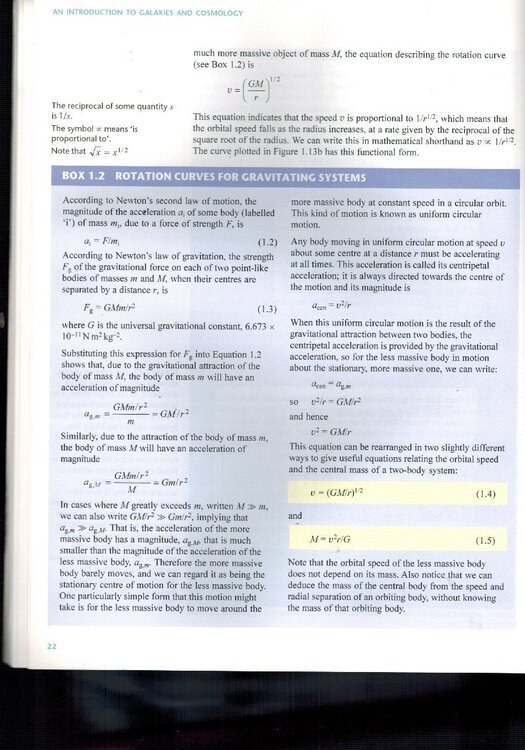
@nizar You and your wnating to learn attitude are welcome. but you now have only one more post in your first 24 hours (your are allowed 5 for security purposes), so do not waste it answering me. I do not know what resources you have access to but Jones and Lambourne are a fabulous resource for cosmology. here is the relevant newtonian maths extract. there is so much more in the book. Click on the image to get full size
-
Your original post mentioned centripetal force, which is correct. Your second force refers to centrifugal effect, which is imaginary. You misunderstand central forces. The centrifugal force is a real force that must be supplied by a real agent of force. In this case gravity. In the case of a stone whirling on a string it is the tension in the string.
-
Yes ditch the helicopter. Centripetal forces are radial Helicopter forces are Torque forces which are tangential. Further there are also helicopters that balance these torques by twin counter rotating main rotors instead of tail rotors.
-
Despite swansont giving the impression that science is only about analysis there is far far more to science than that. There are other classifications, but thought and physical processes can be classified into two camps (since you like binary so much). Explanations come from the first camp - Analysis. The second camp - Synthesis is very different and much more difficult than analysis - Synthesis. Both religion and science practice synthesis but science is just so much more effective at it. Analysis of questions like Why or How does the Sun shine ? or How fast did the apple fall ? are so much better handled by the scientific method. This leads to much better synthesis in relation to providing our own light ( a light bulb rather than the blinding light of angels) or being able to create, fly and land an aircraft, rather than expect to be carried of by angels.
-
Why would I hate it ? I don't agree with it, but that is another discussion. Perhaps the speaker has never done any marine biology or read Stafford Beer.
-
I think we are divided by more than a common language (if you understand that quote because I didn't understand half of your last post)
-
Because of the emotive language and binary terms you have classified others. I am a don't care. I do not need an emotional crutch to justify my actions or beliefs. Here is an interesting Poem from Robert Service My Father Christmas passed away When I was barely seven. At twenty-one, alack-a-day, I lost my hope of heaven. Yet not in either lies the curse: The hell of it's because I don't know which loss hurt the worse -- My God or Santa Claus.
-
To me this reply also shows a certain measure of contempt for the opinions of others. I do not fit into any of the categories you describe.
-
I think it is worth pointing out that not everyone who is non religious (me for instance) is aetheist. In fact I consider it rather insulting to be lumped with them (aetheists).