
studiot
Senior Members
-
Joined
-
Last visited
Everything posted by studiot
-
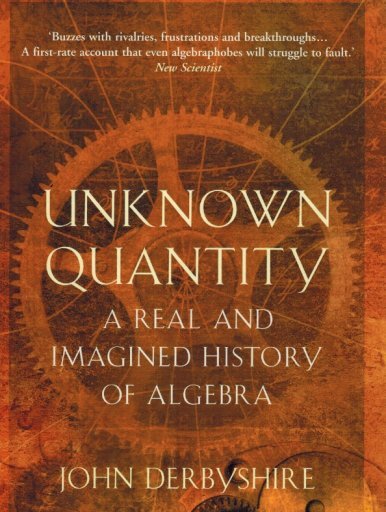
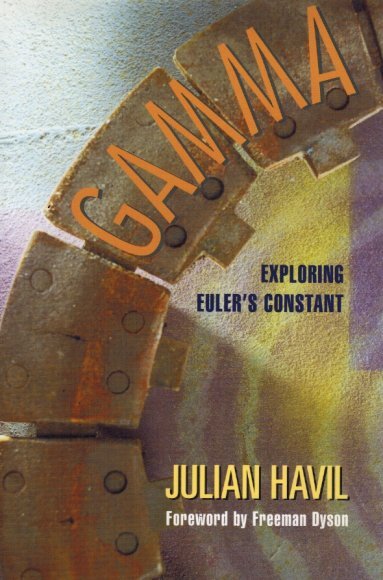
yes I agree +1. Interestingly 21 century anthropological research suggests that the very significant chnage from 'picture writing' - one symbol per word, all different ie many many symbols - to an 'alphabet' to use over and over again to make up words occurrred during the time of the construction of the Great Pyramids 0f Egypt, about 3000 BC. The interesting thing is that it was not an invention of the scribes of the day but an invention of slaves or near slaves who worked the turqoise and copper mines of Egypt. They scratched copied the magnificent carved 'glyphs' of the rulers but could only scratch crude abbreviations into the rocks of the mineworkings and caves they lived in. The last programme of the BBC series I linked to and some members turned their noses up at showed how these scratches became letters and morphed into alpha beta etc over time. Well really it was an ongoing accelerating process from Fibonacci (Leonardo of Pisa ) on. Several other italian algebraicists - and one frenchman who introduced superscript or index notation - worked on it and published books etc before Viete and Descartes. That acceleration has continued to this day. I'm sure you would enjoy both these algebra study books.
-
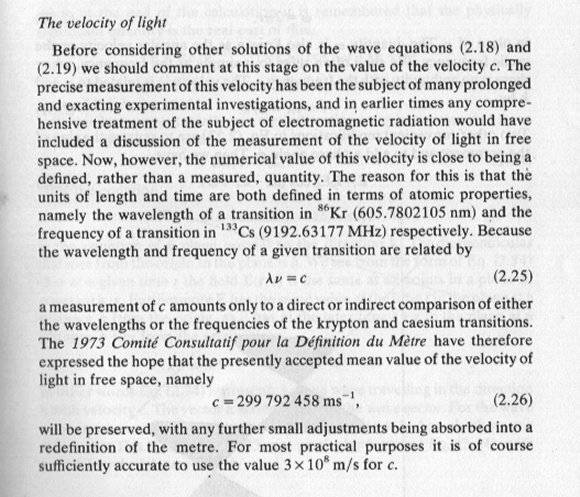
That’s easy: this doesn’t happen. Not since 1983, at least. Prior to that experiments refined the value, but the changes were quite small. The actual process you refer to started someway back before 1983 This reference comes from a Manchester Physics Series book whcih is sasly now out of print but I heartily recommend to @Eric Smith As it contains good explanations of most of his queries. Electromagnetic Radiation F. H. Read Wiley 1980
-
I have no interest in playing childish games. It is actually impossible to calculate the mass of this particle since you have omitted some information, that I asked for. If and when you are ready to discuss the calculation like an adult I am happy to explain further.
-
It is not all increasing accuracy. Some of the change is attributed to which fundamental constants we fix and which we adjust to suit. The speed of light (in isolation) is a scalar (number). Associated quantities epsilon and mu are only constant in an isotropic situation. If non isotropy is considered they are not even scalars they are Tensors to take account of this.
-
An interesting coincidence. 😄
-
Can someone tell me how my honest attempt to take the OP seriously and make a start on answering his question is offensive ?
-
If the bread is still rising its structure is changing, which is unwanted as you should put the risen dough in to cook when it has rised satisfactorily. There is a rising stage (or two or even three) and a baking stage. The double or treble rising happens before baking at much cooler temperatures. For ordinary bread the optimum rising temp is somewhere between 25 and 30 degrees C. Yes sugar is there to start the dry yeast off. You do not need it for 'live' yeast paste. You do not want the yeast to have too much sugar as you want it to digest the flour protein (gluten) into more nourishing protein. It is also a question of controlling the rate of biochemical reaction between the yeast and the flour. ( A little) salt slows it down. So you heard correctly all those years ago. Here is the recipe for the rolls is posted a picture of in your last baking thread. Dry ingredients. 100 grammes wholemeal rye flour 200 grammes strong white bread flour. 700 grammes strong wholemeal breadflour 1.5 heaped teaspoons white sugar 1 heaped teaspoon (sea) salt 2 level teaspoons 'easy bake' yeast granules (for single rising technique) Wet ingredients. 100 millilitres corn oil 1 very heaped teaspoon malt extract Warm water to make up to 550 millilitres. Method Add the flours together in a mixing bowl, Sprinkle the sugar, salt and yeast evenly on top. Mix together thoroughly dry. Put the oil in a measuring jug. Add the malt. Pour in enough warm water (from kettle) to make up to 550 ml. Mix well. Using a thermometer allow the water to cool to 49 - 50 degrees C Pur into the bowl all at once and mix in well, untill a good dough is made. I use a Kenwood Chef for the mixing with a 'dough hook'. (Pastries and crumbles are better done with a K beater in the Chef.) Turn out the lump of dough onto a board and divide. Give a final hand kneading to each divided lump and adjust the Originally I divided into 2 and filled 2 small bread loaf tins. But by popular demand I now make 16 medium or 12 large rolls instead, as per photograph. Put the dough to rise in its baking tin, which should be about half full I do this in the slow oven of the AGA at about 30 degrees. When the rising dough has filled the baking tin for rolls or risen about one inch and a half above the top of a loaf tin (This occurs a round about 1 hour later.) it is ready to bake. I do this by transferring to the AGA hot oven at about 175 degrees C Bake for about 25 minutes untill the loaf or rolls sound hollow when tapped.
-
Please explain why you have chosen this particular energy and since it refers to a particle, which particle since that makes a differnce to how fast or slow the particle can be said to be moving.
-
More likely since yeast and sourdough continues to increase until killed by the baking temperature. Some salt is also added to prevent the yeast growing too much. Commercial bakers often add extra salt to give additional flavour. Cheesemakers and indeed manufacturers of many foods also do this.
-
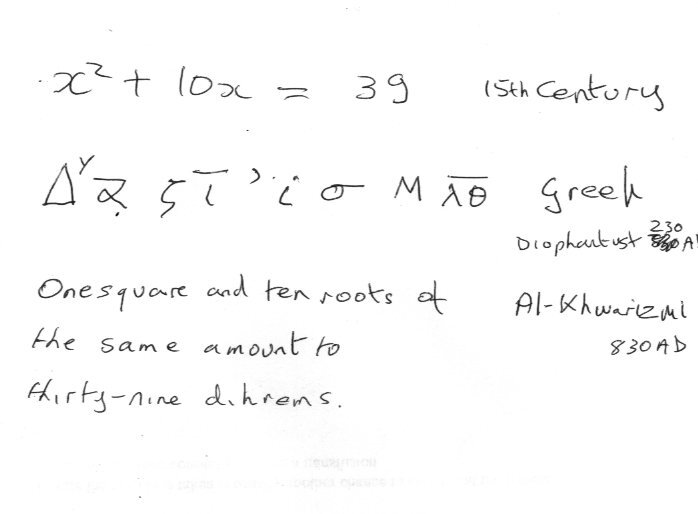
The point is that neither the Greeks nor the Arabs had a suitable system to take advantage of algebra as we know it. Both were missing something to complete the picture. It is quite natural for Geometry to come first as we can draw representations and take measurements. But to perform calculations you need two more things. You need a suitable system of symbols And of course you need a suitable system of numbers. The Greeks had a suitable of symbols, but did not have a suitable system of numbers. The Arabs on the other hand had no system of symbols, all their problems were written in words. But they had borowed a suitable system of numbers from further East in India. These were combined by European scholars between the 13th and 15 centuries AD. Here is a simple quadratic equation as we would write it any time after about 1500 AD, followed by its form in Greek as solved by Diophantus (about 230 AD) and as it appears in Al-Khwarizmi's book about 830 AD (English translation of the words).
-
Here is an interesting scientific experiment to distinguish between 2 competing hypotheses. 1) Member Eric Smith has a genuine interest in the subject of why there are real measured gravity anomolies on Earth and what discovery that led to in 1823. 2) Member Eric Smith is just here to poke fun at the scientific world. I await his reply to decide which hypothesis to place the most credence in.
-
Several snippets of good advice here. The decision to use oil (as in Italian bread) or a fat as in Mrs Beaton or the Good Housekeeping is important and does indeed soften the crust somewhat. It also softens the crumb and improves the keeping quality, which would otherwise go hard and dry quite quickly. Commercial bakers often add glycerine for the same reason. Yeah, single rise bread is prone to large voids or cavities (you must have seen this in sliced bread pre wrapped 'Chorleywood' loaves) But see also my comment on the yeast. Achieving an even distribution of air voids and 'crumb' is the objective. Fat is traditional for taller loaves as it gives a stronger structure than oil. This is also true of cake making. The idea of the initial high temperature is to kill the yeast quickly so that the risen structure remains in place. You can then reduce the oven temp (if it is a quick enough response) - I suggest some trial and error it will depend upon your loaf or roll sizing. An nearly enclosed tin will also give a crusty topping, whils providing some protection for softer sides. Continental loaves are baked on a flat sheet so do not offer such differentiation so are crusty all round. Chorleywood loaves are steam baked, not dry baked so are not really crusty. The yeast comes in at least three different forms. (sourdough is a different organism) Live yeast which is a cake, softer than fudge, This can often be obtained free from a bakerand is added to the wet ingredients. Traditional dried yeast for two rise method. This comes in dry granules, that can be stored for months. It need to be activated before use. That is mixed with blood temp water and a little sugar. It is then added with the wet ingredients. Ready yeast also comes in dried granules, which are added to the dry ingredients before any liquid. It reactivates immediately liquid is added so the dough can be made and used immediatedly. This is the single rise type. Breadmakers have some additional techniques. I should have mentioned that with any cake you mix the dry ingrediants separately, before adding the pre-combined wet ingrediants.
-
Although many do not follow forum guidelines about evidential support I have sometimes see the following statement "Statistically Significant". This claim has also accompanied some of the outlandish AI generated stuff more recently. I would draw members attention to the 2011 experiment by Simmons et al in which they statistically demonstrated that audiences who listened to a Beatles song literally became younger after the event. Obviously impossible, but that's statistics for you if mishandled. https://www.researchgate.net/publication/51725721_False-Positive_Psychology I wonder if we shouln't have a sticky outlining the dangers of false positives in statistics ?
-
Perhaps you wouln't mind outlining that you understand by 'phase space' as the are several definitions available. At least one is to do withs statistical physics and has 2s dimensions One other is to do with differential equations and has c+1 dimensions where where s is the number of degrees of freedom or available and c is the number of derivatives (in calculus) available and either may tend to infinity.
-
Marvellous insight +1. I wish you would spread that insight around the teaching profession and the youngsters of today as it doesn't only apply to the old and decrepit. There really are few if any short cuts.
-
I rather think both the claims about WWI and WWII lie on very shaky ground indeed. But I do not want to stray very far from the OP.
-
In which case I apologise to you. There was definitely a red demerit when I posted just after you. So I cancelled it out. Shows how easy it is to mistakenly assume things.
-
There are two sorts of mathematics available and both are used by the military for the purpose of predicting the likelyhood of not only war but also the outcome of various responses. The mathematics of game theory. The mathematics of Bayesian statistics. In respect of your question about Gaza, that war has been going on for nearly 3 thousand years. At one time Israel was not only at war with the then people of Gaza (part of Philistia) but also with itself so that it was divided into two kingdoms. Israel and Judea.
-
I see your point, pinball. But does this really deserve a demerit ? deema please try to organise your posts a bit better. However I do see what you are driving at. The thing is that 'logic' is abstract so it has no physical existence. But yes we can discuss your proposal philosophically (it does not deserve the status of a theory), bearing in mind that abstract nature of logic I referred to. What you are asking is akin to the age old question "What is the sound of one hand clapping ?" or "If a tree falls in the forest where there is no one there to hear it, does it make a sound ?"
-
to others.There more correspondence and symmetry to be discovered it's not like we are at end of the world..once we accept to come out of fear mongering echoes filled cocoon, problems like yang-mills mass gap issues can be easily deciphered ....they is nothing wrong with intuition as long as you are not doing magic,provided intuition is followed by scientific explanations...once person intuition can be different to another person intuition..if person is able to use his intuition well and good. Can I ask for more detail ? I see a lot of your posts that contian a grain of truth wrapped up in a banana skin, so the whole package is not only too short but unintelligable to others.
-
Looks to me as if you are having Oxford Don fireside discussions with your son. All power to your elbow. History and comparative history is an interesting subject. But it is an incredibly vast and complex subject. So I ask what the focus of this thread is please? UK, US, or French or German constitutions ? A couple of comments. Whilst looking at Trump's antics, perhaps you should also look at Putin's. The disinformation being fed to the Russian people is classic. This is also what the Chinese did under Chairman Mao and continue to do today. One of the interesting facts about the Magns Carta is that there were many copies made and deliberately distributed so that the monarch couldn't keep the only copy and spread disinformation about it.
-
If I replied again to this thread I was going to point this example out to MigL. But you beat me to it. I take the statement "the map is not the territory" as allegorical. That is it is a metaphorical depiction of a deeper meaning. And I think, as obviously a lot of people do, that it is a good one. Mathematically there are two considerations. Firstly the strict definition of a map as a formal description of a relation between two sets leads to the first law of equivalence An equivalence reation is reflexive. In other words the map is identical to the territory because it is the territory. In all other circumstances the relation map only offers identity for some aspect or aspects, but not all of them. Which leads us the applied world where we constantly use models which only correspond for some desired aspect or aspects to the phrase The map is not the territory. You would not expect to fly to Berlin in the model that was used in the wind tunnel for the airliner.
-
I'm sorry Eise but that website you linked to does not conform to either UK or EU law in that it did not offer me th option to decline all cookies. I could not be bothered the trawl through the extremely long list of thing to turn off or find out what would be left. Why does IT think it is above the law ? Even some government agencies that should know better act like that.
-
Yeah it is kinda funny. +1
-
Entertainer founder hands over toy shop chain to staff