
studiot
Senior Members
-
Joined
-
Last visited
Everything posted by studiot
-
My answer to the first one is not necessarily, but you need to tell us your answer and why you think that since this looks like homework to me.
-
Is 'free will' not a form of determinism ? Once we have made our choice and enacted it the result is determined. Chocolate or Vanilla ? Once I walk away scoffing my chocolate ice cream the result was determined by my free will.
-
Yet there seem to still be some who promote it in threads here. Some of these threads have been have been very long and it is now even difficult to determine (pun intended) what their position actually is.
-
There have been several threads recently where some dubious statements about the distinction between constant and invariant have been made. I am therefore posting this thread to examine this issue by discussion. I am kicking off with a question An observer is watching the rear end of a train which is receeding a high speed , but not accelerating. Hanging on the back of the train by a long coil spring is a lamp which is oscillating up and down. What is the relativistic effect on the spring constant, ie what is the difference, if any, between the spring constant according to the train guard and the observer ?
-
With the recent debates about determinism v some other explanation of everything is a belief in determinism unwise ? I ask this because throughout the entire history of mankind there has never been a time when there was not something known that was unexplained. Even the God-did-it squad can only say GDI, they cannot say why or how he did it so cannot in all honesty say it was or was not determined. Likewise those philosophers and scientists who cleave towards the mechanistic 'clockwork universe' have to admit that they cannot definitely conclude that everything, because if their their best explanation is ' we believe there is an explanation, we just don't know what that is' this is not conclusive.
-
You are definitely moving forward. +1
-
My freezer is kept at a constant temperature of -20oC, but this is not invariant as I can turn the control knob up or down.
-
Since you clearly think you know better than anyone else and are not interested in what they have to say I wish you goodnight and pleasant dreams.
-
Perhaps I should add related words 'steady' and 'uniform' to the list of oft misapplied words.
-
Do you mean this ? Just what is a disturbance of spacetime ? If you don't understand something ask don't guess. Of course I don't call them time varyiing. Why would I ? Is there any evidence of gravitational field varying with time ? A gravitational field is however a good example to make my point. When viewed as a field (it can be viewed or described in other ways) the quantity of interest is called the gravitational potential. This potential has a definite, measurable value at every point in the gravitational field. It is an example of a potential field, with some special properties, one being that it is a conservative field. Other fields may also be assigned to the region of space occupied by the gravitational field. One such is the field of gravitational force acting on a material body. Another is an example of a direction field as force is a vector and as such has a direction at every point in the field. So you see, fields can be pretty complicated things, and so far we have just opened the book at static fields. The answer to my question 'what is waving' is the quantity of interest. This quantity may be a field quantity (ie part of a field) or it may not. It may be a material quantity such as water or it may be non material such as displacement or amplitude.
-
People used to imagine the atom as a plum pudding before Rutherford. I asked you what was waving., but received no answer. My question was not a joke but a subtle hint as to the proper definition of a Field. A Field is a region of 1, 2, or 3 dimensional space where some quantity can be defined and assigned a definite value. Most primary fields are static which means that these values do not vary. If the values are functions of another parameter such as time they are called time (or whatever) varying fields.
-
Yes indeed knowing the difference between invariant and constant is vitally important. +1
-
I thought you might be using unusual definitions for your words. In both Mathematics and Physics the term the term field has special meaning, (unfortunately different in each) but neither meaning is the same as yours, whcih is more like a rolling mist. I also do not think your use of the term resonance is the usual one. Just as a matter of interest what do you think is 'waving' when you speak of waves ? It is very difficult to hold a sensible conversation when you are not both speaking the same language.
-
what exactly do you imagine field to be ?
-
2.611, 3.533 and 1.0067 are no odd numbers ? Pity if instead you didn't post the speed of sound you employed and the fact that you changed my figure of 45 m/s to 50 m/s. That would have saved me looking up the speed of sound on Google and accepting the first reasonable academic answer listed. Of course resulting in pointless exchanges of posts. You still haven't shown how your claim that this method of analysis (Which is classical ) supports a Lorentz transformation into any inertial frame I choose. I choose to work in the ground frame (as you did) and tranform this into the wind frame (as Arago et al did) and I arrive at the fact that the time of transit is dependent on the wind speed, as otheres did. If you think there is a Lorenz tranformation then it should work and give these figures for the transformation to the wind frame. So what is x' = ?(x, t) t' = ?(x, t) in your system ? For interest here is Professor Beiser's alternative and simpler explanation as to why other waves are not a good analog (which was my point). The behaviour of light waves is unique.
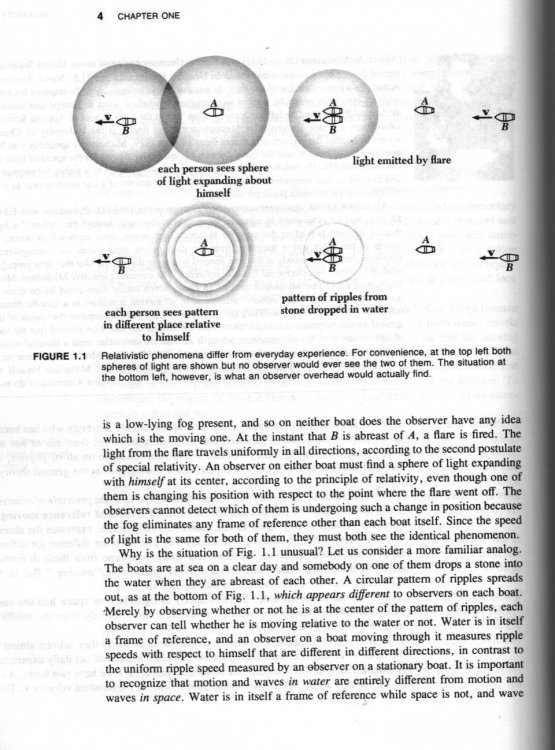
-
This sound authoritative because it contains number. But when I analyse those numbers I find disturbing discrepancies. Firstly in calm weather the outward and return journey should be identical so exacly half of 'roughly 6'. In fact the double journey takes 2000 / 346 or 5.780 seconds. Now this double journey should cancel out any effect of medium motion so if I add up your to outward and return times I make 2.61 + 3.53 = 6.14, not 6.04 as you have. Either way this is quite different from my value. Furthermore adding my outward and return times 1000 / (346 + 45) + 1000 / (346 - 45) = 2.55754 + 3.32226 = 5.88 seconds. Comfortingly close to my undisturbed double journey value.
-
You seem to have forgotten my comment from Einstein. I see I owe you an apology here: it is actually the second postulate. What he does not describe is the effect of motion of any transmission medium, which is different from other waves where this motion has to be taken into account. This is the key difference with light (in empty space). It has no transmission medium. So c will be invariant in all frames. there is nothing to add to it. An acoustic wave between A and B however, depends also on the motion of the transmission medium.
-
I retired a few years ago.
-
What would I do without other members to correct my atrocious spellung ? Thans +1 Wow. And here am I thinks this is easy Physics. It is easy to find the speed of sound in still air (ignoring temperature effects) as 346 m/s So in the ground frame both source and observer are stationary as is the transmission medium. So the time of flight is simply 1000/346 = 2.890 seconds. In the case including the wind, the wind carries the sound pulse forward at an additional 45 m/s so this pulse reaches the observer at 1000 / (346 + 45) = 2.558 seconds. Now a transformation is to another coordinate system and the only one that makes sense here to use is the coordinate system comoving with the wind. Here we have that the observer appears to be approaching the source at 45m/s but the sound is moving at 346m/s in the frame of the wind. So the sound will appear to travel the distance (already measured as 1000m in both systems) in 1000 / (346 +45) = 2.558 seconds. How is that a Lorentz transformation from the ground frame to the wind frame ?
-
OK consider this experiment: There is a flagpole 1000m from where I am standing with a sound pulse apparatus. My assistant is standing by the flagpole with timing apparatus. At the beginning of the experiment all is calm and still. Then storm Ciaran arrives and there is a wind directly towards the flagpole at 45 m/s. Calculate the time of transit of my sound pulse to my assistant in the cases of still air and of the storm wind and explain how this difference exhibits Lorenz invariance.
-
Sound waves do not obey Lorenz transformations. This is the key result implied but not explicitly stated (you have to think about it to find it) in the first postulate in Einstein's theory of relativity.
-
Since you propose measuring a time difference of the order of 10-11 seconds, please explain the electronics of your 'start pulse', which must be several orders of magnitude smaller. Please also evaluate the accuracy to which the synchronisation must be achieved.
-
Is this homework ? The mathematical model you seek is called a Markov process. This is the process underlying what is popularly called artificial intelligence. The good news is that the concept is very easy to understand. The bad news is the quantity of data that needs to be collected and processed to achieve any reasonable sort of correspondence between the model and reality. For AIs literally trillions of cases were examined to obtain realistic the required realistic processes.
-
To me this has the appearance of posting someone's homework. So tell us what you have thought about so far.
-
So you are offering a theoretical calculation (if your theory is correct) not an experiment as I originally read your piece.
