
Externet
-
Joined
-
Last visited
Posts posted by Externet
-
-
-
11 hours ago, nec209 said:
That passage seems to contradict the other passage what Jesus says and the other passage in the bible.
The bible is a collection of re-shaped text pieces from varied authors glued together with care about not stepping on itself and after centuries of censorship at closed doors by the pope affiliates in order to present to the believers, a tailored credible fairy tale guidance even in the senseless passages by using the 'faith' foundation basis.
-
Borrowed from the web:
-------------------------------------
Bible poor and wealthyThe Bible presents a nuanced view of poverty and wealth, emphasizing that both are under God’s sovereignty (1 Samuel 2:7). Here are some key insights:
- God’s equality: Proverbs 22:2 declares that “the rich and the poor meet together: Jehovah is the maker of them all.” This verse highlights that both the wealthy and the poor are created by God and have equal value in His eyes.
- No distinction: The Bible does not teach that poverty or wealth is inherently sinful or blessed. Rather, it emphasizes that both are neutral, and it is how one uses their resources that matters (Matthew 25:14-30).
- Responsibility to the poor: The Bible consistently calls believers to care for the poor and vulnerable (Deuteronomy 15:7-11, Psalm 41:1-3, James 1:27). This is seen as a demonstration of faith and obedience to God’s commands.
- Warning against wealth’s dangers: The Bible warns against the dangers of wealth, such as arrogance (1 Timothy 6:17) and a lack of spiritual focus (Matthew 19:23-24). Jesus taught that it is difficult for the rich to enter the kingdom of God due to their attachment to material possessions (Mark 10:23-25).
- God’s provision: The Bible affirms that God provides for both the rich and the poor (Psalm 104:28, Matthew 6:25-34). It encourages believers to trust in God’s provision, rather than relying solely on their wealth or poverty.
Key Verses
- 1 Samuel 2:7 - “The Lord makes poor and rich; He brings low, He also exalts.”
- Proverbs 22:2 - “The rich and the poor meet together: Jehovah is the maker of them all.”
- James 2:2-5 - “My Christian brothers, our Lord Jesus Christ is the Lord of shining-greatness. Since your trust is in Him, do not look on one person as more important than another. What if a man comes into your church wearing a gold ring and good clothes? And at the same time a poor man comes wearing old clothes…”
Scriptural Perspectives on Poverty and Prosperity
The Bible presents a nuanced view of poverty and wealth, highlighting both their positive and negative aspects.
Poverty
- God is concerned with the poor and needy (Psalm 72:12-13, Proverbs 31:8-9)
- Poverty can be a result of God’s humbling or testing (1 Samuel 2:7, Job 5:7)
- The poor can be rich in faith and spiritual wealth (Matthew 5:3, Luke 12:15)
- Examples of poor individuals who trusted and served God include Job, David, and the widow who offered her last meal to Elijah (Job 1:1, 1 Samuel 20:42, 1 Kings 17:8-16)
Wealth
- Wealth can be a blessing from God, indicating His pleasure and favor (Deuteronomy 28:1-8, Genesis 13:2, 1 Kings 10:23)
- However, wealth can also lead to pride, greed, and spiritual decay (Proverbs 30:8-9, Luke 12:15)
- The Bible warns against the dangers of wealth and materialism, encouraging believers to use their resources wisely and generously (Matthew 6:19-20, Luke 12:15, 1 Timothy 6:17-19)
Key Principles
- God is the one who gives and takes away wealth (Job 1:21, 1 Samuel 2:7)
- Wealth is not an indicator of one’s standing with God (Psalm 73, Jeremiah 12:1)
- True riches come from a right relationship with God, not from material possessions (Matthew 6:33, Luke 12:15)
In conclusion, the Bible presents a balanced view of poverty and wealth, emphasizing the importance of faith, generosity, and a right relationship with God, regardless of one’s economic circumstances.
Conclusion
The Bible presents a balanced view of poverty and wealth, emphasizing God’s sovereignty, equality, and provision for all people. While wealth can be a blessing, it also carries risks, and believers are called to use their resources responsibly and to care for the poor and vulnerable. Ultimately, our trust and focus should be on God, rather than our material circumstances.
Religion refers to the poor of spirit, not in material wealth
-
-
-
-
-
-
-
Thanks. Like your detailed knowledge 😀
The water temperature I usually start the cold soak is ~15C (tap) and reproducibility little variance seems irrelevant, enjoying some days this way, some days that way variety. So am ready to get the spank from a chef that does not dare to deviate from the "norm"
-
Hi all.
Done and tried it dozens of times. In a pot, put the dry pasta, barely cover with water and set fire until boils for 3 minutes.
Works every time and never taste any difference with the "boil a lot of water first and when boiling, then add the pasta for 3 minutes" Are my taste buds dead or it is just another myth of having a lot of water wasting heat first ? Why ?
I would guess that pasta in cold water first; starts hydration without wasting time until boils. Actually, am in doubt that the heating part improves the pasta. Hydrating in plain cold water for 30 minutes or as needed is a next test, no heat at all... Just warm to serve. Now you know am no cook, but I have to try contesting the establishment. 🙄
-
-
-
Greetings.
Those 19th century water coolers were made with porous ceramics or stone for the evaporation to lower a bit the temperature, is that right ?
Then, the vessel surfaces were not to be glazed, as such would impair evaporation; is that right ?
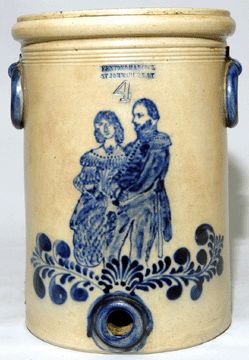
This shiny one may not be a genuine cooler, right ?
Seen perhaps two in my life; and do not remember being glazed...
Were their outside walls always moist when 'working' ?
-
-
-
-
Hi. On a recent thread about microwaving steam, a graph posted has this portion :
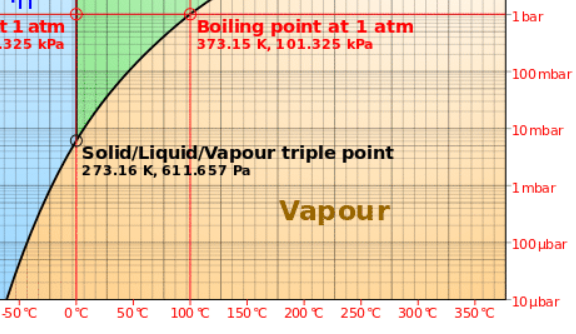
Is the word vapour valid only for the pink area left of the vertical red line by 100C ? and steam the correct word for the area at right of that vertical red line by 100C ?
If I leave a glass of water under my bed for a couple of weeks; it will be dry. Water turned to vapour, was never exposed to over 100C. If the same glass of water was exposed to over 100C, it turned to steam, not vapour. Am I wrong ? Or should the graph say GAS instead; that depending on temperature it can be vapour or steam ?
-
Edited by Externet
Exponent zero at temperature to denote degrees became a zero when posted. Corrected.Thank you.
When water already reached boiling in a microwave oven (100C) but the oven is still 'on'; what is the energy doing to the water/pot/steam/air/contents, assuming the air and the pot are transparent unaffected by the microwaves, and walls are reflective ? What changes that boiling becomes more energetic ? Water cannot rise more its temperature, what else is happening ? The boiling bubbles are pure steam, right ?
-
-
-
-
-

Soldering iron tip...
in Applied Chemistry
Hi MigL. Did not have a chance to check against the gold plating on some traces; as soon as the hot gold tip touched tin, the gold disappeared/eroded into liquid? inside? the liquid tin wetting the tip. It was a long ago at my workplace while migrating production into lead-free solders. Was an unexpected surprise learned. Never tried with silver Ag nor other metal tip, Ti, Cd, Zn, Ni, Cr... The intention was to achieve more tin wettability of the tip, if remember well.