swansont
Moderators
-
Joined
-
Last visited
Everything posted by swansont
-
I think the issue is where the chips are specifically in an EV, not which chips are going to be common to both an EV and ICE vehicle. Lights, door locks, etc. are common to all vehicles. To me the batteries, the power distribution and regenerative brakes are the obvious candidates when looking at differences between the two types of cars.
-
There are people that do, and more will do so as infrastructure is put into place. To view this another way, nobody will if the infrastructure isn't there, and then you will limit adoption of EVs. Only if you view minimizing gas consumption and safety as conveniences. That would be one way of forcing the US to expand rail and mass transit, I suppose, but our system is built on being able to drive from point A to point B, and much of that at speeds faster than 30 mph. And we have lots of vehicles that get much better than 25 mpg. Same here; especially living where it snowed in the winter - cars would rust because they had steel everywhere, and it got attacked by the salt.
-
And got what, 10 miles per gallon? Plus a top speed of 30 miles/hour and, as a bonus, were not very safe!
-
But you have a lot of battery cells/modules, probably each with a voltage, current and temperature sensor, which are chips. Plus the battery management system.
-
Yes. You can compare the phase (time) not frequency. If a clock is running slow, it accumulates phase more slowly. If it runs slow for a longer period, a larger phase difference accumulates.
-
I'm unsure as to what you mean by "route dependent" I know that if a clock moves, it runs slow relative to another clock, and that this is both (1) experimentally confirmed and (2) in accordance with the predictions of relativity I don't care what you believe to be true. I want to know what you can demonstrate to be true.
-
! Moderator Note <points at everything you've posted> You have presented no model and done no analysis. It's all hand-waving and calling people who disagree with you idiots. Which is not science, and not sufficient to sustain a thread. Last chance.
-
There are observations that support the existence of dark matter. https://en.wikipedia.org/wiki/Dark_matter#Observational_evidence That's hardly a valid criterion. The fact remains that the article that you linked to does not mention this as a dark matter issue. How about you comply with the rules and present a rigorous analysis, rather than vague assertion? ! Moderator Note We can do without such invective. There were severe problems with Zwicky's data and analysis regarding dark matter https://www.forbes.com/sites/startswithabang/2021/08/24/who-really-discovered-dark-matter-fritz-zwicky-or-vera-rubin/?sh=4478bd0217a7
-
! Moderator Note Is there a question or topic of discussion here?
-
This is triggering my OCD. Can we agree that the proper terminology is to "bear" offspring? Anyone can bare offspring; you do this when you give them a bath.
-
We know it wasn’t your error.
-
! Moderator Note I'm not going to fault someone for not getting responses on a narrowly-focused topic. There is a clear invitation to discussion, there are calculations and copious references for interested parties, which is in stark contrast to most speculations threads. <referee motions for play to continue>
-
But nobody is saying this No, this is suggesting the vaccine is 100% effective and nobody is claiming that. That's a misconception that many have pointed out. Let's say you have 1000 people and 900 of them are vaccinated. The chance of getting infected is 5% in unvaccinated and 1% in vaccinated. You will have 100*5% = 5 unvaccinated people getting infected, and 900 * 1% = 9 vaccinated people getting infected So it should be unsurprising that you have more vaccinated people getting infected when vaccination rates are high.
-
They show what they show, so there's nothing "wrong" with that, but the question is whether they support the claim that the vaccine does nothing to prevent infection, while reducing mortality. It's clear that the latter happens. The question was about the former. If a graph doesn't indicate vaccination status, it's hard to tease such information out of it. edit: especially in light of the delta variant being more contagious
-
And I've provided two sources that specifically say the rate of infection is lower in vaccinated people in the groups in question. Meanwhile, the original claim goes unsupported.
-
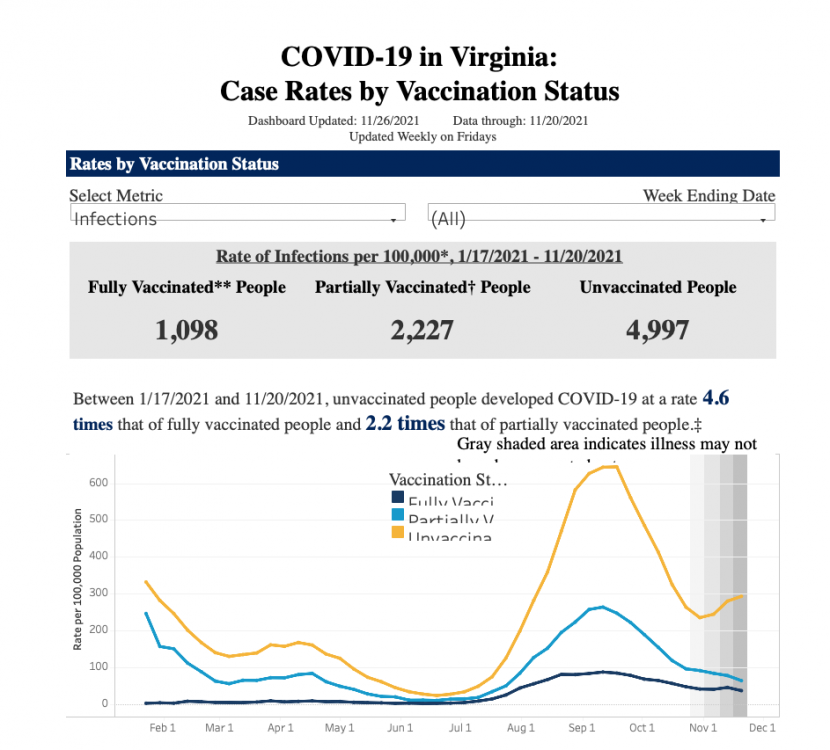
I didn't quote (couldn't copy/paste). I relayed the information; 4997/1098 (the number presented as infection rates per 100k) is 4.6 For me, it's having to have been fully vaccinated by Nov 22, per directives stemming from an executive order for US federal employees
-
It has no inertial frame of reference. As beecee notes, it has no rest mass, so photons travel at c. You can't use the Lorentz transforms to go between an inertial frame an a photon frame; the equations diverge.
-
Developing COVID and developing symptoms are different things. The website is quite clear that the numbers are infections, and that infection and "developing COVID" are the same thing. You keep insinuating that this is deceptive, and yet have provided no evidence to the contrary. Your graph doesn't distinguish between vaccinated and unvaccinated people, so for this discussion it's irrelevant, and I've already linked to a rigorous study where everybody was tested. This is also true of the original clinical trials (such as https://www.nejm.org/doi/full/10.1056/nejmoa2034577). Do you have anything pertinent to offer?
-
We have a vaccine mandate, so the letter of the law needs to be spelled out. The annoying thing is I got my first two shots at Walter Reed, so these records are already somewhere in the system, and yet my colleagues and I still have to fill out paperwork to confirm the information the system already has.
-
In the form I recently had to fill out, it was quite clearly defined as two weeks after the second shot if it's a two-shot vaccine, and two weeks after the shot of it's a one-shot vaccine. Which is a reason to pay attention to results from clinical trials and controlled tests, which do this rigorously, and show that the vaccines are effective in reducing infection.
-
These statements are incompatible, because the equations of relativity show that length and time are quite clearly relative
-
Not strictly true. We did neutrino spectrometry measurements via momentum reconstruction when I was a postdoc at TRIUMF (in the TRINAT group) back in the 90s and they've continued the work. The neutrinos weren't generated directly in the cyclotron collisions, but we were most definitely at the site.
-
Seriously? How do you develop COVID other than by infection? The COVID fairy? You also might note that just above that passage, where they present the numbers, they say "rate of infection per 100,000" so clearly the two descriptions mean the same thing, and I didn't misrepresent anything. What straws are you clutching at here? Here's the whole shebang
-
Here’s more data from Virginia, US https://www.vdh.virginia.gov/coronavirus/see-the-numbers/covid-19-in-virginia/covid-19-cases-by-vaccination-status/ Unvaccinated got infected at 4.6 times the rate as fully vaccinated, data from Jan 17 2021 through Nov 20. Except your graph doesn’t show the relevant information. “reliability” is moot
-
Symptoms ≠ deaths These charts don’t have proper labels, so I don’t know what they’re showing. There’s nothing there that distinguishes between symptomatic and asymptomatic cases, and whether the people were vaccinated meanwhile https://www.cidrap.umn.edu/news-perspective/2021/08/cdc-unvaccinated-5-times-more-likely-get-covid-19 new data from Los Angeles County collected from May to July, which show unvaccinated peoplewere 5 times more likely to get COVID-19 than vaccinated peers