swansont
Moderators
-
Joined
-
Last visited
Everything posted by swansont
-
But you have to, in order to eliminate it.
-
Are there any reactors that directly generate electricity, rather than heating water to run a steam turbine?
-
And you have to eliminate the mundane to conclude the sensational.
-
The FTL signal doesn’t violate causality for the sender and receiver. The violation appears when you add the moving observer.
-
It would violate it just as explained in the video. Instantaneous is just the most extreme case of FTL.
-
Because it sounded good to the writers, and that overruled any science objections that might have popped up. IOW, they wanted to keep the dialog where they call Neo “copper-top” And they needed a reason for the machines keeping humans around, because without them there’s no movie. And perhaps other plot-driven reasons. It’s a work of fiction.
-
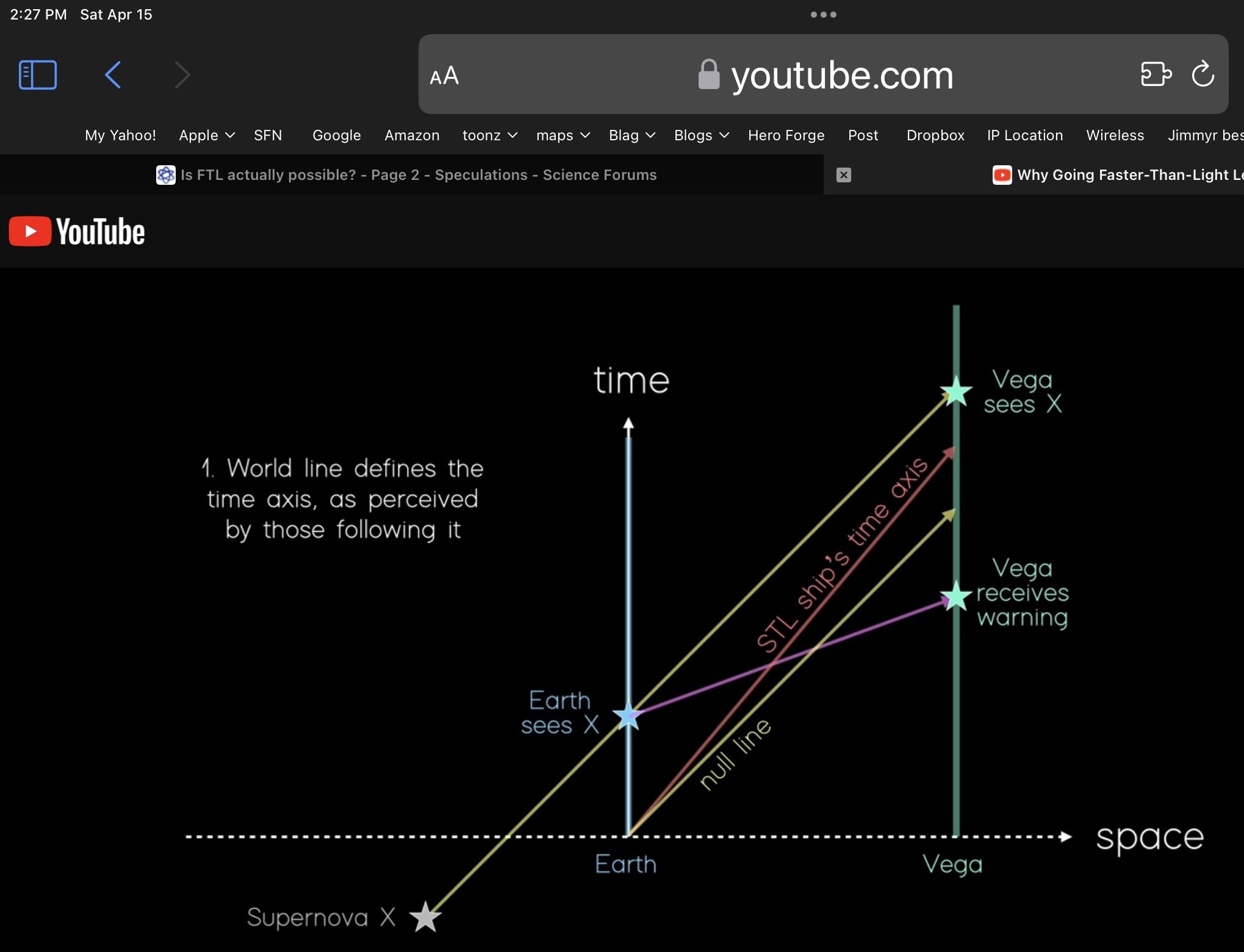
It’s not even Lorentz transforms being shown. Just x vs ct. Light travels at c, so it shows up as a 45 degree line (the null line). If you go slower it takes longer to go some distance x, so that will appear above (steeper). FTL would go below. Both cases are depicted - one for the FTL signal, one for the STL ship. If you didn’t move it would show up as a vertical line - motion through time but not space. The Lorentz transforms would show up if you rotated this to be in the ship’s frame.
-
Yes, my mistake. Apologies to @Moontanman
-
I’m only responding to what you say when you quote me. That’s presumably a reply to me.
-
You keep changing the topic. This was not the point under discussion. The issue was whether a FTL craft could see a causality violation and the answer is yes. It does not require a STL craft. I suspect he used the STL craft so that there was only one violation of physical law. If there were two, then the source of the violation would be ambiguous. We were discussing the video you asked me to watch. Not another example.
-
What train of ships? The video discusses a supernova and when Vega learns of it. There’s one ship. The diagram did not use an instantaneous communication. You can see the signal took time. Instantaneous would be a horizontal line A FTL ship would be below the null line, rather than above, but it can still arrive later than Vega receiving the warning. An even larger range if the warning is instantaneous.
-
There are for beta decay, but I suspect alpha decay would damage the semiconductor, and the higher temperatures might not be well-tolerated. https://en.m.wikipedia.org/wiki/Betavoltaic_device
-
Instantaneous will violate causality. I’m not sure how that’s OK.
-
! Moderator Note Your thread on this was closed. Don’t bring it up again.
-
I said “in principle”
-
The devil's in the details here. How does it do this?
-
You could draw the lines in his diagram for a FTL ship. Depending on the speed of the ship (it's not instantaneous in his example; that would be a horizontal line) you could have a violation or not, depending on the speed. But you had said it was instantaneous, and if you drew the lines, you would get a causality violation for a finite speed FTL ship If you can put it in a nutshell and hand it to me (in principle) it's a physical thing.
-
I think Aesop wrote about this phenomenon. The presumption that it's mundane is supported by the sheer volume of all the mundane things that happen every minute of every day. And all of the experimental evidence supporting all of our theories. I can assume my TV works by the known workings of digital electronics. I don't have to give equal weight to the idea that it's tiny goblins inside the box. You can only reach a conclusion that it's goblins if you eliminate the possibility that it's mundane science. IOW, the conclusion that it's goblins requires that you conclude that the mundane science is in fact wrong, which you can't do unless you have sufficient evidence — something that we know is not the case. And then you need a coherent model of the goblins. Did I claim that you did? I said incomplete is not the same as being wrong. Unless you are in the domain of relativity or the standard model where the model is incomplete, you are in the realm where it is experimentally confirmed, i.e. accepted to be correct. If some phenomenon doesn't follow the model, then you need to have sufficient evidence to show that this is the case. You can ask for clarification with accusing me of misrepresenting you, and when you make that accusation, it would be nice if it were actually the case. Unless one is positing that UAPs are dark matter or dark energy phenomena, I don't see the relevance. And it's not that we know nothing about DM and DE, so there are constraints. If you want to reinvent the wheel every time, that's up to you. But it's not how science proceeds.
-
I’m sure there are, but I can only go by what you posted. If you have a video that says what you claim - that causality is only violated for STL craft but not from FTL craft - from a credible source, and you tell us when they say it, I will watch it (if the video is watchable in the US) But you said the issue is with a diagram in the video, so if that’s the case, why can’t you post a screenshot?
-
And we never seem to get the details of these incidents, with all this great data. We’re told they exist, but that seems to be the end of the road.
-
Because black holes are formed from particles in sufficiently close proximity
-
A sphere has a curved geometry, but it’s not a physical object.
-
! Moderator Note 1. You have a thread on this already, so this is closed 2. If you quote from a text you need to give a better citation (is this journal, or a book, or just a title of a website? 3. You appear to be citing yourself 4. “probably” means very little, especially with no theoretical basis for such an assertion.
-
Are we talking about things that are unexplainable? How do we know that they are unexplainable? I was under the impression these were unexplained/unidentified. That's not the same thing. A large number of the UAP reports were resolved, meaning they were explained, and therefore not unexplainable. There's a huge difference between them. You don't have a default assumption about whether something is natural or supernatural? How do you proceed to investigate? An apple falls from a tree. Do you initially assume gravity, or do you assume ghosts? You see hoof prints in North America. Do you initially assume they are from horses or zebras? Which direction leads to a massive waste of time and effort as you begin to investigate? Incomplete is not the same as wrong. And these tend to come with fairly well-defined areas where we know we need better models. When an apple falls from a tree we don't question it because General Relativity doesn't mesh with quantum mechanics. We know those issues appear at the Planck scale. Yes, we've been discussing this in another thread. She is discussing the issue within the confines of science. Does she discuss aliens in any of this?
-
I am not objecting to the example, I am objecting to your claim that "It appears that instantaneous communication doesn't cause time travel unless it's from a spacecraft going slower than light.” Someone showing the effect from a STL craft in no way implies that a FTL craft would not experience this problem.