
Anton Rize
Senior Members
-
Joined
-
Last visited
Everything posted by Anton Rize
-
Did you even open my Desmos project? Out of 3 inputs precession derived: 3 IINPUTS NO MASS NO G NO c PRECESSION DERIVATION 1. Mercury's kinetic projection beta_p at perihelium unitless ( transverse Doppler shift, obtained via spectroscopy or radio signal.) \beta_{p}=0.000196736103348 2. Gravitational Redshift at the surface of the sun (R_sun) (obtain via spectroscopy) z_{sun}=2.1224\cdot10^{-6} 3. Ratio between R_sun and r_p (Mercury radius at perihelium) R_ratio=R_sun/r_p from astrometric data. No absolute scales needed. R_{ratio}=0.0151235185169 THATS ALL OUR INPUTS if gravitation is the curvature of 4D spacetime induce by mass, then mass and G has to be primary parameters. But in my calculation they are unphysical unmeasurable redundant values: \kappa_{p}=\sqrt{\left(1-\left(1+z_{sun}\right)^{-2}\right)\cdot R_{ratio}}=0.000253369506895 \Delta_{precession}=\frac{3\cdot\pi}{2}\cdot\frac{\kappa_{p}^{4}}{\beta_{p}^{2}}=5.0175347157\times10^{-7} after units conversion we getting 42.9710621566 arcsec/100years DATA SOURCES: \cite{NASA_Eclipse_Mercury}, \cite{UniverseToday_Mercury}, \cite{IAU_2015_ResB3}. Dare to interpret this result? P. S. I don't know what article you reading probably not mine. im talking about WILL_GR_I.pdf on my website. You still dont get it. When you think about physical process you assuming that there's a flexible "box" (4D manifold) where mass/energy/fields are interacting. Im NOT MAKING THIS ASSUMPTION. I argue that the hole concept of the "box" thinking is an anthropocentric speculation inbuild silently in foundations of modern physics. If you would red anything that I wrote this would be the first thing you would understand. Its a very old debate going back to Newton vs Leibniz. I don't get it... Why are you engaging in criticism without a clue about the subject of your critic? Whats the point? To show your arrogance? Thats not something you should be proud about.
-
@Mordred , buddy, hold on. You still having major problems in understanding the most basic things. If you did read my paper as you claim than your reading skills rising concerns: 1. Spacetime is about meters and seconds. Relations are unitless. Its NOT "Maximally symmetric spacetime". Its a relational carrier of conservation. 2. The relational geometry of Sun-Mercury system will not change regardless of your point of view. 3. Lying is bad. You haven't read my paper and by continue lying about it you only make it worse. 4. Im not going to engage in philosophy with you because you have no clue what you talking about. 5. I gave you VERY SIMPLE solution for Mercury's precession with no mass no G and asked you "How would you explain this?" And the unswear you gave me is: "Do you honestly believe that simply because you can plot a 2d orbital that this encompasses all possible observer from other angles ?" - Your answer sounds like you saying that precession will change when viewed from different frame. Im just hoping that this some kind of misunderstanding. And in general try to remember that before you want to critic anything make sure that you at least can repeat your opponents point of view without twisting it. Without it everything we say is meaningless.
-
Maybe you guys can clear this to me?: How particle origin of DM can explain Tully-Fisher Relation and Wide Binary's phenomena without shameless curve fitting? Isn't it require exactly the same evolution history of halos in vastly different galaxies? And where the halo is hiding in Wide Binary systems?
-
@Mordred , we achieved incredible results in physics so far but there's fundamental challenges still remain. By blindly repeating textbooks we cant achieve any progress. That's why challenging anthropocentric beliefs is the main engine in scientific progress. Unfortunately you still have no clue what are you talking about. Spacetime interval is a mathematical tool we invented, Its just one of many possible interpretations. Same as fundamentality of mass and G. But look, when we ignore interpretations and dealing with directly measured phenomena we can see that neither mass or G needed to predict Mercury's presession. Here's Desmos project explicitly showing this https://www.desmos.com/calculator/wimnrykbvy How would you explain this?
-
This is getting ridicules! All my results are publicly open but instead of reading you accuse me in not showing. We have nothing to discuss because you never engaged with the arguments provided.
-
So for nearly 3 months this post was in Relativity section without a word about moving it and then after your public humiliation you suddenly remembered the the rules. I see... @Mordred , buddy, you have no clue what you are talking about. Memorizing and understanding are not the same thing. Google the words I suggested. If you would actually read what you trying to critic you would know that there's several sections dedicated to this precise question. Its Part I, you can start from \section{Operational Independence and the Role of Constants} and finish with \section{Relational Orbital Mechanics (R.O.M.) Without Mass or $G$} And if you will provide criticism please make sure that its not just your opinion. Support it with mathematical proves. For example prediction of the Mercury, S2, and S4716 stars precession. You can try to disprove it. Good luck.
-
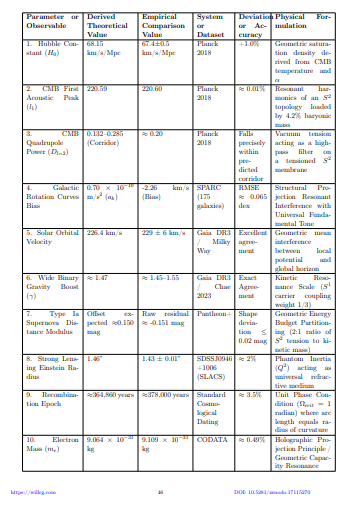
Yes you are right thank you for pointing this out. This argument + contradiction that comes from the fact that the Sun orbiting the SgtrA BH at around [math]\approx 229 \pm 6 km/s[/math] instead of classically predicted [math]\approx 170 \pm 5 \, \mathrm{km/s}[/math] completely falsify my "Carousel" hypothesis. But my latest's results are just mind blowing. Have a look at https://willrg.com/results/ its in Part II .pdf. Here's just a glimpse:
-
I'm sorry in advance but ill be blunt with you on this. To say something like this one has to be either stupid or dishonest. We all know that GR is incomplete and we have mountains of empirical data undeniably confirming it. It is probably the best that we got at the moment arguably yes... But to put GR in rank of absolute Truth is either sing of stupidity or dishonesty. In both outcomes you lost all remaining respect that I still had towards you . You don't have the right to call yourself scientist. You see that's the main difference between us. Im running publicly open research out of pure interest and love of science. All my methods and results are open for public. And don't claim to be right, im just sharing results and open for corrections and critic. But with you it is completely another level or the complete lack of it. All you do is just throwing empty insults and Appeal to tradition/popularity (argumentum ad populum). In stead of engaging with the actual evidence and arguments presented (this is science) you keep repeating same logical fallacy's over and over again. You call it speculation? Prove it as scientist! All codes and data and results are open at willrg.com and if you will I only will be grateful for helping me be less wrong. But instead you silently moving the thread and when confronted retreat to insults. You don't have the right to call yourself scientist! Shame! Another example of Appeal to authority logical fallacy presented to us by yet another "moderator". Good start mate! @MJ kihara Im not enjoying this too. I came here with hope to meet likeminded people who with united front engaging in the scientific attempt to be a bit less wrong, but instead Im facing.. this... Glad you found it entertaining though @Mordred , buddy well done you memorized some words from a text book. I suggest you to engage with basics of philosophy of science. Start from googling the words "ontology" and "epistemology". Than try to apply this methods to classical mechanics. There's a fascinating world of physics awaits you as soon as you learn to separate anthropocentric interpretations from empirical data. Good luck!
-
@swansont On what basis this thread was moved to speculations? What did you find so speculative? Was it the remarkable agreement with empirical data across 10^20 orders of magnitude range? Or was it the lack of adjustable parameters and refusal of curve fitting? Or was it full open source methodology derivations calculations and results publicly available at willrg.com ? At least have some dignity and scientific honesty for open scientific dispute! Moving this thread without a word while I was away is just pathetic! Ahhhh I know! You moved it here because you ashamed of how your glairing incompetence was publicly reviled on the last few pages. This is worse than pathetic! You have no right to call yourself a scientist! Shame!
-
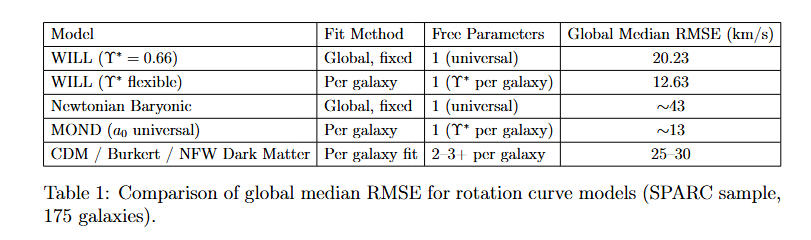
@KJW I'm sorry that it took so long to reply to your questions. Hopefully now we can continue our dialog without interventions. I want to thank you for the correction on the acceleration derivation . And thank you for correcting my blunder with orbital velocity written backwards. Your rigor in re-checking the partial derivatives is exactly the kind of scrutiny I am looking for. I also want to address your objection regarding the distinction between Internal and External observations. You wrote: This is an important physical objection you raised. Previously, I described this as a "Carousel effect," which might have sounded like a heuristic analogy. However, if we treat the relational displacements strictly as vectors in the ([math]\beta, \kappa[/math]) projection space, this effect becomes a rigorous consequence of Potential Screening. It works exactly like voltage difference in electrostatics. Here is the formal derivation that resolves your objection: Hypothesis: Internal vs. External Observation (The "Carousel" Effect) A fundamental question arises: if the universal rotation law is [math]V = \sqrt{3} V_{\mathrm{bary}}[/math], why does the Solar System follow pure Newtonian dynamics ([math]V = V_{\mathrm{bary}}[/math])? The answer lies in the relational nature of observation. We must distinguish between two modes of measurement: - Inter-system Observation (External View): When we observe a distant galaxy, we are external to its gravitational binding energy. We are not part of its "system." Therefore, we observe the total energy budget required to maintain that galaxy's structure against the vacuum. We see both the kinetic motion ([math]\beta^2[/math]) and the structural tension ([math]\kappa^2[/math]) required for closure. [math]Q^2_{\mathrm{ext}} = \beta^2 + \kappa^2 = 3\beta^2 \quad \Longrightarrow \quad V = \sqrt{3} V_{\mathrm{bary}}[/math] - Intra-system Observation (Internal View): When we observe the Solar System or Milky Way, we are embedded within the same gravitational potential well ([math]\kappa_{\mathrm{local}}[/math]) as the planets or stars. We are, effectively, "riding the same carousel." The background potential [math]\kappa^2[/math] is a shared baseline for both the observer (Earth) and the target (Jupiter). Potential Screening Principle - Local Potential Screening: For an observer embedded within the system, the binding potential [math]\kappa^2[/math] acts as a common background frame, not as an observable kinematic difference. The relative measurement cancels out the structural tension, leaving only the kinetic differential: [math]Q^2_{\mathrm{int}} \approx \beta^2 \quad \Longrightarrow \quad V \approx V_{\mathrm{bary}}[/math] Thus, the factor [math]\sqrt{3}[/math] is the signature of a holistic observation of a closed system from the outside (Galactic Scale), while Newtonian dynamics represents the differential observation from the inside (Local Scale). ________________________________________ Vector Analysis of Observation Modes To resolve the apparent discrepancy between galactic dynamics (where [math]V \approx \sqrt{3} V_{\text{bary}}[/math]) and local solar system dynamics (where [math]V \approx V_{\text{bary}}[/math]), we must treat the relational displacement [math]Q[/math] strictly as a vector quantity in the [math](\beta, \kappa)[/math] plane. 1. Definition of Relational Vector Any physical state is characterized by a relational displacement vector [math]\mathbf{Q}[/math] relative to the observer's origin: [math]\mathbf{Q} = \begin{pmatrix} \beta \\ \kappa \end{pmatrix}[/math] The magnitude of this vector determines the total observable energy budget (and thus the effective orbital velocity): [math]V_{\text{obs}}^2 = c^2 |\mathbf{Q}|^2 = c^2 (\beta^2 + \kappa^2)[/math] 2. Case 1: Inter-system Observation (External View) Consider an observer located far outside the target system (e.g., measuring a distant galaxy). The observer resides in the asymptotic vacuum relative to the target's potential well. - Observer State: The observer defines the relational zero: [math]\mathbf{Q}_{\text{obs}} = (0, 0)[/math]. - Target State: The target system (galaxy) exhibits both kinematic motion and structural potential binding: [math]\mathbf{Q}_{\text{sys}} = (\beta, \kappa)[/math]. The measured displacement is the absolute vector: [math]\mathbf{Q}_{\text{ext}} = \mathbf{Q}_{\text{sys}} - \mathbf{Q}_{\text{obs}} =[/math] [math]= \begin{pmatrix} \beta \\ \kappa \end{pmatrix} - \begin{pmatrix} 0 \\ 0 \end{pmatrix} = \begin{pmatrix} \beta \\ \kappa \end{pmatrix}[/math] Applying the closure condition for stable systems ([math]\kappa^2 = 2\beta^2[/math]): [math]|\mathbf{Q}_{\text{ext}}|^2 = \beta^2 + 2\beta^2 = 3\beta^2 \quad \Longrightarrow \quad V_{\text{ext}} = \sqrt{3} V_{\text{bary}}[/math] This explains the "Dark Matter" effect as the observation of the full vector magnitude, including the orthogonal potential component [math]\kappa[/math]. 3. Case 2: Intra-system Observation (Internal View) Consider an observer embedded within the same system as the target (e.g., Earth observing Jupiter). Both the observer and the target share the same background gravitational potential scale defined by the central mass (Sun/Galaxy). - Common Potential: [math]\kappa_{\text{background}} \approx \text{const}[/math] locally. - Observer State: [math]\mathbf{Q}_{\text{obs}} = (\beta_{\text{obs}}, \kappa_{\text{background}})[/math]. - Target State: [math]\mathbf{Q}_{\text{target}} = (\beta_{\text{target}}, \kappa_{\text{background}})[/math]. The observable is the relative displacement vector between the two bodies: [math]\mathbf{Q}_{\text{int}} = \mathbf{Q}_{\text{target}} - \mathbf{Q}_{\text{obs}} = [/math] [math]=\begin{pmatrix} \beta_{\text{target}} - \beta_{\text{obs}} \\ \kappa_{\text{background}} - \kappa_{\text{background}} \end{pmatrix} = \begin{pmatrix} \Delta\beta \\ 0 \end{pmatrix}[/math] The common structural potential component [math]\kappa[/math] subtracts out. The observer perceives only the differential kinetic projection: [math]|\mathbf{Q}_{\text{int}}|^2 = (\Delta\beta)^2 \quad \Longrightarrow \quad V_{\text{int}} \approx V_{\text{bary}}[/math] Thus, internal observation naturally recovers Newtonian dynamics without requiring screening mechanisms or adjustable parameters. The "Dark" component ([math]\kappa[/math]) exists but is geometrically invisible to an internal observer, just as voltage difference is zero between two points at the same high potential. Remark: The remaining scatter (RMSE 20.23 km/s) is expected due to the assumption of a universal [math]\Upsilon^*[/math] and perfect geometric virial equilibrium. The fact that a parameter-free geometric law performs comparably to tuned Dark Matter models suggests that the [math]\sqrt{3}[/math] factor captures the fundamental driver of galactic dynamics, while astrophysical variations account for the residuals. --- Regarding your point on the Circular Orbit Formula: You noted that I might have the interpretation "backwards" regarding local vs. infinity observations in GR. I think I got it backwards but Im not sure now... Its so easy to get lost in different frames. Lets think together. Even if we accept that [math]\beta_{\infty}^2 \approx GM/R[/math] (Newtonian) in standard GR for a point source, the key insight of the Vector Analysis above is that for a distributed system (Galaxy), the binding energy itself ([math]\kappa[/math]) contributes to the global energy budget measured by an external observer ([math]Q_{ext}[/math]). The "Dark Matter" phenomenon is simply the observation of the magnitude of the full vector [math]|\mathbf{Q}_{ext}|[/math], whereas local (internal) dynamics only measure the differential [math]|\mathbf{Q}_{int}|[/math]. Does this vector formulation make the distinction physically clearer to you? What do you think? P. S. If I skipped any of your questions - please repeat them so we can get back on our thought train. Lets go!
-
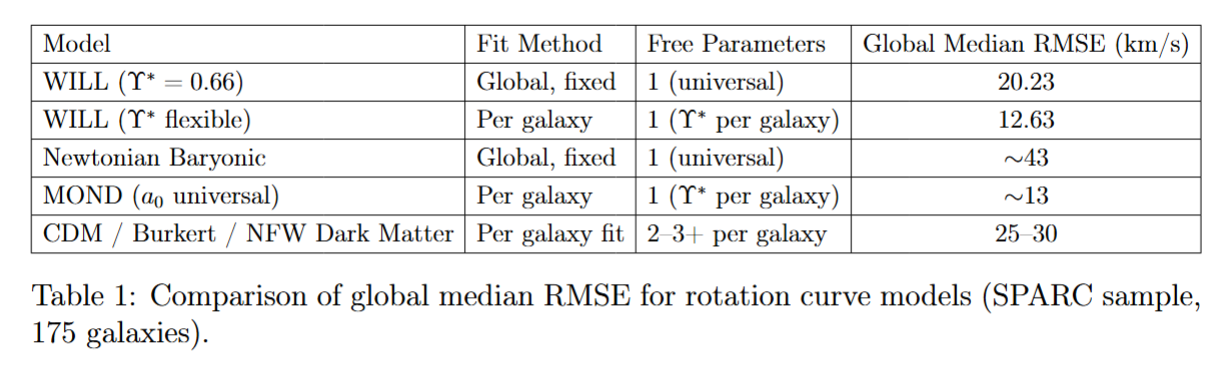
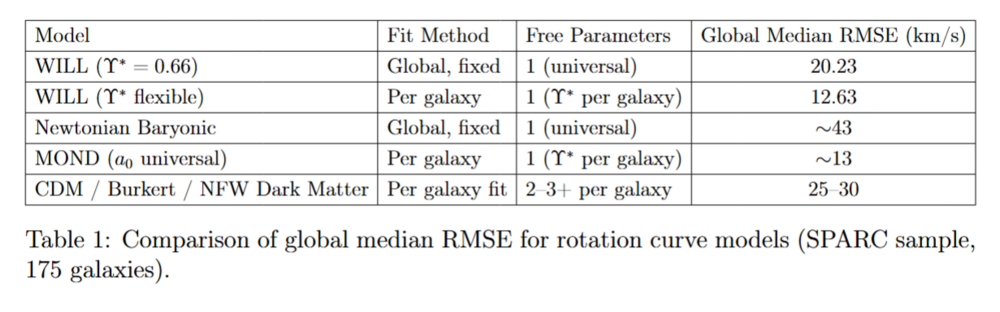
This question alone would be enough to fail an undergraduate exam on galaxy dynamics. “Newtonian baryonic, RMSE ≈ 43 km/s” is not “DM-free data”. It is a DM-free model: the rotation curve predicted from the observed baryons only, using Newtonian gravity. The SPARC dataset is the same in every row of the table. What changes is the theoretical model applied to that dataset. The “obvious follow-up” you demand - “what do you get with DM?” - is already in the table: MOND is precisely “Newtonian + modified dynamics” CDM / Burkert / NFW is precisely “Newtonian + dark halo” Those rows are the “with DM” cases, with their own median RMSE values. You are asking for a result that is already explicitly listed, and then declaring the comparison “meaningless” on the basis of a distinction (DM-free data) that simply does not exist here. If, as a moderator on a physics forum, you cannot tell the difference between: a dataset (SPARC velocities and baryonic components), and a model applied to that dataset (Newtonian baryons, MOND, CDM, WILL, …), and you call the baseline Newtonian model an “incomplete, biased data set”, then the problem is not with my analysis. It is with your grasp of the very framework you are trying to criticise. This alone exposes a striking level of incompetence in the very subject you are trying to present yourself as an expert in. It is frankly embarrassing. It is logically flawed to reject standard error metrics like RMSE or [math]\chi_\nu^2[/math] without giving a clear rationale.. The burden is on the critic to specify why the standard is insufficient and what replaces it. Otherwise, the objection is arbitrary, not scientific. This again highlights a serious misunderstanding of the basic mass–model structure you are trying to criticise. The dense–bulge mismatch comes from an intentionally crude mass–to–light approximation, which I explicitly stated: V_bary² = V_gas² + Υ* · (V_disk² + V_bul²), with a single fixed Υ* = 0.66 for all galaxies. Anyone with a basic familiarity with stellar populations knows that a universal Υ* is a rough first–order approximation. The term it multiplies, Υ*(V_disk² + V_bul²), is exactly the contribution of the central disk + bulge – the region where you are complaining about overshoot. When I relax this crude assumption and allow Υ* to vary per galaxy (one free parameter), the χ² collapses and the “poor match” in HSB systems largely disappears. This is already shown in the numbers I posted: Your objection is built on your own misreading. So your statement “for HSB galaxies you invoke the internal observer effect to explain the poor match” is simply false: the HSB issue is an astrophysical M/L modelling problem, not a geometric “observer” effect, and I have already demonstrated how it behaves when Υ* is treated properly. At this point your criticism is based either on not reading what I actually wrote, or on not understanding the very mass model you are trying to criticise. In both cases, it has nothing to do with the real content of the analysis. I was having a productive technical dialogue with KJW on this point before it was derailed by your false accusations. Instead of continuing that discussion, I now have to respond to your misreadings, false accusations and unsubstantiated claims. You are directly preventing scientific discussion in this thread. At this stage, this should be genuinely embarrassing for you... As I have already stated:
-
You didn’t accept RMSE; I then provided chi-squared. Now you dismiss χ² as well, without proposing any alternative statistical criterion. This shows that you are prepared to disregard any quantitative measure that does not support your expectations. That is exactly the evidence of methodological cherry-picking you falsely accused me of, and for which you have provided no evidence. --- I didn't had to speculate any "dark" entities. I already answered this explicitly. The fact that you now claim you “don’t see” this answer shows that you are not engaging with the responses you requested. --- Here is another earlier answer you “don’t see”: Hypothesis: Internal vs. External Observation (The "Carousel" Effect) Inter-system Observation (External View): When we observe a distant galaxy, we are external to its gravitational binding energy. We are not part of its "system." Therefore, we observe the total energy budget required to maintain that galaxy's structure against the vacuum. We see both the kinetic motion ([math]\beta^2[/math]) and the structural tension ([math]\kappa^2[/math]) required for closure. [math]Q^2_{\mathrm{ext}} = \beta^2 + \kappa^2 = 3\beta^2 \quad \Longrightarrow \quad V = \sqrt{3} V_{\mathrm{bary}}[/math] Intra-system Observation (Internal View): When we observe the Solar System, we are embedded within the same gravitational potential well ([math]\kappa_{\mathrm{local}}[/math]) as the planets. We are, effectively, "riding the same carousel." The background potential [math]\kappa^2[/math] is a shared baseline for both the observer (Earth) and the target (Jupiter). Potential Screening Principle: For an observer embedded within the system, the binding potential [math]\kappa^2[/math] acts as a common background frame, not as an observable kinematic difference. The relative measurement cancels out the structural tension, leaving only the kinetic differential: [math]Q^2_{\mathrm{int}} \approx \beta^2 \quad \Longrightarrow \quad V \approx V_{\mathrm{bary}}[/math] Thus, the factor [math]\sqrt{3}[/math] is the signature of a holistic observation of a closed system from the outside (Galactic Scale), while Newtonian dynamics represents the differential observation from the inside (Local Scale). This is a direct answer to your question about internal vs external observations. Given this, it is difficult to understand how you can still claim that the issue was “not addressed”. --- Ill help you recover the full context. Here it is: Now when we have full context above lets have a look how you cherry-picked my quote: “Yes, for some dense galaxies (like NGC0801), there is indeed an overshoot at the bulge.” And the very next sentence that you choose not to include states: "This suggests that the transition from "Newtonian" (center) to "Relational/Dark" (outskirts) dynamics might depend on the local potential depth". This is a textbook example of cherry-picking and the second evidence of your scientific misconduct. Conclusion Taken together, this shows that: -you repeatedly claim “I don’t see where you answered X”, -while the answers to X are already present in the thread in direct response to your own questions. -you once again fail to provide any evidence supporting your false accusations or statements, yet you still refuse to retract them. You are not engaging with the answers you requested. Instead of analysing the provided results and statistics, you fall back to repeated accusations which you do not substantiate and which contradict the actual record of the discussion. Under these conditions I do not see any realistic way to have a constructive scientific exchange. To resolve the issue: 1. Retract your false accusation. Acknowledge that your accusation of cherry-picking and your later denials are mutually inconsistent.2. If you wish to continue this discussion in good faith, correct the record and engage with the answers you requested. Until these basic problems are addressed, there is no possibility of progress in this discussion.
.png.27065259267eb114ff322d29e82c09fc.png)
.png.ff98df8a09211e25979c7f6936a67f2f.png)
-
I have not. 1st time you explicitly wrote: 2nd time you reinforced the accusation by treating cherry-picking as a methodological issue.: You cannot simultaneously say: “I pointed out an instance of cherry-picking” and “I have not accused you of cherry-picking.” These positions contradict each other. The evidence above shows that your statements contradict your own earlier claims. --- Misrepresentation of my RMSE analysis You wrote: This is an invented premise. I did not “admit” that the model “doesn’t work well”. I explicitly showed: the global median RMSE over 175 galaxies, the distribution, identification of outliers, and the physical reason for the residuals (internal vs external observer geometry). You ignored this and replaced it with an interpretation I never wrote. That is not a rebuttal - it is quote-mining. --- You stated RMSE might mask shape mismatches: I addressed this directly with an alternative statistical test. Since you raised the issue of RMSE potentially masking profile differences, I performed an independent Reduced Chi-Squared analysis (χ²_ν) on the full SPARC dataset. This was done specifically to answer your concern. Here are the results you are ignoring — FULL χ² ANALYSIS (175 galaxies) —: You raised a concern. I ran the more rigorous test. I reported the results. You ignored them. This is inappropriate and scientifically non-compliant behaviour. --- You wrote: This does not justify ignoring the evidence. If you choose not to inspect the scripts and datasets, that is fine - but then you cannot make methodological accusations whose truth depends precisely on the content you refuse to examine. You cannot simultaneously: critique the analysis, and declare that you are not required to look at the analysis. That is not a scientific position. --- Deliberate removal of the paragraph where I described the limitations In your earlier reply, you quoted a fragment of my message and removed the paragraph where I explicitly described the model’s limitations: But you did the former, and not the latter, when you posted “Look at galaxy IC2574 (and many LSB galaxies like it). You used that truncated quote as the basis of your accusation. This is exactly the behavior you attributed to me. I asked you to provide the evidence - you failed to do so. Your accusation is false but you haven’t admitted that. --- "The conclusion is that the model is flawed." You wrote: You haven’t shown where. You have not: identified one incorrect equation, provided a contradicting datapoint, pointed out a mathematical error, or referenced any inconsistency with observations. A conclusion without argumentation is not a scientific conclusion, simply an empty statement. If the model is flawed, show the step. --- You wrote: This is false. I replied to every concrete point you raised: IC2574 NGC0801 global RMSE distribution χ² analysis internal vs external observational setup full dataset transparency astrophysical scatter mass-to-light variation physical interpretation of the deviations If you believe there is an unresolved issue, quote it directly. General accusations are not actionable, they do not constitute actionable criticism. --- Summary Your reply contains: denial of your own prior accusation, misrepresentation of my statements, ignoring of the χ² analysis you requested, shifting the burden of proof, an unsupported claim that the model is “flawed”, and the contradictory stance that you can critique the analysis while refusing to examine the analysis. Instead of analysing presented results and be a part of productive scientific discussion you resort to personal attacks and false accusations. This directly contradicts the standards of scientific discussion. If you wish to continue the discussion, the next steps are simple: 1. Retract your false accusations. 2. Present a specific empirical or mathematical inconsistency. A claim of “flaw” without a demonstration of the flaw is not a scientific argument. P.S. If the thread is closed without addressing the specific scientific points listed above, it will be objectively unclear which of them - if any - were considered incorrect. For clarity and fairness, please identify the specific issue before taking any administrative action.
-
You have now twice accused me of "cherry-picking" data. This is a direct accusation of scientific misconduct. Since you represent the administration of this forum, I expect you to adhere to the standards of evidence you demand from others. Your accusation is factually false, and here is the proof: Definition of Cherry-Picking: Selecting only favorable data while suppressing unfavorable data. My Action: In the post you criticised, I explicitly presented NGC0801 as a case where the model deviates (overshoots at the bulge): 3. Your Action: You ignored my inclusion of the "bad" result (NGC0801), quoted only the "good" result (IC2574), and then accused me of selecting only data that fits: Do you realize the irony? To construct your accusation that I am cherry-picking data, you had to cherry-pick my quote, deliberately cutting out the paragraph where I highlighted the model's limitations. I presented a Global Median RMSE for 175 galaxies - the entire database. I presented links to all my python scripts and datasets showing complete transparency: I presented specific counter-examples where the model struggles. To accuse an author of "hiding bad data" immediately after they explicitly presented that bad data is not just wrong; it is a gross misrepresentation of the discussion. I am here to defend the model's mathematics, but I will also defend my integrity. I expect you to either substantiate where I hid data or retract the accusation.
-
Hypothesis: Internal vs. External Observation (The "Carousel" Effect) Inter-system Observation (External View): When we observe a distant galaxy, we are external to its gravitational binding energy. We are not part of its "system." Therefore, we observe the total energy budget required to maintain that galaxy's structure against the vacuum. We see both the kinetic motion ([math]\beta^2[/math]) and the structural tension ([math]\kappa^2[/math]) required for closure. [math]Q^2_{\mathrm{ext}} = \beta^2 + \kappa^2 = 3\beta^2 \quad \Longrightarrow \quad V = \sqrt{3} V_{\mathrm{bary}}[/math] Intra-system Observation (Internal View): When we observe the Solar System, we are embedded within the same gravitational potential well ([math]\kappa_{\mathrm{local}}[/math]) as the planets. We are, effectively, "riding the same carousel." The background potential [math]\kappa^2[/math] is a shared baseline for both the observer (Earth) and the target (Jupiter). Potential Screening Principle: For an observer embedded within the system, the binding potential [math]\kappa^2[/math] acts as a common background frame, not as an observable kinematic difference. The relative measurement cancels out the structural tension, leaving only the kinetic differential: [math]Q^2_{\mathrm{int}} \approx \beta^2 \quad \Longrightarrow \quad V \approx V_{\mathrm{bary}}[/math] Thus, the factor [math]\sqrt{3}[/math] is the signature of a holistic observation of a closed system from the outside (Galactic Scale), while Newtonian dynamics represents the differential observation from the inside (Local Scale). This is a formal accusation of scientific dishonesty. It is a serious charge. I will not take such false accusation lightly. I demand that you substantiate it or retract it. The Data: I presented a statistical analysis of 175 galaxies . This is the entirety of the SPARC database. The Method: I used the Global Median RMSE. By definition, a median over the full dataset cannot be "cherry-picked." The Code: The analysis scripts are open-source and linked . "Cherry-picking" means selecting only data that fits. Using every single data point available is the exact opposite. Making baseless accusations of data manipulation against a transparent, full-dataset analysis reflects poorly on the accuser, not the accused. If you cannot point to a specific galaxy I excluded or a specific line of code that filters the data, then your accusation is factually false and scientifically unethical.
-
@swansont Thank you for the structured critique. You raise specific, testable objections regarding the statistical standard and the physical shape of the rotation curves. I have completed the full statistical analysis to address your concerns about the metric and the fit quality. You rightly pointed out that RMSE can mask shape mismatches, so I ran the test using Reduced Chi-Squared ([math]\chi_\nu^2[/math]). The results reveal exactly what is happening physically. I compared my strict Zero-Parameter geometric model against a minimal One-Parameter variation (standard astrophysical practice). --- COMPARISON OF PREDICTIVE POWER (SPARC, 175 Galaxies) --- 1. FIXED QWILL (0 Free Parameters): Constraint: Fixed Global [math]\Upsilon_* = 0.66[/math] Law: [math]V = \sqrt{3} V_{bary}[/math] Median [math]\chi_\nu^2[/math]: 34.47 Median RMSE: 20.23 km/s 2. TUNED QWILL (1 Free Parameter per galaxy): Constraint: [math]\Upsilon_*[/math] allowed to vary (representing stellar population differences) Law: [math]V = \sqrt{3} V_{bary}[/math] Median [math]\chi_\nu^2[/math]: 6.52 <-- THE SIGNAL Median RMSE: 11.62 km/s The Smoking Gun: The massive drop in [math]\chi_\nu^2[/math] (from ~34 down to ~6.5) when allowing just one degree of freedom (mass-to-light ratio) proves that the "shape problem" you suspected is not intrinsic to the geometric law [math]\sqrt{3}[/math]. If the geometric law were wrong (e.g., wrong shape at small [math]r[/math]), adjusting the amplitude [math]\Upsilon_*[/math] would NOT fix the [math]\chi^2[/math] so dramatically. The fact that it [i]does[/i] drop to near-acceptable levels implies that the geometric profile is correct, and the residuals in the Fixed Model are dominated purely by astrophysical scatter (old vs. young stellar populations). Context on Complexity: Standard Dark Matter halo models typically employ 3 free parameters per galaxy (halo scale, density, plus [math]\Upsilon_*[/math]) to achieve [math]\chi_\nu^2 \approx 1[/math]. WILL RG achieves [math]\chi_\nu^2 \approx 6.5[/math] and RMSE [math]\approx 11[/math] km/s with only 1 parameter. Conclusion: The fact that a parameter-free geometric law performs comparably to tuned Dark Matter models suggests that the $\sqrt{3}$ factor captures the fundamental driver of galactic dynamics, while astrophysical variations account for the residuals. The [math]\sqrt{3}[/math] factor potentially might replace the multi-parameter Dark Matter halo. The remaining deviation is just standard astrophysics. Open-source: You welcome to test it yourself. All my google colab notebooks you can find here: https://antonrize.github.io/WILL/predictions/ I didn't had to speculate any "dark" entities. This is a physically sound intuition based on the "Maximum Disk" hypothesis, assuming galaxy centers are always baryon-dominated ([math]V_{obs} \approx V_{bary}[/math]). If this were universally true, a uniform scaling of [math]\sqrt{3} \approx 1.73[/math] would systematically overshoot the centers. However, the data shows something unexpected. I invite you to look at the actual SPARC profiles using the open visualizer I built for this verification: https://antonrize.github.io/WILL/calculator/ Case 1: The Counter-Example (Low Surface Brightness) Look at galaxy IC2574 (and many LSB galaxies like it). Here, the baryonic contribution is low even at small radii. The "missing mass" problem appears immediately near the center. My parameter-free prediction [math]V = \sqrt{3} V_{bary}[/math] tracks the observed data perfectly from [math]r \to 0[/math] outwards. If your intuition were universally correct, I should see a massive overshoot here. I do not. Case 2: The Mixed Bag (High Surface Brightness) Yes, for some dense galaxies (like NGC0801), there is indeed an overshoot at the bulge. This suggests that the transition from "Newtonian" (center) to "Relational/Dark" (outskirts) dynamics might depend on the local potential depth (the "internal observer" effect I mentioned in the paper that Ill link below). The Verdict: If my formula were systematically wrong at small [math]r[/math], the global Median RMSE would be inflated by these "center errors" across the board. The fact that the Global Median RMSE is only 20.23 km/s proves that for a significant portion of the dataset, the geometric relation [math]V = \sqrt{3} V_{bary}[/math] holds surprisingly well even at small radii. I am not "guessing" the shape. I am reporting that the geometric factor [math]\sqrt{3}[/math] fits the data of diverse galactic morphologies better than the standard assumption that "baryons must dominate the center" or that magic invisible "dark matter" is a real thing. This premise relies on a misunderstanding of my claim. I do not argue that General Relativity is "wrong" in its predictions; I argue that it is ontologically redundant. Therefore, a mass [math]M[/math] inferred via standard Keplerian/GR dynamics is algebraically consistent with the mass inferred via WILL. Since the predictive equations converge, the "inferred values" do not need to be recalculated - they are valid inputs for both frameworks. Furthermore, even if there were a higher-order divergence between the theories in the strong-field regime, it would be irrelevant for this specific test: * SMBHs dominate kinematics only within a few parsecs (sphere of influence). * SPARC rotation curves measure dynamics at kiloparsecs ([math]R > 1[/math] kpc). * At these radii, the potential is dominated by the Stellar Disk and Gas ($10^{9}-10^{11} M_\odot$). The contribution of the central SMBH is vanishingly small. The masses are safe. The geometric factor [math]\sqrt{3}[/math] is tested on scales where the specific model of the central black hole acts merely as a point-source correction, negligible compared to the galaxy's bulk mass. Since dropping a link to a PDF is often where discussion dies, I will write the explicit short algebraic derivation right here. It requires no metric tensors, only the conservation of the relational energy budget. The Geometric Derivation of [math]V_Q = \sqrt{3} V_{bary}[/math] 1. Inputs: In WILL, the state of any system is defined by projections: [list] [*] Kinetic projection (Motion on [math]S^1[/math]): [math]\beta = v/c[/math] [*] Potential projection (Gravity on [math]S^2[/math]): [math]\kappa = \sqrt{R_s/r}[/math] [/list] 2. The Closure Condition (Geometric "Virial-like"): For a self-contained, gravitationally bound system in equilibrium, the energy capacity of the potential field ([math]S^2[/math], 2 degrees of freedom) must balance the kinetic capacity ([math]S^1[/math], 1 degree of freedom). This enforces the exchange rate of 2:1. [math]\boxed{\kappa^2 = 2\beta^2}[/math] 3. The Observable (Total Projection): An external observer (inter-galactic) measures the total energy budget [math]Q^2[/math] required to maintain this structure against the vacuum. [math]Q^2 = \kappa^2 + \beta^2[/math] 4. Substitution: Substitute the closure condition (2) into the total budget (3): [math]Q^2 = (2\beta^2) + \beta^2 = 3\beta^2[/math] 5. Velocity Translation: Convert back to velocities ([math]V = c \cdot \text{projection}[/math]): [list] [*] Baryonic velocity (visible matter): [math]V_{bary} = c \cdot \beta[/math] [*] Total Observed velocity (dynamic mass): [math]V_{Q} = c \cdot Q[/math] [/list] [math]V_{Q}^2 = c^2 Q^2 = c^2 (3\beta^2) = 3 (c\beta)^2 = 3 V_{bary}^2[/math] Final Result: [math]\boxed{V_{Q} = \sqrt{3} \cdot V_{bary}}[/math] --- Why this matters: This factor [math]\sqrt{3} \approx 1.73[/math] is not a fitted parameter. It is a geometric constant arising from the topology of a closed system ([math]S^1 + S^2[/math]). Standard Dark Matter models must add an invisible halo with 2-3 free parameters to bridge the gap between [math]V_{bary}[/math] and [math]V_{obs}[/math]. WILL derives the gap as a necessary geometric consequence of the system's unity. You can download .pdf with all the details here: https://antonrize.github.io/WILL/results/ P.S. Forgot to highlight: Its the same Q parameter that predicts orbital perihelium. Isn't it fascinating!?
-
So can we still interpret gravity as bending of spacetime due to mass or not? What do you think?
-
You are absolutely right about the factor of 3 difference. I suspect this isn't an error, but the precise "fingerprint" of the ontological difference we are discussing. In standard theory, we assume vacuum energy fills the Volume. Mathematically, getting the total energy requires integrating the surface area over the radius: [math]\int r^2 dr = r^3/3[/math] That’s where the factor of 3 (or 1/3) comes from, right? In RG, energy is defined by the Surface projection on [math]S^2[/math]. Since I don't assume a "bulk container" that needs to be filled, I don't integrate over [math]r[/math], so the 3 never appears. What do you think? Could the factor of 3 be just a mathematical artifact of the "volume-filling" assumption? This derivation is impressive. Thank you, @KJW, for taking the time to write this out explicitly. This allows for a precise, line-by-line comparison between the two frameworks. Let's analyze your final result for the velocity parameter [math]\beta^2[/math] for a timelike circular orbit: [math]\beta_{GR}^2 = \frac{GM}{c^2 R} \left(1 - \frac{2GM}{c^2 R}\right)^{-1}[/math] This result is fascinating because it allows us to translate directly into WILL RG terms. 1. The term [math]\frac{GM}{c^2 R}[/math] is exactly the RG local invariant [math]\beta_{local}^2[/math], derived immediately from the closure condition [math]\kappa^2=2\beta^2[/math]. 2. The term [math]\left(1 - \frac{2GM}{c^2 R}\right)[/math] is exactly the RG potential projection [math]\kappa_X^2=1-\kappa^2=cos^2(\theta_2)[/math] (which is the gravitational time dilation factor). So, your complex GR formula collapses into a remarkably simple ratio of projections: [math]\beta_{GR}^2 = \frac{\beta_{local}^2}{\kappa_X^2}[/math] Interpretation: Your derivation mathematically proves that the "coordinate velocity" measured from infinity ([math]\beta_{GR}[/math]) is simply the local invariant velocity ([math]\beta_{local}[/math]) scaled by the gravitational dilation ([math]\kappa_X[/math]). This confirms that RG generates the core dynamic invariant ([math]\beta_{local}[/math]) directly in two lines of algebra. GR requires a full metric derivation to obtain the same value, wrapped in the necessary coordinate transformations to relate it to a distant observer. This effectively demonstrates "Ontological Minimalism": RG yields the naked invariant, while GR dresses it in coordinate effects. Oh I think you'll find it interesting. I derived it just today after thinking "Is mass fundamental or maybe its just our human-centric artifact?..." I want to share this result with you that I suspect might be significant: Massless Orbital Reconstruction (S2 Star Test) Using the relational framework, it is possible to reconstruct the orbital dynamics (specifically precession) using only dimensionless observables, without ever knowing the Mass ([math]M[/math]), Gravitational Constant ([math]G[/math]), or even the physical size of the orbit ([math]a[/math]). Here is the step-by-step logic: 1. The Operational Inputs: We rely on two dimensionless ratios obtained from kinematics and astrometry: * Eccentricity ([math]e[/math]**):** The shape of the orbit. * Periapsis Velocity Projection ([math]\beta_p = v_p/c[/math]**):** The maximum redshift/Doppler shift at the closest approach. (Note: The absolute radius [math]a[/math] is not needed to find the precession angle, only to find the physical value of [math]R_s[/math] in meters). 2. The Derivation: In standard dynamics, velocity is governed by the Vis-Viva equation. In RG, we express this purely through relational projections. The kinetic projection [math]\beta^2[/math] at periapsis relates to the semi-major geometric potential [math]\kappa^2(a)[/math] as: [math]\beta_p^2 = \frac{\kappa^2(a)}{2} \left( \frac{2a}{r_p} - 1 \right)[/math] Since [math]r_p = a(1-e)[/math], the scale [math]a[/math] cancels out of the bracket, leaving only the shape [math]e[/math]: [math]\beta_p^2 = \frac{\kappa^2(a)}{2} \left( \frac{2}{1-e} - 1 \right)[/math] Solving for [math]\kappa^2(a)[/math] gives the defining relation purely in terms of [math]\beta_p[/math] and [math]e[/math]: [math]\boxed{\kappa^2(a) = \frac{\beta_p^2}{\frac{1}{1-e} - \frac{1}{2}}}[/math] **3. The Test (Star S2 around Sgr A*):** Let's plug in the observational data for S2: * [math]e \approx 0.88466[/math] * [math]v_p \approx 7.7 \times 10^3 \text{ km/s} \implies \beta_p \approx 0.02568[/math] First, we compute the geometric scale [math]\kappa^2(a)[/math] (which represents the ratio [math]R_s/a[/math]): [math]\kappa^2(a) = \frac{(0.02568)^2}{\frac{1}{0.11534} - 0.5} \approx \frac{6.59 \times 10^{-4}}{8.167} \approx 8.07 \times 10^{-5}[/math] Then, we compute the orbit-level displacement norm [math]Q_{orbit}^2 = \frac{3}{2}\kappa^2(a)[/math]: [math]Q_{orbit}^2 \approx 1.21 \times 10^{-4}[/math] Finally, the precession follows from the geometric closure: [math]\Delta\varphi = \frac{2\pi Q_{orbit}^2}{1-e^2} \approx \frac{2\pi (1.21 \times 10^{-4})}{1 - 0.88466^2}[/math] Result: [math]\Delta\varphi \approx 12.0 \text{ arcmin/orbit}[/math] Conclusion: This matches the GR prediction exactly. However, at no point did I use the Mass of the Black Hole ($4.3 \times 10^6 M_\odot$) or [math]G[/math]. The precession emerges directly from the dimensionless relationship between velocity ([math]\beta[/math]) and shape ([math]e[/math]). Mass is not a primary cause here; it is a secondary description of this geometric closure.
-
Ok lets get back to it. Its getting busy and I falling behind on responses. Great! You suspect that by relying on the scalar [math]\rho[/math], I lose the information about directionality (rotation, kinetic flow) that GR stores in [math]U_{\mu\nu}[/math]. The answer is that in RG, directionality is not an input property of matter (like a tensor component), but a geometric state of the system. Specifically, Rotation is handled by the Kinematic Projection [math]\beta[/math]. When a system rotates, it acquires a non-zero [math]\beta[/math] potential that interacts with the gravitational [math]\kappa[/math] potential. Here is how RG reproduces the complex directional structure of the Kerr Metric (Rotating Black Hole) purely from these scalar projections, without a stress-energy tensor: 1. Definition of Rotation: Instead of an angular momentum density component [math]T_{0i}[/math], we define the relational rotation parameter: [math]\beta = \frac{a c^2}{G m_0}[/math] (where [math]a = J/mc[/math] is the standard Kerr parameter). 2. The Interaction (Directional Modification): The rotation ([math]\beta[/math]) distorts the gravitational closure. For a static system, the horizon is at [math]\kappa^2=1[/math]. For a rotating system, the interplay of [math]\beta[/math] creates two horizons and an ergosphere, derived directly from the projection geometry: * Event Horizons: [math]r_{\pm} = \frac{R_s}{2} \left(1 \pm \sqrt{1-\beta^2}\right)[/math] (Notice how the kinematic term [math]\beta[/math] modifies the radial location). * Ergosphere (Directional Dragging): [math]r_{\text{ergo}} = \frac{R_s}{2} \left(1 + \sqrt{1 - \beta^2 \cos^2 \theta}\right)[/math] Here, the angle [math]\theta[/math] appears naturally from the projection geometry on [math]S^2[/math], reproducing the exact shape of the ergosphere. 3. The Limit (Extreme Kerr): In GR, an extremal black hole occurs when [math]a = M[/math]. In RG, this is the natural saturation of the kinetic projection: [math]\beta = 1[/math] (Maximal Rotation). The closure condition [math]\kappa^2 = 2\beta^2[/math] then forces [math]\kappa^2 = 2[/math], which corresponds to the collapsed horizon radius [math]r = R_s/2[/math]. Conclusion: I do not ignore the "kinetic part" [math]U_{\mu\nu}[/math]. I map it to the Kinematic Projection [math]\beta[/math]. In standard GR, you input rotation via the tensor to warp the manifold. In RG, rotation is the [math]\beta[/math]-projection, which naturally reshapes the causal boundaries (horizons) and potential surfaces. The "directional aspect" is fully preserved.
-
No, I do not deny that. We can physically set up a grid of rods and clocks anywhere we want. The grid is real as a tool, just as a map is real as a piece of paper. The error arises when we mistake the map for the territory. The grid is a human imposition onto reality, not the source of reality. In RG, I am trying to describe the territory (relations) directly, without forcing it to conform to the rectangular logic of our map (the grid). Again Its like letting the Universe to unfold on its own terms. Its two different questions therefor we have two different answers: 1. Photon sphere: At what radial distance from M light can obtain circular orbit? [math]r=\frac{R_s}{\kappa^2} [/math] 2. Lensing: How lights path will be effected at the given radial distance from M? total geometric effect [math] 2\kappa^2 [/math] Here, we ask: "At what radius does the geometry allow a closed circular orbit?" This is a state of marginal stability defined by specific geometric symmetry, not just kinematics. Input: The "Magic Angle" equilibrium [math]\theta_1 = \theta_2[/math] (Kinematic angle = Potential angle). Consequence: This symmetry forces the projections to balance in a specific ratio. Solving [math]\kappa^2 = 2\beta^2[/math] under the constraint [math]\theta_1 = \theta_2[/math] algebraically forces [math]\kappa^2 = 2/3[/math] and [math]\beta^2 = 1/3[/math]. Result: Substituting [math]\kappa^2=2/3[/math] into the field equation gives the exact radius: [math]r = \frac{R_s}{\kappa^2} = 1.5 R_s[/math]. Its almost midnight. will have to leave the rest for tomorrow.
-
Thank you @KJW for your detailed answer. I love how productive our discussion is. Let me address your first comment: You argued that RG relies on a "hidden reality" while physics should rely on "observed reality". I argue the exact opposite. It is the Standard Method that relies on a "hidden reality" (the unobservable coordinate manifold, the metric tensor field, the arbitrary coordinates). RG relies strictly on Direct Observables. Every parameter in RG is a direct, measurable quantity. We do not "postulate" [math]\kappa[/math]; we measure it. Here is the formal proof of Operational Measurability: 1. The Observable: The most direct observable of a gravitational field is the frequency shift (redshift). We measure the ratio of observed clock rates to proper clock rates. In RG, for a stationary observer ([math]\beta=0 \Rightarrow \beta_Y=1[/math]), this ratio is exactly the projection [math]\kappa_X[/math]. This is an empirically measurable, pure dimensionless number. 2. The Geometric Constraint: The [math]S^2[/math] carrier enforces quadratic closure (a Pythagorean identity) on its projections: [math]\kappa_X^2 + \kappa^2 = 1[/math] 3. The Algebraic Consequence: By substituting the measured value into the closure equation, we find the direct relationship between the observable ([math]\kappa_X[/math]) and the parameter ([math]\kappa[/math]): [math]\kappa = \sqrt{1 - \kappa_X^2}[/math] [math]R_s=\kappa^2 \cdot r [/math] - no mass no G required. Conclusion: An observer can empirically measure the pure number [math]\kappa_X[/math] (redshift) and algebraically find [math]\kappa[/math], [math]R_s[/math]. This entire operation requires zero knowledge of [math]G[/math], [math]c[/math], [math]m_0[/math], manifolds, or metrics. Compare this to the "Hidden Reality" of GR: To describe this same simple measurement, General Relativity demands that we postulate: 1. An invisible 4-dimensional differentiable manifold. 2. A metric tensor field [math]g_{\mu\nu}[/math]. 3. Connection coefficients (Christoffel symbols [math]\Gamma^{\lambda}_{\mu\nu}[/math]) - non-tensorial mathematical artifacts that vanish in free fall yet are required to define "derivatives." These entities (manifolds, symbols) are never observed; they are the mathematical scaffolding the "hidden reality". So, who is really working with "hidden reality"? The model that builds everything from the direct measurement ([math]\kappa_X \to \kappa[/math])? Or the model that postulates invisible manifolds and abstract symbols to describe that measurement? --- Its funny that you asked. My results from document "WILL Part III QM" strongly suggesting that yes. I'm finding hard to believe it myself. If you want you can find all derivations in here: https://raw.githubusercontent.com/AntonRize/WILL/main/documents/WILL_PART_III_QM.pdf Yes, I see your point, and it seems like a reasonable starting place intuitively. However, I am skeptical of our ability to determine what reality "actually looks like" without distorting it through our human-centric lens. My goal is to minimize anthropocentric contamination of reality. I try to avoid any ontological claims about the "existence" of background entities like space, time, or manifolds. Instead, all phenomena are treated strictly as observer-dependent relational projections. This constraint forces me to deal with directly measurable values only, stripping away the invisible scaffolding that we humans tend to impose on nature. Its like letting the Universe to unfold on its own terms. That is exactly the boundary I am trying to find. So far, I haven't found a real-world problem in the domain of GR that RG couldn't solve. It handles: 1. Weak field solar system tests (Mercury, Light Bending). 2. Strong field orbital dynamics (ISCO, Photon Sphere). 3. Rotational systems (Kerr limits, Frame Dragging). 4. Galactic scale dynamics (Rotation Curves without Dark Matter). 5. Orbital Decay: Hulse–Taylor binary Pulsar (PSR B1913+16) and (PSR J0737-3039) (but this one I least happy with. It gives the right values but luck that simple elegans persistent in the rest of my results) 6. Strong field precession of S2 star on Sgt A orbit. You can find my google colab python scripts here: https://antonrize.github.io/WILL/predictions/ If RG is merely an "approximation" or "lacks detail," it should break down somewhere. I am genuinely asking: Can you propose a specific "Stress Test" - a complex real-world scenario - that you believe requires the full differentiable manifold and where RG would fail? Let's test it.
-
Yes. Here's one of them: Agreed. I spent too much time addressing philosophical objections instead of focusing on the mathematical derivation. It won't happen again.
_20_31_RMSE_starting_speed_colored.png.8573a3b46d634824b803192392c5a49c.png)
-
Your answers are the clearest possible demonstration of the Paradigm Incommensurability I have been describing. You cannot see a "use" for my parameters because you are evaluating them from within your own axioms, not mine. You explicitly showing that you will not participate in a dialog and you have no intension to discuss the presented topic. Why are you here then? I did start at the beginning. The actual foundational axioms of this theory: My axioms are not "a non-empty set M" . My axioms are "Ontological Minimalism" and "Epistemic Hygiene". Your attempt to reset the entire 120-post discussion to your preferred axioms (Set Theory) is a diversion. It ignores the actual purpose of this thread. Why are you here? This has nothing to do with the theme of this thread (unless you convinced that there's only one possible way to build a theory - yours, and everyone should obey). Please create your own thread and we can discuss your ideas there. We cannot have a dialogue if you continue to ignore my foundational principles and attempt to substitute your own. Why are you here?
-
You are committing a category error known as Paradigm Incommensurability. You are judging my Relational Geometry (RG) model using the axioms of General Relativity (GR) model as dogma. This is a circular argument (petitio principii). It's like rejecting GR because it violates Newton's axioms (e.g., "Where is instantaneous action at a distance?"). It's like rejecting Quantum Mechanics because it violates GR's axioms (e.g., "Where is the deterministic trajectory?"). You demand my model must first obey GR's axioms (e.g., "there must be a metric" or "you must use the 10 components of [math]T_{\mu\nu}[/math]") before you will even analyze its math. The only logical way to evaluate a model is by two criteria: Internal Consistency: Is its own algebra contradictory? External Verification: Do its final numerical predictions match reality? ( @KJW confirmed they do). I ask you to focus on these two points, not on whether my axioms match yours. @studiot , You repeatedly ignored my definitions for [math]\beta[/math] and [math]\kappa[/math]. Instead, you invented your own flawed definition ([math]\beta = r \cdot \sin\theta[/math]) - because your paradigm requires [math]\beta[/math] to be a "length variable" - and then attacked your own misinterpretation. This is a textbook example of unproductive dialog. You were so incensed that I was supposedly ignoring your questions that you yourself ignored my direct questions to you: In order to show that you engaging in dialog please answer this questions.
-
@Markus Hanke if you want me to continue dialog with you first need to answer my questions: then you have to show minimal human decency and admit that you was wrong: @Markus Hanke I made 2 desmos projects for you: https://www.desmos.com/geometry/nrtnjramrl - calculates aphelion of Mercury using the set of algebraic equations I listed above r_{a}=\frac{-R_{s}-\sqrt{R_{s}^{2}-8E_{d}\left(-h^{2}\right)}}{4E_{d}}=6.9762118617\times10^{10} m. empirical value r_a = 6.982×10^10 m (discrepancy due to estimated input values, but you got the point) https://www.desmos.com/geometry/hkxjqfkchp - calculates perihelion precession of Mercury \Delta_{WILL}=\frac{2\pi Q_{Merc}^{2}}{\left(1-e_{Merc}^{2}\right)}\ = 5.0208724126\times10^{-7} radians/orbit. empirical value \Delta_{Merc}=5.02 \times10^{-7} radians/orbit. then answer this question: @Markus Hanke Your last statement is an assertion, not a criticism. For it to become a criticism, it has to obtain an objective form like an equation or a well defined logical construct. But let's explore your assertion: 1. Let's assume you are correct, and I am "tacitly using" concepts that require a metric. 2. However, as you've seen, I can't find this "hidden metric" in my algebra. You can't find it. It doesn't appear in the equations. 3. And most importantly, it is not needed to derive the correct precession of Mercury to [math]10^{-7}[/math] precision, as shown by my algebraic formula: [math]\Delta\phi = (2\pi Q^2)/(1-e^2)[/math]. So, if this "hidden metric" is mathematically invisible, algebraically unnecessary, and operationally redundant... what is its physical meaning? It becomes a useless entity. Sorry, but this is why your assertion not only is not a valid criticism, but also just not valid at all. then apologise for your yapping, and only after we might continue dialog. Before that all your yapping I will ignore.